 |
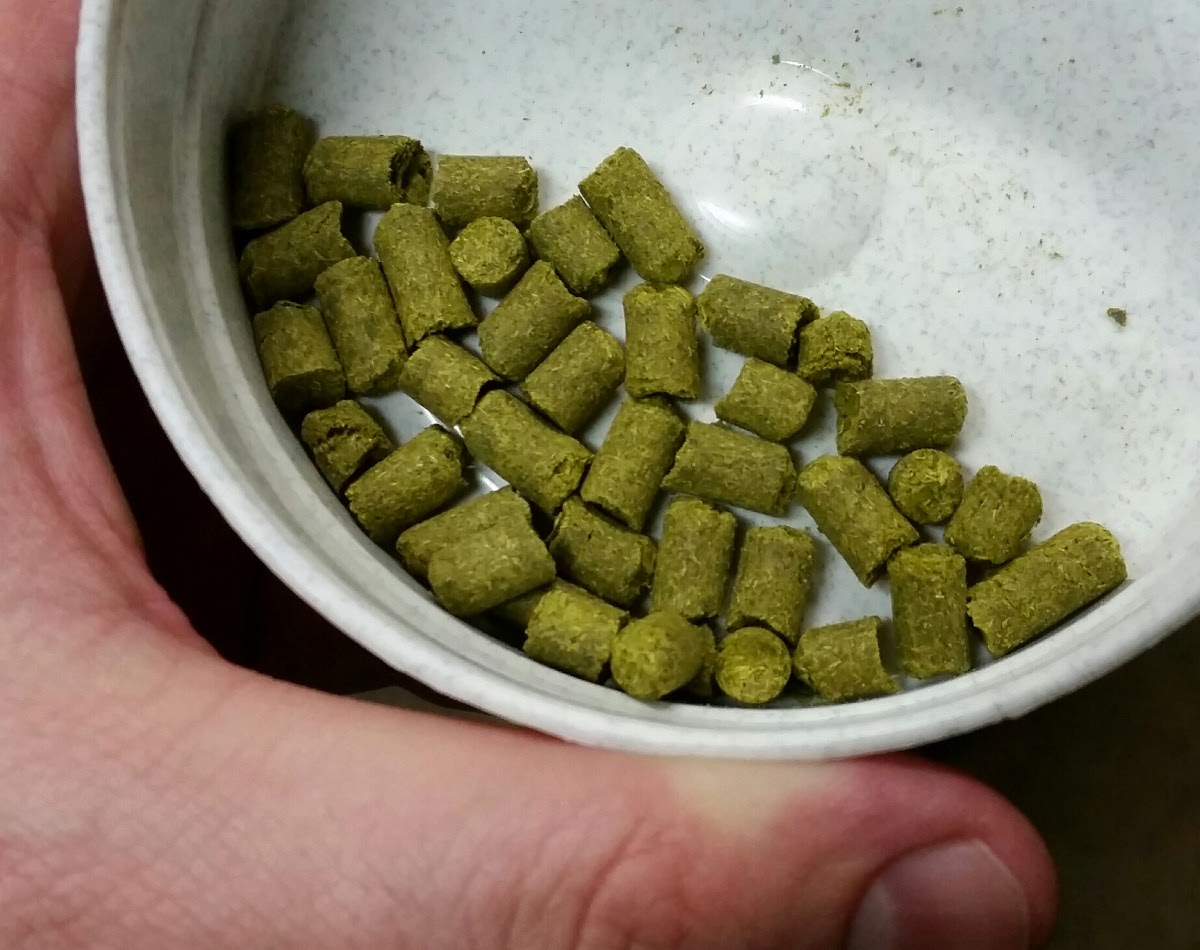
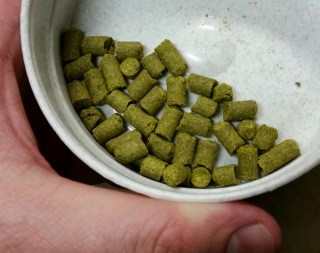
| Magnum hops pellets, locked and loaded for this recipe. |
As we inch closer and closer to the southern California version of spring, it’s time to wind down the “winter beers”, and start gearing up for some spring and summer brews. A kölsch seems like a good start for this. After thumbing through back issues of Brew Your Own, I found a recipe that is just the ticket. Vitamin K Kölsch Clone is a recipe mirroring a beer from Thunder Island Brewing Company, featured in the May/June 2014 issue of BYO. My adaptation of the recipe would probably horrify style purists, because I’ll be using American 2-row malt as the backbone. Then again, I’m not brewing this in Cologne, either, so authenticity (or indeed, the right to call it a kölsch) is out the window from the get-go.
I’m using White Labs WLP029, German Ale/Kölsch yeast. Following the calculations from my brewing software, I needed about 1 L starter (~1.040 starting gravity). This was prepared roughly 36 hours in advance of pitching; I haven’t yet made a stir plate, so I am relying instead on constant agitation. It took nearly 24 hours before I saw any real signs of activity in the starter (e.g., extensive foaming when agitated, etc.). The starter initially (for the first 24 hours or so) had a prominent fruity aroma, which is quite different from starters I have made for other strains. This transitioned into the more expected “yeast/bready” aroma after 30 hours or so. I am going to presume that this is just a characteristic of the strain (nothing online mentions typical aroma for this strain’s starter).
Following exceptional efficiency (75% and 83%) in my last two all-grain recipes, I have adjusted my equipment profile accordingly in BeerSmith to assume average efficiency of around 78%. Additionally, I will be tweaking my temperature settings a touch, based on the fact that my mash was ending up just a degree or two warmer than target on most occasions. I am heating up my mash tun with hot tap water prior to mashing in; in the past, I’ve been assuming a mash tun temperature of 75°. For BeerSmith calculations in this batch, I will assume a pre-warmed mash tun temperature of 130°.
Vitamin K Kölsch Clone
- 7.25 lbs. 2-row malt (Great Western Malting Co.)
- 0.75 lbs. white wheat malt
- 0.5 lbs. Munich malt
- 0.45 oz. Magnum hops pellets (13.7% alpha, 6.4% beta), 50 minute boil
- 1 tsp. Irish moss, 10 minute boil
- White Labs German Ale/Kölsch yeast (WLP029), in 1 L starter prepared 36 hours in advance.
Anticipated Statistics
- S.g.=1.045; f.g. = 1.009, 4.6% abv
- Bitterness = 22.2 IBU
- Color = 3.7 SRM
Procedure
- I mashed in with 3.25 gallons of water at 163° (a ratio of 1.5 quarts of water per pound of grain), aiming for a mash temperature of 150°. The mash settled at ~154° after five minutes, and was at 152° after 40 minutes. My mash temps are still running a little above calculated targets; I need to do a little more tweaking in BeerSmith. I wonder if my mash water isn’t rising in temperature just a touch after I turn the flame off.
- After 60 minutes, I added 0.9 gallons of water at ~190°. I let this rest for 10 minutes, vorlaufed, and then drained the mash tun. From this step, I collected 3 gallons of wort.
- Next, I added 3.1 gallons of water at ~185°. This brought the mash temperature up to 168°. I let this rest for 10 minutes, vorlaufed, and drained the mash tun.
- In total, I collected 6.5 gallons of wort, with an overall gravity of 1.038. This equates to roughly 78% efficiency; looks like I guessed correctly on my mash efficiency assumptions.
- I brought the wort to a boil; after 10 minutes, I added the Magnum hops (which were boiled for a total of 50 minutes).
- 10 minutes before flame-out, I added the Irish moss. At this same time, I measured the volume of the wort to be ~5.6 gallons; this was a little below where I wanted, and I suspected this would bump my gravity up just a touch over target, so I added 0.25 gallons of distilled water. The boil-off rate must be just a touch higher than calculated for my equipment; I’ll have to adjust this in BeerSmith.
- After a total of 60 minutes on the boil, I turned off the flame and began chilling the wort with my wort chiller. I brought the wort down to ~69°.
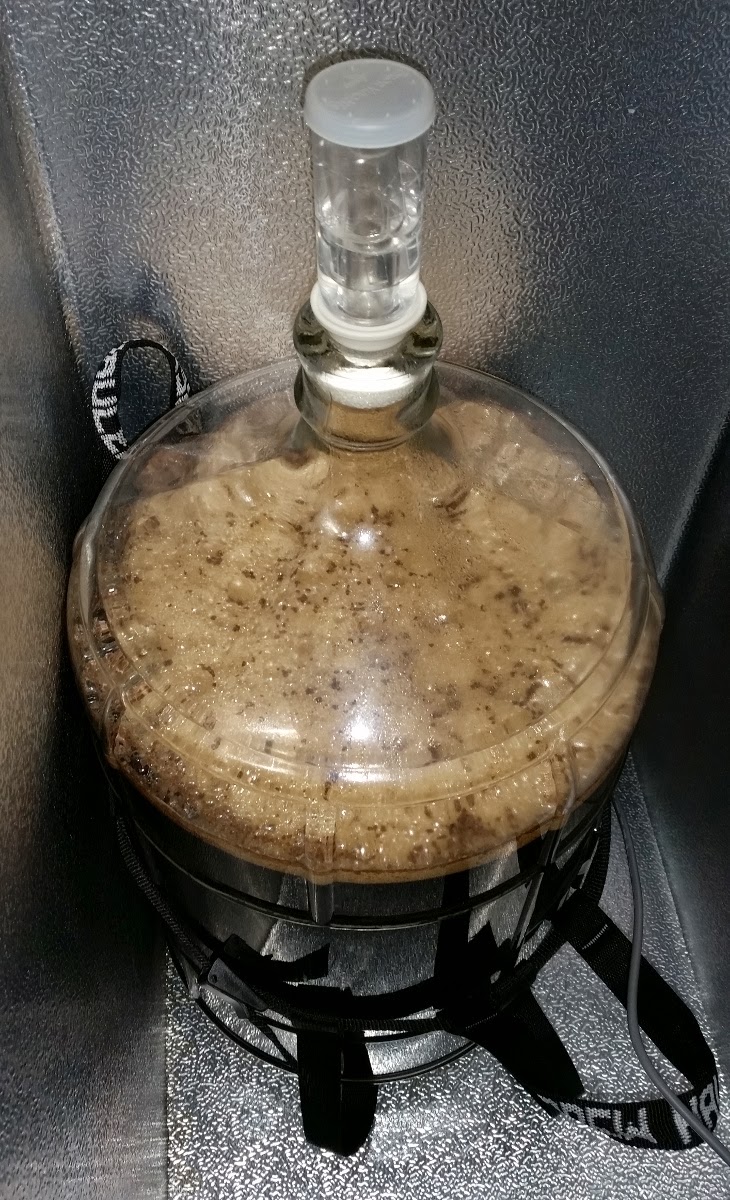
- I transferred the wort to the fermenter and added the entire 1 L starter. Although I do not have this particular fermenter calibrated for volume measurements, based on my measurements at the end of the boil I transferred approximately 5.5 gallons into the fermenter.
- I will be fermenting this beer at approximately 66°, which is right at the lower end of the optimal zone for WLP029 (65-69°). This way if things heat up a tad during the most vigorous part of fermentation, I should still keep esters and such under control.
- Starting gravity was 1.045 – exactly on the nose! The wort is a beautiful light yellow in color, with excellent hot break separation.
- I brewed this up on March 1, 2015. I will let it ferment for ~7 days before cold crashing it. Then, I’ll let it sit at least another week before kegging.