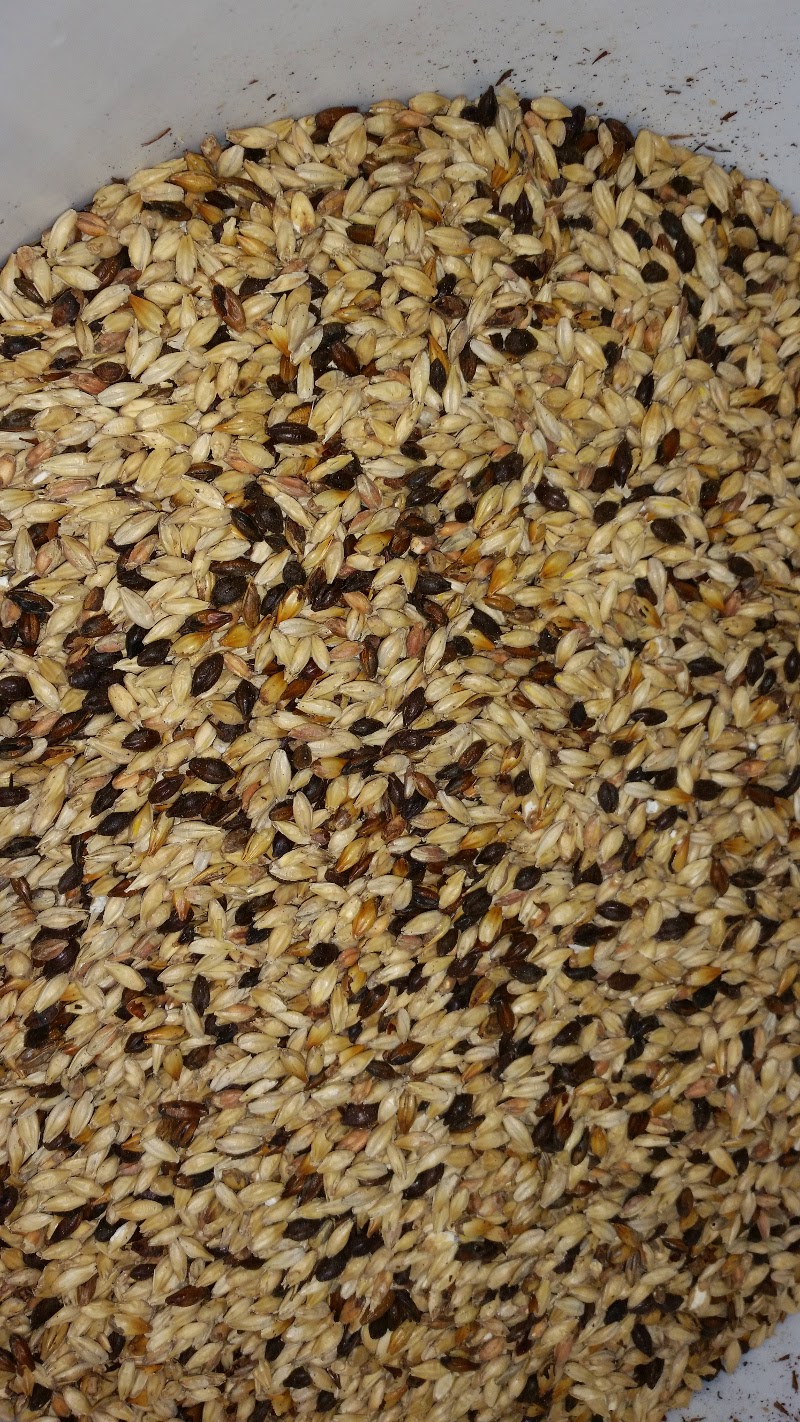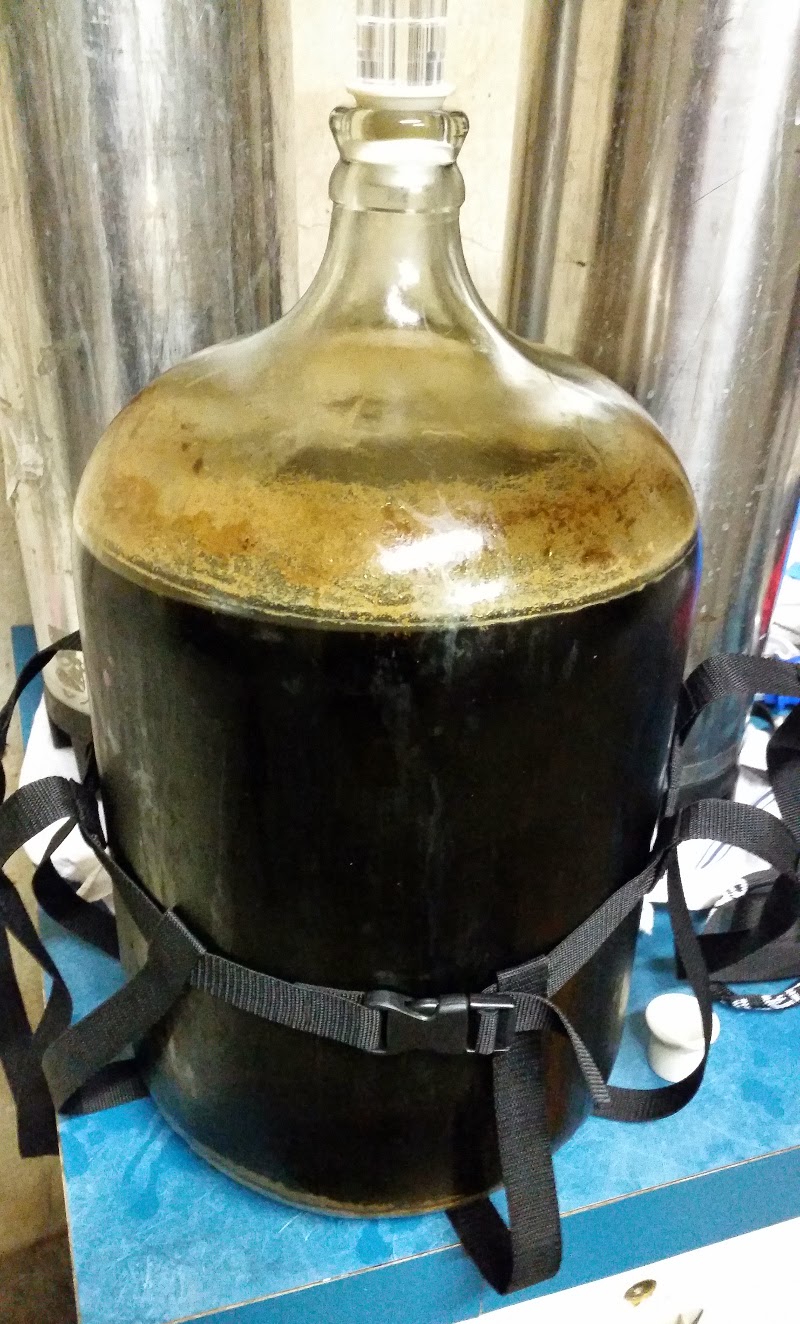
Eagle Face Oatmeal Stout 1.1

In my second brew for the AHA club night, I’m revisiting my Eagle Face Oatmeal Stout. The beer recipe is pretty much unchanged, with just a touch more flaked oats to round out the body a bit.

Eagle Face Oatmeal Stout

  • 8.5 lbs. 2 row malt (Great Western)
  • 1.25 lbs. flaked oats
  • 1 lb. 80° L crystal malt
  • 1 lb. Victory malt
  • 0.75 lb. chocolate malt
  • 0.5 lb. roasted barley
  • 0.5 lb. rice hulls
  • 1 tsp. Irish moss
  • 1.5 oz. Northern Brewer hops pellets (7.8% alpha, 4.5% beta)
  • 1 pkg. English Ale yeast (White Labs WLP002, 1L starter)
Procedure
  • 24 hours before brewing, I began a 1L starter (4 oz. of extra light DME in 1L water), and ran this on the stir plate. True to the yeast strain (WLP002), the culture was a snowstorm of flocculated yeast by the end.
  • I mashed in with 4.25 gallons of water at 169°, and hit 155-156° for my mash-in temperature. The mash had dropped to 155.4° after 10 minutes and was down to 152.4° after 50 minutes.
  • After 60 minutes, I added 0.5 gallons of 170° water, let this sit for 10 minutes, vorlaufed, and collected 3 gallons of wort at ~1.070 gravity. Then, I added 3.25 gallons of water at 180°, which raised the mash bed to 168°. I let this sit for 10 minutes, vorlaufed, and collected the remainder of the wort.
  • All together, I collected 7.6 gallons of wort with a gravity of 1.049. This works out to a mash efficiency of 81%! I suspect I collected only 3 gallons on the first round due to slow draining of the mash tun; the rice hulls were definitely a good addition to this recipe!
  • I brought the wort to a high, rolling boil. After 5 minutes, I added the hops.
  • After 50 minutes, I added the Irish moss.
  • After 60 minutes, the wort gravity was reading ~1.054 on my refractometer, a little bit lower than I wanted. So, I removed the hops (to avoid over-bittering), and boiled for another 15 minutes. This may have overboiled the Irish moss a bit, but I figured that was a small price to pay for hitting my target gravity.
  • After flame-out, I chilled the wort down to 70° using my wort chiller. In the end, I had 6.25 gallons of wort, ~5.75 gallons of which went into the fermenter. Final gravity was 1.061 at 60°. This was nearly exactly at my target of 1.062.
  • I put this in the fermentation chamber, which was set at 66°.

Gondwana Pale Ale 1.2

Mash on!

Ramping up for the National Homebrewers Association conference, my club is going to be serving our beers at club night! I’ve (perhaps foolishly) agreed to provide three kegs, using some of my more tried-and-true recipes. First out: Gondwana Pale Ale. I’ve made this recipe in two previous iterations, and have modified the grain and hops bill just a touch as my techniques are refined. Additionally, I’ll be using a liquid yeast starter (WLP001) instead of dried yeast (Safeale US-05).

Gondwana Pale Ale 1.2

  • 8.25 lbs. 2-row malt
  • 0.85 lbs. Vienna malt
  • 0.45 lbs. carapils malt
  • 0.45 lbs. crystal 40 malt
  • 1 oz. Citra hops (pellets, 13.2% alpha, 3.7% beta), 35 minute boil
  • 1 oz. Citra hops (pellets, 13.2% alpha, 3.7% beta), 1 minute boil
  • 2 oz. Citra hops  (pellets, 13.2% alpha, 3.7% beta), dry hop 14 days
  • 1 tsp. Irish moss (boil 10 minutes)
  • 1 pkg. California Ale Yeast (White Labs, WLP001); prepared 24 hours in advance in 1L starter

Procedure

  • I mashed in with 3.185 gallons of water at 164°, nailing 152° on the nose for a mash temperature. This had declined to 151° after 10 minutes and 150.4° after 35 minutes.
  • I added 1.18 gallons of water at 190°, which brought the temperature up to 154°. I let it sit for 10 minutes, vorlaufed, and collcted 3.25 gallons of wort.
  • I added 3.18 gallons of water at 185°, which brought the mash temperature up to 172°. This was a touch high, so I added .125 cups of ice cubes, which brought the temperature down to 165°. I let it sit for another 10 minutes, vorlaufed, and collected the rest of the wort.
  • All told, I collected 6.95 gallons of wort with a gravity of 1.037. This works out to ~72% efficiency. Because my efficiencies have been a touch low the last two batches (compared to the usual 75%+), I rechecked the gap on the rollers on my grain mill. Sure enough, they had slipped out just a touch, so I readjusted them back to 0.039.
  • I brought the wort to a boil and added the first hops charge after 25 minutes (for a 35 minute total boil).
  • I added the Irish moss after 50 minutes of boiling.
  • I added the second hops charge 1 minute before flame-out. At flame out, I removed the “old” hops, left the “new” ones in to steep, and cooled the wort. Once it was down to ~75°, I transferred the wort to the fermenter and pitched the yeast.
  • I have ~5.5 gallons of beer in the carboy, with a gravity of 1.048 (exactly where I was at for my last batch, too!). I’ll be fermenting it at 66°.
  • Within 12 hours after pitching the yeast, fermentation was well under way.
  • I brewed this beer on Saturday, April 11.

Pannotia White IPA

During my European travels last year, I sampled a heavenly brew called Vergött White IPA, brewed by Birrificio Artigianale Lariano of Dolzago, Italy. It was my first time encountering a White IPA, which is essentially a Belgian wit ramped up with hops. In my memory, the brew was crisp, tart, and citrusy–a really fun combination of flavors and aromas. Upon my return to the United States, a little more research turned up additional information on this burgeoning style. I tracked down some bottles of Deschutes Chainbreaker White IPA, which was good, but just a little heavier and sweeter than my own tastes and as compared to my memories of the Italian beer. So, I set off to create a new recipe that would bring together the best of all worlds. I have no idea how it will turn out, and I suspect it may get iterated through a few batches.

This was the first batch where I used yeast cultured on my new stir plate. The yeast was culturing for around 24 hours when I pitched it, looking to be at high krausen. Also, it was my first time working with pilsner malt.

Per my usual custom, I am naming this IPA after a supercontinent–Pannotia this time around.

Pannotia White IPA

  • 7 lbs. Pilsner (Weyermann) malt
  • 3 lbs. white wheat malt
  • 1 lb. flaked wheat
  • 8.10 g gypsum (added to boil)
  • 1.73 oz. whole Cascade hops (first wort hopping and 90 minute boil; 2014 crop, estimated 4.29% alpha acid)
  • 1 oz. whole Cascade hops (first wort hopping and 90 minute boil; 2013 crop, estimated 2.61% alpha acid)
  • 0.35 oz. bitter orange peel (added for last minute of boil)
  • 0.15 oz. coriander seed (lightly crushed, added for last minute of boil)
  • 3 oz. Citra hops pellets (added at flame-out; 13.2% alpha, 3.7% beta)
  • 1 oz. whole Cascade hops (added at flame-out; 2013 crop, estimated 2.61% alpha acid)
  • Belgian Wit ale yeast (WLP400), prepared 24 hours in advance with 1.5 L starter
  • 3 oz. Citra hops pellets (14 days dry-hop, 13.2% alpha, 3.7% beta)
Anticipated statistics
  • 1.059 o.g., 1.010 f.g., 6.5% abv
  • 50.2 IBU
  • 3.7 SRM

Procedure

  • I mashed in with 3.5 gallons of water at 159°. The mash stabilized at ~147° within 5 minutes, which was a little on the cool side for my taste. So, I added 1 gallon of ~185° water, stirred it a bit, and got the mash  to 151° within a minute. The mash still measured 151° after 10 minutes and 149° after 40 minutes.
  • I drained the mash tun, collecting ~3 gallons of wort with a gravity of 1.064. The hops were in the kettle starting at this point. Note that I adjusted the alpha acid for the calculations based on the age of the hops, using the hops aging tool in BeerSmith.
  • For mash-out, I added 3.5 gallons of water at ~185°.
  • All told, I collected 7 gallons of wort with a gravity of 1.045. This works out to ~74% efficiency.
  • I added the gypsum and brought the wort to a boil. Because I used pilsner malt, which is supposed to have a higher susceptibility to DMS production, I boiled for a total of 90 minutes.
  • One minute before flame-out, I added the coriander and bitter orange peel. At flame-out, I added the Citra hops pellets (contained in a mesh bag) as well as the whole Cascade hops.
  • I cooled the wort down to ~70°, transfered to the carboy (aerating with the Venturi pump along the way), and pitched the yeast (starter and all).
  • This beer was brewed on Monday, April 6, 2015. Starting gravity was 1.057, just a touch below my predicted gravity (1.059). This is likely due to a slightly lower boil-off rate. Total volume was 5.25 gallons. I placed the carboy in my fermenting chamber, and set the temperature controller for 70°.
  • In less than 12 hours, the fermentation was proceeding quite vigorously. Score one for using a starter!
Pannotia White IPA at high krausen

DIY Stir Plate

Stir plate in action

As I continue to expand my home microbiology lab, a stir plate seemed like a logical addition. Good laboratory grade ones are reliable, but expensive ($75 on up). Cheap kits and cheaply made stir plates are easy to find on-line, but often only have middling reviews. So, I decided to make my own.

Not being an electrical engineer, I wasn’t entirely in love with the idea of soldering wires and the like, so I elected to use one of the builds that modifies a computer cooling fan. A project posted at Homebrew Finds gave basic directions, some designs for a 3D printed magnet mount, and a list of parts easily found on Amazon. A little more searching on Thingiverse found this base for the Ehrelenmeyer flask, which I shrank slightly in the Z-axis (subtracting ~5 mm, but leaving the X and Y dimensions unchanged) before printing in order to move the magnets closer to the stir bar. I also added some silicone feet under the fan, to give a little air circulation as well as to prevent movement of the stir plate when in use.

Parts list:

All told, it cost about $40 in materials to put this together. I assembled the stir plate this weekend, and ran a test with about 1.5 L of water in my 2 L flask. The setup works pretty well, and I’ll be putting it into use for my next batch.

The finished stir plate

Lab Bench Pale Ale Kegged

Tonight I kegged my Lab Bench Pale Ale, after 13 days in the primary fermenter. The yeast had dropped out pretty nicely, leaving a golden beer with a smooth bitterness and a crisp, slightly malty aroma. The gravity was 1.010, down from 1.047, which equals 4.8% abv and ~78% apparent attenuation.

I got around 4.75 gallons of beer. Before sealing up the keg, I added 2 oz. of Cascade hops in pellet form (7.5% alpha, 5.5% beta). In about 5 days, I’ll start carbonating (leaving the hops in place); the goal is to have this ready to go on Easter!