Farke’s Best Pils

My dad has a few hop bines on the farm in South Dakota, and usually has a fair bit of Cascade that he sends my way (see my recent pale ale). This year, I also managed to snag some South Dakota-grown versions of Saaz, Hallertauer, and Sterling, so a German pilsner seemed like an awesome use of them. I went with a super simple grist, and loaded up most of the hops towards the end in a hope to elevate relative flavor and aroma. I had to guess on alpha acid levels, so aimed a bit higher in estimated IBU in the presumption that they would be a bit lower in potential bitterness than is typical for the varieties.

Farke’s Best Pils

  • 10 lb. Viking Pilsner malt
  • 1 oz. Sterling whole hops (est. 7.4% alpha), 60 minute boil
  • 1 tsp. BruTanB, 10 minute boil
  • 1 Whirlfloc tablet, 5 minute boil
  • 1 oz. Hallertauer whole hops (est. 4.8% alpha), 5 minute boil
  • 1 oz. Saaz whole hops (est. 5.3% alpha), 5 minute boil
  • 1 tsp. yeast nutrient (WLN1000), 5 minute boil
  • 2 pkg. Saflager lager yeast (W34/70)

Target Parameters

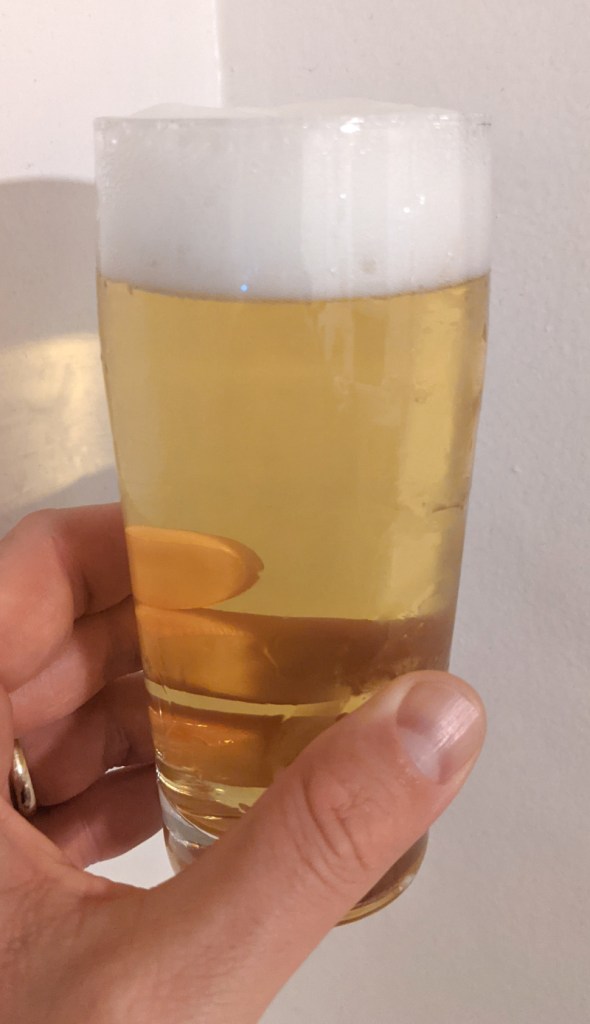
pale yellow beer with white foam held aloft in tall clear glass
  • 1.046 o.g., 1.009 f.g., 4.9% abv, 32 IBU, 4 SRM
  • Full volume mash at 149° for 60 minutes, with 10 minute mash-out at 168°
  • Water built up from RO water, to hit target of 59 Ca, 8 Mg, 89 SO4, 63 ppm Cl, RA=-47

Procedure

  • I added 2.8 g gypsum, 2.3 g epsom salt, and 3.6 g CaCl in 7.25 gallons of water to hit a profile of 59 Ca, 8 Mg, 89 SO4, and 63 ppm Cl, with RA=-47.
  • I heated the water to 154° and mashed in to hit a temperature of 149°. At this point, I added 0.7 mL (approximately) of 88% lactic acid, to hit the target mash pH of 5.3 to 5.4.
  • I mashed at 149° for 60 minutes (with recirculation), before raising the temperature to 168° and holding it there for 10 minutes.
  • After the mash, I removed the grains. In total, I collected 6.5 gallons of runnings with a gravity of 1.041, for 70% mash efficiency.
  • I brought the runnings to a boil, adding finings per the recipe. After 60 minutes, I chilled to 78°, let settle for 90 minutes, and then transferred to the fermenter. I chilled it down the rest of the way to 50° in the fermentation chamber, before pitching the yeast.
  • Starting gravity was 1.046. I brewed the beer on 18 September 2021.
  • After starting fermentation at 50° on 18 September 2021, there were active signs of bubbling by 20 September 2021. I raised the temperature to 53° on that day, and then up to 56° on 22 September 2021, and 60° on 30 September. I dropped it to 55° on 3 October, 50° on 4 October, 45° on 5 October, 40° on 6 October, 35° on 7 October, and to 32° on 9 October.
  • I kegged the beer on 11 October 2021. There was a gorgeous and delicate malt flavor at that time, with a really nice floral hop character, and moderately low level of bitterness. This was shaping up to be a nice beer!
  • Final gravity was 1.010, for 4.7% abv.

Tasting

  • Appearance
    • Light yellow, very clear (nearly brilliant), with a fairly persistent white head
  • Aroma
    • Delicate malt aroma with a grainy character and light honey-sweet quality. A very low floral hop aroma. Very nice and clean fermentation character!
  • Flavor
    • Light malty character, slightly sweet, with a clean fermentation character. The bitterness is clean and moderate, but not overly so. There is a nice balance between hops and malt!
  • Mouthfeel
    • Medium body and moderate carbonation, with an off-dry finish.
  • Would I Brew This Again?
    • The malt aroma is amazing, but I wish there was a little more hop aroma alongside that in the final product. The bitterness level is perfect, and it dodges some of the issues I have had with overbittering in past recipes. The body could be a touch lighter. That said, I’m very happy with how clean the fermentation turned out, and the water character is great, too! Overall, this is not an amazing beer, but still a pretty good one.
  • Overall
    • 7/10

Humboldt’s Lesser Hefeweizen

I enjoy German hefeweizens, but just don’t brew them that often. So, I decided it was time to do a rebrew of a recipe from last year. Because I was using up some grains, I ended up with a slightly smaller beer. Hence, the name change from Humboldt’s Hefeweizen to Humboldt’s Lesser Hefeweizen. Additionally, I decided to try out a dry wheat beer strain from Lallemand, just to see how it compares with the liquid varieties available.

Humboldt’s Lesser Hefeweizen

  • 4 lb. 10 oz. Viking Pilsner Zero malt
  • 4 lb. 1 oz. Viking wheat malt
  • 2 oz. melanoidin malt (Weyermann)
  • 8 oz. rice hulls
  • 0.4 oz. Vanguard hop pellets (6.5% alpha), 60 minute boil
  • 1 tsp. yeast nutrient (White Labs WLN1000), 5 minute boil
  • 1 pkg. Munich Classic Wheat Beer (Lallemand)

Target Parameters

  • 1.043 o.g., 1.010 f.g., 4.3% abv, 10 IBU, 4 SRM
  • Full volume mash at 149° for 60 minutes, with 10 minute mash-out at 168°
  • Water built up from RO water, to hit target of 43 ppm Ca, 76 ppm Cl, RA=-30 ppm

Procedure

  • I built up my water starting with RO water and 4 g of calcium chloride, to hit 43 ppm Ca and 76 ppm Cl. I then heated this to 158° before mashing in, to hit a target mash rest of 149°. I added 2 mL of 88% lactic acid, to adjust pH.
  • I held the mash (with recirculation) at 149° for 60 minutes, before raising to 168° for 10 minutes. Then, I removed the grain basket and brought the runnings to a boil.
  • In total, I collected 6.4 gallons of runnings with a gravity of 1.036, for 68% mash efficiency.
  • I boiled for 30 minutes before adding the hops, to drive down the volume of the beer and increase the gravity a bit.
  • I added hops and yeast nutrient per the recipe. After the 30 minutes of initial boil and 60 minutes of boiling with the hops, I turned off the heat and chilled the wort down to 78° before transferring to the fermenter.
  • After chilling the wort down to 64° in the fermentation chamber, I pitched the yeast and set it to ferment at 65°.
  • I brewed the beer on 25 September 2021. Starting gravity was 1.041.
  • Active fermentation was well underway by the next day. I raised the fermentation temperature to 70° by 3 October 2021, and kegged the beer on 8 October 2021.
  • Final gravity was 1.012, for 3.9% abv.

Tasting

  • Appearance
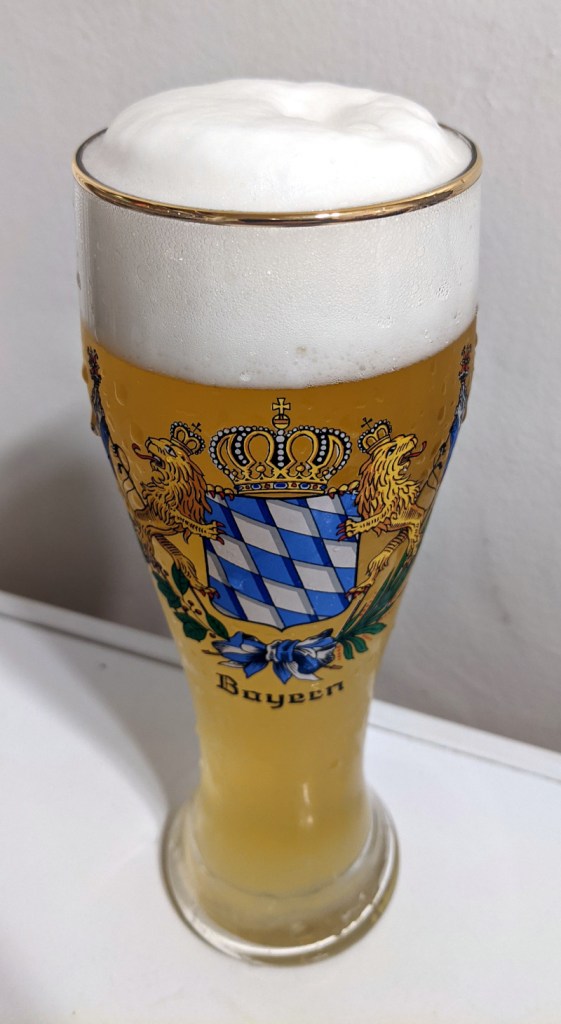
    • Very hazy, straw colored beer that pours with a creamy and persistent white head.
  • Aroma
    • Tart aroma, moderately low levels of spicy phenolics; no banana or bubblegum aroma. No hop aroma.
  • Flavor
    • Bready malt character that is really pleasant. There is a slight tartness to the yeast character, and a bit of fruitiness along with that. There is not much for banana or bubblegum or spice. Bittering level is low, with no real distinct character to speak of.
  • Mouthfeel
    • High level of carbonation, but not overly so. Medium light body, and a smooth finish.
  • Would I brew this again?
    • This isn’t a bad beer, but it is missing the yeast character I like in a good German hefeweizen. I fermented this at a somewhat low temperature (~65°). Some recommendations for this yeast strain have suggested that temperature is desirable to avoid a case of the bubblegums, but I feel that in this case much of the yeast character was lost. There was no banana, and little clove, and just a general moderate level of fruitiness. I would definitely ferment this higher next time, at least with the particular dry yeast strain! In fact, I would probably just find a different yeast, and go back to the liquid White Labs (or equivalent).
  • Overall
    • 6/10

Review: Yakima Valley HOPBOX

When it comes to hops, I am often a creature of habit. I love Cascade, Centennial, Citra, and Simcoe for my IPAs, and I’ll sometimes throw in Galaxy or Amarillo. I love Saaz, Hallertauer, and their American equivalents for my German beers. And…I don’t get much outside of that box very often. With a bewildering array of hops on the market for homebrewers, I just get overwhelmed and usually stick with what I know.

Now, that philosophy can be great for consistency and predictability. It also helps me to avoid chasing the latest expensive fad hop, and I’ve really gotten to know the flavors in each familiar variety. That said, I’m almost certainly missing out on some real gems. But, how can I break out of my rut, without too much effort on researching and such?

About two months ago, I was super excited to learn about a hop subscription box from Yakima Valley Hops, called The HOPBOX. HOPBOX was totally sold out then, but one of their reps said to check back at a certain date, and I should be good to go. Sure enough, I visited the website a few weeks later and I could order! (thanks for the tip, YVH rep!) I signed up for a full year (which came with a 15% discount), and waited for my first shipment…

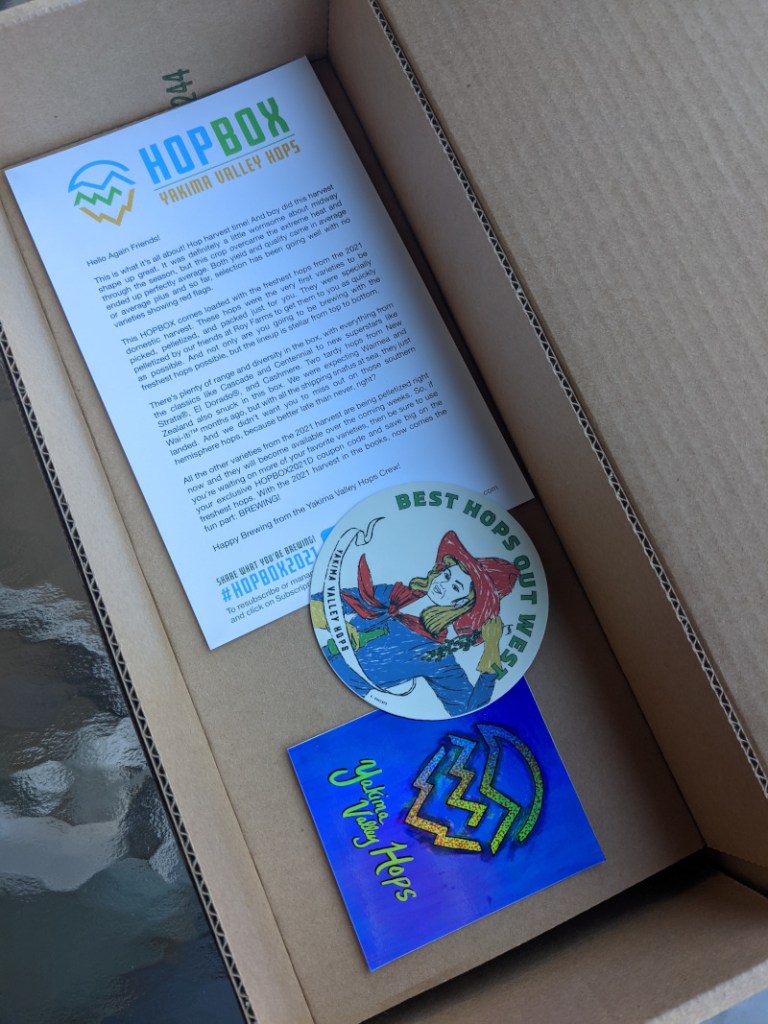
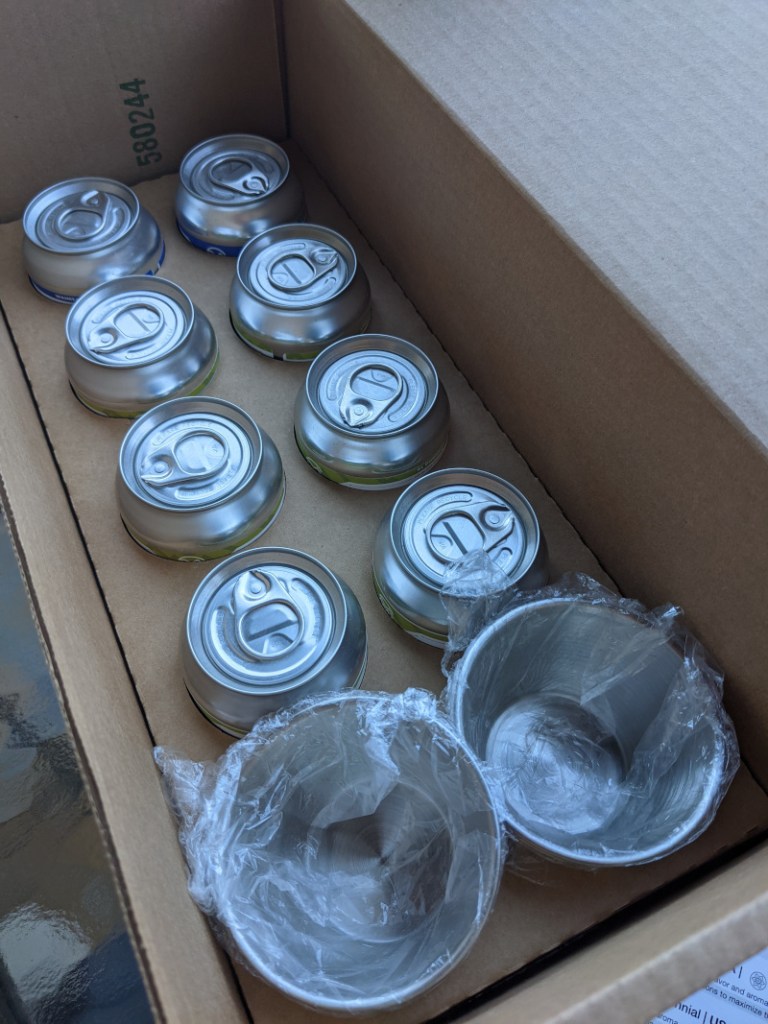
A little over a week ago, a very attractive box landed in my mailbox. Opening it up, I saw eight 2-oz. cans of eight different hop varieties, along with some stickers, a card describing the hops, and a set of stainless steel cups to portion out hop additions.

So, what do I think about all of this? Let’s take a look! (note: I paid for this myself, and did not receive any compensation for the review, so I feel I can be reasonably even-handed)

The Hops

I was pretty impressed by the hops! All were from the 2021 crop, so I have no doubt on freshness. High marks there.

I am also impressed by the varieties–this box included Bravo, Cashmere, Cascade, Centennial, El Dorado, Strata, Waimea, and Wai-iti. A few are ridiculously expensive to buy at some suppliers (e.g., Strata sells at over $2.50 per ounce at some online stores), and others aren’t yet available for this crop via YCH (e.g., Cashmere and El Dorado).

For my brewing habits, this is a perfect quantity of hops. There are enough to do a few beers with fun blends–for instance, my first batch uses Bravo as the bittering with Waimea+Wai-iti+Cashmere for the whirlpool and dry hop. There isn’t enough of each for a five gallon SMaSH beer, but I think I’m okay with that. I can always go back and try a particularly intriguing variety in more depth. For me, Waimea is the standout in my current package so far, and I may well come back to that.

I like that this box fits within a general theme, of “hops that are good for IPAs and pale ales”. That made it a lot easier to plan brewing, versus if I had gotten a smattering of hops suited for disparate styles.

One thing that might have been nice is access to detailed data on individual lots. The packages had alpha acids, etc., but I wouldn’t complain if there were specifics on particular hop oil quantities, etc. That is a very minor quibble, though.

The Extras

This box came with two stickers as well as a set of stainless steel cups to portion out hops. I’m not really a sticker person, so those were somewhat of a wash, but the cups have already gotten use in my brewery. Previously I have been using reusable plastic containers, which are OK but a bit large for what I need. The little stainless steel containers (the same as 4 oz. sauce cups you might get at a restaurant) are branded with the YVH logo and will fit 3 oz. of hops fairly comfortably. The cups also make it easy to weigh out an ounce at a time, or a measure mineral additions.

One extra I might suggest for future boxes would be to include variety-specific recipes for the hops. I of course had fun thinking up something on my own, but at the very least a starting point would be helpful.

The Packaging

Yakima Valley Hops uses a nitrogen-flushed pull-top can, which is pretty slick. There’s no doubt as to the fact that they’re sealed and pretty impermeable to oxygen. A minor beef is that they are a little less convenient to store compactly in my deep freezer than bags are, and the cans also tend to wrinkle slightly due to the contraction of the internal gases at freezer temperatures. That said, they’re quite visually attractive.

The box itself was nicely arranged, and it was enjoyable to open and see what all was inside. I personally find unboxing videos or excessive commentary on such things a bit over the top, but I can’t deny that I had fun.

The box/packaging itself are maybe a little big for what’s inside, but it is all cardboard and recyclable, so I give them high marks for that. There’s no excess plastic junk, or unrecyclable bits. Also, everything arrived in perfect shape.

The Cost

Because I ponied up for a one year (four box) subscription, this knocked 15% off the $40 price tag per box, so I’m paying $34/box. And, shipping is free! Is that worth it? Overall, I think yes.

For comparison, I priced out 2 oz. containers of each hop on the Yakima Valley Hops website. This adds up to about $18.50 of hops and $9.70 of shipping, for $28.20 total. I will note, though, that some of the things in my box are currently sold out or only available in 2020 or 2019 crop years. When I compared with MoreBeer, you’d spend around $31.42 and then an additional $8 or $10 for shipping, and you wouldn’t necessarily get as much control over which year you got.

In pricing out the stainless steel cups, it looks like they run around 50 cents to $1 each online; just for the sake of argument, let’s say $1 each (they have printing on the outside, after all). So, that’s $6 value there, more or less.

With everything included ($28.20 of hops and $6 of steel cups), and free shipping, I would say this box is about a break-even proposition, and you definitely come out ahead versus if you had to pay shipping. The exclusive access to some hops is also a nice perk. Overall, the box is also a fairly good value versus buying each individually at a reseller. However, the box wouldn’t necessarily be a good value at full price ($40).

Overall

On the whole, I rate the HOPBOX a 4 out of 5, and it comes awfully close to being 5 out of 5. The cost for what you get is pretty good, although not a ridiculous steal. The full-price one-off box might make for a good gift for someone, but if you brew a lot and are likely to use the hops, I would just get a full-year subscription to save a fair bit of money. The hop selection is top-notch, and the extras in the box are pretty cool. Additionally, at least this first box has definitely helped me to expand my brewing horizons, so mission accomplished! I definitely recommend this if you are a hophead or know someone who is.

What’s Brewing? October 2021

This month is a busy one, and I am taking a few weekends off from brewing. That said, I’ve been sliding a brew or two in wherever possible, because I seriously need the downtime.

Beer Batch Updates

  • I’ve moved a few beers from kegs to fermenters to keezer…these are listed below.
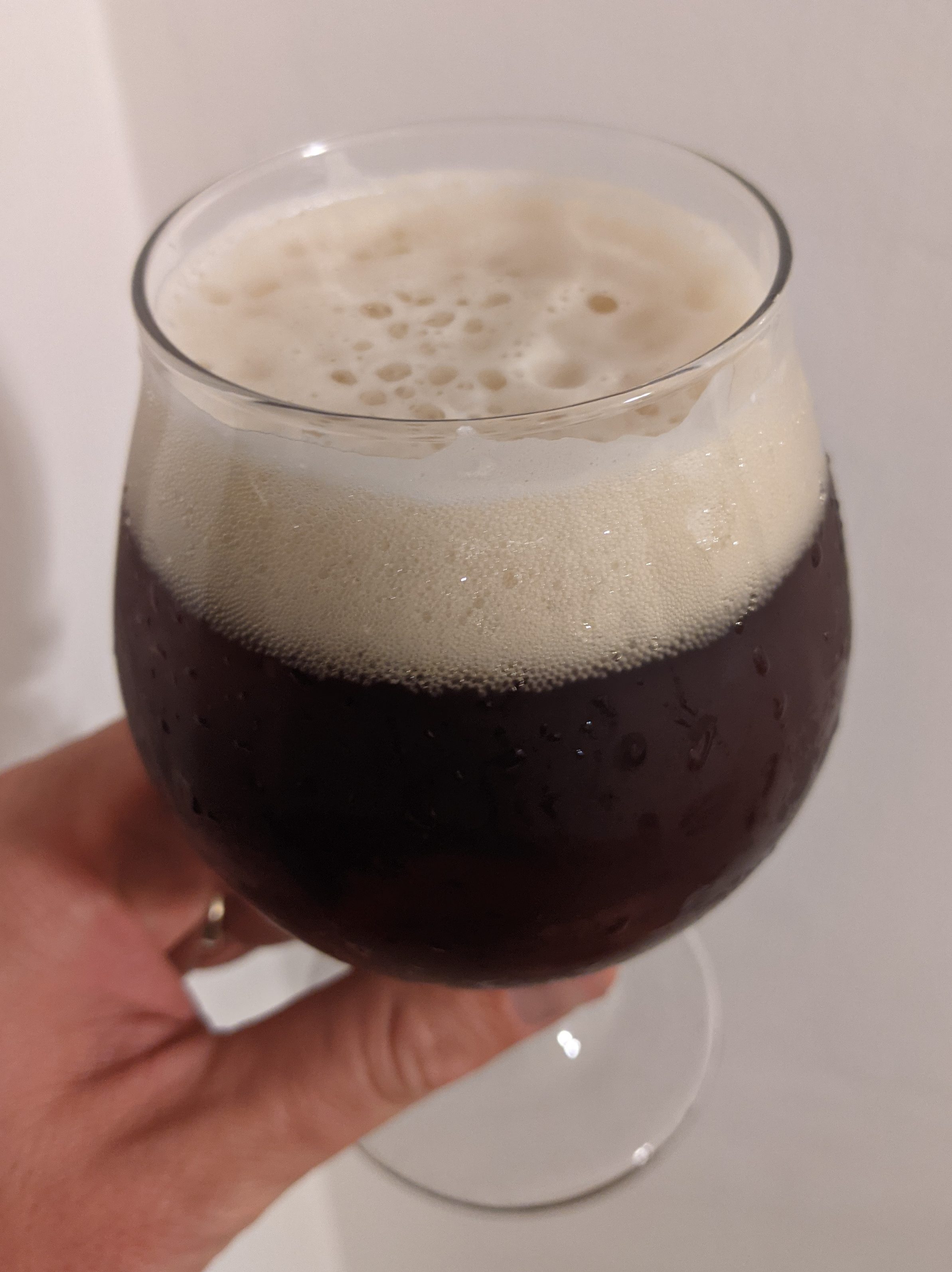
  • My German pils made with South Dakota hops is kegged as of last week. The initial tastings show that this will be a really nice beer, on the less hopped side of the style. The malt character is beautiful, and I get a floral hop aroma that’s also pretty nice. Right now, it’s lagering until a tap opens up. See the bottom of the post for a preview picture.
  • On October 9, I brewed a clone recipe of Ill Tempered Gnome, from Oakshire Brewing. It’s a super malty winter seasonal beer, without any spicing. My plan is to have it ready around Thanksgiving time.
  • On October 12, I brewed a 3 gallon batch of another winter ale (Winter Dream Ale). This is a bit of a kitchen sink recipe to use up some ingredients, and I am throwing in Belgian Abbaye yeast as an experiment. The intent is to have something dark and full-bodied, with an interesting malt and yeast character that is in the realm of Belgian quads.

What’s On Tap?

  • The raspberry Belgian sour is still on tap; because the weather has cooled a bit, we’re not going through it quite as quickly as before. At this point, it is ridiculously clear and has a wonderful raspberry character.
  • Turtle Toe Porter is just so enjoyable! I can’t say enough great things about the beer.
  • I recently moved a hefeweizen onto tap. It’s on the lighter side for the style, and quite drinkable.

What’s Coming Up?

A preview of my new German pils, with South Dakota hops

Turtle Toe Porter

As the weather swings cooler, my tastes swing to darker beers–porters, stouts, and such. So, I found a clone recipe for Deschutes Black Butte Porter on the AHA website and made a few modifications for yeast (American ale instead of English ale) and hops (to use up on-hand varieties).

The name comes from a fossil specimen in the museum lab at the moment–it’s a ~67 million year old turtle from Wyoming, which unexpectedly had complete hands and feet. “Turtle Toe Porter” is a very alliterative title for a beer, so the name stuck!

beer label image, showing foot skeleton of turtle on left side, text saying "Turtle Toe Porter" on right side, and "Farke Brewing, Claremont, California" at the bottom.
(bone image from Williston’s 1925 Osteology of the Reptiles)

Turtle Toe Porter

  • 9.5 lb. California Select 2-row malt (Great Western)
  • 14 oz. chocolate wheat malt (Weyermann)
  • 10 oz. 80L crystal malt (Warminster)
  • 4 oz. carapils malt (Briess)
  • 0.75 oz. Magnum hop pellets (10.1% alpha), 90 minute boil
  • 1 oz. Cascade whole hops (5.5% alpha), 10 minute boil
  • 0.5 oz. Mt. Hood hop pellets (8.0% alpha), 5 minute boil
  • 1 Whirlfloc tablet, 5 minute boil
  • 1 pkg. US-05 American ale yeast (DCL/Fermentis)

Target Parameters

  • 1.050 s.g., 1.011 f.g., 5.2% abv, 39 IBU, 30 SRM
  • Full volume mash at 152° for 60 minutes, with 10 minute mash-out at 168°
  • Claremont tap water, treated with Campden tablet

Procedure

  • I mashed in with 7.5 gallons of water heated to 157°, to hit a target mash temperature of 152°. I added 5 mL of 88% lactic acid to bring down the mash pH. I recirculated the mash at this temperature for 60 minutes, before raising the mash to 168°. Then, I removed the grains and brought the runnings to a boil.
  • In total, I collected 6.4 gallons of runnings with a gravity of 1.044, for 69% mash efficiency.
  • I brought the kettle to a boil, adding hops and finings per the recipe. After a 90 minute boil, I turned off the heat and chilled to ~80°, before transferring to the fermenter. I chilled the wort the rest of the way in the fermentation chamber, before pitching the yeast.
  • I brewed this beer on 11 September 2021. Starting gravity was 1.051, and I fermented it at 66°.
  • On 18 September 2021, I pulled the beer out to ambient, around 70° to 72°, to finish out fermentation.
  • I kegged the beer on 24 September 2021. Final gravity was 1.014, which works out to 4.9% abv.

Tasting

  • Appearance
    • Brilliantly clear, deep brown beer with garnet highlights, that pours with a decently persistent tan head.
  • Aroma
    • Roasty aroma of coffee and chocolate at the front. No significant hop or yeast character evident.
  • Flavor
    • Roasty and cocoa notes dominate, with a touch of dark caramel behind that. The base malt profile has a slightly grainy character. Bitterness is moderate and fairly clean, with perhaps a slight woody character.
  • Mouthfeel
    • Medium body, moderate carbonation, dry finish.
  • Would I brew this again?
    • Yes! This is exactly the American porter that I wanted. It is flavorful, yet very drinkable. I like the roasted character in it, and it is a good beer to bridge the summer to fall transition. If brewed as a winter beer, I might add a bit more character by using Maris Otter, but that’s a fairly mild critique in the scheme of things.
  • Overall
    • 10/10