Wild Times Pale Ale

I recently acquired a pound of wild hops from the Seattle area of Washington state, courtesy of a generous friend who found them on his property. The plus side of wild hops is that they have a definite “cool” factor. The negative side is that wild hops are indeed wild (or naturalized, if they are “feral” versions of cultivated hops)–you have no real published guidelines to constrain expectations for aroma, flavor, and bittering properties. It’s all lab analysis and careful sensory evaluation. In other words–a grand opportunity for a motivated homebrewer.

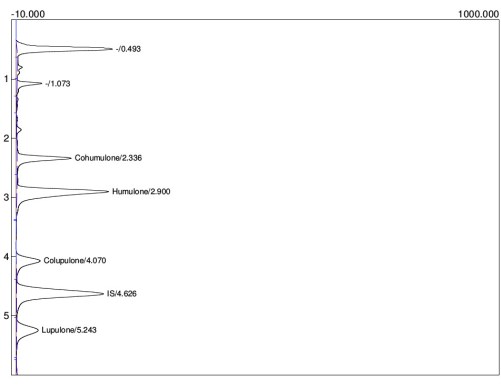
My first order of business was to figure out the chemistry of these things, particularly alpha acids. Because I had a good quantity of the hops, I didn’t mind sending them off for analysis. My go-to place has been BrewLaboratory; they are relatively inexpensive, fast, and supportive of homebrewers. They use HPLC (High Performance Liquid Chromatography), and their turn-around time has been less than 2 or 3 days from receipt of the sample.

I was pleasantly surprised by the alpha acid values–5.8%! Beta acids clocked in at 3.2% and cohumulone at 30%.
2016-washington-state-wild-hops

HPLC Profile for Washington State Wild Hops

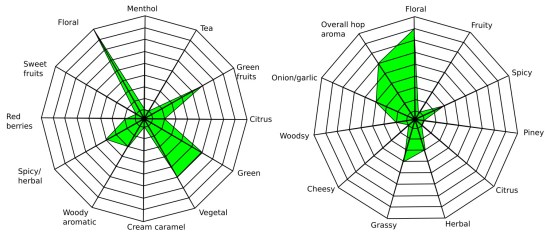
The analysis nicely covered the basic chemistry, but what about the more complex aromas and flavors? When rubbing the hops between my palms, I noted a dominant, very perfume-like aroma! Behind that is a bit of vegetal/allium aroma. To help formalize my thinking on the matter, I roughed out the hop profile using spider diagrams. There are two slightly different formats that I found in my research, included below. Each breaks out the aroma descriptors slightly differently–for instance, one specifically has an “onion/garlic” category, whereas in the other that is lumped in with “vegetal”.
Wild Hop Spider Diagrams

Wild Hop Spider Diagrams, Showing Level of Intensity of Different Aroma Components

With nearly a pound of thoroughly analyzed wild hops in hand, I wanted to put together a nice and simple batch of beer to highlight their flavor and aroma. After consulting with some friends, I settled on an American pale ale. The goal was for something that was clean and not overly malty, to let the hops shine. Because I didn’t want to commit to five gallons of beer for the first round on these hops, I settled on a 3 gallon batch, which will fit into a 2.5 gallon keg that I have on-hand.

The weather is turning cool, and I didn’t want to deal with the thermal loss of brew-in-a-bag. So, I also elected to do a full-volume, no-sparge mash in my mash tun.

Wild Times Pale Ale

  • 5.5 lbs. California Select 2-row malt (Great Western Malting Co.)
  • 0.5 lb. 10°L caramel malt (Briess)
  • 0.25 oz. Galena hop pellets (13.8% alpha), 60 minute boil
  • 1.5 oz. Washington wild hops (5.8% alpha, 3.2% beta), 10 minute boil
  • 1.5 oz. Washington wild hops (5.8% alpha, 3.2% beta), 1 minute boil
  • 1 oz. Washington wild hops (5.8% alpha, 3.2% beta), 5 minute whirlpool
  • 0.5 tablet WhirlFloc, 10 minute boil
  • 1 pkg. Safale American dry yeast (US-05)
  • 1.5 oz. Washington wild hops (5.8% alpha, 3.2% beta), 10 day dry-hop

Target Parameters

  • 152° mash, no sparge, 60 minutes
  • 1.051 o.g., 1.011 f.g., 5.2% abv, 43 IBU, 4 SRM, 3 gallons into the fermenter

Procedure

  • I mashed in with 5.3 gallons of water at 168.8°, to hit a mash temperature of 152.4°. The mash was down to 149.5° after 25 minutes and down to 147° after 50 minutes.
  • After 60 minutes, I drained the mash tun. I collected 4.5 gallons of wort at a gravity of 1.036, for 74% efficiency. Not too bad!
  • I started the boil, and added the hops per the recipe specifications.
  • After 60 minutes, I turned off the flame, added the whirlpool hops, and chilled the beer down to 76°.
  • I transferred the beer to the fermenter while aerating, and pitched the yeast. I’ll be fermenting this at 68°.
  • Starting gravity was 1.046, a bit less than expected. However, I am not surprised because I kept a gentle touch on the flame to avoid overboiling with the smaller volume of wort.
  • I brewed this beer on 21 November 2016.
Isolation Ale Clone

20161119_204044Another winter beer! Thumbing through the November 2016 issue of Brew Your Own, I ran across a clone recipe for Odell Brewing Company’s Isolation Ale. I can’t say I’ve ever sampled the beer myself, but the description of a rich, malty British strong ale (which isn’t a complete alcohol bomb) had me intrigued. This is the perfect brew to balance out my winter line-up!
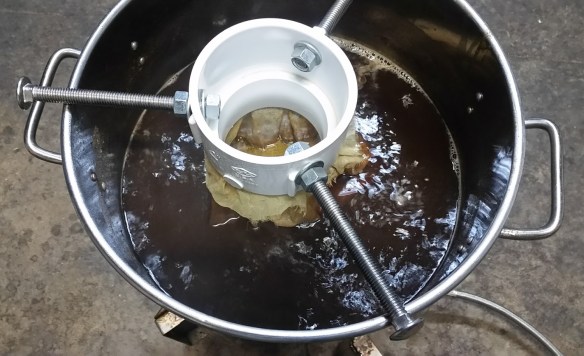
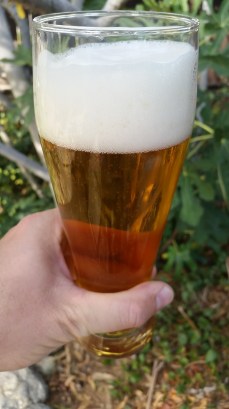
The recipe I am brewing here is pretty similar to what was in BYO, with a few minor changes to account for my system’s efficiency and the ingredients I have on-hand. I decreased the amount of Maris Otter by a quarter pound, increased the mild malt by a quarter pound, and decreased the Vienna malt by a half pound. Additionally, I opted for an all-Cascade hopping, which better accommodates my hop stash (I really, really don’t need to buy any more hops!). Finally, I swapped out liquid yeast (WLP007) for dry yeast (SafAle S04), because my local shop had just run out of WLP007 on the day I stopped by.

Isolation Ale Clone

  • 4 lbs. Maris Otter pale malt
  • 3 lbs. mild malt – Ashburne (Briess)
  • 2.5 lbs. Vienna malt (Weyermann)
  • 1 lb. Munich malt
  • 0.75 lb. 90°L caramel 6-row malt (Briess)
  • 0.5 lb. 10°L caramel malt (Briess)
  • 0.25 lb. 120°L caramel malt (Briess)
  • 0.25 lb. 45°L crystal light malt (Crisp)
  • 1 oz. Cascade whole hops (5.1% alpha), 60 minute boil
  • 1 oz. Cascade whole hops (5.1% alpha), 40 minute boil
  • 1 WhirlFloc tablet, 10 minute boil
  • 2 pkg. SafAle English Ale dry yeast (S-04)

Target Parameters

  • 152° mash, 60 minutes
  • 1.062 o.g., 1.016 f.g., 6.1% abv, 30 IBU, 15 SRM, 5.5 gallons into the fermenter

Procedure

  • I mashed in with 4.8 gallons of water at 168.5°, to hit a mash temperature of 153°. I let it sit for 60 minutes (at which point it had declined to around 150°), and added 0.86 gallons of water at 185°. After 10 minutes, I vorlaufed and collected the first runnings. Then, I added another 3.5 gallons of water at 185°, let sit for 10 minutes, vorlaufed, and collected the second runnings.
  • In total, I collected 6.8 gallons of wort with a gravity of 1.050, for 75% mash efficiency.
  • During the 60 minute boil, all hop and other ingredients were added per the schedule above.
  • After flame-out, I chilled the wort to 76°, transferred to the fermenter, and pitched the yeast. I will ferment at 67° for the first three days, and then raise the temperature to 70° for the remainder of fermentation.
  • Starting gravity was 1.061. This was a great brew session, in terms of how closely I hit my targets! I consider this well within the margin of error for my measuring equipment. I brewed this up on 19 November 2016.

Fade to Black IPA

The quest to explore new styles continues! My current IPA is almost all gone, so it’s time to brew something to replace that keg. I was getting a little bored with citrusy American IPA’s, though, so something different was called for. Why not a black IPA?

As if by magic, the latest issue of Brew Your Own had an advertisement for Briess malts including a recipe for “Fade to Black IPA.” The ad copy promised “old school hops, with a new school malt bill.” Interesting! The ingredient list (below) had all sorts of things I hadn’t tried before. It’s worth noting that “Fade to Black” is a fairly common commercial beer name, with at least a handful of IPA’s bearing the moniker. I have no idea if this recipe is intended to clone of any of those.

I followed Briess’s recipe pretty closely, with only minor tweaks on the ingredients. The most notable was switching the base malt from Briess Full Pint Brewers Malt to Great Western California Select 2-row (which I already had on hand). I also modified the hop additions a touch, but everything else stayed the same.

20161112_211553

Fade to Black IPA

  • 11 lbs. California Select 2-row malt (Great Western Malting Co.)
  • 1 lb. 80°L caramel 6-row malt (Briess)
  • 1 lb. special roast malt (Briess)
  • 0.25 lb. chocolate dark 6-row malt (Briess)
  • 0.25 Midnight Wheat malt (Briess)
  • 0.5 oz. Galena hop pellets (13.8% alpha), 60 minute boil
  • 1 oz. Chinook hop pellets (13.1% alpha), 30 minute boil
  • 2 oz. Cascade whole hops (5.1% alpha), 10 minute boil
  • 1 Whirlfloc tablet, 10 minute boil
  • 0.25 tsp. yeast nutrient, 10 minute boil
  • California Ale Yeast (WLP001, White Labs), prepared in starter
  • 1 oz. Cascade whole hops (5.1% alpha), dry hop
  • 1 oz. Chinook hop pellets (13.1% alpha), dry hop
  • 1 oz. Galena hop pellets (13.8% alpha), dry hop

Target Parameters

  • 154° mash, 60 minutes
  • 1.067 o.g., 1.016 f.g., 6.7% abv, 67 IBU, 28 SRM, 5.5 gallons into the fermenter

Procedure

  • I prepared a 1.75L starter with 175g of extra light DME, three days in advance. After two days, I decanted 0.6L to save for later. The remainder was cold crashed, decanted, and pitched at the start of fermentation. This was the second round for this yeast.
  • I mashed in with 4.5 gallons of water at 167.7°, to hit a mash temperature of 154°.
  • After 60 minutes, I added 0.6 gallons of water at 160°, let sit 10 minutes, vorlaufed, and collected the first runnings. Then, I added another 3.5 gallons of water at 180° to hit a mash temperature of 160°, let sit for 10 minutes, vorlaufed, and collected the remainder of the wort.
  • I collected 6.8 gallons of wort with a gravity of 1.057, for 79% efficiency.
  • I brought the kettle to a boil and added hops and other ingredients per the schedule above.
  • After 60 minutes of boiling, I turned off the flame and chilled the wort to 78°. At this point, I transferred to the primary fermenter with aeration, and then pitched the yeast.
  • Starting gravity was 1.065, and I will be fermenting at 66°. I brewed this beer on 12 November 2016.

Beer Tasting: Decoction Envy Vienna Lager

20161106_140947My first attempt at a Vienna lager has nicely cleared and conditioned, turning into one delicious beer! My overall evaluation is below.

  • The Basics
    • Original gravity = 1.055; final gravity = 1.014; abv = 5.4%; estimated IBU = 29
  • Aroma
    • Spicy hop note, really delicious, with a slight crackery aroma behind that for the malt.
  • Appearance
    • Light gold, crystal clear, with frothy white head that is incredibly persistent. The beer is definitely paler than a Vienna lager should be, though.
  • Flavor
    • Bready and crackery maltiness at the forefront; really, really nice. This is balanced against a decent bitterness. It comes across as a somewhat dry beer, which is within line for a Vienna lager. The finish is very clean; no abnormal esters or phenols on this thing!
  • Mouthfeel
    • Medium body, moderately dry on the finish, with moderate carbonation that seems about right for this beer.
  • Would I brew this again?
    • On its own merits as a beer, I’d give it a 9.5/10, but in terms of color it misses the mark for a true Vienna lager as defined by BJCP. If I do this again, I would add a slight bit of dark malt for coloration (maybe 2-3 oz. of debittered black malt), but maintain the overall process of decoction. The head and head retention are pretty amazing (almost too amazing–it’s hard to get a good pour!), and I would bet that is the result of the decoction process. I’m quite surprised that the beer didn’t darken up more during the decoction–maybe I should have boiled long enough, or didn’t boil intensely enough? The yeast I used on this one worked out really well, and the water build also seems to have been just the ticket.
  • Overall: 
    • 8/10

Update: Olde Persica Porter

My smoked porter has been in the primary fermenter for 13 days, coasting along at around 66°. So, I kegged it tonight. Final gravity was 1.016, down from 1.060, for 5.8% abv. The aroma and flavor are pretty darned delicious! The level of smokiness is just about perfect for my palate, too. Everything is carbonating and conditioning now at 40°.