Summer Session IPA 2024

I’ve been making a session IPA at least annually for awhile now, because it’s a good way to balance the needs of my palate with the needs of my liver. These recipes usually go with a lighter grain bill that leans on flavorful base malts, alongside a high mash temperature to boost body and reduce attenuation. Kveik strains are part of my usual recipe in these, also, because I am often brewing these last-minute and so want a quick fermenting, temperature tolerant variety of yeast.

The 2024 iteration of my session IPA is in the same mold as previous years–I used a 2-row base malt, but beefed things up with a generous helping of Vienna and some Crystal 40. The hops aren’t too dramatic, but are old favorites for this style of beer.

Summer Session IPA 2024

  • 8 lb. 2-row malt (Briess)
  • 1.25 lb. Vienna malt (Weyermann)
  • 0.5 lb. Crystal 40 malt (Great Western)
  • 0.5 tsp. BrewTanB, in mash
  • 2 oz. Citra hop pellets (12.8% alpha), 15 minute boil
  • 1 tsp. BrewTanB, 10 minute boil
  • 1 Whirlfloc tablet, 5 minute boil
  • 1 pkg. Lutra kveik (Omega #OYL-071, dry)
  • 2 oz. Ella hop pellets (17.6% alpha), dry hop in keg
  • 2 oz. Galaxy hop pellets (15.3% alpha), dry hop in keg

Target Parameters

  • 1.044 s.g., 1.011 f.g., 4.4% abv, 48 IBU, 6 SRM
  • Full volume infusion mash to hit target of 156°, 60 minutes, no sparge
  • Claremont tap water, neutralized with lactic acid to reduce carbonates, target parameter of 60 ppm CA, 22 ppm Mg, 136 ppm Na, 175 ppm SO4, 150 ppm Cl, 10 ppm HCO3, RA=-48 ppm

Procedure

  • Prior to the mash, I added 6.5 mL of 88% lactic acid to the 7.25 gallons of tap water (along with a Campden tablet), to drop out the carbonates. Then, I heated the water to 161°, before adding the grains and 1 mL of 88% lactic acid to adjust the mash pH. I held the mash at 156° for 60 minutes, with recirculation, before raising to 168° for 10 minutes.
  • After the mash was done, I pulled the grains and brought the runnings to a boil. In total, I collected 6.5 gallons of runnings with a gravity of 1.039, for 70% mash efficiency.
  • Once the runnings were at a boil, I added hops and finings per the recipe. Following the 60 minute boil, I turned off the heat and chilled to 78° before transferring to the fermenter and pitching the yeast.
  • Starting gravity was 1.045. I brewed this beer on 28 April 2024 and fermented it at ambient.
  • I kegged the beer on 20 May 2024, adding the dry hops in a baggie at this time. FInal gravity was 1.012, for 4.3% abv.

Tasting

  • Appearance
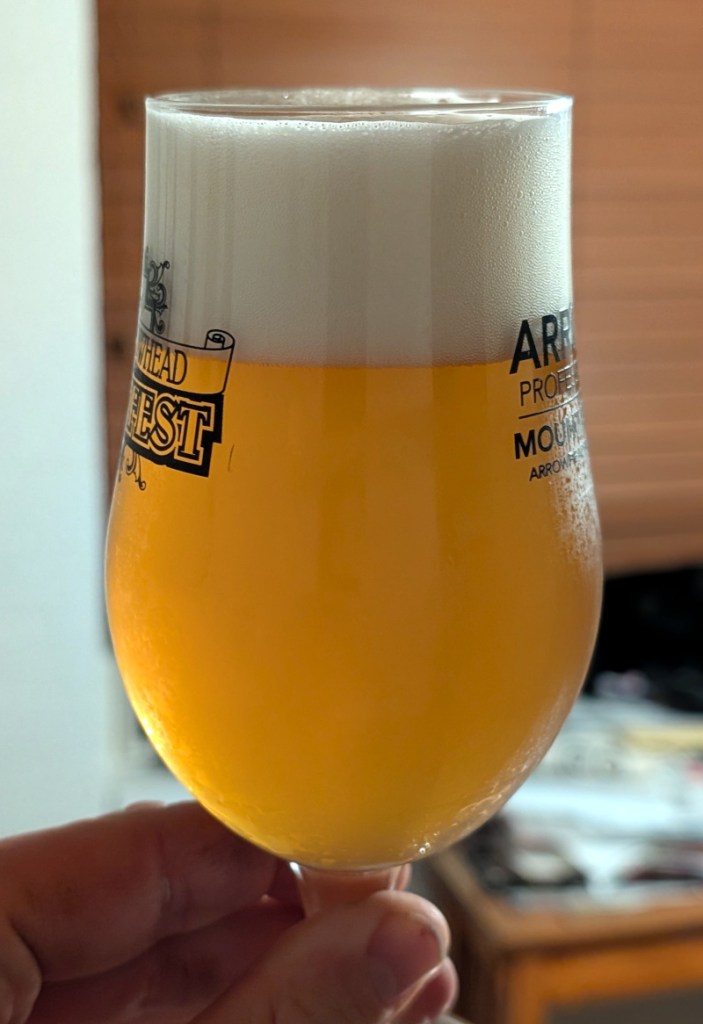
    • Clear, light gold beer, pouring with a persistent white head. Very pretty!
  • Aroma
    • Mandarin orange aroma, with a hint of tropical fruit. Hop aroma moderately high. The malt is in the background, and I don’t get much for yeast.
  • Flavor
    • Hop-forward, with a strong bitterness against a fairly light malt backbone. Very quaffable! Hop flavor has elements of orange and citrus pith. There might be a little peach, but that is more by suggestion (due to the characters of the variety) than something that is easily perceived.
  • Mouthfeel
    • Medium-light body, moderate level of carbonation, crisp and dry finish.
  • Would I brew this again?
    • This is a delightful session IPA, which has matured nicely. It doesn’t taste watery at all, and the hop elements are just what I would want in a modern West Coast IPA, I am quite happy with this one! I might go for a little more hop complexity – but it’s an easy fix with different varieties of hops.
  • Overall
    • 9/10

Totality Blonde Ale

It has been nearly six years since I’ve done a proper blonde ale, because pilsners are now my go-to for a light, drinkable brew. In the interest of returning to my roots, I made some light modifications to Gordon Strong’s New World Blonde Ale in Modern Homebrew Recipes. I have made a version of this previously, and the main edit here was to the hops. I wanted a beer that would be relatively simple to brew and ferment, but also with some interesting hop character. The name is a nod to the recent total eclipse–enhanced by the astronomically-themed hop varieties.

For a little extra fun, I drafted a bottle label for the beer — the stylized sun matches the pattern of prominences and the visible corona shape visible on April 8, 2024.

beer label with blue background and stylized sun in total eclipse surrounded by stars, with text that says Totality Blonde Ale, Farke Brewing, 5.2% abv, April 8, 2024

Totality Blonde Ale

  • 4.75 lb. 2-row malt (Briess)
  • 4.75 pilsner malt (Rahr)
  • 8 oz. Munich I malt (Weyermann)
  • 4 oz. Caravienne malt (Dingemanns)
  • 0.25 tsp. BrewTanB (added to mash)
  • 0.5 oz. Galaxy hop pellets (15.3% alpha), 10 minute boil
  • 0.25 tsp. BrewTanB, 10 minute boil
  • 1 Whirlfloc tablet, 5 minute boil
  • 0.5 oz. Galaxy hop pellets (15.3% alpha), 5 minute boil
  • 1 pkg. California Ale dry yeast (White Labs, WLP001)
  • 2 oz. Eclipse hop pellets (17.6% alpha), dry hop in keg
  • 1 oz. Galaxy hop pellets (15.3% alpha), dry hop in keg

Target Parameters

  • Full volume infusion mash to hit target of 152°, 60 minutes, no sparge
  • 1.047 o.g., 1.010 f.g., 4.8% abv, 16 IBU, 5 SRM
  • Water built from RO to hit 49 ppm Ca and 87 ppm Cl

Procedure

  • I formulated the strike water with 7.25 gallons of RO water and 5 g of CaCl, to match the desired water profile. I heated the water to 157°, before adding my grains and 0.9 mL of 88% lactic acid. I held the temperature at 152° for 60 minutes, with recirculation, before raising the mash to 168° for 10 minutes and then pulling the grains.
  • In total, I collected 6.5 gallons of runnings at 1.041, for 71% mash efficiency.
  • I brought the kettle to a boil and added hops and finings per the recipe. After a 60 minute boil, I turned off the heat and chilled to 68°. Once transferred to the fermenter, I pitched the yeast.
  • I brewed this beer on 12 April 2024. Starting gravity was 1.049.
  • I fermented the beer at 68°, and evidence of vigorous fermentation was visible by 14 April 2024.
  • Final gravity was 1.009, for 5.2% abv. I kegged the beer using a closed transfer on 11 May 2024, and added the hops in a baggie (very quickly opening the lid to the keg). I attempted to remove them a few days later after carbonation, but they had sunk to the bottom already.

Tasting

  • Appearance
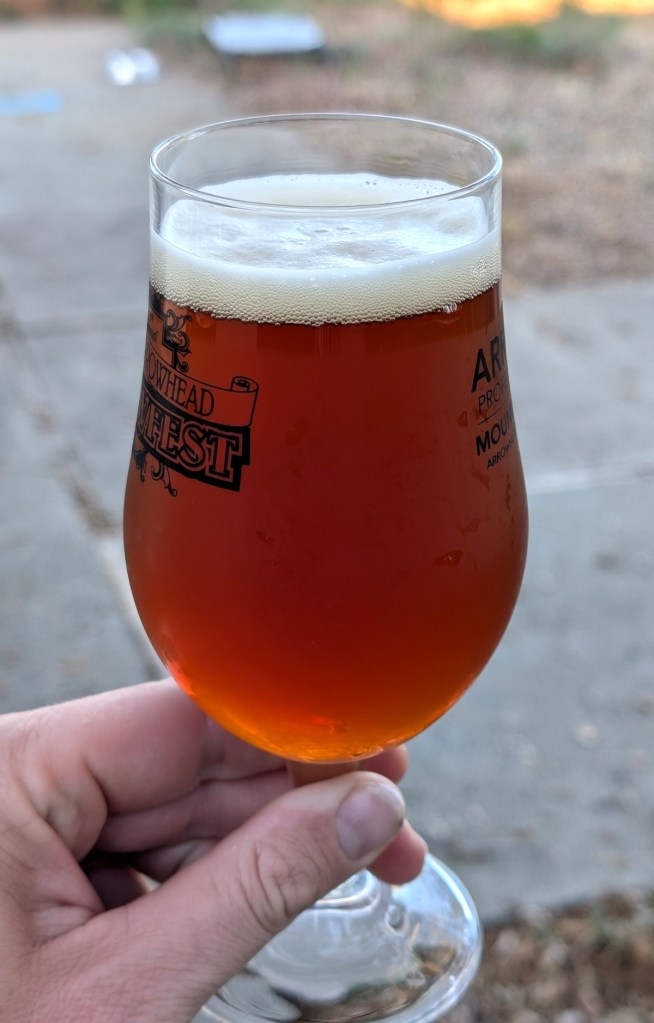
    • Gold beer with very slight haze. Pours with a persistent and fluffy white head that leaves slight lacing on the glass.
  • Aroma
    • Medium-light hop aroma; some peach, maybe a bit of orange. This is alongside a light malty aroma, with slight caramel/candy aspects.
  • Flavor
    • Medium bitterness and medium maltiness. There is maybe a slight fruity nature in the beer, but it’s quite subtle; probably from the hops? As it warms, it becomes “peachier” in nature!
  • Mouthfeel
    • Medium body, moderate carbonation, smooth and slightly dry finish.
  • Would I Brew This Again?
    • This is a pretty decent blonde ale! It comes in perhaps a touch more bitter and dry than I would like, and the slight haze (probably from the dry hops) is a minor style ding, but overall it’s quite drinkable. I enjoy revisiting this classic style! The peach character–presumably from the Galaxy hops–is really nice
  • Overall
    • 8/10

Humboldt’s Hefeweizen 2024

I have made weissbiers (hefeweizens) a few times previously, with decent but not consistent results. This is a style that can be quite enjoyable or quite awful, so I invested some time into learning more of the underlying ingredients and techniques for a tasty, traditional recipe. An article at brau!magazine was incredibly useful, with lots of detailed suggestions. I reformulated my previous Humboldt’s Hefeweizen (because I like the name) for this batch.

My first big decision–perhaps the most important–was yeast choice and fermentation control. Without a good yeast character, you don’t have a good hefeweizen (in my opinion). I am fairly committed to using dry yeast whenever possible because the convenience can’t be beat, and I wanted to give Lallemand’s Munich Classic another chance. My previous attempt was okay, but had little of the yeast character I wanted. That batch was fermented cool (~65°), and I knew I should up the temperature a bit to get more “oomph” to the yeast. So, I aimed for 67°. Working backwards, I decided a ferrulic acid rest would be critical–my previous batch didn’t use that, and I think that factor also set back beer quality.

My second decision concerned the grist. Past beers were ~45 to 55 percent wheat, and I wanted to increase that. This time around, I aimed for over 60 percent wheat, in hopes that it would 1) be more true to style; and 2) tilt the head quality in a positive direction.

I had fun formulating the batch and figuring out what would give the best results. The end product was definitely worth it!

Humboldt’s Hefeweizen 2024

  • 6.75 lb. red wheat malt (Briess)
  • 4 lb. pilsner malt (Rahr)
  • 0.5 lb. rice hulls
  • 0.5 tsp. BrewTanB (mash)
  • 1 oz. Sterling whole hops (4.5% alpha estimated), 45 minute boil
  • 0.5 tsp. BrewTanB, 10 minute boil
  • 1 tsp. yeast nutrient (White Labs WLN1000)
  • 1 pkg. Munich Classic Wheat Beer yeast (Lallemand)

Target Parameters

  • 1.049 o.g., 1.010 f.g., 5.2% abv, 14 IBU, 5 SRM
  • Full volume mash, no sparge, 113° mash for 20 minutes, 145° mash for 45 minutes, 162° mash for 30 minutes
  • RO and Claremont tap water, mixed to hit 10 ppm Ca, 4 ppm Mg, 18 ppm Na, 16 ppm SO4, 19 ppm Cl, 3 ppm CaCO3, RA=-7, effective hardness=10 ppm.

Procedure

  • I collected 2.5 gallons of Claremont tap water and neutralized it with 1.76 mL of 88% lactic acid and a small bit of Campden tablet. Then, I added 5 gallons of RO water, to hit my mash water profile.
  • I started the mash at 113° for 20 minutes, to enable a ferulic acid rest. Then, I raised the mash to 145° for 45 minutes, and finally ended at 162° for 30 minutes. Once the mash was done, I pulled the grains and heated the runnings to a boil.
  • The kettle had 6.6 gallons of runnings with a gravity of 1.040, for 65% mash efficiency. This was a touch lower than I anticipated, but that may be due to the high amount of wheat.
  • Once the kettle was boiling, I added finings per the schedule and then turned off the heat after 60 minutes. A slightly greater boil vigor was used to increase gravity. I chilled the wort to 66° and then transferred to the fermenter.
  • I brewed this beer on 14 April 2024. Starting gravity was 1.048, nearly exactly to target.
  • After pitching the yeast, I started fermentation at ambient for a few hours, and then transferred the fermenter into my fermentation chamber set for 67°. Fermentation seemed to take off pretty quickly!
  • I kegged the beer on 24 April 2024. The beer had an amazing aroma–a decent amount of spicy phenol and a hint of banana; exactly what I was looking for! I carbonted to a higher level, around 3.5 volumes of CO2.
  • Final gravity was 1.014, for 4.4% abv.

Tasting

  • Appearance
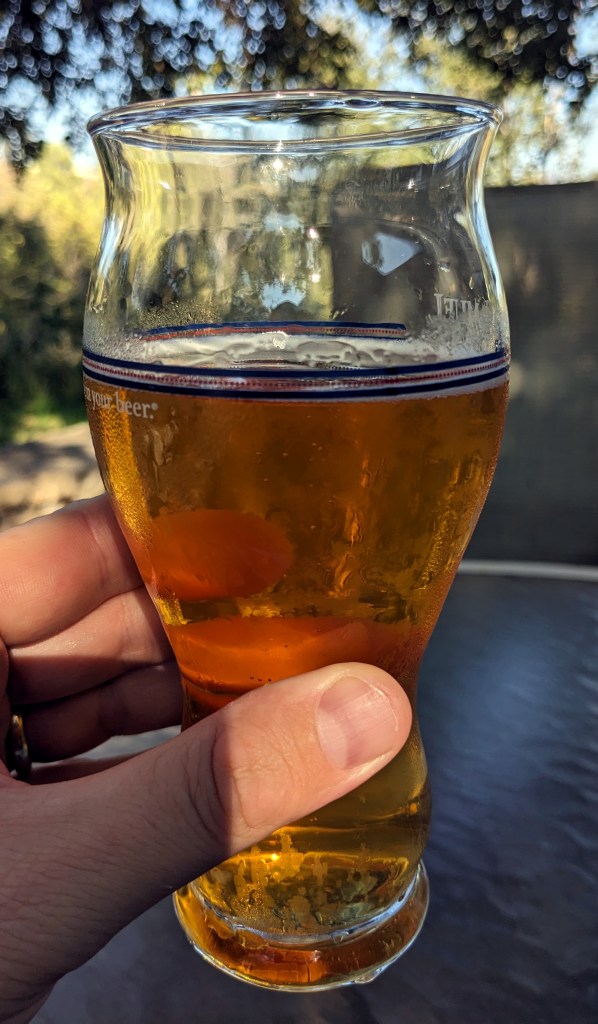
    • Pours with a merangue-like, tall, gorgeous white head that sticks around for ages and leaves gorgeous lacing on the glass. The beer itself is straw yellow and hazy beer. It’s exactly as a fresh hefeweizen should be!
  • Aroma
    • Yeast at the forefront, with a medium-high level of yeast character–primarily clove plus a touch of banana.
  • Flavor
    • Even balance of clove and banana, and a light dough malt character behind that. Low level of bitterness.
  • Mouthfeel
    • Light body. medium-high carbonation, smooth, lightly dry finish (from the hops?).
  • Would I brew this again?
    • This is the best hefeweizen I have made. Everything ran perfectly, and I wouldn’t change a thing. The yeast quality is perfect, head is perfect, all is amazing. It had a sulphur aroma and flavor early on; this faded in a few days.
    • Overall
      • 10/10

Eagle Face Oatmeal Stout 2024

dark stout with tan head in tall, slightly bulged-out craft beer glass, sitting on table
Eagle Face Oatmeal Stout, in a Spiegelau stout glass. I know that beer can be enjoyed in nearly any glassware, but this sure does look pretty!

I have brewed this one many times before, and it is a house favorite. After a two-and-a-half year hiatus, I once again returned to my favorite oatmeal stout recipe. This version has two significant departures — firstly, I returned to the use of 2-row rather than Maris Otter in the recipe. The very first brew used 2-row, and I have more frequently used Maris Otter since. The biggest change here, though, was to try out BRY-97 instead of Nottingham or another higher attenuation English ale yeast. I figured it would be a worthy experiment, creating a more “American” take on the style.

Eagle Face Oatmeal Stout 2024

  • 8.5 lb. 2-row malt (Briess)
  • 1.25 lb. flaked oats (Quaker)
  • 1 lb. 80L caramel malt (Briess)
  • 1 lb. Victory malt (Briess)
  • 0.5 lb. chocolate malt (Bairds)
  • 0.5 lb. roasted barley (Crisp)
  • 0.25 lb. chocolate malt (Simpsons)
  • 1.1 oz. Magnum hops (10.1% alpha), 45 minute boil
  • 1 Whirlfloc tablet, 5 minute boil
  • 1 pkg. American West Coast Ale dry yeast (BRY-97, Lallemand)

Target Parameters

  • 1.058 o.g., 1.015 f.g., 5.6% abv, 35 IBU, 48 SRM
  • Full volume mash, no sparge, 156° mash for 60 minutes, 10 minute mash-out at 168°
  • Claremont tap water, treated with Campden tablet

Procedure

  • I mashed in with 7.75 gallons of Claremont tap water, heated to 163°. I also added 3 mL of 88% lactic acid.
  • I held the mash, with recirculation, at 156° for 60 minutes, before raising to 168° for 10 minutes and then pulling the grains.
  • I collected 6.75 gallons of runnings with a gravity of 1.050, for 72% mash efficiency.
  • I brought the runnings to a boil, adding hops and finings per the recipe. After 60 minutes, I turned off the heat and chilled to 68°.
  • I transferred the wort to my fermenter, pitched the yeast, and started it at ambient (~65°) in my back room.
  • I brewed the beer on 6 January 2024. The starting gravity was 1.056.
  • I kegged the beer on 18 March 2024. Final gravity was 1.020, for 4.8% abv.

Tasting

  • Appearance
    • Very deep brown & clear beer that pours with a fine tan head, with decent persistence.
  • Aroma
    • Clean, chocolate and coffee aroma, with a touch of roastiness. Not much for hop or yeast aroma.
  • Flavor
    • Roasty coffee in the malt profile, and a bit of subtle graininess behind that. Moderate level of bitterness.
  • Mouthfeel
    • Medium body, moderate carbonation, very slightly dry finish.
  • Would I Brew This Again?
    • This recipe is still a winner! My 2024 edition is a touch drier than I recall in past versions, likely because I went with BRY-97 rather than Nottingham. The return to 2-row also probably lightens the flavor a bit. I would consider this one an Americanized version of the style, but I’m ok with that. All of the past versions have been great, but this one is probably most “drinkable” (in terms of having more than one glass). I served the beer at a recent gathering, and it was certainly quite popular! It’s nice to know the recipe has a bit of flexibility–this version might be better for the warmer days of spring, and the “traditional” recipe targeted better for cold winter nights.
  • Overall
    • 9/10

Denny Kongish West Coast IPA

Last fall, I managed to snag a can of the Denny Kong West Coast IPA, which was brewed by North Park Beer Co. for the 2023 Homebrew Con in San Diego. It was an incredibly delicious beer, and because the recipe is readily available, I thought it would be worth a try!

The malts parallel the original reasonably well, but I made some adjustments for my hop stash and also made an adjustment to the yeast. It should be in the general ballpark, but as Denny Conn would say, my version is an homage and not a clone. The main innovations I applied here were the long mash rest and the massive dose of hops.

Denny Kongish West Coast IPA

  • 12 lb. pilsner malt (Rahr)
  • 1.25 lb. Vienna malt (Weyermann)
  • 0.5 tsp. BrewTanB, added to mash
  • 4 oz. dextrose, added to boil
  • 1.3 oz. Magnum hop pellets (12.6% alpha), 60 minute boil
  • 0.5 tsp. BrewTanB, 10 minute boil
  • 1 Whirlfloc tablet, 5 minute boil
  • 2.8 oz. Cascade hop pellets (7.5% alpha), 30 minute whirlpool
  • 1 pkg. California ale dry yeast (WLP001, White Labs)
  • 2 oz. Eclipse hop pellets (17.6% alpha), dry hop in primary fermenter for 3 days
  • 2 oz. Idaho #7 hop pellets (14.0% alpha), dry hop in primary fermenter for 3 days
  • 2 oz. LUPOMAX Azacca hop pellets (16.0% alpha), dry hop in primary fermenter for 3 days
  • 2 oz. LUPOMAX Citra hop pellets (18.5% alpha), dry hop in primary fermenter for 3 days
  • 2 tbs. (30 mL) Biofine Clear, added to keg
  • 2 oz. Nelson Sauvin hop pellets (12.9% alpha), dry hop in keg

Target Parameters

  • 1.063 s.g., 1.010 f.g., 6.9% abv, 65 IBU, 5 SRM
  • Full volume infusion mash, held at 149° for 120 minutes and 168° for 10 minutes
  • Neutralized Claremont tap water with Campden tablet, and mineral salts added to boil to achieve 55 ppm Ca, 12 ppm Mg, 54 ppm Na, 106 ppm SO4, 60 ppm Cl, 10 ppm CaCO3, RA=-38, alkalinity=8 ppm

Procedure

  • Starting with 7.9 gallons of tap water, I added 5.6 mL of 88% lactic acid as well as a Campden tablet, followed by 3 g of CaCl.
  • I heated the water to 155° and added the grains, along with 2.9 mL of 88% lactic acid for pH adjustment.
  • I held the mash at 149° for 120 minutes, with recirculation, and then raised the mash to 168° for 10 minutes, before pulling the grains.
  • In total, I collected 6.9 gallons of runnings with a gravity of 1.046, for 65% mash efficiency.
  • I brought the runnings to a boil, for a 90 minute total boil. After 30 minutes, I added the first round of hops, and then proceeded following the recipe.
  • After the 90 minute boil, I chilled to 170° before adding the whirlpool hops and letting them sit for 30 minutes.
  • Next, I chilled to 70°, transferred to the fermenter, and chilled down to 63° before pitching the yeast.
  • I brewed the beer on 2 March 2024, and it had a starting gravity of 1.062–nearly exactly on target!
  • I added the dry hops on 10 March 2024, in a boiled (sterilized) hop bag. It was a bit tight for the volume of hops, so I was a bit concerned about how much hop contact I would get.
  • I kegged the beer on 26 March 2024, into a CO2 purged keg. Final gravity was 1.007–that’s quite low, and results in a 7.4% abv! The 120 minute, 149° mash really did the trick for drying things out. Hop flavor and aroma were a bit lower than expected, probably because of the thick concentration of hops in the bag.
  • Once the beer was down to around 34°, I quickly added the Biofine Clear, and then re-cycled the CO2.
  • I put the beer on tap on March 30.
  • Because hop aroma was underwhelming, I added 2 oz. of Nelson Sauvin hops to the keg (in a baggie) on 12 April 2024.

Tasting

  • Appearance
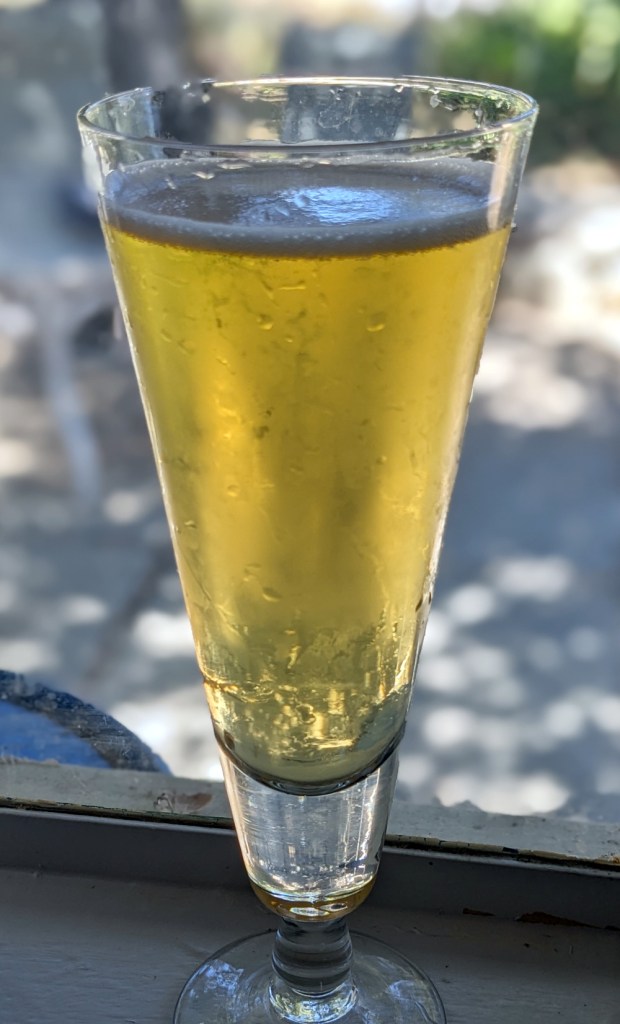
    • Light gold color, slight haze. Pours w/ a thick and persistent off-white head that leaves beautiful lacing on the glass.
  • Aroma
    • Light citrus aroma, a hint of white wine (presumably from Nelson Sauvin hops).
  • Flavor
    • High level of citrus-pith bitterness. Clean, light malty character behind that.
  • Mouthfeel
    • Moderate carbonation, medium-light body, dry finish.
  • Would I Brew This Again?
    • Yes, but with different hop handling. I am underwhelmed by the hop aroma and flavor, especially relative to the commercial version I tried. It was dumb of me to use such a tightly packed hop bag! The hops just didn’t shine like they should. I would definitely try a variation in the future, though. I love the dryness on this, but it might be too much for some. The low temperature, extended mash really did the trick! The BioFine also worked its magic, resulting in a fairly clear beer. Other than aroma, though this is a nice American IPA!
  • Overall
    • 7/10

Note: I tasted this again on 25 April 2024, after nearly two weeks with the extra hops. It definitely helped the beer! Although the appearance is now a bit hazier, the aroma has a fantastic tropical fruit profile (kiwi, guava, a bit of sweet white wine, and more). The flavor is perhaps a bit harsher now (I suspect due to the hops in the keg), but it also has a more prominent tropical aspect overall. Not a bad end result!