Live Oak Canyon Ale

The holidays aren’t just for dark beers–anything with a decent bit of “heft” to it in flavor, alcohol, body, or some combination of those can be a great sipper next to the fire. Looking to expand my brewing repertoire, I returned to wood-aged beers, with a riff on an Imperial Red IPA from beloved local brewery Claremont Craft Ales. The original, called Happy Days, is an exceptional beer that has taken gold at the GABF (twice!), among a ton of other awards. It weighs in at 9.5% abv, so isn’t a casual beer–but it goes down smoothly nonetheless!

A clone recipe for Happy Days is available, and it’s a surprisingly simple brew. It starts out with just three malts — 2-row, crystal 150L, and a dash of chocolate malt for color, with some dextrose to dry out the beer. CTZ, Mosaic, and Simcoe round out the hop bill…and that’s it! This beer is a testament to how great recipe design and careful handling come together to make something exceptional.

For my own version, I used Happy Days as a starting point, but not the end. One goal was to play with wood aging, so the beer departs from a “clone” pretty much right away. Second, I wanted to try out some different hops, partly to see how they worked and partly to use up my (admittedly too large) hop stash.

I kept the target gravity around the same as the original Happy Days, but dropped the chocolate malt from the recipe. It seemed to be there only for color adjustment, and I just didn’t need it to hit my goals in the current batch. I had crystal 120 but not crystal 150 on-hand, so that was another malt adjustment. I aimed for around the same level of bitterness, but chose HBC 522 and Talus as my flavor/aroma hops. They seemed to have roughly similar qualities to the original recipe. Finally…I needed to figure out an oaking strategy. I didn’t want this beer to be an oak bomb, and I also didn’t want an extended barrel aging process that would kill the hop character. So, I elected to use the BeerStix product, aging a textured slab of wood in the primary as well as a bit in the keg.

The end result was pretty satisfying–one of the better experimental beers I’ve made! I am both glad and sad I did only a small batch–glad because I didn’t need 5 gallons of a 10% abv beer; and sad because this beer really is a smooth drinker, pretty darned tasty, and gone distressingly quickly.

The name for this beer comes from a canyon near where we live…it conveniently has “oak” in the name, so was a logical choice for a wooded beer.

Live Oak Canyon Ale

  • 10.5 lb. 2-row malt (Briess)
  • 13 oz. caramel malt 120L (Briess)
  • 1 oz. Warrior hop pellets (13.4% alpha), 60 minute boil
  • 0.5 oz. Magnum hop pellets (16.5% alpha), 60 minute boil
  • 0.75 lb. corn sugar, 5 minute boil
  • 1 Whirlfloc tablet, 5 minute boil
  • 2 oz. HBC 522 hop pellets (9.4% alpha), 15 minute whirlpool
  • 1 pkg. WLP001 (White Labs), California Ale dry yeast
  • 1 medium toast American oak Beer Stix carboy stick, added to primary and carried over to keg
  • 2 oz. LUPOMAX Talus hop pellets (12.0% alpha), dry hop in keg

Target Parameters

  • 1.093 s.g., 1.015 f.g., 10.5% abv, 125 IBU, 17 SRM
  • Infusion mash, held at 152° for 60 minutes and 168° for 10 minutes, with sparge
  • Claremont tap water, with Campden tablet, adjusted with minerals to achieve 58 ppm Ca, 23 ppm Mg, 54 ppm Na, 155 ppm SO4, 60 ppm Cl, 10 ppm CO3, -47 ppm RA

Procedure

  • Starting with 5.6 gallons of water, I added 4 mL of 88% lactic acid to neutralize the carbonates. Then, I added 2 g epsom salts and 2 g gypsum, to achieve my target water profile.
  • I heated the strike water to 161°, added the grains, and hit a 152° mash temperature. I also added 4 mL of 88% lactic acid, to adjust the pH.
  • After a 60 minute mash and recirculation, I raised the mash temperature to 168° for 10 minutes, before pulling the grains and sparging with ~0.9 gallons of water.
  • In total, I collected 5.25 gallons of runnings with a gravity of 1.058, for 72% mash efficiency. This was great…but meant that I needed to boil for a full 60 minutes before adding hops — so, the beer had a total of a 120 minute boil.
  • After the initial 60 minutes of boiling, I began adding hops and other finings per the recipe, with corn sugar added at the very end.
  • After the boil, I chilled the beer down to around 68°, before transferring to the fermenter.
  • I brewed this beer on 4 November 2023; it had a starting gravity of 1.089. Once pitching the yeast, I let it ride at ambient (around 62°).
  • Visible evidence of fermentation was present within 24 hours, and the beer was up to around 68° and had vigorous fermentation by 6 November 2023. On the morning of 7 November, the beer had climbed to 74°, so I put it into the conditioning chamber to drop it down over the course of the day. Unfortunately, I overshot a bit and it went all the way down to 45°. I pulled it out to ambient again, and it steadily rose to 62° by 9 November 2023. At this point, I put a thick towel around the beer to raise and maintain the temperature.
  • I soaked the oak stick in water overnight, and then put it into the microwave for around 90 seconds to flash steam and sanitize. I spritzed the oak with StarSan, before adding it to the fermenter. The oak was added to the primary fermenter on 7 November 2023.
  • I kegged the beer on 19 November 2023, adding the dry hops in a baggie and also transferring the oak to the keg.
  • Final gravity was 1.016, for 9.9% abv.
  • I left the keg at ambient until 27 November 2023, when I removed the dry hops and oak, moved the keg to the conditioning chamber, and let it condition and carbonate at 34°.

Tasting

  • Appearance
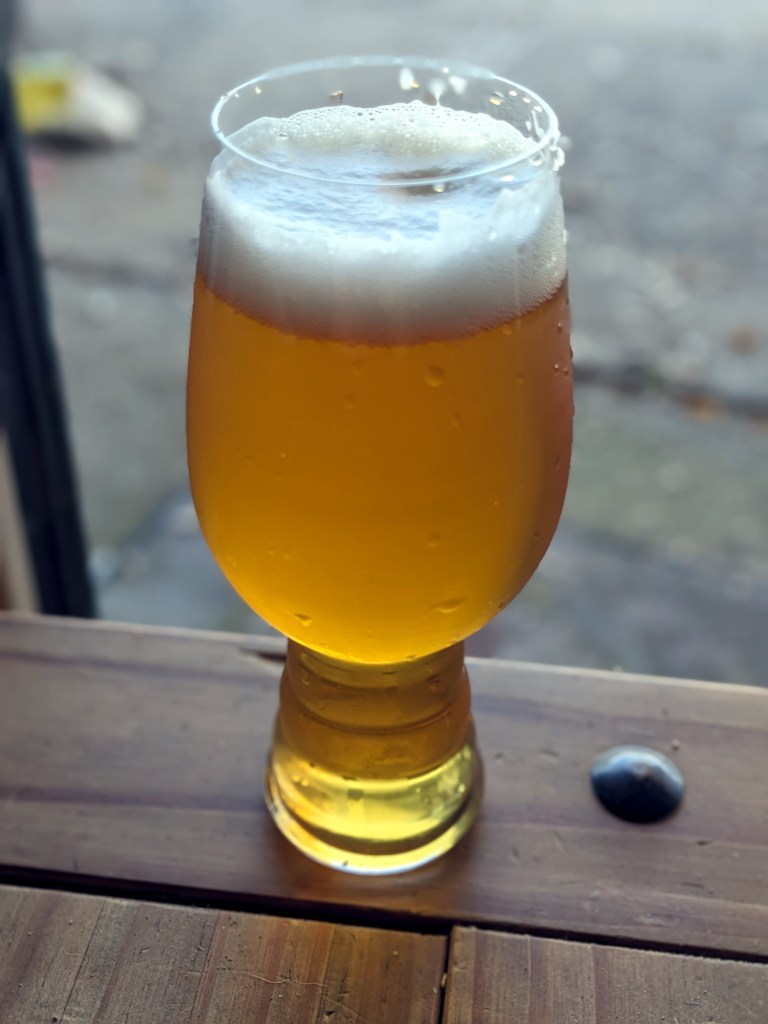
    • The beer has a deep reddish amber color, with a slight haze; it pours with a creamy and persistent ivory head. Gorgeous!
  • Aroma
    • Pine, sweet orange, and resin, with a hint of woody oakiness. As the beer warms up, the wood comes through more prominently.
  • Flavor
    • Hop forward, very bitter beer, with a hint of orange and resiny bitterness, and some woody character behind that. Caramel maltiness is at a moderate level. This woodiness holds mainly until the back end of the palate and the finish, which complements the hops nicely.
  • Mouthfeel
    • Medium carbonation, medium body, off-dry finish.
  • Would I Brew This Again?
    • What a wonderful experiment! This has been an incredibly enjoyable beer, with high drinkability. Overall, it’s an awesome winter seasonal brew.
  • Overall
    • 10/10

Deep Space Imperial Stout

The dark depths of winter are a perfect time for dark, deep beers. It’s really hard to go wrong with an imperial stout. I most frequently have them in barrel-aged form, though, which I think distracts from the fact that the “regular” form can have a ton going on as it is.

As I often do, I used a recipe from Gordon Strong’s Modern Homebrew Recipes as my starting point. His “Katherine the Strong” hit everything I was looking for, although I made my usual modifications for ingredients on-hand. In particular, I used US 2-row for my base malt instead of Maris Otter, swapped in some American hops here and there as relevant, and stuck with an American ale yeast. The end result is something that is perhaps more American in character than British, but nonetheless hopefully quite good.

Because I don’t normally make big batches of big beers, both for my own health as well as due to equipment limitations, I aimed for a 3 gallon batch. This makes for a challenging brew, but a rewarding one.

Deep Space Imperial Stout

  • 4.75 lb. Lamonta Pale American Barley Malt (Mecca Grade)
  • 3.5 lb. 2-row malt (Briess)
  • 13 oz. roasted barley (Bairds)
  • 12 oz. caramel 60L (Briess)
  • 8.5 oz. chocolate malt (Bairds)
  • 6 oz. flaked barley
  • 6 oz. black malt (Briess)
  • 6 oz. caramel 80L (Briess)
  • 6 oz. special roast (Briess)
  • 3 oz. caramel 120L (Briess)
  • 0.55 oz. Magnum hop pellets (16.5% alpha), 60 minute boil
  • 1 oz. Chinook hop pellets (11.9% alpha), 10 minute boil
  • 1 Whirlfloc tablet, 5 minute boil
  • 0.5 oz. Crystal hop pellets (4.5% alpha), 5 minute boil
  • 2 pkg. BRY-97 American West Coast Ale yeast (Lallemand)
  • 1 oz. Chinook (11.9% alpha), dry hop in keg

Target Parameters

  • 1.087 s.g., 1.019 f.g., 9.1% abv, 69 IBU, 79 SRM
  • Infusion mash, held at 152° for 60 minutes and 168° for 10 minutes, with sparge
  • Claremont tap water, with Campden tablet

Procedure

  • I mashed in with 6 gallons of water at 160°, to hit 152°. I recirculated at this temperature for 60 minutes, before raising the mash temperature to 168°. I held it here for 10 minutes, before pulling the grains. I sparged with ~0.75 gallons of hot water.
  • In total, I collected 5.35 gallons of runnings with a gravity of 1.055, for 69% mash efficiency. This was well below my target gravity, so I knew I would need to boil for awhile longer than expected.
  • I brought the runnings to a boil, boiling for 75 minutes before adding the first round of hops. I then boiled another 60 minutes with hops and finings added per the recipe, for a total of 125 minutes boiling time.
  • I chilled the wort to 75°, transferred it into the fermenter, and then chilled to 67° in the fermentation chamber before pitching the yeast.
  • I brewed the beer on 7 October 2023, and it had a starting gravity of 1.082. This is slightly below the target but not awfully so.
  • I set the fermentation temperature for 66°, and pulled the beer to ambient on 28 October 2023. On 29 October, I agitated the fermenter to rouse the yeast and ensure that the beer fermented out fully.
  • I kegged the beer on 4 November 2023. Final gravity was ~1.023, for 7.9% abv.
  • I bagged and added the dry hops to the keg on 14 November 2023 and removed the hops on 27 November 2024.

Tasting

  • Appearance
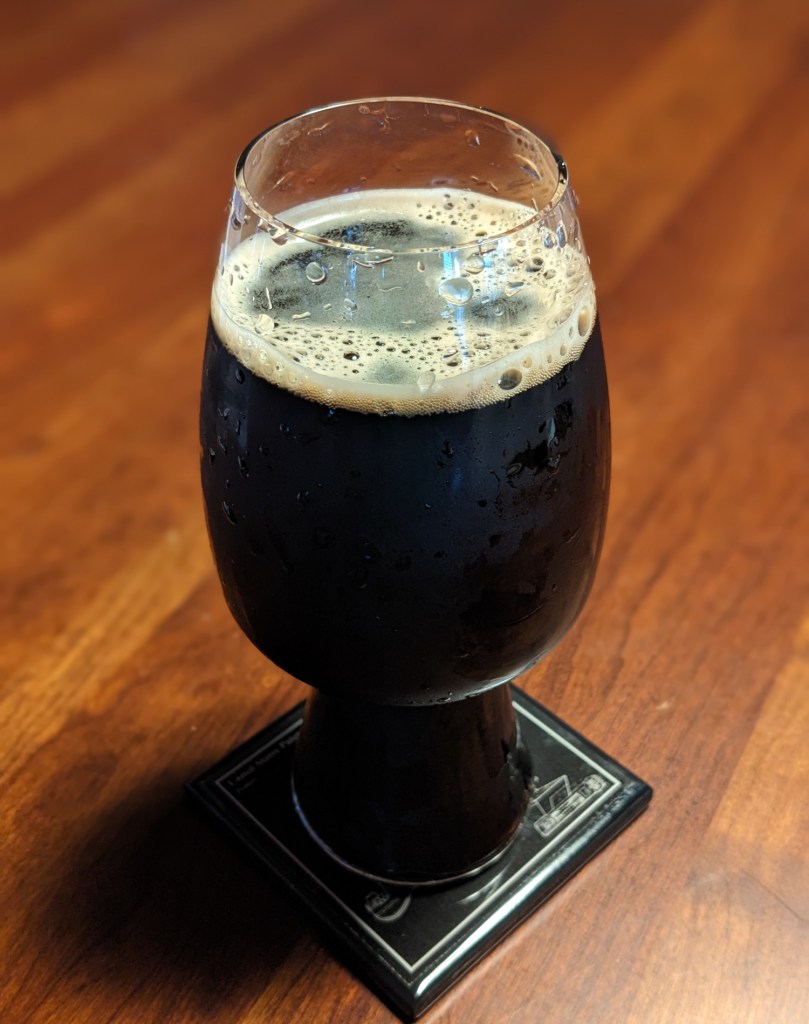
    • The beer pours with a rich and creamy deep brown head, which leaves gorgeous lacing down the side of the glass over time. The stout is a deep, deep brown beer, almost jet black in appearance in the glass. Amazing!
  • Aroma
    • Cocoa and roasty notes dominate, along with dark roast coffee as the beer warms. At this later point in the glass, there is a very subtle hint of alcohol, but it’s not at all unpleasant.
  • Flavor
    • Deep roasty cocoa and coffee flavors predominate, with a dark chocolate aspect too. Bitterness is high, manifesting on the finish in particular, which keeps the beer from being overly cloying and sweet. The hop character is slightly resiny.
  • Mouthfeel
    • Medium-low carbonation, rich and full-bodied, with an off-dry finish due to the intense hopping.
  • Would I Brew This Again?
    • YES! This is exactly what I had envisioned as an imperial stout–big and complex flavors, rich, and paradoxically drinkable. The beer definitely tilts towards the roasty and chocolatey, rather than fruity, character as a stout. So, I would say it’s more American than British in overall character.
  • Overall
    • 10/10

Thanksgiving Transatlantic Barleywine

Every year, I make a beer for our Thanksgiving celebration with friends (or at least in honor of Thanksgiving, during years when we couldn’t travel). Previous batches have included Stygimoloch Bock, Ill Tempered Gnome Clone, and Thanksgiving IPA 2017. In general, I like a Thanksgiving beer that is a bit fuller-bodied and maltier, versus an easy sipper like a blonde ale.

For 2023, I wanted to turn the dials to the max, and so I honed in on English barleywine for my style. This is a style that rewards a loooong conditioning time, so I knew I had to work on it sooner than later. The November 2022 BYO magazine came to the rescue, with a recipe called Winter’s Barleywine. My version was modified rather heavily from the BYO version, to accommodate ingredients on-hand; thus I had a combination of American, German, and English ingredients and a naming idea for this batch. The beer was brewed at the end of January, allowing a full nine months of fermentation and conditioning.

I targeted a 2.5 gallon batch, because I really don’t need 5 gallons of a 10% abv beer.

Thanksgiving Transatlantic Barleywine

  • 8 lb. Golden Promise pale ale malt (Simpsons)
  • 0.75 lb. Mela malt (Great Western)
  • 0.5 lb. Caramel 60 malt (Briess)
  • 0.25 lb. Caramunich II malt (Weyermann)
  • 0.25 lb. Caravienne malt (Weyermann)
  • 0.65 oz. Magnum hop pellets (16.5% alpha), 60 minute boil
  • 1 oz. Fuggles hop pellets (4.6% alpha), 10 minute boil
  • 0.75 lb. brown sugar, light, 10 minute boil
  • 1 Whirlfloc tablet, 5 minute boil
  • 1 oz. Cascade whole hops (5.5% est. alpha), 5 minute boil
  • 1.25 g. WLN1000 yeast nutrient (White Labs), 5 minute boil
  • 1 oz. Willamette hop pellets (5.0% alpha), 10 minute whirlpool
  • 2 pkg. English ale dry yeast (CellarScience)
  • 1 oz. Willamette hop pellets (5.0% alpha), dry hop for 1 week in primary

Target Parameters

  • 60 minute infusion mash, held at 149° for 60 minutes, with 10 minutes at 168°, sparge
  • 1.105 o.g., 1.015 f.g., 12.3% abv, 74 IBU, 17 SRM
  • Claremont tap water, with Campden tablet

Procedure

  • I mashed in with ~5 gallons of water at 157°, to hit a strike temperature of 149°. Upon adding the grains, I also added 2.5 mL of 88% lactic acid to adjust the pH.
  • Following 60 minutes of recirculation at 149°, I raised the temperature to 168° and held it there for 10 minutes. Then, I removed the grain basket, let it drain, and sparged with 0.5 gallons of water.
  • I collected around 4.25 gallons of runnings with a gravity of 1.058, for 70% mash efficiency. Because this was a bit below my target of 1.070, I decided to boil for awhile before adding the hops.
  • After 30 minutes, my gravity was down to 1.065. I decided to continue boiling for another 30 minutes. before adding the first charge of hops.
  • Following the initial 60 minute boil, I added the hops and finings per the recipe, and then turned off the heat following the full 120 minutes.
  • I chilled to 66°, transferred to the fermenter, and pitched the two packets of yeast. Starting gravity was 1.093.
  • I brewed this beer on 21 January 2023, fermenting at 66°. On 26 January 2023, I pulled it to ambient and let it free-ride for the rest of fermentation.
  • I added the dry hops in a baggie on 21 February 2023.
  • I kegged the beer on 25 February 2023, removing the hops and adding 1.5 oz. of corn sugar boiled in 0.75 cups of water. Final gravity was 1.023, for 9.4% abv.
  • Sealing the beer under pressure, I let it sit at ambient until late October, when I pulled it into my keezer and applied some carbon dioxide to increase the carbonation.
  • The beer still had a fair bit of haze when I sampled it in early November, so on 14 November 2023, I added ~1/4 tsp. of gelatin boiled in ~1/4 cup of water, to clarify the beer further.

Tasting

  • Appearance
    • The barleywine pours with a tall, thick ivory head that subsides over time to pretty much nothing by the end of the glass (over an hour or two). The beer itself is deep amber in color and red highlights, with some chill haze.
  • Aroma
    • The aroma changes a fair bit as the beer warms up. Caramel and malty notes are prominent. There is a moderate earthy note hop note when cooler, and alcohol notes become more prominent as the beer warms up (almost too much at around 56°).
  • Flavor
    • A big and rich maltiness with caramel is dominant, with some subtle honey at the back end as well as some dark fruit qualities. Hop bitterness is medium-high, with resin and earthy qualities, but it definitely takes a back seat to the malt. The beer is best described as “chewy,” like a cookie.
  • Mouthfeel
    • The beer has a full mouthfeel, with moderate carbonation. It has a smooth finish, with some sweetness on the back end.
  • Would I Brew This Again?
    • Yes! Next time, though, I would let it age out for awhile, but this batch is already on its last legs. Aging would help to mellow the alcohol character; interestingly, I don’t pick that up in the flavor so much as the aroma in the current state of the beer.
  • Overall
    • 6.5/10

Oktoberfest 2023

It’s nice to brew a festbier from time to time; I most recently made one nearly four years ago! They are a perfect style for fall and winter, given their malt complexity as well as their high drinkability.

For this version, I followed Gordon Strong’s Modern Oktoberfest recipe from Modern Homebrew Recipes. My main adjustment was to swap in some Bohemian floor-malted malts that I had on-hand from the recent Czech dark lager project.

Oktoberfest 2023

  • 9 lb. Pilsner Zero malt (Viking)
  • 4 oz. Floor-Malted Bohemian Pilsner malt (Weyermann)
  • 1 lb. 10 oz. Floor-Malted Bohemian Dark malt (Weyermann)
  • 0.5 lb. Munich I malt (Weyermann)
  • 1 lb. Vienna malt (Weyermann)
  • 0.5 tsp. BrewTanB, added to mash
  • 1 oz. Hallertauer Mittelfrueh hop pellets (5.2% alpha), 60 minute boil
  • 0.5 tsp. BrewTanB, 10 minute boil
  • 1 Whirlfloc tablet, 5 minute boil
  • 0.5 oz. Hallertauer Mittelfrueh hop pellets (5.2% alpha), 5 minute boil
  • 2 pkg. Novalager dry yeast (Lallemand)

Target Parameters

  • 1.056 s.g., 1.005 f.g., 6.7% abv, 21 IBU, 5 SRM
  • Full-volume infusion mash, held at 146° for 40 minutes, 158° for 20 minutes, and 168° for 10 minutes
  • Claremont tap water, adjusted with lactic acid and minerals to hit target parameters of 59 ppm Ca, 12 ppm Mg, 54 ppm Na, 50 ppm SO4, 107 ppm Cl, 10 ppm HCO3, 8 ppm alkalinity, -41 ppm RA

Procedure

  • I collected 8.1 gallons of water, adding 5.7 mL of 88% lactic acid in order to knock out the carbonates. Next, I added 3 g of CaCl to achieve my target water profile.
  • I heated the strike water to 151° and added the grains along with 0.5 mL of 88% lactic acid, to hit a calculated pH target of 5.4 and a mash temperature of 146°.
  • After holding the mash at 146° for 40 minutes, I raised the temperature to 158° for 20 minutes, before finally raising it to 168° for a 10 minute mash-out.
  • I removed the grains, collecting in total 7.25 gallons of runnings at a gravity of 1.044, for 69% mash efficiency.
  • I brought the runnings to a boil, adding hops and finings per the recipe. After 60 minutes, I turned off the heat and chilled down to 79° before transferring to the fermenter.
  • I chilled the wort to 49° before pitching the yeast. I brewed this beer on 16 September 2023. Starting gravity was 1.053.
  • Fermentation temperature was held at 52° for the first 10 days, and then raised to 54° on 26 September 2023. I raised it to 58° on 28 September, 60° on 1 October, and cold crashed to 34° on 4 October 2023.
  • I kegged the beer on 14 October 2023, using a closed transfer.
  • Final gravity was 1.010, for 5.7% abv.

Tasting

  • Appearance
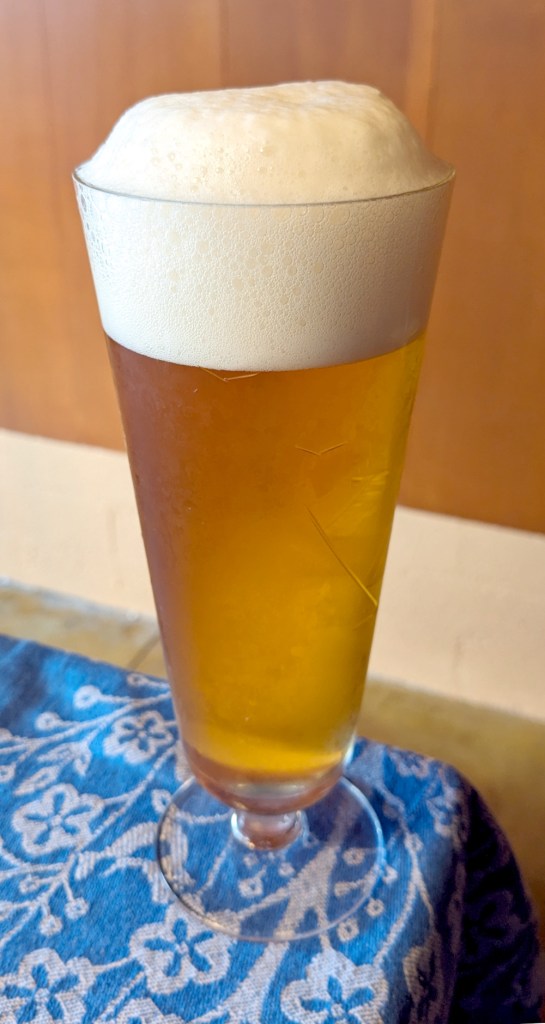
    • This festbier pours with a tall white head that subsides rapidly; it’s a bit disappointing in that regard. The beer is a medium gold color and very clear, but not brilliant.
  • Aroma
    • Clean and malty aroma, with a slight doughy quality.
  • Flavor
    • Soft but forward maltiness, with lightly toasty and doughy qualities. Medium-low bitterness.
  • Mouthfeel
    • Medium body, medium carbonation, and a smooth, soft finish.
  • Would I Brew This Again?
    • This is an incredibly drinkable beer! The flavor is spot on, although the head and head retention are not at all what I want. For this reason, I would probably try a different malt combination next time.
  • Overall
    • 7/10

The Weekend IPA

It’s a bad pun of a name, but it also reflects the fact that the strength of this beer is best suited for “The Weekend” (rather than a weeknight).

The recipe used here generally follows my “Spring Classic IPA,” with adjustments to use up grains and hops on-hand. Thus, the mix of pilsner and 2-row malt. My goal with the hops was to create something that had a classic “West Coast IPA” feel to it.

The Weekend IPA

  • 9.5 lb. Lamonta pale American barley malt (Mecca Grade)
  • 5 lb. pilsner zero malt (Viking)
  • 0.5 lb. crystal 40 malt (Great Western)
  • 0.25 lb. biscuit malt (Dingeman)
  • 0.5 tsp. BrewTanB, added to mash
  • 1 oz. Warrior hop pellets (13.4% alpha), 60 minute boil
  • 0.5 tsp. BrewTanB, 10 minute boil
  • 1 Whirlfloc tablet, 5 minute boil
  • 1 oz. Lupomax Chinook hop pellets (17.0% alpha), 15 minute whirlpool
  • 1 oz. McKenzie hop pellets (13.0% alpha), 15 minute whirlpool
  • 2 pkg. BRY-97 American ale yeast (Lallemand)
  • 2 oz. Lupmax Amarillo hop pellets (14.0% alpha), dry hop in keg
  • 1 oz. McKenzie hop pellets (13.0% alpha), dry hop in keg

Target Parameters

  • 1.064 s.g., 1.011 f.g., 7.0% abv, 70 IBU, 8 SRM
  • 60 minute infusion mash, full volume, 149°
  • Claremont tap water treated with Campden tablet

Procedure

  • I heated 7.625 gallons of water to 156°, and mashed in with the grains for a target temperature of 149°. I also added 8.8 mL of 88% lactic acid at this time, to hit an estimated mash pH of 5.2. I recirculated for 60 minutes, holding at 149°.
  • Next, I raised the mash to 168°, holding it there for 10 minutes before removing the grains.
  • In total, I collected 7 gallons of runnings with a gravity of 1.051, for 64% mash efficiency. This was low, so I’m guessing I messed up one of the volume measurements, or perhaps could have mashed a bit longer.
  • I brought the runnings to a boil, and added hops and finings per the schedule, for a 60 minute boil.
  • After the whirlpool, I chilled the wort to 75° and transferred to the fermenter, before chilling the rest of the way down to 65°.
  • I brewed this beer on 1 October 2023, and fermented at 66°. Starting gravity was 1.064.
  • I kegged the beer on 15 October 2023, with hops added loose to the keg. Final gravity was 1.011, for 7.0% abv.

Tasting

  • Appearance
    • This beer pours with a persistent white head and a moderate gold color with some haze.
  • Aroma
    • Fresh orange peel aroma, very prominent. It’s nice!
  • Flavor
    • Fairly bitter (but not over the top), with a sweet orange character to the hops–almost like candied orange peel. The malt is definitely in the background, with a light caramel quality. The hop and malt combination give a slightly sweet profile.
  • Mouthfeel
    • Medium-light body, moderate carbonation, very slightly dry finish.
  • Would I Brew This Again?
    • This is a very drinkable American IPA, and it hits many of the flavor notes I like in a beer of this style. It’s very citrus-forward, and is surprisingly smooth for its strength! I also really like the persistent head on this one. The haze detracts slightly, but other than that it’s an excellent beer. I’m a bit surprised I don’t get more pine/grapefruit on this one, given the hop combination, but I’m guessing it’s the Amarillo that’s really driving orange flavor here.
  • Overall
    • 8/10