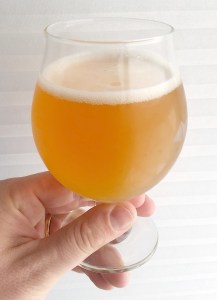
Countdown IPA

So named because we’re on the countdown to a new baby in the household…gotta brew while I can! This recipe is basically a minor tweak of my Centennial IPA, just mixing up the hops a little bit both for variety and complexity as well as to burn through a bit more of my stash. I also swapped in the US equivalent of the Belgian crystal malts, so that I didn’t have to buy more malt. Finally, I added a touch of Carafa Special II to deepen the color a bit.

Countdown IPA

  • 10.5 lbs. 2-row pale malt (Rahr)
  • 1.75 lbs. Vienna malt (Great Western)
  • 0.5 lbs. 20° caramel malt (Briess)
  • 0.25 lbs. 10° caramel malt (Briess)
  • 1.5 oz. Carafa Special II (Weyermann)
  • 1 oz. Amarillo hop pellets (7% alpha), first wort hop and 90 minute boil
  • 1 oz. Amarillo hop pellets (7% alpha), 15 minute boil
  • 2 oz. Amarillo hop pellets (7% alpha), 10 minute boil
  • 1 oz. Centennial hop pellets (7.6% alpha), 5 minute boil
  • 1 oz. Amarillo hop pellets (7% alpha), 5 minute whirlpool
  • 1 oz. Centennial hop pellets (7.6% alpha), 5 minute whirlpool
  • 1 oz. Ekuanot (HBC 366 aka Equinox) hop pellets (13.6% alpha), dryhop in keg
  • 1 oz. Simcoe LupuLN2 (23.8% alpha) cryohop pellets (23.8% alpha), dryhop in keg
  • 1 Whirlfloc tablet, 10 minute boil
  • 1 tsp. Fermax yeast nutrient, 10 minute boil

Target Parameters

  • Infusion mash to hit target of 149°. Batch sparge.
  • Claremont tap water with RO and salt additions to hit targets of 113 Ca, 22 Mg, 24 Na, 194 SO4, 42 Cl, 207 HCO3, 170 ppm alkalinity, 76 ppm RA.
  • 1.066 o.g., 1.012 f.g., 7.2% abv, 68 IBU, 9 SRM, 5 gallons into fermenter

Procedure

  • My base water for this beer was all Claremont tap water. I added 3.2 g of gypsum, 1.8 g of epsom salts, and 0.6 g of calcium chloride to 4.3 gallons of mash water, along with 45 mL of 10% phosphoric acid. I used the same masses of salts for 4.75 gallons of sparge water, with 50 mL of 10% phosphoric acid there.
  • I mashed in with 4.3 gallons of water at 157.3°, to hit a mash temperature target of 149°. I mashed for 90 minutes; at the end, temperature was down to 145°. I collected the first runnings after a vorlauf, and then added 4.75 gallons of sparge water at around 185°. I let the mash sit for 10 minutes before vorlaufing and collecting the remaining runnings.
  • In total, I collected 7.2 gallons of runnings with a gravity of 1.052, for 78% efficiency.
  • I boiled the hops per the schedule, adding the kettle finings and yeast nutrients appropriately. After the full 90 minute boil, I turned off the heat, added the final hops, whirlpooled for 5 minutes, and began chilling.
  • Groundwater is pretty warm this time of year, so I could only chill the beer down to around 85°. I transferred to the fermenter and then let it chill overnight (~10 hours) down to 66°. I pitched the yeast, and things had begun to take off within 18 hours.
  • Starting gravity was 1.064. I brewed the beer on 14 July 2017 and pitched the yeast early on the morning of 15 July 2017. I’ll be fermenting at 66°.

Beer Tasting: Ophidia IPA & CA IPA

Both of my recent IPA’s are long-gone (Ophidia IPA first, and CA IPA most recently), but I hadn’t gotten around to posting the tasting information. So, this post is a double-header!

ophidia_IPAOphidia IPA

  • The Basics
    • O.G. = 1.055; f.g. = 1.012; 5.6% abv; 6 SRM; 52 estimated IBU
  • Aroma
    • Beautiful tropical fruit aroma–guava notes are really prominent (I feel a bit silly typing out this kind of pontification, but it’s seriously there!), and a bit of citrus is behind that when it is first poured. As the beer warms up, the purported blueberry associated with Mosaic hops comes forth. It’s a very hop-forward aroma, covering up the malt.
  • Appearance
    • Gold color, moderately hazy, with a low and persistent off-white head.
  • Flavor
    • Hop-forward once again, as you would expect for an IPA. The bitterness is clean and persists nicely from first sip to the finish. Any hop flavor is vaguely tropical and citrusy. The malt is clean, ever-so-slightly-sweet, and in the background.
  • Mouthfeel
    • This is a moderately dry and fairly light-bodied beer, carbonated as appropriate for the style. The dry finish lingers pleasantly on the tongue.
  • Would I brew this again?
    • Hmm…this is in the category of “pretty good, but not life-changing.” It hits nicely on most notes, but I think it might fall victim to “tropical hop burn-out” in the wake of many citrus/fruit-bomb IPAs and pale ales that I’ve done over the past year. I didn’t quite hit my marks for final gravity due to the mash being a bit too cool, but I’m honestly not sure if that’s a totally bad thing. The aroma is absolutely delicious–the Mosaic and Citra combo play together beautifully. This is a very drinkable beer; probably too easily drinkable! I really like it, but it is just missing something very minor that I can’t quite place in the flavor. Ah well!
  • Overall
    • 8/10

CA_IPACA IPA

  • The Basics
    • O.G. = 1.060; f.g. = 1.009; 6.7% abv; 6 SRM; 63 estimated IBU
  • Aroma
    • Slightly phenolic, which overpowers any hop aroma. There is maybe a slight piney hint, but that’s about it.
  • Appearance
    • Gold beer with a moderate haze. The off-white head forms a persistent blanket over the surface of the beer.
  • Flavor
    • Pear/apple notes (probably from the yeast), with a slightly herbal/spicy character behind that–perhaps even a bit phenolic. I attribute this to a brief lapse with the fermentation chamber–the freezer side accidentally got unplugged, so the temperature peaked at 73 or 74 degrees. It’s actually rather close in many ways to what my first, non-temperature-controlled batches tasted like.
  • Mouthfeel
    • Medium-dry body, moderate carbonation.
  • Would I brew this again?
    • Maybe? Unfortunately, enjoyment of this beer is really ruined by the slight bump into high temperatures early in fermentation. I’m willing to try this temperature and technique again, though.
  • Overall
    • 3/10

CA IPA

Time to IPA it up again! I’ve been doing a lot of either “fruity” hops (Citra/Mosaic) or single hop IPA experiments, so for this recipe I wanted to do an American hop blend focusing on Centennial and Amarillo (hence the name “CA IPA”). I’m also going to switch up techniques a bit–rather than dry-hopping in the keg, I’m going to dry-hop in the fermenter towards the end of the main fermentation cycle, followed by cold crashing prior to kegging.

CA IPA

  • 11 lbs. 2-row malt (Rahr)
  • 2 lbs. 4.8 oz. Vienna malt (Weyermann)
  • 8 oz. crystal 20° malt (Briess)
  • 5 oz. crystal 10° malt (Briess)
  • 0.75 oz. Warrior hop pellets (15.8% alpha), 60 minute boil
  • 1 oz. Amarillo hop pellets (7% alpha), 15 minute boil
  • 1 oz. Centennial hop pellets (7.6% alpha), 15 minute boil
  • 1 Whirlfloc tablet, 10 minute boil
  • 1 oz. Amarillo hop pellets (7% alpha), 5 minute whirlpool
  • 1 oz. Centennial hop pellets (7.6% alpha), 5 minute whirlpool
  • 1 pkg. Burton Ale yeast (WLP023, White Labs), prepared in 1.25L starter
  • 1 oz. Amarillo hop pellets (7% alpha), 5 day dry-hop in primary fermenter
  • 1 oz. Centennial hop pellets (7.6% alpha), 5 day dry-hop in primary fermenter

Target Parameters

  • 150° mash, 60 minutes
  • 1.065 o.g., 1.015 f.g., 6.6% abv, 63 IBU, 6 SRM, 6 gallons into the fermenter

Procedure

  • The morning of my brew day, I prepared the yeast in a 1.25L starter. I don’t plan on setting any aside, so I did not bother with overbuilding the starter.
  • I prepared my mash water by adding a quarter Campden tablet, 8g gypsum, and 5g epsom salt to 4.75 gallons tap water. The 4.5 gallons of sparge water will be plain RO.
  • I heated the mash water to 170°, added it to the fermenter, and then let the temperature settle to 161.5° before adding the grains. This hit my mash temperature right at 150.2°, pretty much exactly where I wanted it.
  • Mash temperature was down to 148.5° after 30 minutes. I was visiting with some friends, so the mash ended up sitting a total of 90 minutes before I got back to it. At this point, I vorlaufed and then collected the first runnings.
  • Next, I added the sparge water (at around 155°, to hit a mash bed temperature of 152°), let it sit for 10 minutes, vorlaufed, and collected the remainder of the wort.
  • In total, I collected 8.1 gallons of wort at a gravity of 1.050 and 78% efficiency. This is a larger volume than expected–I think this is likely because I had assumed my RO jug had 4.5 gallon exactly, and it was probably a touch more than this. I’ll measure more carefully next time! For this particular batch, I boiled a bit harder than usual to bring the volume down and the gravity up.
  • Once I had the wort at a hard boil, I added the hops per the schedule, boiling for 60 minutes total. At the end of the boil, I added the whirlpool hops (in a mesh bag) and let them sit for 5 minutes before chilling the wort.
  • Once the beer was down to ~75°, I transferred to the fermenter and pitched the yeast. I put approximately 5.75 gallons into the primary. I pitched the yeast, and will be fermenting at 67°. I plan to add the dry hops in 5 days.
  • Starting gravity was 1.060, a bit below my target (but not surprising given the extra boil volume).
  • I brewed this beer on 25 March 2017. Visible yeast activity was evident in under 24 hours.

Fade to Black IPA

The quest to explore new styles continues! My current IPA is almost all gone, so it’s time to brew something to replace that keg. I was getting a little bored with citrusy American IPA’s, though, so something different was called for. Why not a black IPA?

As if by magic, the latest issue of Brew Your Own had an advertisement for Briess malts including a recipe for “Fade to Black IPA.” The ad copy promised “old school hops, with a new school malt bill.” Interesting! The ingredient list (below) had all sorts of things I hadn’t tried before. It’s worth noting that “Fade to Black” is a fairly common commercial beer name, with at least a handful of IPA’s bearing the moniker. I have no idea if this recipe is intended to clone of any of those.

I followed Briess’s recipe pretty closely, with only minor tweaks on the ingredients. The most notable was switching the base malt from Briess Full Pint Brewers Malt to Great Western California Select 2-row (which I already had on hand). I also modified the hop additions a touch, but everything else stayed the same.
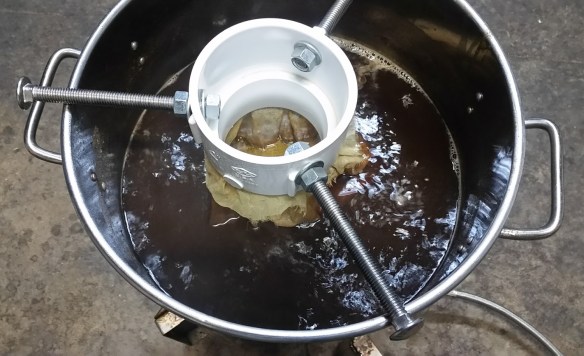
20161112_211553

Fade to Black IPA

  • 11 lbs. California Select 2-row malt (Great Western Malting Co.)
  • 1 lb. 80°L caramel 6-row malt (Briess)
  • 1 lb. special roast malt (Briess)
  • 0.25 lb. chocolate dark 6-row malt (Briess)
  • 0.25 Midnight Wheat malt (Briess)
  • 0.5 oz. Galena hop pellets (13.8% alpha), 60 minute boil
  • 1 oz. Chinook hop pellets (13.1% alpha), 30 minute boil
  • 2 oz. Cascade whole hops (5.1% alpha), 10 minute boil
  • 1 Whirlfloc tablet, 10 minute boil
  • 0.25 tsp. yeast nutrient, 10 minute boil
  • California Ale Yeast (WLP001, White Labs), prepared in starter
  • 1 oz. Cascade whole hops (5.1% alpha), dry hop
  • 1 oz. Chinook hop pellets (13.1% alpha), dry hop
  • 1 oz. Galena hop pellets (13.8% alpha), dry hop

Target Parameters

  • 154° mash, 60 minutes
  • 1.067 o.g., 1.016 f.g., 6.7% abv, 67 IBU, 28 SRM, 5.5 gallons into the fermenter

Procedure

  • I prepared a 1.75L starter with 175g of extra light DME, three days in advance. After two days, I decanted 0.6L to save for later. The remainder was cold crashed, decanted, and pitched at the start of fermentation. This was the second round for this yeast.
  • I mashed in with 4.5 gallons of water at 167.7°, to hit a mash temperature of 154°.
  • After 60 minutes, I added 0.6 gallons of water at 160°, let sit 10 minutes, vorlaufed, and collected the first runnings. Then, I added another 3.5 gallons of water at 180° to hit a mash temperature of 160°, let sit for 10 minutes, vorlaufed, and collected the remainder of the wort.
  • I collected 6.8 gallons of wort with a gravity of 1.057, for 79% efficiency.
  • I brought the kettle to a boil and added hops and other ingredients per the schedule above.
  • After 60 minutes of boiling, I turned off the flame and chilled the wort to 78°. At this point, I transferred to the primary fermenter with aeration, and then pitched the yeast.
  • Starting gravity was 1.065, and I will be fermenting at 66°. I brewed this beer on 12 November 2016.

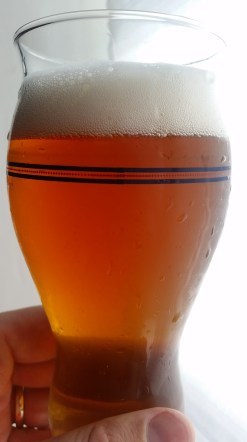
Equinox IPA Kegged

Today I kegged the Equinox IPA. It had been in the primary fermenter since 27 August, just a little over two weeks. After the first week, on 3 September, I moved the beer out of my fermentation chamber (which was getting switched over for a lager), and let it ride at ambient temperature for a week or so. I figured this would be OK, because the main run of the yeast had presumably wrapped up by this point, so the risk of getting off-flavors from a hot fermentation was quite low.

Final gravity was 1.010, down from 1.062, equating to 6.8% abv. I added the dry hops (3 oz. of Equinox hop pellets) at this time; they’re in a bag, weighted down with some stainless steel washers and suspended in the keg via unwaxed and unflavored dental floss. I will leave it at ambient temperature for a few days, before tossing it into the keezer to carbonate at the lagering temperatures.