English IPA

I’ve done soooo many American-style IPAs (especially tending towards the citrusy/fruity variety) that I’ve lost sight of what else an IPA can be. I wanted to get back to the style’s roots roots, with an English-style recipe. Creatively, I decided to call it…English IPA. It’s modified from a recipe on the AHA website, which won gold in the NHC during 2016.

English IPA

  • 12 lbs. Maris Otter malt (Bairds)
  • 0.5 lb. biscuit malt (Dingemans)
  • 0.5 lb. red wheat malt (Briess)
  • 6 oz. crystal 120 malt (Great Western)
  • 6 oz. crystal 40 malt (Great Western)
  • 1 oz. Magnum hop pellets (13.2% alpha), 60 minute boil
  • 1 Whirlfloc pellet, 10 minute boil
  • 1 oz. Fuggles hop pellets (5.6% alpha), 10 minute boil
  • 2 oz. East Kent Goldings hop pellets (6.0% alpha), 10 minute whirlpool
  • 2 pkg. Nottingham dry yeast (Lallemand)
  • 3 oz. East Kent Goldings hop pellets (5.0% alpha), dry hop in keg

Target Parameters

  • 1.064 s.g, 1.015 f.g., 6.5% abv, 49 IBU, 11 SRM
  • Infusion mash with batch sparge
  • Water built from Claremont tap water with mineral additions.

Procedure

  • Starting with Claremont tap water, I added 9 g gypsum, 5 g epsom salt, and 4 g CaCl to 4.6 gallons of water with a partial Campden tablet. I heated it to 166° and added the grains along with .5 tbs. of 88% lactic acid, to hit a mash temperature of 152° for 60 minutes. Then, I added 0.7 gallons of water at 185°, let sit for 10 minutes, vorlaufed, and collected first runnings.
  • Next, I added 3.6 gallons of water at 185° with 0.3 tbs. of 88% lactic acid for the sparge. After 10 minutes, I vorlaufed and collected second runnings.
  • In total, I collected 6.9 gallons of runnings with a gravity of 1.055 and 75% efficiency.
  • I brought everything to a boil and added the various kettle ingredients per the recipe. After 60 minutes, I turned off the flame and cooled to 85°. Finally, I transferred to the fermenter (with aeration) and cooled to 66°.
  • I brewed this and pitched the yeast on 7 November 2018.
  • I kegged the beer on 19 November 2018 and added the dry hops.
  • Original gravity was 1.063, and final gravity was 1.015, for 6.4% abv.

Tasting Notes

I drank this beer fairly quickly, because it was so tasty, and unfortunately I kicked the keg before I could do a full, formal tasting. Nonetheless, I kept a few brief notes on my last glass…

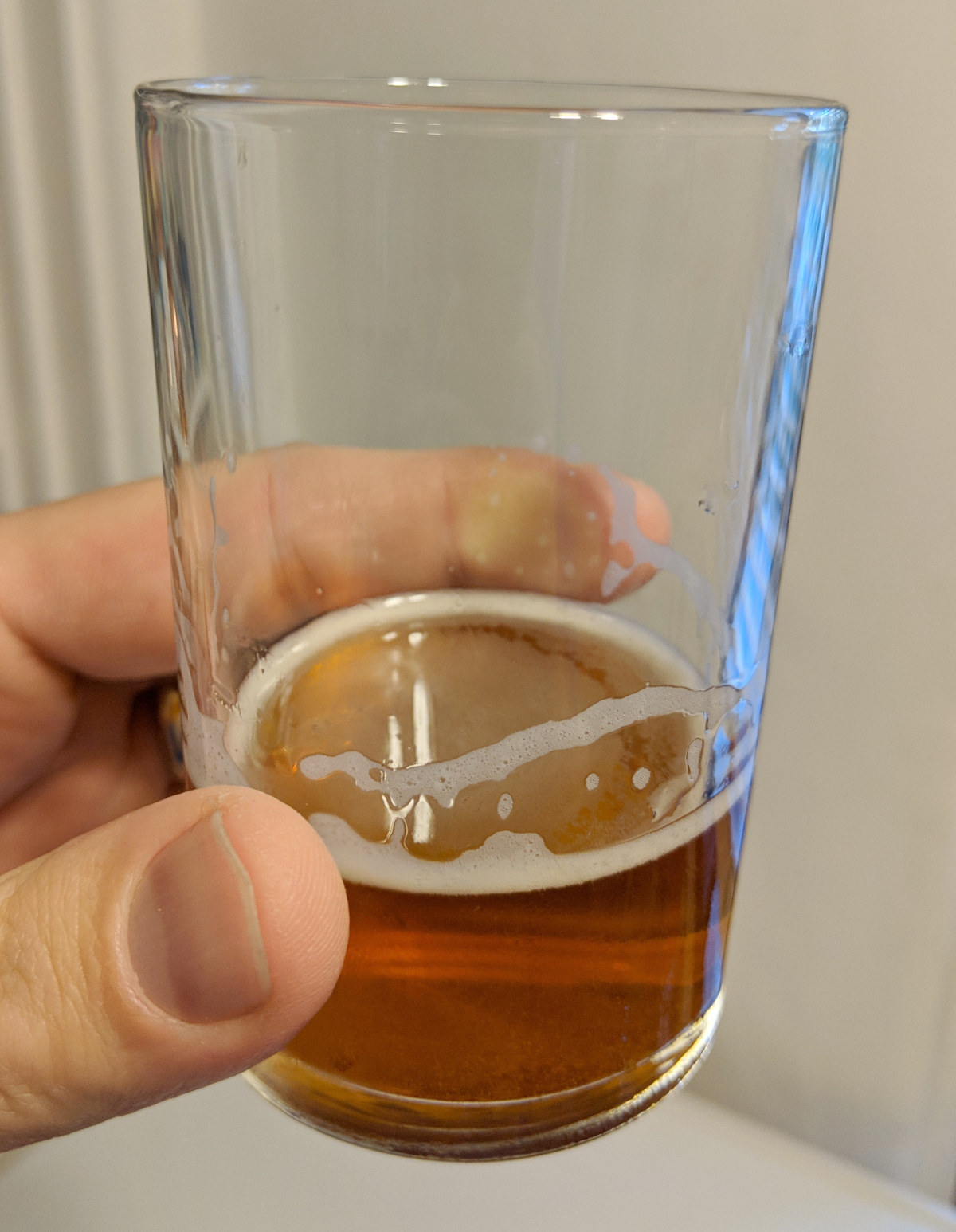
The beer had a hop-forward, nicely earthy aroma, with a slight caramel malt character behind that. On the taste, the malt and bitterness were well balanced. Hop character was pretty smooth on the finish, against the caramel malt qualities. Color was a gorgeous medium amber, with a slight haze.

Overall, I give this beer a 9 out of 10. I could perhaps round out the body a bit more (maybe with some oats or flaked barley), but overall this beer is pretty close to exactly what I wanted. The hops in particular are a treat–this feels like something Bilbo Baggins might enjoy next to the fire on a cold night in the Shire.

Centennial IPA

I’ve gotten bored with tropical fruity, citrusy, guava bomb IPAs; they’re fairly easy to nail at least half-way well, but come across as a bit one-note after awhile. I don’t have a huge interest in the hazy IPA trend, either–they’re nice to try from time to time, but I don’t really want or need a 5 gallon keg of IPA orange juice. So, it’s back to the basics for me!

Two years ago, I did a Centennial hop-centered IPA based on one of Gordon Strong’s recipes. The result was quite good, so I figured I would revisit the recipe. 

The new batch is fairly close recipe-wise to the old one, with the main change being in the yeast. I decided to give the Mangrove Jack Liberty Bell Ale (M36) a try; it’s supposed to be a strain good for English or American pale ales.

Centennial IPA

  • 9.5 lbs. 2-row pale malt (Rahr)
  • 2 lbs. Vienna malt (Great Western)
  • 0.5 lb. Caravienne malt (Weyermann)
  • 0.25 lb. Carahell malt (Weyermann)
  • 3.4 oz. acidulated malt (BESTMALZ)
  • 1 oz. Centennial hop pellets (9.3% alpha), 60 minute boil
  • 1 oz. Centennial hop pellets (9.3% alpha), 15 minute boil
  • 1 Whirlfloc tablet
  • 2 oz. Centennial hop pellets (9.3% alpha), 10 minute whirlpool
  • 3 oz. Centennial hop pellets (9.3% alpha), dry hop in keg
  • 2 pkg. Liberty Bell Ale dry yeast (Mangrove Jack’s #M36)

Target Parameters

  • 1.063 o.g., 1.012 f.g., 6.7% abv, 59 IBU, 6 SRM
  • Infusion mash to hit target of 150°, 60 minutes, batch sparge
  • Water built from 3 gallons of Claremont tap water, 3.5 gallons of RO water treated with 4.5 g gypsum, 1.5 g epsom salt, 1 g calcium chloride, to hit target of 74 Ca, 10 Mg, 14 Na, 120 SO4, 27 Cl, 129 HCO3, 47 RA.

Procedure

  • I mashed in with ~4.1 gallons of the RO water with minerals and the balance in tap water, at 161°, to hit a mash temperature of 150°.
  • After a 60 minute mash, I added 0.8 gallons of tap water at 185°, let sit for 10 minutes, vorlaufed, and collected the first runnings. Then, I added 3.5 gallons of tap water at 185°, let sit for 10 minutes, vorlaufed, and collected the second runnings.
  • In total, I collected 6.5 gallons of runnings at a gravity of 1.051, for 72% efficiency.
  • I brought the kettle to a boil, boiling for 60 minutes and adding hops per the schedule. After a full hour boil, I added the whirlpool hops and let them sit for 10 minutes before chilling, transferring to the fermenter, and pitching the yeast.
  • I brewed this batch on 18 September 2018, and fermented it at around 67°. Starting gravity was 1.058.
  • On 30 October 2018, I kegged the beer. Final gravity was 1.005, working out to 7.1% abv. The beer had a somewhat estery aroma and flavor on first taste (see below).

Tasting

  • The Basics
    • Original gravity = 1.058; final gravity = 1.005; abv = 7.1%; esimated IBU = 59
  • Aroma
    • Slight phenolic, citrusy aroma
  • Appearance
    • Fine white head that sticks around for awhile; the beer itself is light gold with a slight haze.
  • Flavor
    • This is a very hop-forward beer, with a firm but even bitterness that persists on the tongue. There’s not a ton of malt character, but that’s OK for what this is. The hops have a slightly floral and citrusy character, which is unfortunately swamped out by a bit of a “hot” phenol note.
  • Mouthfeel
    • This is a fairly dry beer. Carbonation is appropriate to style.
  • Would I brew this again?
    • The description for Liberty Bell Ale yeast mentions pear esters in the aroma, which will get out of the way of prominent hop and malt aromas. Sadly, I couldn’t disagree more. The aroma was an estery mess on this one early on–it smelled somewhat like my early homebrew batches fermented without temperature control. I checked my records on power losses at home, and couldn’t find any record of a power outage during the height of fermentation, so I suspect it’s just a flaw in the yeast strain relative to this recipe. It doesn’t really seem like an infection, either, although I suppose that’s not completely outside the realm of possibility (especially given the low finishing gravity). The off flavor has moderated a fair bit as the beer sits in the keg, but in any case, I won’t be trying this yeast strain again.
  • Overall
    • 5/10 — the off flavor overwhelms the positive features of this beer.

Thanksgiving IPA 2017: Recipe & Tasting

I wanted to have a nice IPA on-hand for Thanksgiving. So, I brewed up a recipe based on my Centennial IPA, first brewed last year. The base beer is a favorite of mine, so it seemed like an easy choice. I did modify it slightly to use crystal 20 and Victory malt instead of Caravienne and Carahell. I also mixed the hopping up a little bit, maintaining focus on the citrus/pine American hops. This was combined with Mandarina Bavaria hops, to add an interesting twist that I hoped would play well with everything else.

Thanksgiving IPA 2017

  • 10.5 lbs. California Select 2-row brewer’s malt (Great Western)
  • 1.75 lbs. Vienna malt (Great Western)
  • 0.5 lb. 20°L caramel malt (Briess)
  • 0.25 lb. Victory (biscuit) malt (Briess)
  • 1 oz. Centennial hop pellets (7.6% alpha), first wort hop with 60 minute boil
  • 1 oz. Centennial hop pellets (7.6% alpha), 15 minute boil
  • 1 oz. Cascade whole hops (5.5% alpha), 10 minute boil
  • 1 oz. Centennial hop pellets (7.6% alpha), 10 minute boil
  • 1 oz. Amarillo hop pellets (9.2% alpha), 5 minute whirlpool
  • 1 oz. Mandarina Bavaria hop pellets (9.5% alpha), 5 minute whirlpool
  • 1 oz. Centennial hop pellets (7.6% alpha), 6 day loose dry hop in primary
  • 1 oz. Amarillo hop pellets (9.2% alpha), 6 day loose dry hop in primary
  • 1 oz. Mandarina Bavaria hop pellets (9.5% alpha), 6 day loose dry hop in primary
  • 1 pkg. California Ale yeast (White Labs WLP001), prepared in starter

Procedure

  • I mashed in with 4.25 gallons of Claremont tap water at 161 degrees, to hit a 150° mash target. After 60 minutes, I added 0.75 gallons of water at 185°, let sit for 10 minutes, vorlaufed and drained. I then added 3.5 gallons of water at 185°, let sit for 10 minutes, vorlaufed, and drained.
  • In total, I collected 6.75 gallons of wort at a gravity of 1.050, for 71% efficiency.
    I brought the wort to a boil, and added hops per the schedule.
  • After a 60 minute boil, I chilled to pitching temperatures and added the yeast (which was prepared in a starter).
  • Original gravity was 1.062.
  • I brewed the beer on 7 November 2017, and fermented at 66° for 6 days. On 13 November, I added the dry hops directly to the primary fermenter. On 19 November, I cold crashed the beer.
  • On the morning of 20 November, I accidentally added 0.25L of lager yeast pitch intended for another beer. Oops.
  • On the evening of 20 November, I split the beer into two kegs (2.5 gallons each). The more full keg received 1 tsp. of gelatin in 1/4 cup of water, heated to 150 degrees. The other (less full) did not get gelatin. I force carbonated the kegs.
  • Final gravity was 1.008, for 7.1% abv.

20171123_131532Tasting

  • The Basics
    • 1.062 o.g., 1.08 f.g., 7.1% abv, 62 estimated IBU, 6 SRM
  • Appearance
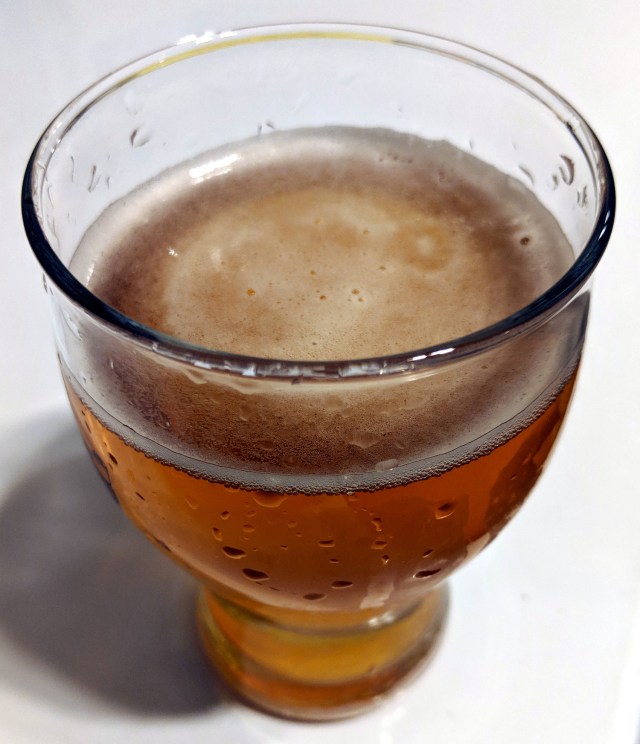
    • This beer is a deep gold, with a modest haze (it looks a bit darker in the photo due to the lighting). The head is exceptionally persistent and off-white, with beautiful lacing on the glass.
  • Aroma
    • Light yet rich citrus aroma from the hops, with a light malty aroma with a slight hint of caramel behind that
  • Flavor
    • The beer has a bready malty character, with a firm and persistent malt bitterness. The hop flavor is piney and citrusy, tending towards a grapefruit character. The bitterness is perfect, with a smooth quality and smooth finish.
  • Mouthfeel
    • The beer has a medium body and has a moderately dry finish with moderate carbonation.
  • Would I brew this again? 
    • Yes! This recipe once again satisfies, and I’m quite pleased with how the hops turned out. This is a classic west coast American IPA. The hop aroma could maybe be a touch stronger, but that’s a minor complaint overall.
  • Overall
    • 9/10

Peach IPA

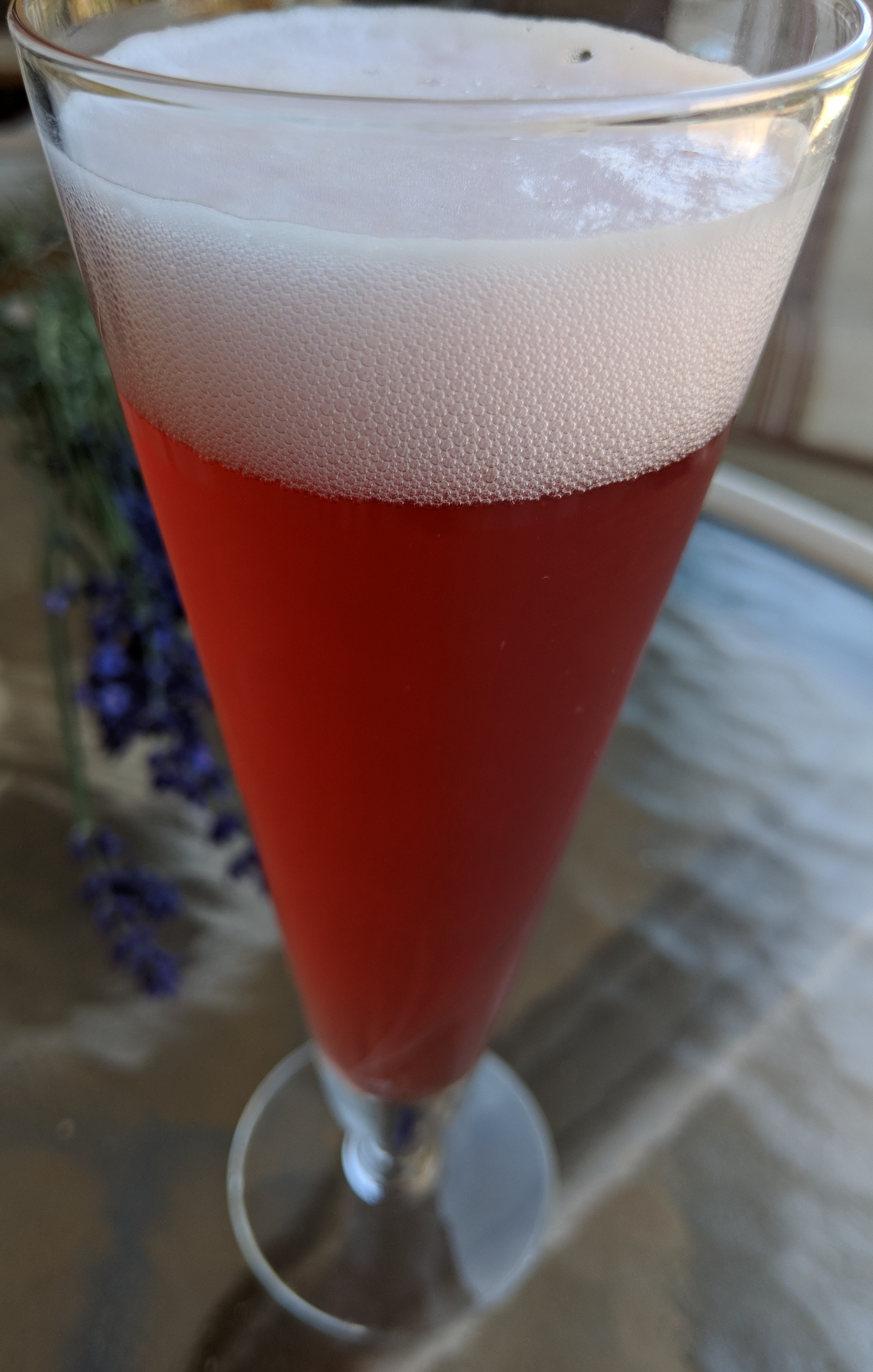
This is a recipe I’ve been wanting to try for quite awhile…fruit beers intrigue me, and a well executed fruit IPA can be exquisite. This particular recipe is modified from the Peach IPA recipe by Mitch Steele in the March/April 2016 Zymurgy magazine. I adjusted the base malt, hops, etc., to match some of what I had in stock. I also upped the dry hop quantities to provide the more intense hop aroma that I like.

Peach IPA

  • 11.25 lb. 2-row pale malt (Rahr)
  • 0.75 lb. Munich I malt (Weyermann)
  • 0.5 lb. Carapils malt (Briess)
  • 1.10 oz. Warrior hop pellets (15.8% alpha), 60 minute boil
  • 1 Whirlfloc tablet, 10 minute boil
  • 1 oz. Galaxy hop pellets (14.0% alpha), 5 minute whirlpool
  • 2 oz. Helga (Southern Hallertau) hop pellets (5.6% alpha), 10 day dry hop
  • 1 oz. Galaxy hop pellets (14.0% alpha), 10 day dry hop
  • 1 oz. Mosaic hop pellets (12.25% alpha), 10 day dry hop
  • 4 oz. peach puree, added on day 3 of fermentation
  • 1 pkg. California Ale yeast (White Labs WLP001)

Target Parameters

  • Single infusion mash to hit target of 152°, 60 minute rest, batch sparge
  • 1.063 s.g., 1.014 f.g., 6.5% abv, 64 IBU, 4 SRM
  • Water adjusted to 113 ppm Ca, 22 ppm Mg, 24 ppm Na, 194 ppm SO4, 42 ppm Cl, 170 ppm alkalinity, 76 ppm RA

Procedure

  • Two days before brewing, I prepared a 2L yeast starter, and let it go for 36 hours before cold crashing in the fridge. I’ll set aside ~0.6L for a later batch.
  • I prepared my mash water and sparge water in two equal batches of 4.25 gallons. To each, I added 3.1g gypsum, 1.7 g epsom salt, and 0.7 g calcium chloride. To adjust the mash pH, I added 2 tsp (10 mL) of 75% phosphoric acid.
  • I mashed in with 4.25 gallons of water at 160.5°, to hit my mash target of 152°. After 45 minutes, I was down to 150°.
  • After 60 minutes, I added 0.75 gallons of water at 185°, let rest for 10 minutes, vorlaufed, and collected the first runnings.
  • Next, I added 3.5 gallons of water at 185°, let rest for 10 minutes, vorlaufed, and collected the second runnings.
  • In total, I collected 6.5 gallons of sweet wort with a gravity of 1.053, for 75% efficiency.
  • I brought the wort to a boil, and added the hops and other ingredients per the recipe. After 60 minutes, I added the final hop dose and then turned off the flame before chilling as far as I can.
  • I got the wort down to about 85°…that’s the best I could do in the midst of this heat wave! So, I transferred the wort into the fermenter and put it in the fermentation chamber overnight to chill down to 66°.
  • Starting gravity was 1.062. I brewed this beer on 1 September 2017, and pitched the yeast on 2 September 2017.

Beer Tasting: Countdown IPA

20170827_131705This recipe isn’t my best IPA, but it’s a pretty darned good IPA.

  • The Basics
    • 1.064 o.g., 1.011 f.g., 7.1% abv, 68 estimated IBU, 9 SRM
  •  Appearance
    • Light copper color with a slight haze, pouring with a dense white head that leaves lacing on the side of the glass as it subsides to a persistent ivory colored blanket.
  • Aroma
    • Moderately prominent dank, piney aroma; quite nice and classic! I could up the aroma a touch, but it’s generally OK.
  • Flavor
    • This beer is dominated by a smooth, piney bitterness, backed up by a smooth and doughy malt profile.
  • Mouthfeel
    • Moderately dry, with a smooth and extended bitter finish. Carbonation is moderate and appropriate for the style.
  • Would I brew this again?
    • Probably. This is a nice, middle-of-the-road American IPA. The hops are nice, although I should I say I don’t find the CryoHops notable one way or another. I was perhaps expecting a bit more hop character from them, given they were touted as providing twice the aroma for a given mass of hop. Maybe it’s more like 1.5x? I might up the aroma a touch, with perhaps a bit more Simcoe. As usual, the general base recipe is pretty solid.
  • Overall
    • 8.5/10