Review: Yakima Valley HOPBOX

When it comes to hops, I am often a creature of habit. I love Cascade, Centennial, Citra, and Simcoe for my IPAs, and I’ll sometimes throw in Galaxy or Amarillo. I love Saaz, Hallertauer, and their American equivalents for my German beers. And…I don’t get much outside of that box very often. With a bewildering array of hops on the market for homebrewers, I just get overwhelmed and usually stick with what I know.

Now, that philosophy can be great for consistency and predictability. It also helps me to avoid chasing the latest expensive fad hop, and I’ve really gotten to know the flavors in each familiar variety. That said, I’m almost certainly missing out on some real gems. But, how can I break out of my rut, without too much effort on researching and such?
About two months ago, I was super excited to learn about a hop subscription box from Yakima Valley Hops, called The HOPBOX. HOPBOX was totally sold out then, but one of their reps said to check back at a certain date, and I should be good to go. Sure enough, I visited the website a few weeks later and I could order! (thanks for the tip, YVH rep!) I signed up for a full year (which came with a 15% discount), and waited for my first shipment…

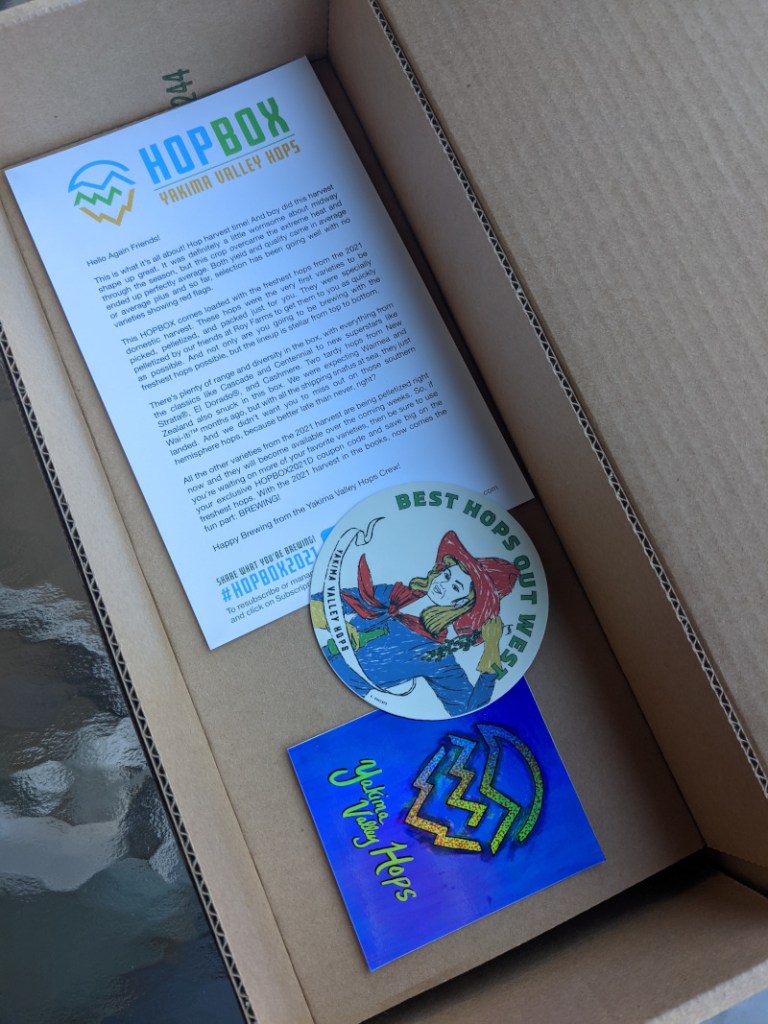
A little over a week ago, a very attractive box landed in my mailbox. Opening it up, I saw eight 2-oz. cans of eight different hop varieties, along with some stickers, a card describing the hops, and a set of stainless steel cups to portion out hop additions.

So, what do I think about all of this? Let’s take a look! (note: I paid for this myself, and did not receive any compensation for the review, so I feel I can be reasonably even-handed)

The Hops

I was pretty impressed by the hops! All were from the 2021 crop, so I have no doubt on freshness. High marks there.

I am also impressed by the varieties–this box included Bravo, Cashmere, Cascade, Centennial, El Dorado, Strata, Waimea, and Wai-iti. A few are ridiculously expensive to buy at some suppliers (e.g., Strata sells at over $2.50 per ounce at some online stores), and others aren’t yet available for this crop via YCH (e.g., Cashmere and El Dorado).

For my brewing habits, this is a perfect quantity of hops. There are enough to do a few beers with fun blends–for instance, my first batch uses Bravo as the bittering with Waimea+Wai-iti+Cashmere for the whirlpool and dry hop. There isn’t enough of each for a five gallon SMaSH beer, but I think I’m okay with that. I can always go back and try a particularly intriguing variety in more depth. For me, Waimea is the standout in my current package so far, and I may well come back to that.

I like that this box fits within a general theme, of “hops that are good for IPAs and pale ales”. That made it a lot easier to plan brewing, versus if I had gotten a smattering of hops suited for disparate styles.

One thing that might have been nice is access to detailed data on individual lots. The packages had alpha acids, etc., but I wouldn’t complain if there were specifics on particular hop oil quantities, etc. That is a very minor quibble, though.
The Extras

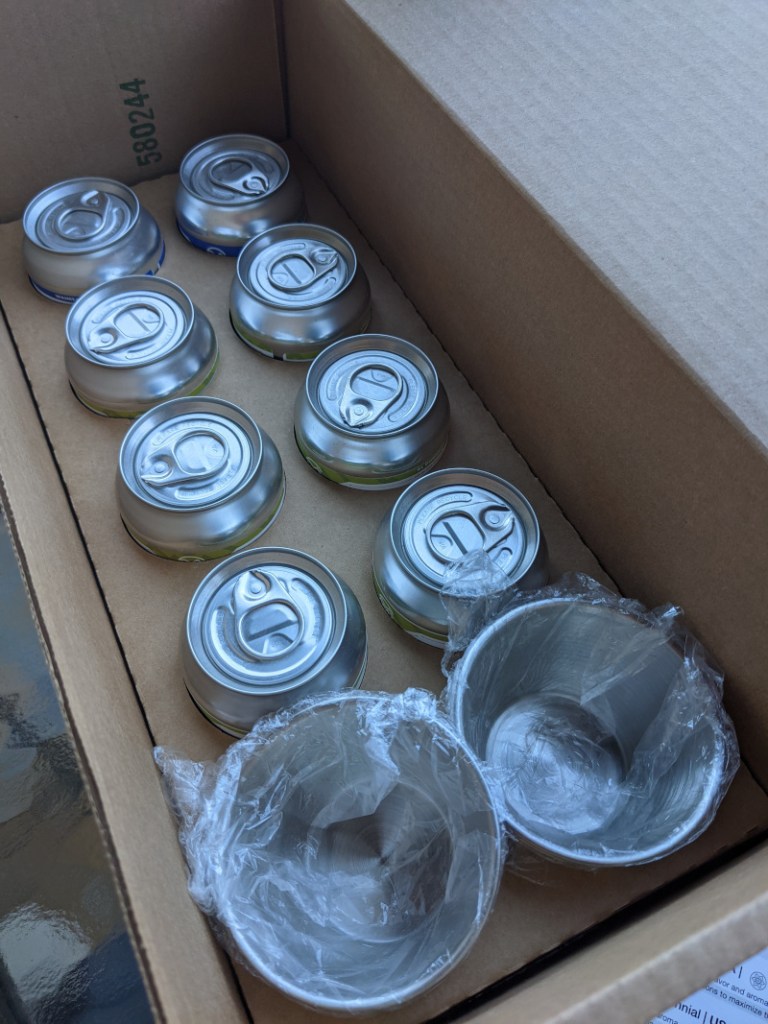
This box came with two stickers as well as a set of stainless steel cups to portion out hops. I’m not really a sticker person, so those were somewhat of a wash, but the cups have already gotten use in my brewery. Previously I have been using reusable plastic containers, which are OK but a bit large for what I need. The little stainless steel containers (the same as 4 oz. sauce cups you might get at a restaurant) are branded with the YVH logo and will fit 3 oz. of hops fairly comfortably. The cups also make it easy to weigh out an ounce at a time, or a measure mineral additions.

One extra I might suggest for future boxes would be to include variety-specific recipes for the hops. I of course had fun thinking up something on my own, but at the very least a starting point would be helpful.

The Packaging

Yakima Valley Hops uses a nitrogen-flushed pull-top can, which is pretty slick. There’s no doubt as to the fact that they’re sealed and pretty impermeable to oxygen. A minor beef is that they are a little less convenient to store compactly in my deep freezer than bags are, and the cans also tend to wrinkle slightly due to the contraction of the internal gases at freezer temperatures. That said, they’re quite visually attractive.

The box itself was nicely arranged, and it was enjoyable to open and see what all was inside. I personally find unboxing videos or excessive commentary on such things a bit over the top, but I can’t deny that I had fun.

The box/packaging itself are maybe a little big for what’s inside, but it is all cardboard and recyclable, so I give them high marks for that. There’s no excess plastic junk, or unrecyclable bits. Also, everything arrived in perfect shape.

The Cost

Because I ponied up for a one year (four box) subscription, this knocked 15% off the $40 price tag per box, so I’m paying $34/box. And, shipping is free! Is that worth it? Overall, I think yes.

For comparison, I priced out 2 oz. containers of each hop on the Yakima Valley Hops website. This adds up to about $18.50 of hops and $9.70 of shipping, for $28.20 total. I will note, though, that some of the things in my box are currently sold out or only available in 2020 or 2019 crop years. When I compared with MoreBeer, you’d spend around $31.42 and then an additional $8 or $10 for shipping, and you wouldn’t necessarily get as much control over which year you got.

In pricing out the stainless steel cups, it looks like they run around 50 cents to $1 each online; just for the sake of argument, let’s say $1 each (they have printing on the outside, after all). So, that’s $6 value there, more or less.

With everything included ($28.20 of hops and $6 of steel cups), and free shipping, I would say this box is about a break-even proposition, and you definitely come out ahead versus if you had to pay shipping. The exclusive access to some hops is also a nice perk. Overall, the box is also a fairly good value versus buying each individually at a reseller. However, the box wouldn’t necessarily be a good value at full price ($40).

Overall

On the whole, I rate the HOPBOX a 4 out of 5, and it comes awfully close to being 5 out of 5. The cost for what you get is pretty good, although not a ridiculous steal. The full-price one-off box might make for a good gift for someone, but if you brew a lot and are likely to use the hops, I would just get a full-year subscription to save a fair bit of money. The hop selection is top-notch, and the extras in the box are pretty cool. Additionally, at least this first box has definitely helped me to expand my brewing horizons, so mission accomplished! I definitely recommend this if you are a hophead or know someone who is.

Beer Tasting: Lemondrop Wheat Ale

20170704_155850I am absolutely thrilled with this beer! In fact, a little too thrilled…the keg is nearly dry. Time for a tasting, then!
Lemondrop Wheat Ale

  • The Basics
    • O.G. = 1.047; f.g. = 1.011; 4.8% abv; 4 SRM; 34 estimated IBU
  • Appearance
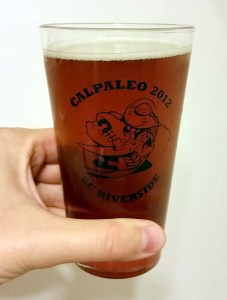
    • Hazy light straw color, with firm and persistent white head. When poured well, it’s like a topping of meringue. Gorgeous!
  • Aroma
    • Light citrus (slightly lemony) and slightly bready aroma
  • Flavor
    • Citrusy forefront, with a smooth and doughy middle, fading then into a lingering but pleasant bitterness.
  • Mouthfeel
    • Light body and moderate carbonation, with a medium-dry finish
  • Would I brew this again?
    • In a second! This is solidly in the running for favorite beer of 2017 so far. It’s just about the perfect summer beer–light, refreshing, and ridiculously drinkable. I’m burning through this keg at a pretty quick pace! The Lemondrop hops are a fun addition, too. Although I wouldn’t call them distinctly “lemon” in all aspects of their character (i.e. it’s not “lemon oil” or “Lemon Pledge”), they definitely have a citrus note that contributes nicely to the overall character of this beer. The only, very minor, flaw in this batch is that the finish has gotten just a touch harsh over time, likely due to the extended keg dry hopping. That’s easily fixed in the next iteration, though. I am quite pleased with just about every other aspect of this recipe; the balance between pilsner and wheat malt is perfect, and the yeast is also a true winner. WLP320 has just a touch of character, but it’s not overwhelming like European wheat beer yeasts. Also, it stays in suspension forever, which also helps with appearance and presentation. I don’t think this would be as good of a beer with a Chico strain yeast. I also think my water adjustments paid off; it’s not overly minerally in character like some of my past lighter beers.
  • Overall
    • 9.5/10

Beer Tasting: Hell Creek Amber Ale 1.1

20170611_212509

Hell Creek Amber Ale, appropriately served in a fossil-themed glass

The keg is gone barely a week for my wild hop amber ale, so it’s better late than never in posting this review. Also, I bottled up a few of these and enjoyed sharing them with some folks at Homebrew Con (including a paleontologist or two)!

  • Aroma
    • Malt dominates the aroma, with malty-sweet toffee and light caramel character. No appreciable yeast or hop character.
  • Appearance
    • Very clear beer with a deep amber color. The head is ivory in color, and settles down to a low but persistent quality.
  • Flavor
    • Hoppiness dominates on the front end of the flavor, and persists throughout the tasting and into the finish. The hop character is fairly herbal, and the bitterness has a slight rough edge to it. The malts come across moderately, with a caramel and bready quality. There is a minerally character to this, and next time I’ll probably adjust the water a bit to lower that. 100 percent Claremont tap water apparently doesn’t work with this recipe!
  • Mouthfeel
    • Moderate body and moderate carbonation. The finish tends toward the dry and bitter side.
  • Would I brew this again?
    • This is an improvement, certainly, on the last version of this beer. I think it was a good move to ditch the special B. This is an interesting beer, because I “have” to brew it within some self-imposed constraints (only Montana/South Dakota ingredients). I would say that the beer doesn’t age entirely well, probably due to the high percentage of caramel malts, and had a bit of an oxidized note towards the end of the keg. For the next iteration of this recipe (assuming there is a next, of course!), I’ll probably switch up the grain bill and see what other amber ale recipes are out there. The caramel is just a touch heavy in this for my tastes. As noted above, I’ll also play with the water a bit.
  • Overall
    • 6.5/10

Gondwana Pale Ale 1.5

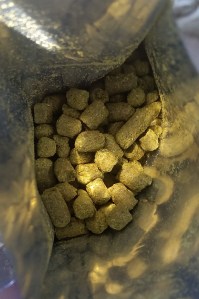
african_queenMy local homebrew shop happened to have a pound of African Queen hop pellets during my most recent visit…for those not in the know, this is a variety grown in South Africa, and one of the few that is available (for now) in the United States. Due to some recent hop farm purchases, future South African hop availability is likely to be even tighter than before, so I had to jump at this chance to brew with this variety.
These hops are touted as being on the flavor/aroma end of things, so I wanted a good pale ale recipe that would highlight this. My classic Gondwana Pale Ale seemed like just the ticket! I subbed in a little Vienna malt for the 2-row to help bolster the maltiness. Otherwise, there is very little changed here from my most recent iteration, just the hops.

Gondwana Pale Ale 1.5

  • 6.5 lbs. 2-row malt (Rahr Malting Co.)
  • 3 lbs. Vienna malt (Great Western Malting Co.)
  • 0.5 lb. crystal 40 malt (Great Western Malting Co.)
  • 7 oz. Carafoam malt (Weyermann Malting)
  • 0.35 oz. Warrior hop pellets (15.8% alpha), 60 minute boil
  • 2 oz. African Queen hop pellets (14.5% alpha), 5 minute boil
  • 2 oz. African Queen hop pellets (14.5% alpha), dry hop in keg
  • 1 Whirlfloc tablet, 10 minute boil
  • 1 pkg. California Ale yeast (WLP001)

Target Parameters

  • Infusion mash to hit target of 152°. Batch sparge.
  • Claremont tap water.
  • 1.053 o.g., 1.011 f.g., 5.4% abv, 41 IBU, 6 SRM, 5 gallons into fermenter

Procedure

  • A few days in advance, I made a yeast starter, cold-crashing it and setting aside some for a future batch.
  • On brew day, I mashed in with 3.5 gallons of water at 163°, to hit a 152° mash temperature. The temp had dropped to ~150° after 30 minutes.
  • After 60 minutes, I added 1.25 gallons of water at 185°, let sit for 10 minutes, vorlaufed, and collected the first runnings.
  • Next, I added 3.5 gallons of water at 185°, let sit for 10 minutes, vorlaufed, and collected the remainder of the wort.
  • In total, I collected 6.6 gallons of wort with a gravity of 1.045, for 78% efficiency.
  • I started the boil and added everything per the schedule.
  • After 60 minutes, I chilled the wort down to 70 degrees, and pitched the yeast. I’ll be fermenting at 66°.
  • Starting gravity was 1.053 (right on target!). I brewed this beer on 27 May 2017.
  • Final gravity on 7 June 2017 was 1.012, which equates to 5.4% abv. I added the hops to the keg in a mesh bag, and began carbonation and dry-hopping at room temperature.

Wild Times Pale Ale

I recently acquired a pound of wild hops from the Seattle area of Washington state, courtesy of a generous friend who found them on his property. The plus side of wild hops is that they have a definite “cool” factor. The negative side is that wild hops are indeed wild (or naturalized, if they are “feral” versions of cultivated hops)–you have no real published guidelines to constrain expectations for aroma, flavor, and bittering properties. It’s all lab analysis and careful sensory evaluation. In other words–a grand opportunity for a motivated homebrewer.

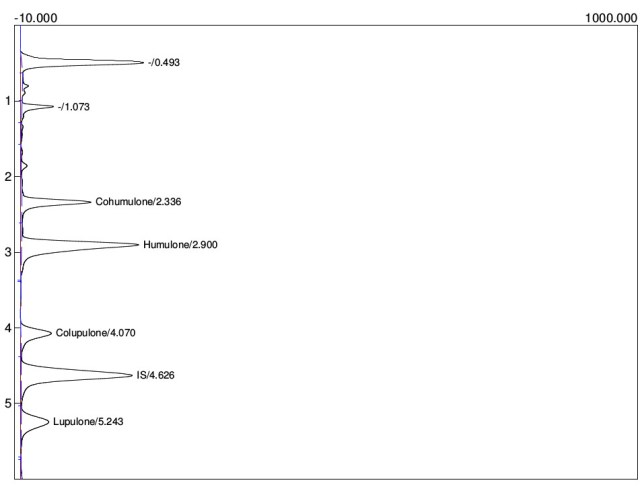
My first order of business was to figure out the chemistry of these things, particularly alpha acids. Because I had a good quantity of the hops, I didn’t mind sending them off for analysis. My go-to place has been BrewLaboratory; they are relatively inexpensive, fast, and supportive of homebrewers. They use HPLC (High Performance Liquid Chromatography), and their turn-around time has been less than 2 or 3 days from receipt of the sample.

I was pleasantly surprised by the alpha acid values–5.8%! Beta acids clocked in at 3.2% and cohumulone at 30%.

2016-washington-state-wild-hops

HPLC Profile for Washington State Wild Hops

The analysis nicely covered the basic chemistry, but what about the more complex aromas and flavors? When rubbing the hops between my palms, I noted a dominant, very perfume-like aroma! Behind that is a bit of vegetal/allium aroma. To help formalize my thinking on the matter, I roughed out the hop profile using spider diagrams. There are two slightly different formats that I found in my research, included below. Each breaks out the aroma descriptors slightly differently–for instance, one specifically has an “onion/garlic” category, whereas in the other that is lumped in with “vegetal”.

Wild Hop Spider Diagrams

Wild Hop Spider Diagrams, Showing Level of Intensity of Different Aroma Components

With nearly a pound of thoroughly analyzed wild hops in hand, I wanted to put together a nice and simple batch of beer to highlight their flavor and aroma. After consulting with some friends, I settled on an American pale ale. The goal was for something that was clean and not overly malty, to let the hops shine. Because I didn’t want to commit to five gallons of beer for the first round on these hops, I settled on a 3 gallon batch, which will fit into a 2.5 gallon keg that I have on-hand.

The weather is turning cool, and I didn’t want to deal with the thermal loss of brew-in-a-bag. So, I also elected to do a full-volume, no-sparge mash in my mash tun.

Wild Times Pale Ale

  • 5.5 lbs. California Select 2-row malt (Great Western Malting Co.)
  • 0.5 lb. 10°L caramel malt (Briess)
  • 0.25 oz. Galena hop pellets (13.8% alpha), 60 minute boil
  • 1.5 oz. Washington wild hops (5.8% alpha, 3.2% beta), 10 minute boil
  • 1.5 oz. Washington wild hops (5.8% alpha, 3.2% beta), 1 minute boil
  • 1 oz. Washington wild hops (5.8% alpha, 3.2% beta), 5 minute whirlpool
  • 0.5 tablet WhirlFloc, 10 minute boil
  • 1 pkg. Safale American dry yeast (US-05)
  • 1.5 oz. Washington wild hops (5.8% alpha, 3.2% beta), 10 day dry-hop

Target Parameters

  • 152° mash, no sparge, 60 minutes
  • 1.051 o.g., 1.011 f.g., 5.2% abv, 43 IBU, 4 SRM, 3 gallons into the fermenter

Procedure

  • I mashed in with 5.3 gallons of water at 168.8°, to hit a mash temperature of 152.4°. The mash was down to 149.5° after 25 minutes and down to 147° after 50 minutes.
  • After 60 minutes, I drained the mash tun. I collected 4.5 gallons of wort at a gravity of 1.036, for 74% efficiency. Not too bad!
  • I started the boil, and added the hops per the recipe specifications.
  • After 60 minutes, I turned off the flame, added the whirlpool hops, and chilled the beer down to 76°.
  • I transferred the beer to the fermenter while aerating, and pitched the yeast. I’ll be fermenting this at 68°.
  • Starting gravity was 1.046, a bit less than expected. However, I am not surprised because I kept a gentle touch on the flame to avoid overboiling with the smaller volume of wort.
  • I brewed this beer on 21 November 2016.