I’m pretty satisfied with my brewing at the moment, which makes sense after nearly 20 years in the hobby! 2026 will be a year of small goals–but I do think it’s important to set some.
Submit something for publication about AquiloPils. It’s a cool story, there’s a cool label, and I have had intentions of writing it up, but just never made the time.
Improve my pH management. I’ve never really stepped up to serious pH measurement, mainly because good equipment is fairly expensive and finicky. In the past, I used cheap pH meters, but they’re not built to last. A few projects–such as Salty One Gose–would benefit from more precise pH data, so 2026 is the year to do this.
Rebrew Salty One Gose. Related to the goal above, this recipe ended up pretty good but I think will be stellar once I dial in the appropriate level of sour.
Embrace dry hopping for pale lagers and similar beers. I have avoided this due to concerns about haze, but I feel that I am missing an opportunity to get a subtle “pop” of hop aroma and flavor in my German pils and kölsch recipes. During the past year or two, I’ve been focusing on late kettle additions, and they have sometimes done well, but I feel like I’m often missing something. I aim to try this with a batch or two and see what happens.
Beer in stock photos always seems to be leaving a mess on the table. Why is spilled beer a trope? Photo by cottonbro studio on Pexels.com
I increasingly enjoy and appreciate saisons, for their easy drinkability and interesting flavors. A good saison can do a lot with simple ingredients! Many homebrew recipes out there are way higher alcohol than I want in five gallon quantities, though, often in the 6 or 7 or even 8 percent range. The first page of results in the AHA recipe archive averages 6.9% abv, and the smallest recipe clocked in at 5.8% abv; that’s just not to my personal tastes.
So, I was intrigued by an article in the Summer 2025 issue of Craft Beer & Brewing, which highlighted saisons and presented a clone recipe for a recent interpretation of the style. Upright Saison Elani originated at Upright Brewing in Portland, Oregon; it was light (4.8% abv), simple (only three grains in the grist), and featured the relatively new hop Elani. This sounded fantastic!
Because Elani is a somewhat new and niche hop, my local homebrew shop didn’t have it in stock, but they did suggest Nectaron as an alternative. I haven’t done anything with Nectaron previously, and the citrus/tropical/stone fruit profile seemed like a good substitute for Elani and a great match for a summer saison. I had some Belle Saison yeast in my stash, so opted for that instead of the Imperial B56 or Wyeast 3276 in the original recipe.
In the spirit of my Brew Year’s Resolution to increase my percentage of “small batch” beers, this was a 3 gallon batch. So far, three out of 13 batches this year (23 percent) have been in this smaller format; by comparison, I had three out of 23 batches in the 3 gallon size last year. I have one or two more 3 gallon batches planned for 2025, so I’m feeling on target to meet my goal. Beyond the metrics, it has been nice to have smaller batches for recipes in the “good beer but I don’t want 5 gallons” categories.
Nectaron Saison
4 lb 2 oz. 2-row pale malt (Rahr)
12 oz. white wheat malt (Briess)
4 oz. Carapils malt (Briess)
1.5 oz. rice hulls
0.25 tsp. BrewTanB, added to mash
0.5 oz. Hallertauer Mittelfrueh hop pellets (2.5% alpha), 75 minute boil
1 oz. Nectacron hop pellets (10.1% alpha), 10 minute whirlpool
1 pkg. Belle Saison yeast (Lallemand)
Target Parameters
60 minute infusion mash, 147°, full volume mash
1.044 o.g., 1.007 f.g., 4.8% abv, 21 IBU, 3 SRM
Water built from RO, to hit targets of 63 ppm Ca, 11 ppm Mg, 105 ppm SO4, 67 ppm Cl, RA=-52
Procedure
I built my water up from scratch, starting with 4.8 gallons of RO, to which I added 2 g epsom salt, 2 g gypsum, and 2.5 g calcium chloride.
Then, I heated the water to 151° before adding the grains and holding at 147° with recirculation for 60 minutes. I raised the mash temperature to 168° for 10 minutes, before removing the grains.
In total, I collected 4.5 gallons of runnings with a gravity of 1.035, for 81% mash efficiency.
I brought the runnings to a boil, boiling for 75 minutes and adding hops and finings per the recipe.
After the boil, I turned off the heat and chilled to 78° before transferring to the fermenter and pitching the yeast.
I brewed this beer on 7 June 2025. Starting gravity was 1.045.
I used an open fermentation, putting a bit of foil across the top instead of an airlock. I fermented at ambient temperature, in the mid-70s.
A good crown of krausen was on the beer within 24 hours of pitching, and the fermenter temperature was around 76°. The krausen had mostly fallen by 14 June 2025, and I put a blow-off tube on the beer on 16 June 2025.
I kegged the beer on 21 June 2025, with 1.8 oz. of corn sugar added. I allowed it to carbonate at room temperature.
The final gravity was 1.003, for 5.5% abv. This is drier than stated in the original recipe or predicted by software (1.007 at each), but I’m not surprised given the diastatic yeast strain and low mash temperature.
Tasting
Appearance
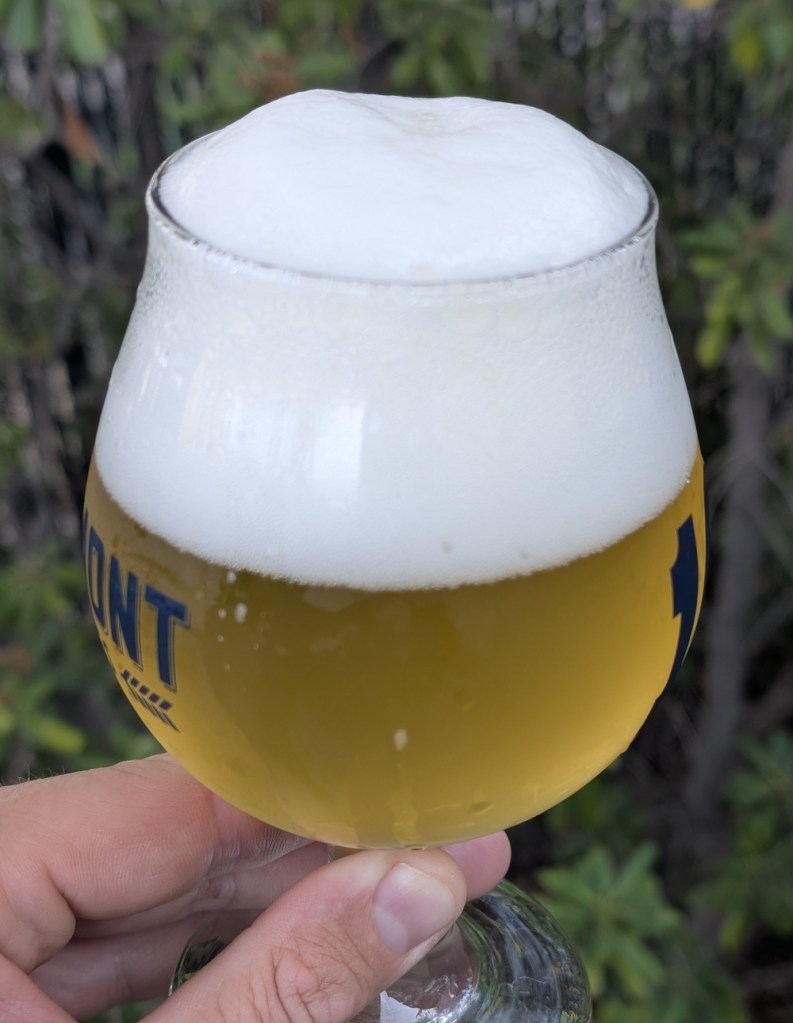
Pale yellow, slightly hazy beer; pours with a persistent and fluffy white head.
Aroma
Pineapple, lemony and slightly spicy aroma at a medium-low level; slight doughy character, too. Pineapple and peach come out as the beer warms, and a stronger peppery character.
Flavor
Medium low malt with slightly grainy quality; medium bitterness which is more apparent due to the dryness of the beer. Pineapple at a low level and peach appear as the beer warms.
Mouthfeel
Light body, high carbonation, dry finish.
Would I Brew This Again?
This is a highly drinkable, refreshing saison! I could see this becoming a house recipe, especially one against which to try out yeast variants. Because Belle Saison is no longer available in homebrew quantities, I suppose the issue is somewhat forced. I really like that strain’s subtlety here, though, and that it’s not a phenol bomb, even with ambient fermentation temperatures. I don’t know that Nectaron really stands out here; it might be better as a dry hop. That said, the hops show more character as the beer warms. It might be interesting to try a dry hop addition or a warmer fermentation, for more hop and yeast character–if that’s what I was looking for. As I have sampled the beer more recently, I’m happier and happier with the current level of things. So maybe it doesn’t need to become a dry hop bomb?
It has been three years since I last did one of these posts, but I figured I would give it a go in 2025. I usually only somewhat loosely adhere to these resolutions, but they can be fun ways to frame the year.
More Small Batches.
I enjoy brewing, and sometimes it’s more about the brew day than consuming the final product. One way to get around an occasional backlog in beer (and to have more variety) is to brew smaller batches. So, I’m going to aim to do a greater percentage of 3 gallon brews this year. Although I anticipate continuing with 5 gallon batches as the bulk of my brewing (especially for favorites like German pils), I hope to work more 3 gallon batches into the rotation, especially for new-to-me styles.
Conditioning Time.
Somewhat paradoxically relative to the item above, some of my beers would benefit from a longer conditioning or lagering time before serving. For instance, my märzen was on tap within 6 weeks after kegging, but a minimum of 8 weeks and preferably 10 would have been ideal to hit the point of brilliance for this particular recipe. A German pils (not yet posted) is at 6 weeks and is now brilliant and ready to serve; I often have these beers on around 2 weeks after kegging. Beyond simple discipline, I think the key to achieving this goal is brewing frequently enough that I can afford to let a keg sit for longer lagering.
New Styles.
I have explored a good chunk of the styles out there, but there are still more to do. In the most recent Zymurgy issue that highlights the winners of the 2024 NHC, there was a really intriguing gose recipe. Sour beers aren’t my usual favorite, quick sour methods are sometimes a bit one dimensional or not advised for many styles, and the possibility of contamination always gives me second thoughts. But, this particular “Salty One” by gold medal winner Jonathan Hernandez relies on a blending technique that avoids souring on the cold side, and allows some complexity on the hot side. Basically, you make a fraction of the batch as sauergut, and then adding this to the rest of the wort at the boil. I’m going to give it a try!
Once again, it’s time to look ahead to the new year of brewing. What would I like to achieve in 2022?
Session Beers
I’ve always had session-strength beers as a regular part of my brewing rotation, and have had some really great successes. I’ve done well with IPAs and stouts, and would now like to branch out a bit. I recently made a session strength dark mild, which I just put on tap and am really enjoying. A Scottish 70-/Heavy is on the schedule, and I might even aim for a patersbier soon.
German Pils
I had this as a goal last year, and although I’m getting closer, I’m not quite there yet with any consistency. I’ve been pulling the various levers of mash and grain bill and hop rates, and want to get things to the level of regular perfection soon. During 2021, I discovered that a German pils on the high end of bitterness didn’t work well for my taste buds, and something on the low end needed a touch more bite. Initial tastes on a recently kegged lager are promising.
Pre-Prohibition Lager
I recently had the 1903 Lager from Craftsman Brewing Company (Pasadena), and this beer was amazing as a pre-Prohibition style lager that clocks in at 5.2% abv. The malt character was fantastic, against some really nice hop qualities. It’s hard to find much information on this beer, so I’m going to need to look around a bit in the world of pre-Prohibition lagers to figure out a comparable recipe. In any case, this is a beer style I want to make!
IPAs
I’ve made some good IPAs, and even some great ones, but I’ve not yet settled on a “house” recipe. I need to change that. I have found that “traditional” West Coast IPAs with a heft measure of Centennial and Cascade are most to my taste, so I want to revisit previoussuccesses and see if I can’t replicate those. I might even return to a session rye IPA, to hit the session beer goal again.
I set a goal to brew more with kveik, and did get two batches in with this family of yeast cultures, both IPAs. They turned out OK, but not great. I’ll probably play around more with kveik in the future, but I feel that the trend has perhaps run its course for my brewing tastes and needs.
Final Score: 5/10
Pilsner.
I set out to perfect a German pils, and came close. I’ve figured out my general grain bill and bitterness regimes, and now it’s just a matter of continued iteration. The Pilsnerpeton batch is perhaps the best from 2020/2021, and Farke’s Best Pils also came out pretty great. I just need a little more practice, and I’ll get there.
Final Score: 7/10
Big Beers in Small Batches.
I’m feeling really great about this one. I ended up with three small-batch beers higher than 7% abv, including the excellent Winter Dream Ale. Although I could have brewed more of these, I am actually pretty satisfied with where I landed on this goal. Each of the beers turned out fairly well, and it was about the perfect quantity for what I had energy to drink (or share).
Final Score: 8/10
Belgian Beers.
I didn’t do great on this one, probably because I got distracted by other brewing projects. Alongside the aforementioned Winter Dream Ale, I fermented three other beers with Belgian yeast. Two of these were old favorites (Raspberry Belgian and Pannotia White IPA), and another was a big quad for a homebrew club barrel project. So…I really have work to do here next year. Maybe a patersbier for Lent?
Final Score: 4/10
Overall Assessment of 2021: 6/10 for brewing goals — not great, but not awful. I still had fun, though!


 Andy's Brewing Blog