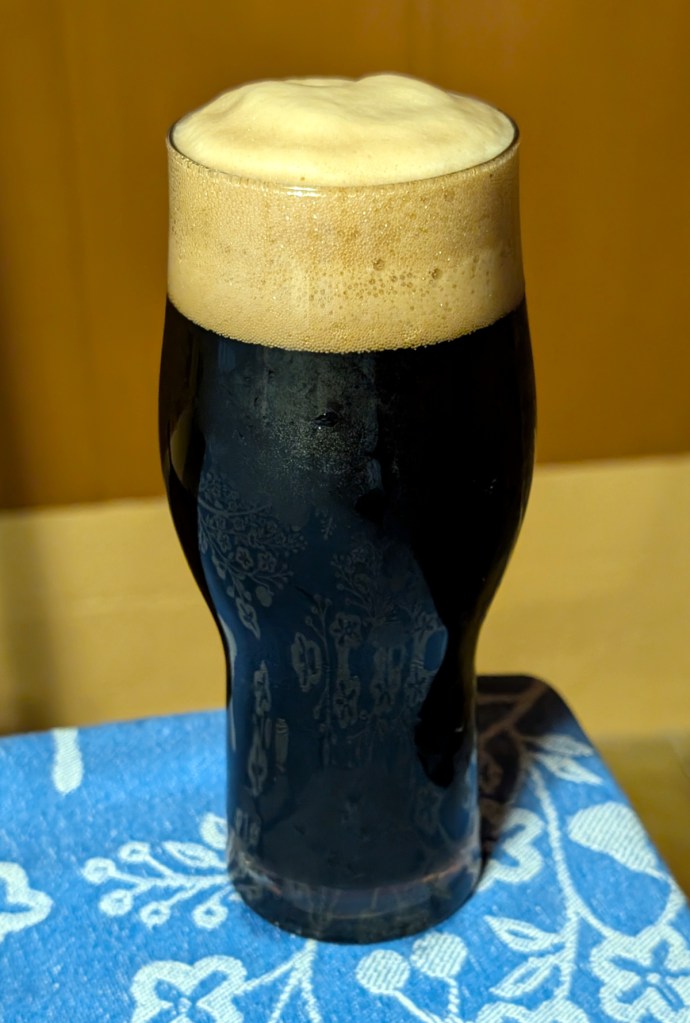
I was recently re-introduced to the American stout style, which harkens back to the early days of craft beer and homebrewing. I feel like this variety of stout was somewhat left in the dust after the rise (and decline) of barrel aged imperial stouts, and these kinds of now-neglected classic craft styles are always enjoyable for me. Relative to other stouts, American stouts are characterized by being fairly robust in body and also fairly bitter, often accentuated by dark grains to amp up the roastiness. Big doses of hops particularly set them apart from their English counterparts.
I have only brewed this style once in the past, and surprisingly few recipes are available. As before, I used a clone recipe for Sierra Nevada’s Stout from the BYO Big Book of Clone Recipes. Last time I boosted the 2-row with Maris Otter, but this time around I stuck closer to the recipe with Munich malt. The supporting grains were a bit different from the original recipe, owing to what I had on hand, but it’s still in the general ballpark. I was low on crystal 60 and roasted barley, relative to the proportions in the original recipe, so I subbed in a bit of crystal 80 and black malt instead, and increased the chocolate malt by a small percentage. Because we’re in the thick of summer, I opted to use Lutra kveik; this particular strain has a reputation for fermenting pretty cleanly. The recipe title is because this beer is incredibly dark, even by the standards of this style; no light can escape!
Recipe Name
- 4 lb. 6 oz. 2-row pale malt (Rahr)
- 1 lb. 4 oz. Barke Munich malt (Weyermann)
- 6 oz. black malt (Simpsons)
- 4 oz. Carafa Special II malt (Weyermann)
- 4 oz. caramel 80L malt (Briess)
- 4 oz. chocolate malt (Bairds)
- 4 oz. crystal 60 malt (Great Western)
- 3 oz. roast barley (Crisp)
- 0.6 oz. Magnum hop pellets (12.0% alpha), 60 minute boil
- 0.5 oz. Cascade hop pellets (5.5% alpha), 10 minute boil
- 1 oz. Northern Brewer hop pellets (8.5% alpha), 10 minute whirlpool at 194°
- 1 pkg. Lutra Kveik (dried; Omega OYL-071DRY)
Target Parameters
- 60 minute infusion mash, 154°, full volume mash
- 1.057 o.g., 1.013 f.g., 5.9% abv, 61 IBU, 64 SRM
- Claremont tap water, with Campden tablet to remove chloramines
- 2.75 gallon batch
Procedure
- I heated 4.25 gallons of Claremont tap water to 160°, and added the grains. I held the mash at 154°, with recirculation, for 60 minutes, before raising the mash to 168° for a 10 minute mash-out. Then, I pulled the grains and brought the kettle to a boil.
- In total, I collected 3.76 gallons of runnings with a gravity of 1.047, for 68 percent mash efficiency.
- I boiled for 60 minutes, adding hops and finings per the recipe. After the boil, I turned off the heat, chilled to 194°, and whirlpooled for 10 minutes before chilling down to 95°.
- I transferred the wort to the fermenter, and pitched the Lutra. I kept the fermenter in the warmest room in our house, which was around 90° during the daytime.
- I brewed the beer on 7 August 2026. Starting gravity was 1.060.
- Active signs of fermentation kicked off within an hour(!), and all bubbling through the airlock had ceased within two days. I left it for a few more days to finish up.
- The beer had a final gravity of 1.020, for 5.2% abv. I kegged the beer on 12 August 2026, with 2.5 oz. of priming sugar.
- The beer was moved on tap on 30 August 2026. Carbonation levels were perfect from the start!
Tasting
- Appearance
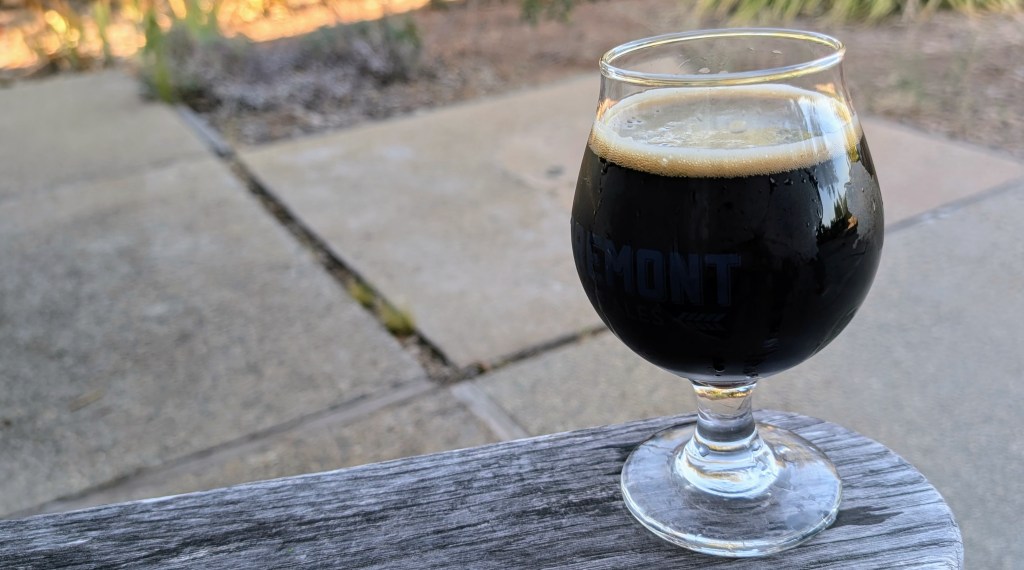
- Inky black beer, with a reasonably persistent deep tan-colored head, which leaves a tiny bit of lacing on the glass.
- Aroma
- Dark chocolate and creamy coffee malt aroma at a medium-high level. Not much for yeast or hop aroma.
- Flavor
- Espresso-like dark maltiness and roast character at a medium-high level, with dark caramel at a low level. Very bitter, with a resiny quality. Slight malt sweetness.
- Mouthfeel
- Medium body, moderate carbonation, slightly dry finish. Mouthfeel has a bit of pleasant creaminess.
- Would I Brew This Again?
- This is a great beer, and quite pleasing as my second attempt at the style. The previous version was perhaps a touch more to my liking, especially in the subtle hop and malt characters. For future brews, I would probably go back to my previous recipe with its particular malt formulation and hop selection. I like a resiny hop character for this style, and I think the Columbus+Cascade combination is just a bit better than the Magnum+Cascade+Northern Brewer combo.
- Overall
- 8/10