
Old Pine Pale Ale

I’ve been doing a lot of IPAs lately, and decided to mix things up a bit with an American pale ale for my next hop-forward beer. The December 2017 issue of Brew Your Own had a clone recipe for Dale’s Pale Ale (by Oskar Blues Brewing), which is one of my favorite beers. I particularly like the malt body with it, so riffed off the recipe to come up with my own version. My other requirement was to focus on piney-type hops, so I bolstered the Cascade core with a hefty Simcoe late addition and dry hop. My hope is to turn this around pretty quickly, because I’m likely going to be out of my Thanksgiving IPA in a matter of days!

Old Pine Pale Ale

  • 9 lbs. California Select 2-row brewer’s malt (Great Western)
  • 1 lb. Golden Promise malt (Simpsons)
  • 0.75 lb. Victory (biscuit) malt (Briess)
  • 3 oz. 80°L caramel malt (Briess)
  • 2 oz. Cascade whole hops (5.5% alpha), 60 minute boil
  • 2 oz. Cascade whole hops (5.5% alpha), 10 minute boil
  • 1 oz. Simcoe hop pellets (13.6% alpha), 5 minute whirlpool after flame-out
  • 1 Whirlfloc tablet, 10 minute boil
  • 1 pkg. California Ale yeast (WLP001), prepared in starter
  • 3 oz. Simcoe hop pellets (13.6% alpha), 5 day dry-hop

Target Parameters

  • Infusion mash to hit target of 152°. Batch sparge.
  • Claremont tap water, with addition of RO water and mineral adjustments to hit target of 98 ppm Ca, 22 ppm Mg, 24 ppm Na, 196 ppm SO4, 48 ppm Cl, and 167 ppm HCO3.
  • 1.055 s.g., 1.012 f.g., 54 IBU, 7 SRM, 5.7% abv
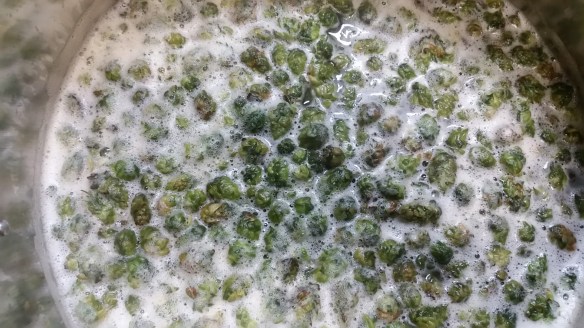
20171202_194028

Procedure

  • Three days in advance of brewing, I prepared a 1.5 L starter (to produce enough yeast for the pitch on this batch as well as to have enough to save for later).
  • For the mash water, I added 2 gallons of RO water to 1.67 gallons of tap water, with mineral additions of 5.9 g gypsum, 0.6 g table salt, 4.8 g epsom salt, and 1.4 g CaCl. I also added 4.5 mL of phosphoric acid (75%) to balance out the pH.
  • I mashed in with 3.67 gallons of the above water at 165°, to hit a mash temperature of 153°. After 50 minutes, I added 1 gallon of tap water at 185°, let sit for another 10 minutes, vorlaufed, and collected the first runnings. I added another 3.6 gallons of tap water at 185°, let sit for 10 minutes, vorlafued, and collected the remainder of the runnings.
  • In total, I collected 6.65 gallons of runnings with a gravity of 1.045. This equates to 75% efficiency.
  • I brought everything to a boil, adding the various hops and Whirlfloc at the appointed times. After 60 minutes, I added the final hop addition, let sit for 10 minutes, and chilled down to 77° before transferring to the primary fermenter and pitching the yeast.
  • Starting gravity was 1.052, just a touch below the predicted. A slightly more vigorous boil probably would have brought things more into line. Even so, I’m not terribly worried; it’s well within overall parameters.
  • I brewed this beer on 2 December 2017, and am fermenting it at 66°.
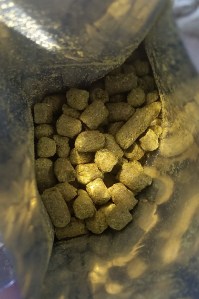
Gondwana Pale Ale 1.5

african_queenMy local homebrew shop happened to have a pound of African Queen hop pellets during my most recent visit…for those not in the know, this is a variety grown in South Africa, and one of the few that is available (for now) in the United States. Due to some recent hop farm purchases, future South African hop availability is likely to be even tighter than before, so I had to jump at this chance to brew with this variety.
These hops are touted as being on the flavor/aroma end of things, so I wanted a good pale ale recipe that would highlight this. My classic Gondwana Pale Ale seemed like just the ticket! I subbed in a little Vienna malt for the 2-row to help bolster the maltiness. Otherwise, there is very little changed here from my most recent iteration, just the hops.

Gondwana Pale Ale 1.5

  • 6.5 lbs. 2-row malt (Rahr Malting Co.)
  • 3 lbs. Vienna malt (Great Western Malting Co.)
  • 0.5 lb. crystal 40 malt (Great Western Malting Co.)
  • 7 oz. Carafoam malt (Weyermann Malting)
  • 0.35 oz. Warrior hop pellets (15.8% alpha), 60 minute boil
  • 2 oz. African Queen hop pellets (14.5% alpha), 5 minute boil
  • 2 oz. African Queen hop pellets (14.5% alpha), dry hop in keg
  • 1 Whirlfloc tablet, 10 minute boil
  • 1 pkg. California Ale yeast (WLP001)

Target Parameters

  • Infusion mash to hit target of 152°. Batch sparge.
  • Claremont tap water.
  • 1.053 o.g., 1.011 f.g., 5.4% abv, 41 IBU, 6 SRM, 5 gallons into fermenter

Procedure

  • A few days in advance, I made a yeast starter, cold-crashing it and setting aside some for a future batch.
  • On brew day, I mashed in with 3.5 gallons of water at 163°, to hit a 152° mash temperature. The temp had dropped to ~150° after 30 minutes.
  • After 60 minutes, I added 1.25 gallons of water at 185°, let sit for 10 minutes, vorlaufed, and collected the first runnings.
  • Next, I added 3.5 gallons of water at 185°, let sit for 10 minutes, vorlaufed, and collected the remainder of the wort.
  • In total, I collected 6.6 gallons of wort with a gravity of 1.045, for 78% efficiency.
  • I started the boil and added everything per the schedule.
  • After 60 minutes, I chilled the wort down to 70 degrees, and pitched the yeast. I’ll be fermenting at 66°.
  • Starting gravity was 1.053 (right on target!). I brewed this beer on 27 May 2017.
  • Final gravity on 7 June 2017 was 1.012, which equates to 5.4% abv. I added the hops to the keg in a mesh bag, and began carbonation and dry-hopping at room temperature.

Beer Tasting: Good Riddance Pale Ale

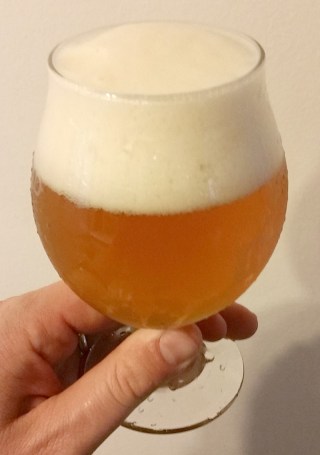
20170218_163101This pale ale has disappeared surprisingly quickly; with only a little bit left in the keg, it’s a good time to do a quick tasting.

  • The Basics
    • O.g. = 1.053; f.g. = 1.011; 5.6% abv; estimated IBU = 41; 7 SRM.
  • Aroma
    • Orange and grapefruit, with a hint of tropical fruit at the background — a nice, medium-strong hop aroma.
  • Appearance
    • When poured, I get a tall, off-white head that is pretty persistent and medium-fine. The beer itself is a burnished gold color and fairly hazy (but not opaque like a NEIPA).
  • Flavor
    • The balance is towards the hops (which have a definite grapefruit character), but the malt character is still pretty nice–slightly grainy.
  • Mouthfeel
    • Bitterness is moderately high, but not over the top. The finish is a touch thinner and drier than I care for, which could be corrected by mashing a degree or two higher or adding in an extra quarter pound of crystal 20. That said, the finish is also nicely balanced between hops and malt, and isn’t puckeringly bitter like some other beers I’ve made.
  • Would I brew this again?
    • This beer was a real surprise! I like it much more than I thought I would. Considering that the main aroma hops were coming up on two years of ago, they held their own really well. I suppose the combination of vacuum seal+deep freeze paid off! This is definitely encouraging for other hops in long-term storage. Overall, the base recipe is another good one to add to my repertoire of American pale ales, with just a few minor modifications for mash temp and hops.
  • Score
    • 7/10

Update: Good Riddance Pale Ale and Eagle Face Oatmeal Stout

Tonight it was time to keg my most recent pale ale and my annual oatmeal stout batch.

Good Riddance Pale Ale, after 20 days in the primary fermenter, was down to 1.011 from a starting gravity of 1.053. This equates to 5.6% abv. As I kegged the beer, I added a weighted mesh bag with the dry hops (1 oz. Amarillo hop pellets, 1 oz. Falconer’s Flight 7C’s hop pellets). I’ll be letting this sit at ~68° under carbonation pressure for at least a few days before serving.

Eagle Face Oatmeal Stout (1.4) had been in the primary fermenter for 15 days. It had a starting gravity of 1.060 and a final gravity of 1.019, equal to 5.4% abv. The gravity was a few points more attenuated than expected–most likely due to the slightly lower-than-normal mash temperature for this particular iteration.

This whole undertaking was a good reminder of why I am glad I was able to switch over to kegging–it took barely an hour to sanitize the kegs, keg the beers, clean my transfer equipment, and set the fermenters to soak! I would have needed up to twice that time for bottling!

Beer Tasting: Wild Times Pale Ale

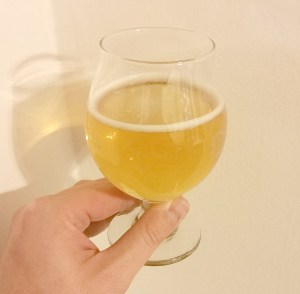
20161226_163216The Wild Times Pale Ale is no more…but I did get a tasting in before the 2.5 gallon keg was all gone!

  • The Basics
    • Original gravity = 1.046, final gravity = 1.011, abv = 4.7%, estimated IBU = 45
  • Aroma
    • Faintly floral hop aroma, with a very light caramel malt aroma.
  • Appearance
    • Brilliantly clear and light yellow in color, with a low white head that is pretty persistant.
  • Flavor
    • A lightly grainy and bready malt aspect; the hop flavor tends towards the distinctly (but not overly) bitter. The bitterness is fairly uncomplex, and the hop flavor has a slightly grassy aspect to it with a faint edge of citrus pith. It’s not bad, just not exceptional.
  • Mouthfeel
    • A pretty dry and light-bodied beer.
  • Overall
    • This is a pretty average pale ale. It’s not bad; it just doesn’t have much that pops out at me. It needs a bit more body and malt complexity; this probably would entail a bit of crystal malt and/or a second base malt (Munich or Vienna, perhaps) to round things out. I also ended up with a slightly lower gravity than expected after the boil, which doesn’t help matters much either. The aroma hop attributes have definitely diminished a bit over time. At their peak, they were surprisingly good, particularly as a novelty item. For an experimental beer, this was certainly a worthy attempt, but any future pale ales will need a different malt base.
  • Score
    • 5/10