
I kegged my Accretion Porter on Tuesday, April 12. Final gravity was 1.020, down from 1.058, for 5.0% abv. No major comments on the beer at this point, other than it seems to be right on target.
My First Homebrew Medals!
Homebrew competitions have had a steep learning curve for me, and the experience has been a mixed bag as a result. I’ve entered two competitions previously, to mostly mediocre scores (28 for a milk stout and 28.6 for a vanilla porter I brewed in 2014, and 25 for an oatmeal stout I entered in 2015, all out of 50). Using the BJCP scoring guide, that puts them range of entries that are “good” but “[miss] the mark on style and/or minor flaws”. This was a bit disappointing at the time, but the feedback was really helpful as a learning experience.
What I Learned From Previous Competitions
Although my scores were not awful, they were instructive on how I could improve my brewing, and even more critically, how I could improve my entries for competition. As I learned from reading many sources, it’s not enough to brew a good beer–you also have to brew a beer that hits the points that judges are looking for within a flight of entries. Time and introspection have shown the following:
- Category matters (Part 1). It’s easier to place in smaller categories, particularly against the odds in big categories with experienced brewers (and there are lots here in SoCal!). This is the reason I haven’t bothered with an IPA, for instance. I really like some of my IPA’s, but am not convinced they would score well against the really excellent brews my friends and colleagues are brewing.
- Category matters (Part 2). If you’re going to enter a category, make sure you are brewing your beer within the overall style parameters. An otherwise good beer might get dinged for being outside of style, if it’s not a good match. For instance, I submitted a vanilla porter as a robust porter — and that was a mistake. The judges noted “odd” aromas that were almost certainly in part from the vanilla–in fact, one even stated that “The herbal flavor is vanilla, so this beer should have been entered as a specialty [beer].” This is a bit different from the oft-repeated advice that winning beers often push the bounds of categories; after all, a beer can push bounds while still being within believable reach of the style. Stretch boundaries, but not too much!
- Fresh, fresh, fresh. I’m really proud of my oatmeal stout, and consider it a good beer. The one time I entered it in competition, though, the bottles had been sitting around for a few months. One judge suggested some oxidized flavors were at play, and another noted that the beer was a tad thin. I suspect both of these were due (in part) to the age of the brew, with maybe a bit of secondary fermentation in the bottle. Surely there were other facets I could improve, but nonetheless resting at room temperature for months didn’t do the beer any favors. Lesson learned.
- You have to be on top of your brewing game. I have definitely improved over the past few years, as I pay closer attention to fermentation temperature and such. For instance, I have drastically improved my carbonation procedures (either by carbonating with CO2 or more carefully measuring my priming sugar), which avoid hazards of overcarbonation. This can only help in judging!
- Read the comments. Even if the judges’ assessments of the beer didn’t match my own lofty expectations, I needed to swallow my pride and take their comments seriously. Every entry has two score sheets, and there is naturally a bit of variance. One judge might pick up oxidation, but the other judge might not. Even so, I have seen enough commonalities between scorings that I am willing to listen. If both judges give middling scores, it is probably a middling beer for the purposes of that category.
Although I was disappointed that I didn’t get any medals in my first two competitions, they were a valuable learning experience. Firstly, I gained confidence that my beers weren’t awful. Nothing the judges said indicated that I had tremendous process flaws–it was a matter of relatively minor tweaking to transform decent beer into good beer into great beer. I also gained an understanding of the competition process–brewing for a medal can be (but isn’t necessarily) different from brewing for personal satisfaction. I might have the best vanilla-infused porter on the planet, but it will never do well if the judges are expecting a standard porter.
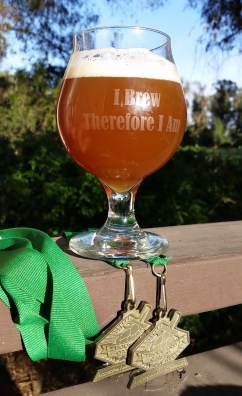
A celebratory IPA for my first medals
Renewed Efforts
Based on my adequate, but not great, performances, I was a little cynical on competitions. I liked my beer, and many of my friends said they liked my beer, so why bother with the dog-and-pony show of a formal beer competition? I had accepted the lessons mentioned above, but wasn’t confident enough or filled with enough energy to test the waters in another competition.
Thankfully, I have a homebrew club to kick my butt into gear.
At the December meeting of Horse Thief Brewers Association, our president noted the upcoming “Romancing the Beer” competition, sponsored by Thousand Oaked Brewers. He wanted to see a good turnout for “The Thieves,” and even offered to transport the beers personally to the entry center. I came to a final realization–what would it hurt to try again? No entries, no awards.
I decided to enter my 80 shilling ale, imperial stout, Berliner Weisse, and Irish stout. They were pretty fresh, decent brews (in my opinion), and for at least two (the Scottish and the Irish beers) were in categories that don’t always get a lot of entries.
Due to my own incompetence, I only ended up with three entries, because I had attached the wrong labels to one set of bottles. Oops! One of my four initial submission was removed from competition as a result (major kudos to the folks in charge for alerting me to this, and refunding my entry fee). So, three beers went into the fray.
And of those three, it turned out the wrong labels were on one (oops again–the wrong set of beers had been removed of the original four). Totally my fault, but needless to say, a Scottish export doesn’t score well in the imperial stout category (to the tune of 17/50 as a score). Lesson learned, and I’ll definitely double-check the bottle labels next time!
But for my remaining two…what a surprise! I was completely shocked to see that both placed first in category.
My Irish Stout placed first out of the five combined “Scottish and Irish Beer” entries, with a respectable (but not outstanding) score of 36.5 (average of 36 and 37). I suspect it wouldn’t have placed so highly if there were more entries, but I’ll take a win! And, it was nice to see the beer so well received.
The real shocker, though, was for my Berliner Weisse. It placed first out of 12 entries in the “Sour Beers” category, with an average score of 41.5 (39 and 44)! This was a pleasant surprise on several counts. First, sour beers are a bit in vogue at the moment, and there are some great sour brewers in Southern California. There must have been stiff competition! Second, I had never attempted a sour before, and I don’t drink a lot of them, so I really had no idea how my beer really fell on the sour spectrum. Finally, I “cheated” a bit with this brew. It was brew-in-a-bag, and kettle soured. Easy, simple, and apparently successful! That was a nice boost of confidence, to realize that simple techniques could produce something so technically solid in the eyes of a judge.
Final Thoughts
It was a nice boost of confidence to get external validation for some of my brews, particularly after the learning curve of earlier competitions. I don’t know if I’m going to enter every competition that comes my way, but I’ll certainly be trying a few more in the future. The overall process has forced me to consider my technical processes more carefully, and provided some helpful feedback along the way. That has definitely added up to better beer overall. I don’t expect to have such success every time, but I am hopeful for future efforts as a whole, regardless of whether they go to competition.
Accretion Porter
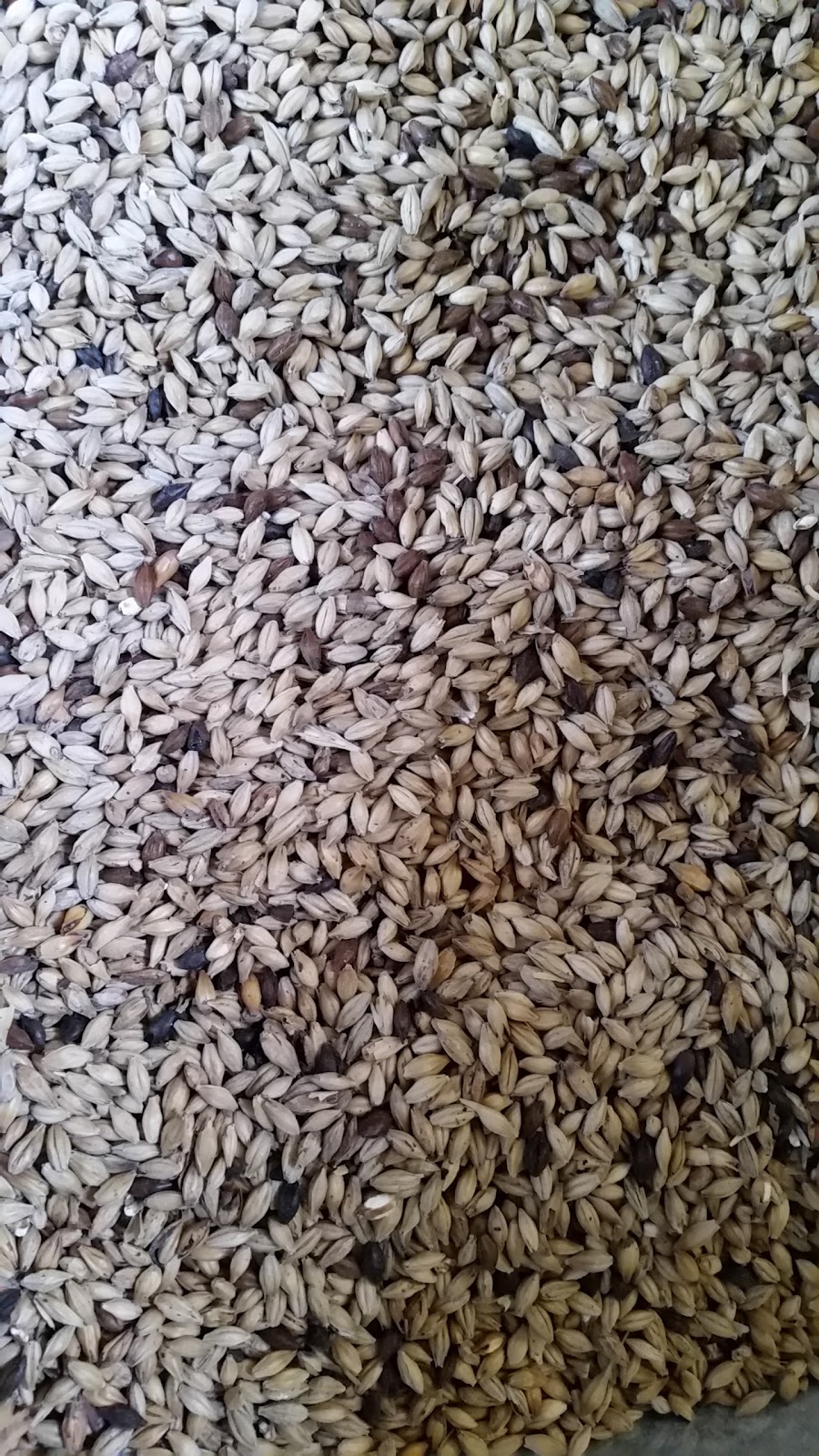
My oatmeal stout is popular–and so it is just about all gone, thanks to the able efforts of many friends and family members. I do like to have a “dark beer” on tap at all times, though, so it’s time for another brew. I had thought about doing a “session porter,” but thought instead I’d use up a bunch of ingredients and go for something a little bigger instead. I haven’t done a robust porter in awhile, so that seemed like a good style to aim for.
In formulating this recipe, I had a two things in mind. Firstly, I wanted/needed to use up a bunch of ingredients. Secondly, I wanted a rich and complex brew. The intersection of these two sets brought in a ton of dark grains–pale chocolate malt, roasted barley, de-bittered black malt, and black patent malt, along with a healthy dose of honey malt and dark crystal malt to bring some rich caramel characteristics. I was okay with having a high percentage of ultra-dark grains, because I felt the beer would need some of that to balance out any sweetness from the honey and crystal malts. I elected to use WLP002 (English Ale yeast), because I had a culture of that in the fridge. Plus, I figured that would add a nice complex and fruity dimension to the beer.
Thus, Accretion Porter was born! The name references the geological process by which some landmasses are formed–successive addition of a random smattering of crust–that mimics the assembly of the grain bill.
Accretion Porter
- 9.5 lbs. Maris Otter (pale malt)
- 1 lb. honey malt
- 0.75 lb. crystal dark malt (77°L, Crisp)
- 0.5 lb. flaked barley
- 7 oz. pale chocolate malt
- 4.4 oz. roasted barley
- 4 oz. de-bittered black malt
- 2 oz. black (patent) malt
- 0.84 oz. Northern Brewer hops pellets (9.9% alpha), 60 minute boil
- 1 oz. Cascade hops (whole; est. 4% alpha), 30 minute boil
- 1 oz. Cascade hops (whole; est. 4% alpha), 10 minute boil
- 1 tsp. Irish moss, 10 minute boil
- 1 pkg. English ale yeast (White Labs WLP002), prepared in 1.5L starter.
Procedure
- A day in advance, prepared a 1.5L starter of the yeast, which I had cultured previously. Because I don’t know when I’ll next get a chance to use this strain, I elected not to overbuild the starter.
- I mashed in with 4.5 gallons of water at 168.5°, to hit a mash temperature of 155.5°. After 50 minutes, I added 0.75 gallons of water at 200°, let sit for 10 minutes, vorlaufed, and collected the first runnings. I added another 3.5 gallons of water at 180°, which raised the mash bed to 165.5°. I let this sit for 10 minutes, vorlaufed, and collected the remainder of the wort. In total, this was 6.9 gallons of wort with a gravity of 1.048, for 70% mash efficiency.
- I brought the wort to a boil, and added the hops and Irish moss at the indicated schedule.
- After 60 minutes, I turned off the heat and chilled the wort to 76°.
- 5.1 gallons of wort went into the fermenter, with a starting gravity of 1.058. I am starting fermentation at ambient temperature (65°), and will move it into the fermentation chamber within 24 hours, for a fermentation temperature of 66°.
- I brewed the beer on 19 March 2016.
Transatlantic IPA 1.1 Kegged

After three weeks in the primary fermenter, I kegged my Transatlantic IPA 1.1 tonight (12 March 2016). The beer was down to 1.015 from 1.060, for 5.9% abv. I added 2 oz. of Falconer’s Flight 7C’s and 1 oz. of Australian Galaxy hops pellets in a mesh bag, and simultaneously began carbonating at ambient temperature (~64°). All indicators seem positive so far!
2016 Orange Summer Wheat Ale Kegged
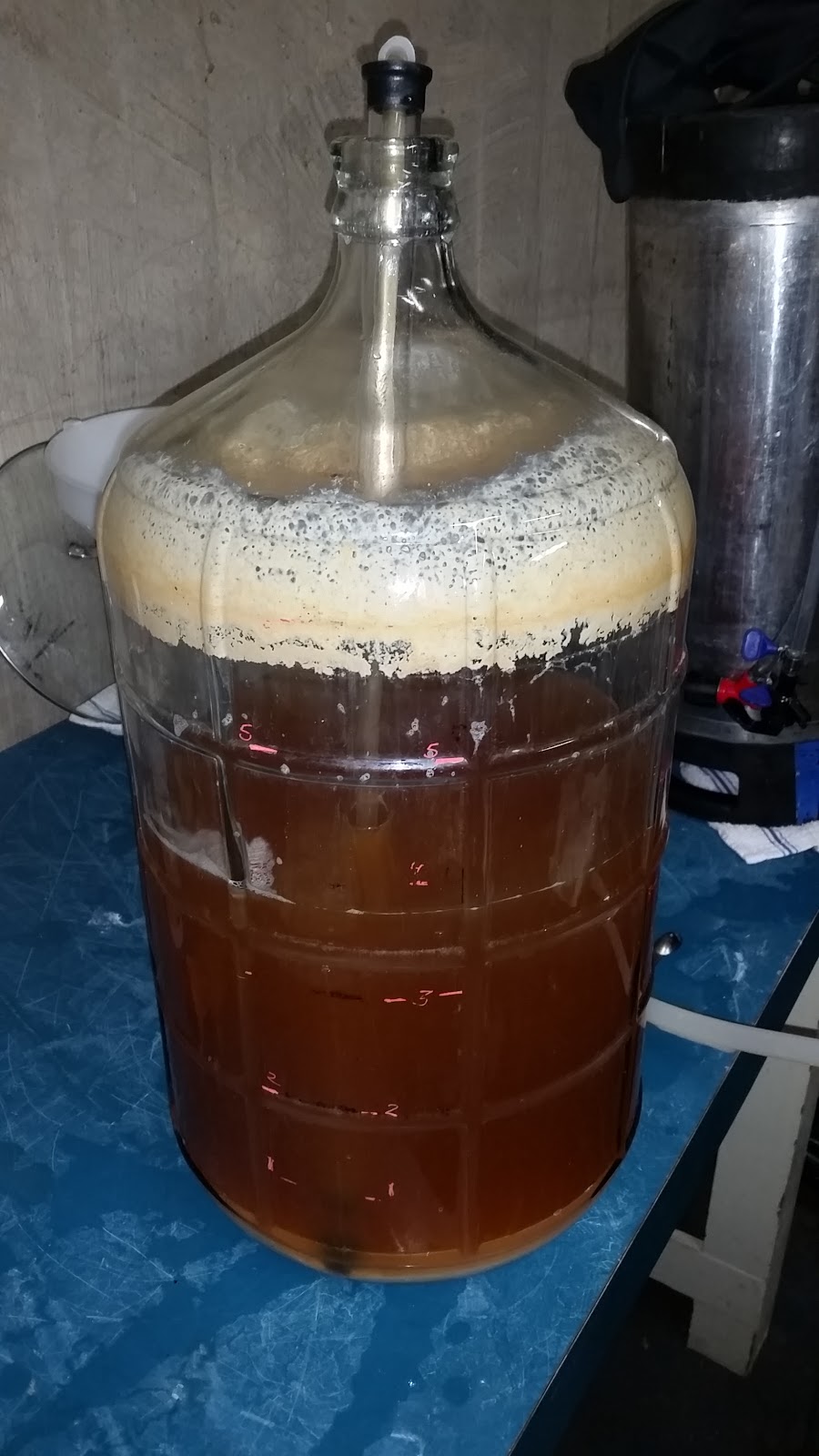
Tonight (24 February 2016), I kegged my latest orange wheat ale. It had dropped from 1.043 to 1.010 gravity, for 4.3% abv. I added the orange extract (I had filtered out the peel pieces, leaving just the liquid), and it has added a great aroma and flavor. Now it’s carbonating, and should be ready to tap in a few days!
 Andy's Brewing Blog