
Sam’s Mead

With the arrival of a new human in our family, I thought I would brew up a batch of mead in his honor. The general idea is to have an “heirloom batch” that can be kept on-hand for special occasions – first birthday, 21st birthday, etc. Hopefully it will last long enough for that! With five gallons, this will allow the occasional sampling down the years.

The recipe is slightly modified from the Antipodal Mead in Charlie Papazian’s Complete Joy of Home Brewing. The main adjustment is the addition of lemon juice (instead of acid blend) and apple cider (to add some nutrients, because I didn’t have yeast extract on hand – I may get some and add it to the secondary fermenter later).

The lemons were from a local lemon tree (picked ourselves), and the U of Minnesota honey was from Sam’s aunt (currently a graduate student at U of M).

Sam’s Mead

  • 5 pounds University of Minnesota Department of Entomology honey 2012 (slightly dark)
  • 5 pounds University of Minnesota Department of Entomology honey 2011 (slightly dark)
  • 5 pounds wildflower honey (originating in Argentina, Mexico, Uruguay) (relatively dark)
  • 1 tbs. gypsum
  • 1/3 cup fresh-squeezed lemon juice (6 small lemons)
  • 1 quart (4 cups) apple cider
  • 1/4 tsp. Irish moss
  • 5 packets champagne yeast (0.88 oz; 25 g); Lalvin EC-1118, Saccharomyces cerivisiae (ex-bayanus)

Procedure

  • Heated 1 gallon of water to boiling; turned off heat, added honey, gypsum, cider, and lemon juice. Rinsed honey jugs using 3 cups of water total, which were added to brew pot.
  • Heated water to boil; boiled for 15 minutes. Add Irish moss after 10 minutes.
  • After 15 minutes, chill mead. Add to fermenter, top up to five gallons with cold tap water.
  • Proof yeast in 1 cup water (boiled and then cooled to ~100 degrees).
  • Add yeast to fermenter. Seal fermenter, add airlock.

The recipe was brewed on December 28, 2012, and initial gravity was 1.118 at 72° F. This converts to 1.119 at 60° F, resulting in an estimated a.b.v. of around 12% (assuming it ferments down to ~1.03 or so).

Because I needed the primary fermenter for my IPA, I transferred over to a glass carboy on January 1, 2013. At this point, the gravity was 1.090. My plan is to let it ferment/settle/condition for about six months before bottling.
Rainy Day IPA 1.2

One of my very favorite recipes so far has been the “Rainy Day IPA” – brewed back in 2010 and 2011.  I modified things a little based on what my local brew shop had (Centennial instead of Cascade, and White Labs rather than Wyeast), but otherwise it’s basically the same as before.

Ingredients for Rainy Day IPA 1.2

  • 10 oz. 20° crystal malt
  • 1 lb. 60° crystal malt
  • 3 lbs. golden light dry malt extract
  • 3 lbs. sparkling amber dry malt extract
  • 2 oz. Centennial hops pellets (11.4% alpha acid; 4.1% beta acid) for bittering
  • 1 oz. Centennial hops pellets (11.4% alpha acid; 4.1% beta acid) for aroma
  • 1.1 oz. Cascade hops pellets for dry hopping
  • 1 oz. Centennial hops pellets for dry hopping
  • 1 tsp. Irish moss
  • White Labs California Ale Yeast WLP001

Steps

  • Steep crystal malt in 3 gallons of water at 158° for 60 minutes. Sparge with 0.625 gallons at roughly the same temperature, for a total pre-boil volume of 3.625 gallons.
  • Heat mixture to boiling, turn off heat. Add dry malt extract. Heat to boiling, add bittering hops.
  • Boil for 45 minutes, add Irish moss.
  • Boil for an additional 12 minutes, add aroma hops.
  • Boil for an additional 3 minutes, for a total of 60 minutes.
  • Cool using cooling coil. Top up to ~4.75 gallons using cold tap water, and pitch yeast at 70° F.
  • Starting gravity was 1.060 at 70° F.

Based on calculations in BeerSmith, the starting gravity was spot-on. The recipe has an estimated bitterness of 63 IBUs, color of 8.5 SRM, and estimated final abv of 5.3%.

As in previous versions of this beer, I plan to dry-hop after transferring to the secondary fermenter in one week. More updates will be posted as appropriate.

Fake Tire Amber Ale 1.2 Update

Having brewed my Fake Tire Amber Ale 1.2 on October 7, I transferred the beer into the secondary fermenter on October 14. Due to various life events, I did not get around to bottling until Monday, November 26. So, the beer sat in the secondary for nearly six weeks. This is longer than I normally go, but the result seems to be an exceptionally clear beer.

Final gravity is 1.010 at 68° F, down from an original gravity of 1.052 at 60° F. Adjusting for temperature, this gives an a.b.v. of 5.5%. The flavor is quite clean, and I think will match Fat Tire pretty well.

I primed the beer with 3/4 cup of priming sugar, and bottled it. The result was 14 12-oz. bottles, 11 18-oz. bottles, and 7 22-oz. bottles.

Fake Tire Amber Ale 1.2

One of my favorite beers from last year was my Fake Tire Amber Ale (a clone of Fat Tire). The first batch was so good that I brewed it again! The second batch was largely the same as the first, except I used pelletized hops instead of whole hops. The unfortunate effect was that the beer was slightly more bitter. Thus, I decided to further refine my pelletized recipe for this brew session. Following advice elsewhere, I reduced the overall hops amounts by 10 percent, to compensate for the greater surface area (and contribution of bitterness) from the pellets versus the whole cones. I also changed the yeast, from Wyeast 1272 (American Ale II) to White Labs WLP051 (California V Ale), based on what was available at my local homebrew supply shop.

The result is:

Fake Tire Amber Ale 1.2

  • 5 pounds plain extra-light DME
  • 0.5 lb Munich light malt
  • 0.5 lb Carapils malt
  • 0.5 lb biscuit malt
  • 0.5 lb crystal malt (20° Lovibond)
  • 0.5 lb crystal malt (40° Lovibond)
  • 1.0 oz chocolate malt
  • 0.9 oz. Cascade hops (60 minutes boil)
  • 0.9 oz. Mt. Hood hops (5 minutes boil)
  • 1 tsp. Irish moss (15 minutes boil)
  • White Labs WLP051 Yeast (California V Ale)

Steps

  • I heated 3.5 gallons of tap water to 154° F, and steeped the grains for 45 minutes. Then, I sparged the grains with 0.5 gallons of tap water at 154°.
  • After bringing the mixture to a boil, I turned off the heat and added the malt. I brought it back to a boil, and threw in the Cascade hops.
  • After boiling for 45 minutes, I added 1 tsp. of Spanish moss.
  • After boiling for another 12 minutes (for 57 minutes total boil), I added the Mt. Hood hops.
  • After 3 more minutes (60 minutes total of boiling), I cooled the wort with my chiller, added cold tap water to a total of 4.5 gallons, and pitched the yeast. Pitching temperature was 76° F, and starting gravity was measured at 1.052 (gravity is recalculated to what it would be at 60° F).
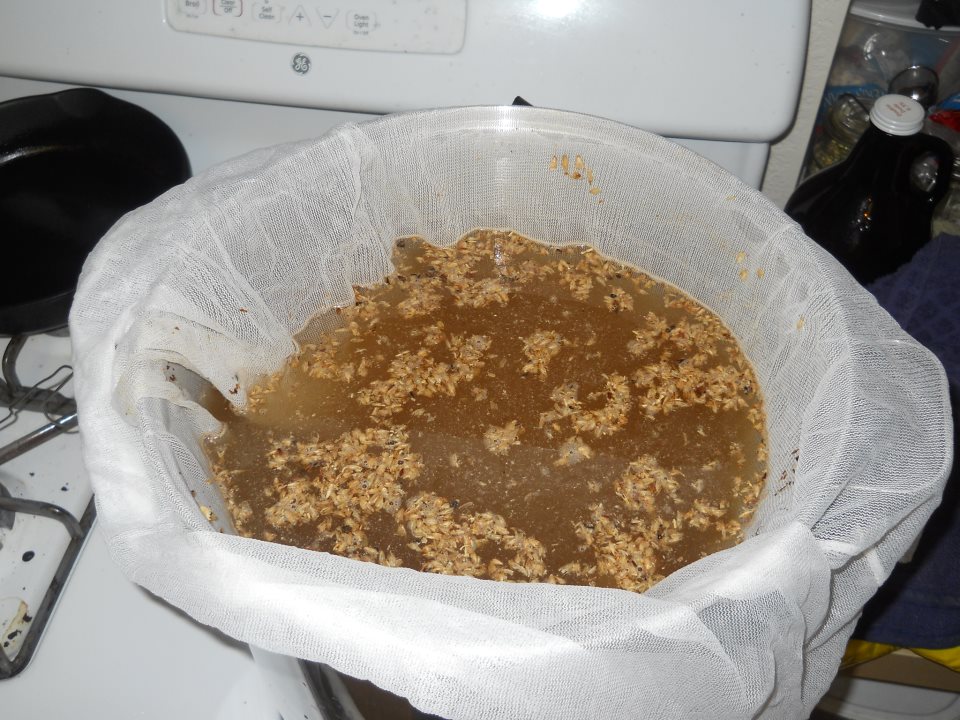
Steeping the grains for Fake Tire Amber Ale 1.2

    Coopers Stout

    Continuing my series of quick-and-dirty brew kits, I brewed up a Coopers Stout last weekend (apparently different from the Coopers Irish Stout that I brewed last year).

    The procedure was pretty much the same as the Muntons nut brown ale kit I did recently. Boil 2 pounds of dry amber malt extract in ~0.75 gallons of water, take off the boil and stir in the can of hopped liquid malt extract. This time, to avoid the problems of trying to get it to cool down fast enough for yeast pitching, I put a lid on the brew pot and stuck it in the fridge for a few hours. That evening (Saturday, September 22), I dumped the cooled wort in the primary fermenter, and topped up to 5 gallons of water. The pitching temperature was 80 degrees, and the starting gravity was 1.042 (at pitching temp). This time, I just pitched the yeast that came with the kit, and put the lid on the fermenter.

    The fermentation was vigorous! Within a day it was spilling out the fermenter. . .because I had this same issue last year with the Irish stout kit, I wonder if it is not something inherent to the yeast strain. In any case, a week went by and the gravity was down to 1.016 at 60 degrees. So, time to bottle!

    I transferred the beer into my bottling bucket, and stirred in 3/4 cup of priming sugar that had been boiled in 2 cups of water. The end result was 7 22-oz. bottles, 7 18-oz. bottles, and 33-12 oz. bottles. Not bad at all! And the taste is pretty good, too (guess the vigorous fermentation isn’t a bad thing in the end). Estimated a.b.v. is 3.7%.