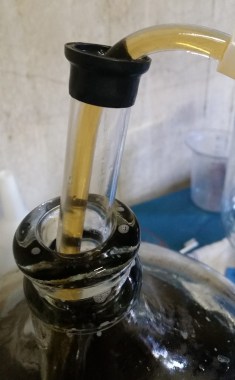
Equinox IPA Kegged

Today I kegged the Equinox IPA. It had been in the primary fermenter since 27 August, just a little over two weeks. After the first week, on 3 September, I moved the beer out of my fermentation chamber (which was getting switched over for a lager), and let it ride at ambient temperature for a week or so. I figured this would be OK, because the main run of the yeast had presumably wrapped up by this point, so the risk of getting off-flavors from a hot fermentation was quite low.

Final gravity was 1.010, down from 1.062, equating to 6.8% abv. I added the dry hops (3 oz. of Equinox hop pellets) at this time; they’re in a bag, weighted down with some stainless steel washers and suspended in the keg via unwaxed and unflavored dental floss. I will leave it at ambient temperature for a few days, before tossing it into the keezer to carbonate at the lagering temperatures.

Citra Wit

It’s time to brew another light-and-drinkable beer (in anticipation of the inevitable kicking of my pilsner keg). For this round, I wanted to try a style I haven’t brewed before, and a Belgian wit seemed like just the ticket. I’ve done a few iterations of a white IPA with Belgian wit yeast, and a less hoppy brew wasn’t too much of a stretch from that.

In putting together this recipe, I settled on a 50% pils20160811_191734ner malt, 50% flaked wheat grist. Based on what I read, flaked wheat seemed like a nice alternative to whole unmalted wheat. The wheat was balanced with a hefty dose of rice hulls in order to ease sparging.

Belgian wits are commonly characterized by a generous dash of coriander and bitter orange peels. I had some coriander on hand in my brewing drawers, but was out of bitter orange. They didn’t have any at my LHBS, either, and fresh oranges are out of season here. So, I grabbed a grapefruit, zested it, and then did a quick peel. To continue on the citrus theme, all of the hopping was accomplished with a very late boil dose of Citra (only around 3 minutes before flame-out, with steeping for the duration of wort chilling).

Citra Wit

  • 5 lbs. pilsner malt
  • 5 lbs. flaked wheat
  • 0.87 lb. rice hulls
  • 2 oz. Citra hops pellets (14.1% alpha, 3.6% beta), 3 minute boil
  • 0.75 oz. fresh grapefruit peel, 5 minute boil
  • 0.25 oz. coriander (crushed), 5 minute boil
  • 0.5 tsp. yeast nutrient, 5 minute boil
  • Belgian Wit Ale Yeast (WLP400)

Procedure

  • Five days in advance, I built a 1.5L starter for some Belgian Wit Ale yeast I had harvested on May 5, when I last brewed a white IPA. After two days on the stir plate, I moved the starter into the refrigerator to cold crash the yeast.
  • On brew day, I mashed in with 3.8 gallons of water at 163°, to hit a mash temperature of 153.2°. This was down to 149° after 50 minutes, and around 147° after 65 minutes. At this time, I added 1 gallon of water at 190°, to raise the mash bed to 149°. I let it sit for 10 minutes, vorlaufed, and collected 2.5 gallons of wort.
  • I added 3.7 gallons of water at 175°, which raised the mash bed to 164°. Because I had only collected 2.5 gallons on the first runnings, I added an additional gallon at 180°, to raise the mash bed to 165°. I figure that the wheat flakes absorbed a lot of extra water, hence the low volume on first runnings.
  • After another 10 minutes, I vorlaufed and collected the remainder of the runnings from the mash tun.
  • In total, I collected 6.6 gallons at a gravity of 1.038. This works out to 69% efficiency. This is a little lower than normal; most likely due to the high percentage of wheat flakes in the grist.
  • I started the boil, and added the various hops, spices, and yeast nutrient per the schedule. Because I was a little distracted, I ended up miscalculating the boil time and ended up with around 55 minutes total.
  • I cooled the wort to 81° (as far as I could get it with the current groundwater temperature), and transferred the wort to my primary fermenter while aerating. I pitched the yeast and sealed everything up.
  • This batch was brewed on 12 August 2016. Starting gravity was 1.043. I am fermenting this at 71°; vigorous fermentation had started within 12 hours of pitching the yeast.

Spring Cleaning Amber Ale Kegged

20160526_174737After 12 days in the primary, tonight I kegged my Spring Cleaning Amber Ale. The beer dropped quite clear in the carboy, and comes across as a fairly classic amber ale in color, flavor, and aroma. Amber ales often aren’t terribly exciting to me, but I think they make a nice “dark” beer to have around during the summer months.

From a starting gravity of 1.050, we ended up at 1.014. That works out as 4.7% abv and 71% apparent attenuation. This is a bit higher final gravity than predicted, but could be explained by evolution of the yeast towards a less attenuative strain over the cultured generations (supported by the very clear beer on the transfer, somewhat different from my earlier batches with this same culture).

Honey Fuggle Ale

I recently ran across a fun-looking recipe in BYO (December 2015 issue), for a clone of Firestone Walker’s 805. I was in the mood to make a blonde ale, and particularly in the mood to make a new recipe of blonde ale. With a few minor modifications (US Fuggles instead of Willamette for the hops, and a touch less wheat malt, to use up my stash without having to buy more), I had everything in order.

The original recipe suggested building up from RO water; given the highly mineralized nature of our tap water, that seemed like a good idea. I’ve noticed that many of my lighter-flavored beers come across as a bit “flabby”, and suspect that the water is behind it. So, I bought a bunch of distilled water and some more brewing minerals. For the 3.75 gallons of mash water, I added 7 g of calcium chloride and just under 1/4 tsp. of 10% phosphoric acid. The 4.9 gallons of sparge water were treated with just 1/4 tsp. of 10% phosphoric acid.

I have to say that I really enjoy the honey malt addition in this one–it adds a deliciously sweet and distinct character to the wort. Although it certainly isn’t a malt for all occasions, it’s a nice ingredient to keep in the back of my mind for other batches. I’m intrigued to see how the honey malt plays out in a blonde ale like this one.

I had planned to use my culture of Conan (Yeast Bay’s “East Coast Ale” yeast), but when growing up the culture I noticed the aroma was a bit “off” from the first few generations. It wasn’t awful–just not quite right. So, I made a decision to toss it and go with dry yeast instead. The yeast didn’t really owe me anything–I got three good batches out of it, so that seemed to be plenty fine. I’m not sure if it was a contamination issue, or if the yeast had just drifted genetically.

20160521_072106

Grains ready for the mash tun.

Honey Fuggle Ale

  • 8.25 lbs. 2-row malt (Great Western Malting Co.)
  • 0.75 lbs. honey malt
  • 0.5 lb. white wheat malt
  • 1 oz. US Fuggle hops pellets (4.5% alpha, 3.1% beta), 60 minute boil
  • 1 oz. US Fuggle hops pellets (4.5% alpha, 3.1% beta), 5 minute steep after boil
  • 1 tsp. Irish moss (10 minute boil)
  • 1/4 tsp. yeast nutrient (10 minute boil)
  • 1 pkg. Nottingham dry yeast (Danstar)
  • Brewing water prepared as follows:
    • 3.75 gallons of mash water, with 7 g. calcium chloride and 1/4 tsp. 10% phosphoric acid
    • 4.9 gallons of sparge water, with 1/4 tsp. 10% phosphoric acid

Brewing Targets

  • Mash temperature = 156°
  • Original gravity = 1.045 (actual = 1.048)
  • Color = 5 SRM
  • IBU = 19

Procedure

  • I mashed in with 3.75 gallons of water at 167.9°, to hit a mash temperature of 157°. The mash was down to 152° after 60 minutes.
  • I collected the first runnings, and then added 4.9 gallons of water at 185°, to bring the mash bed up to right at 170°. I let it sit for 10 minutes, vorlaufed, and collected the rest of the wort.
  • I collected 7.2 gallons of wort at a gravity of 1.039, for 81% efficiency! Wow! I am not sure if this was the result of my water treatment, or something else, but it was certainly unexpectedly high.
  • I brought the wort to a boil, and added the various ingredients per the schedule in the recipe.
  • After 60 minutes, I added the final dose of hops and chilled the wort down to 80°. After transferring it into my carboy, I let it cool in the fermentation chamber for an hour or two, down to 68°, and then sprinkled the yeast on the wort.
  • The starting gravity was 1.048, and I am fermenting the beer at 68°. This beer was brewed on Saturday, 21 May 2016.

Summer Blonde Ale 1.1 Kegged

Tonight I kegged the Summer Blonde Ale that I brewed up on May 10. It has been in the primary for 12 days, with a very vigorous fermentation. Starting gravity was 1.047, with a final gravity of 1.009. This calculates out as 5.0% abv, nearly identical in stats to the first iteration of the recipe. The flavor is clean and lightly malty, at least in its uncarbonated state. Approximately 4.75 gallons of beer went into the keg. I’ll be force carbonating this, with an aim to have it on tap within a few days.