St. Arnold Christmas Ale (Homage)

Early in November, I visited the St. Arnold Brewing Company taproom, where I sampled their newly tapped Christmas Ale. True to its reputation, this was a phenomenal beer, and I enjoyed sitting down with the BYO Big Book of Clone Recipes to compare with my perceptions from the actual beer. That evening, I decided my next batch would be a Christmas Ale clone, and I planned out the brew session while sipping the real thing.

The batch brewed here hews pretty closely to the published clone in the malt bill and bittering hops. However, I subbed in Hallertauer for Liberty hops at flameout and used WLP066 (London Fog) instead of Wyeast 1968 or WLP002. WLP066 and WLP002 are very different, but the purported citrus and tropical fruit characters for WLP066 seemed like a good match for a holiday ale. From perspective of convenience, WLP066 is available in dry form and I already had some on-hand, too.

Saint Arnold Christmas Ale (Homage)

  • 6.25 lb. 2-row pale malt (Rahr)
  • 11 oz. Caravienne malt
  • 8 oz. Munich malt (BESTMALZ)
  • 4 oz. Caramunich II malt (Weyermann)
  • 4 oz. Special B malt (Dingemans)
  • 0.25 tsp. BrewTanB, added to mash
  • 0.75 oz. Perle hop pellets (6.3% alpha), 30 minute boil
  • 1 Kick carrageenan tablet, 5 minute boil
  • 0.25 tsp. yeast nutrient (White Labes WLN1000)
  • 1.1 oz. Hallertauer hop pellets (3.0% alpha), 5 minute whirlpool
  • 1 pkg. London Fog ale dry yeast (WLP066)
  • 0.5 oz. BioFine Clear, added to keg

Target Parameters

  • 75 minute infusion mash, 150°, full volume mash
  • 1.066 o.g., 1.011 f.g., 7.3% abv, 24 IBU, 14 SRM
  • Claremont tap water, neutralized with 88% lactic acid to remove bicarbonates.
  • 2.75 gallon batch

Procedure

  • I collected 4.3 gallons of tap water and added 4.4 mL of 88% lactic acid to knock out the carbonates. I heated this water to 156°, added the grains, and then held the mash at 150°, with recirculation, for 75 minutes. I added 2.7 mL of 88% lactic acid, to further adjust mash pH.
  • After 75 minutes, I raised the temperature to 168° for a 10 minute mash out. Finally, I removed the grains and brought the runnings up to a boil.
  • I collected 3.75 gallons of runnings at a gravity of 1.051, for 65% mash efficiency. I boiled the beer for 90 minutes, adding the hops and finings following the recipe. After the full boil, I added the whirlpool hops and recirculated for 5 minutes before chilling the rest of the way.
  • I chilled the beer to 71°, pitched the yeast, and let it ferment at 72°.
  • Starting gravity was 1.072; I brewed this beer on 9 November 2025.
  • Vigorous fermentation had kicked off within 24 hours. I pulled the beer to ambient on 22 November 2025 and kegged it on 23 November 2025.
  • Final gravity was 1.015, for 7.6% abv.
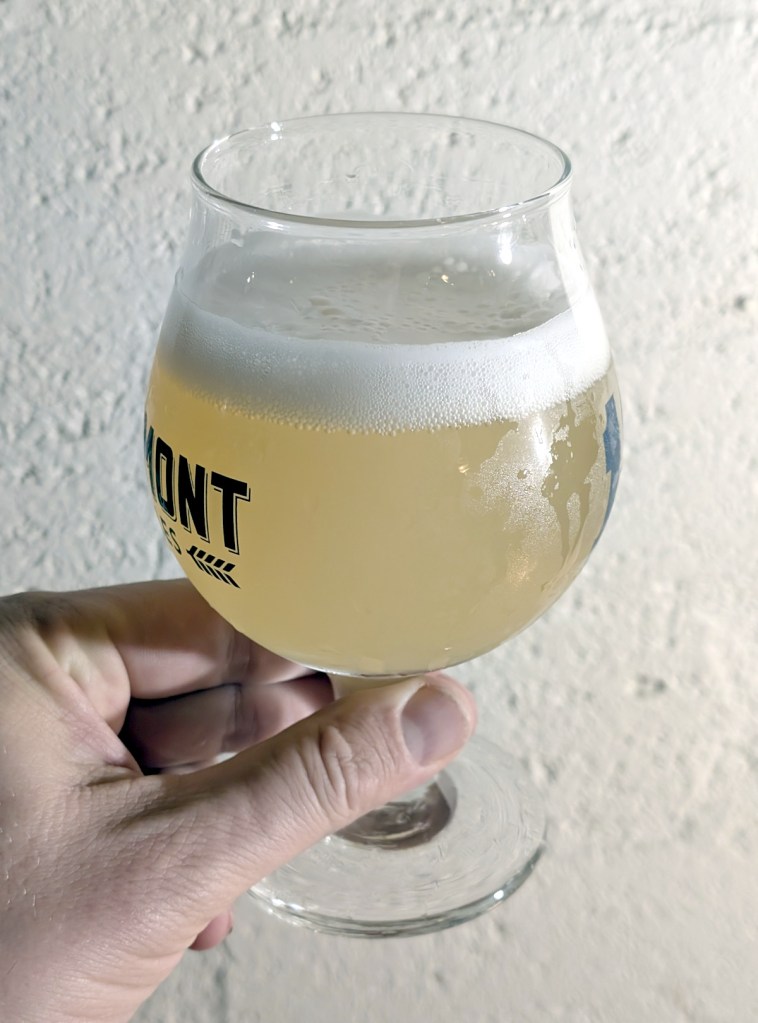
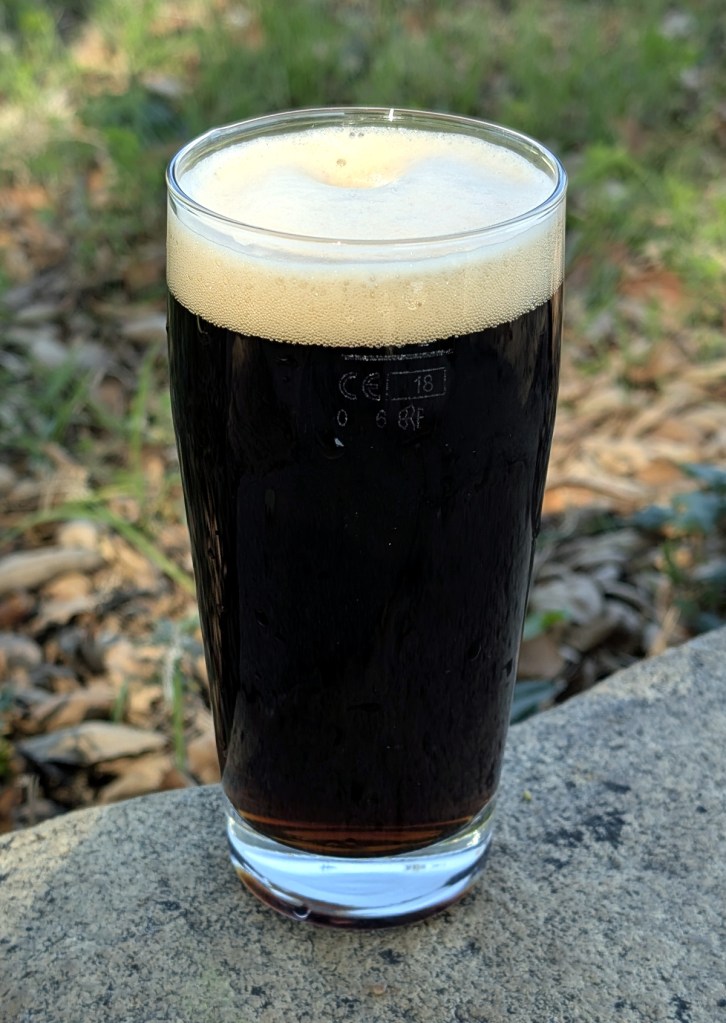
  • As expected, the beer was pretty hazy — WLP066 is used for hazy IPA’s, after all! I added Biofine Clear on 30 November 2025, to fix this. I was rewarded with a wonderfully clear beer, as shown in the picture.

Left: the original St. Arnold’s Christmas Ale, at the brewery; right: my homebrew version

Tasting

  • Appearance
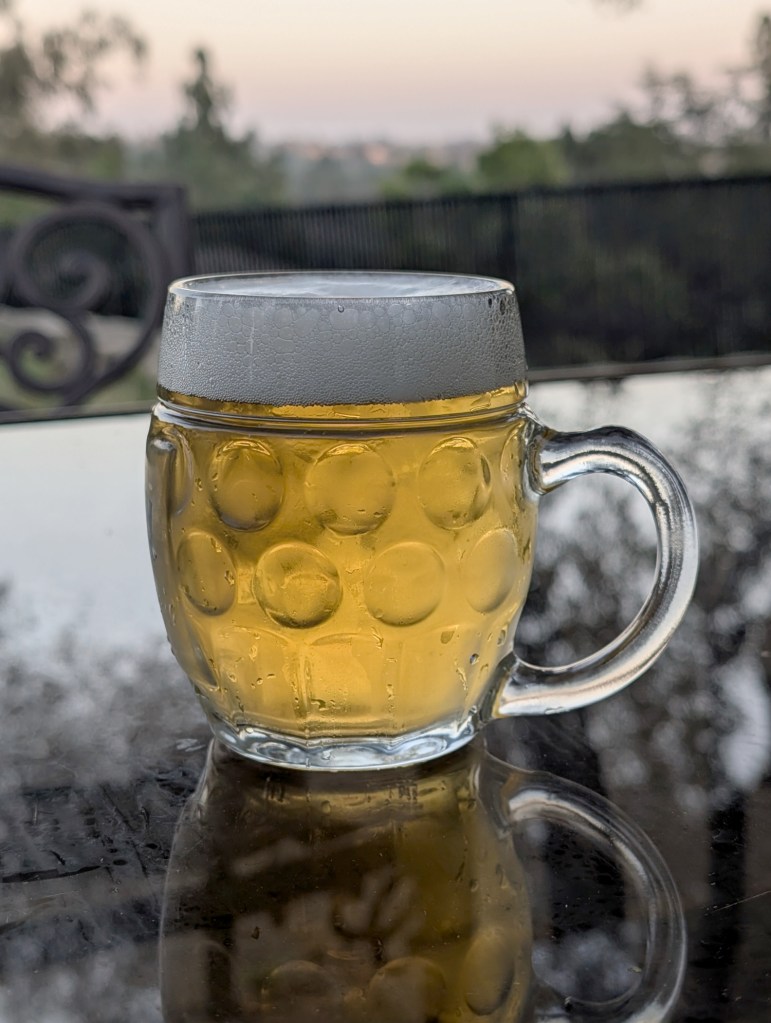
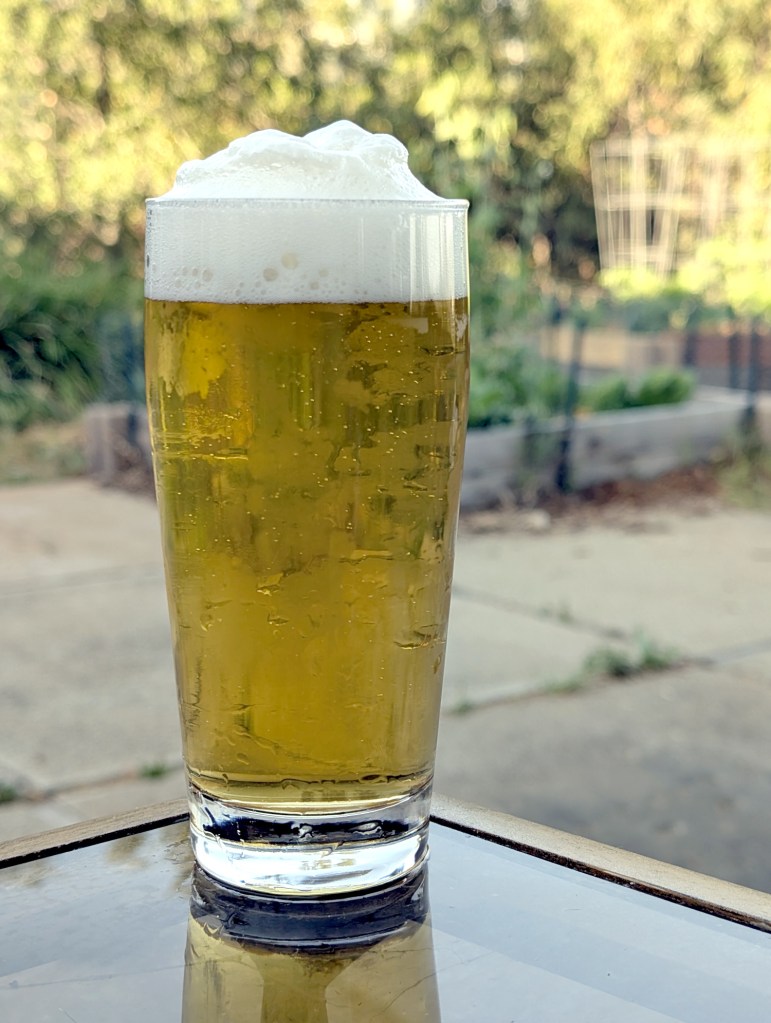
    • This beer pours with a persistent ivory head, and displays a beautifully clear amber orange color in the glass.
  • Aroma
    • Slightly herbal and spicy hop aroma, with a caramel malty aroma at a moderate level.
  • Flavor
    • Medium herbal bitterness in the hopping. Caramel and bready quality to the malt, at a medium-high level. Rich flavor!
  • Mouthfeel
    • This is a full-bodied beer, with a moderate level of carbonation. The finish is relatively smooth.
  • Would I Brew This Again?
    • This is a very drinkable and enjoyable holiday beer–pretty much exactly what I wanted. I don’t know how it stacks up as a clone (given I can’t do a side-by-side-tasting), but in any case the beer itself is super good. The flavors and body add up to a rich and flavorful beer. I also really like the concept of leaning on the base hops and malts to get the suggestion of holiday spices, versus actual spice additives. I’m a fan of this beer!
  • Overall
    • 10/10

Fall Brown Ale

American brown ales seem somewhere between American IPAs and porters, and consequently hit a broad range of characteristics (at least in practice). I enjoy brown ales, brewing them whenever the mood hits me–I have nine previous versions on the books, with six of those American versus English styles. My current recipe is lightly modified from “Dirty Water Brown Ale” in Brewing Classic Styles. I changed the first addition from Horizon to Chinook, and also turned that first addition into a first wort hop addition. In order to increase hop aroma and flavor, I added an ounce of Cascade hops at the end, and changed a flameout charge of Amarillo into a dry hop addition. Everything else is pretty much the same. I elected to do a ~2.75 gallon batch, instead of a full 5 gallons.

Fall Brown Ale

  • 5 lb. 2-row pale malt (Rahr)
  • 5 oz. chocolate malt (Bairds)
  • 5 oz. caramel malt 100 / crystal 40 (Viking)
  • 2 oz. crystal 60 malt (Great Western)
  • 2 oz. Victory malt (Briess)
  • 0.25 oz. Chinook hop pellst (12.3% alpha), first wort hop and 60 minute boil
  • 0.25 oz. Amarillo hop pellets (10.4% alpha), 15 minute boil
  • 1 Whirlfloc tablet, 5 minute boil
  • 1 oz. Cascade whole hops (~4.5% alpha), 5 minute boil
  • 1 pkg. BRY-97 American Ale Yeast (Lallemand)
  • 0.75 oz. Amarillo hop pellets (10.4% alpha), dry hop in fermenter

Target Parameters

  • 60 minute infusion mash, 152°, full volume mash
  • 1.049 o.g., 1.011 f.g., 5.1% abv, 37 IBU, 25 SRM
  • Water built from neutralized Claremont tap water to hit 85 ppm Ca, 18 ppm Mg, 102 ppm Na, 157 ppm SO4, 130 ppm Cl, 10 ppm bicarbonate
  • 2.75 gallon batch

Procedure

  • I added 4.4 mL of 88% lactic acid to 4.25 gallons of water, along with 3 g of gypsum, in order to hit my water target.
  • Next, I heated the water to 157°, added the grains, and held at 152° with recirculation for 60 minutes. Then, I raised the mash temperature to 168° for 10 minutes, before removing the grains, collecting all of the runnings, and then adding the hops on the way to the boil.
  • In total, I collected 3.9 gallons of runnings with a gravity of 1.039, for 69% mash efficiency.
  • I boiled the runnings and added hops and other finings per the recipe. After a 60 minute boil, I turned off the heat, chilled to 74°, and transferred to the fermenter. I pitched the yeast, and then chilled to 66° in my fermentation chamber.
  • I brewed this beer on 7 October 2025, and it had a starting gravity of 1.047.
  • Signs of fermentation had kicked off within 24 hours after pitching the yeast. I held the fermenter at 66° for the bulk of fermentation, and pulled it to ambient on 11 October 2025.
  • I kegged the beer on 18 October 2025, adding the dry hops in a bag at this point, leaving the keg to sit at ambient.
  • I removed the dry hops on 22 October 2025, and then moved it to the conditioning chamber for cold crashing and carbontation.
  • Final gravity was 1.011, working out to 4.8% abv.

Tasting

  • Appearance
    • A deep brown beer with a garnet tinge, brilliantly clear; it pours with a tall and exceptionally persistent deep tan head.
  • Aroma
    • Citrus and pine hop aroma at a medium level, alongside a medium-low malt character–chocolate, caramel, faint nuttiness. A grainy quality comes into perception as the beer warms. Clean yeast profile.
  • Flavor
    • Bitter beer with a resiny quality. Moderate level of maltiness with a slight chocolate, caramel, and toasty character. This beer definitely tips more bitter than malty.
  • Mouthfeel
    • Medium-high carbonation–a touch overcarbonated, perhaps. Medium light body and dry finish.
  • Would I Brew This Again?
    • This is a good beer! It is probably closer to a brown IPA than a brown ale, given the lighter malt character and body, as well as the more prominent hops aroma on the nose. It’s super drinkable! I like the dry hop aroma–it is perfect for this beer, and melds well with the malts. I might dial back the bitterness on future versions, down to around 30 IBU. Although the recipe calls for ~35 IBU, I think it’s a bit much, at least to my palate at the moment.
  • Overall
    • 8/10

Encampment American Strong Ale

It’s time for another Thanksgiving beer! I always make a special small batch for friends and family, usually aiming for something a little bigger and richer than my usual. It’s a good opportunity to try new styles, or at least styles I rarely brew. The Fall 2025 issue of Craft Beer & Brewing highlighted an American Strong Ale recipe, which seemed like a perfect Thanksgiving kind of ale. It’s a bit bigger, bolder, and maltier, getting close to IPA territory but not directly inside of it.

My attempt at the recipe is a touch more bitter than the original, at an estimated 65 IBU versus 54 IBU’s, and I used similar but not identical hops for the bittering and late additions (Columbus and Amarillo instead of Nugget and Motueka, respectively). I also used WLP066 (London Fog) instead of the recipe’s Wyeast 1318 (London Ale III). According to David Taylor’s Yeast Master chart, WLP066 is close to 1318, which is good enough for me. The grain bill is pretty much identical, so my interpretation is still in the ballpark.

Encampment American Strong Ale

  • 3.75 lb. Munich malt (BEST, ~7.6 SRM)
  • 3.75 lb. Maris Otter pale ale malt (Thomas Fawcett)
  • 10 oz. flaked barley
  • 8 oz. Victory malt (Briess)
  • 4 oz. Special B malt (Dingemans)
  • 4 oz. Viking caramel 100 (crystal 40 equivalent)
  • 0.5 oz. Columbus hop pellets (15.6% alpha), 60 minute boil
  • 0.5 oz. Amarillo hop pellets (10.4% alpha), 10 minute boil
  • 0.5 whirlfloc tablet, 5 minute boil
  • 1.5 g yeast nutrient (White Labs WLN1000), 5 minute boil
  • 1 oz. Amarillo hop pellets (10.4% alpha), 10 minute whirlpool
  • 1 pkg. London Fog ale yeast (White Labs WLP066)

Target Parameters

  • 60 minute infusion mash, 154°, full volume mash
  • 1.075 o.g., 1.017 f.g., 7.8% abv, 65 IBU, 17 SRM
  • Claremont tap water adjusted to hit target of 92 ppm Ca, 24 ppm Mg, 102 ppm Na, 200 ppm SO4, 130 ppm Cl, 10 ppm bicarbonate
  • 2.5 gallon yield

Procedure

  • I collected 4.1 gallons of tap water, adding a Campden tablet, 4.2 mL of 88% lactic acid, 3.5 g of gypsum, and 1 g of epsom salt to hit my water target.
  • Next, I heated the strike water to 162°, added the grains, and held at 154° with recirculation for 60 minutes. Finally, I heated the mash to 168° for 10 minutes, before removing the grains.
  • In total, I collected 3.5 gallons of runnings at 1.055, for 57% mash efficiency. That’s pretty dismal, but I suppose not surprising given the amount of grains used. Additionally, I’ve noted that this Maris Otter malt has been low on efficiency overall.
  • I heated the runnings to a boil, adding hops and finings per the recipe. I boiled at a higher level of vigor, to raise the gravity a bit.
  • After the 60 minute boil, I turned off the heat, added the whirlpool hops, and recirculated for 10 minutes before removing the hops and chilling to 78° before transferring to the fermenter.
  • I chilled the beer down to 64° before pitching the yeast.
  • I brewed this beer on 13 September 2025. Starting gravity was 1.072.
  • Fermentation kicked off within 24 hours, showing slight signs of fermentation on the surface of the beer. Active bubbling was evident within 36 hours.
  • I fermented the beer at 64°, and moved it to ambient on 21 September 2025.
  • I kegged the beer on 5 October 2025, with 2.7 oz. of corn sugar dissolved in 3/4 cup of water.
  • After two weeks, I moved the beer into the conditioning chamber and force carbonated the rest of the way.
  • Final gravity was 1.024, for 6.4% abv.

Tasting

  • Appearance
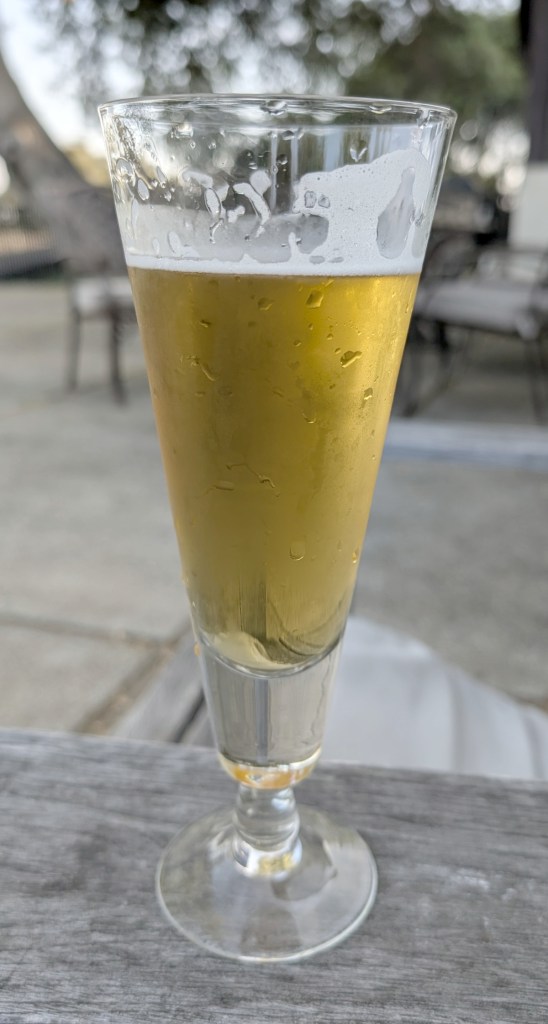
    • Amber-orange beer with a medium-low level of haze, pouring with a persistent ivory head that leaves a moderate level of lacing on the glass.
  • Aroma
    • Medium level of malty and caramel aroma. Resin and pine hop aroma at a medium-low level, with a slight citrus hint. Very slight alcohol hot note on the aroma.
  • Flavor
    • Bready and malty sweet malt character at a medium level, with a light caramel backend. Medium high level of bitterness, with resiny and piney character.
  • Mouthfeel
    • Medium-high body, moderate carbonation, smooth finish, only slightly dry.
  • Would I Brew This Again?
    • This is a nice beer, and perfect for the holiday season! The haze puts it out of perfection for the style, so that dings it a little bit. I might like a touch more malt complexity, but I think it might improve with more aging or dropping the yeast out via finings.
  • Overall
    • 7/10

Pryes Miraculum Midwest IPA

IPA’s are way too abundant at the expense of other styles, and yet there is a good reason why they are so popular. I truly enjoy the classic American IPA’s, with their malt complexity and citrusy hops. Hazies don’t do it for me, because they’re not crisp enough, and something has been lost in the quest for the pilsner-malt-only “West Coast IPAs.” That something is yeast and malt character. Hops are great, but it’s a one-note beer if the other ingredients recede beyond the horizon. So, the “Midwest IPA” is a bit of an atavistic species, a relict population from the late 1990’s when it was still acceptable to use 10 percent crystal malt in an IPA and Pinesol was a desirable hop character.

Craft Beer & Brewing has been killing it with their recipes, and I had great success with one in the recent past and a few just about ready to serve. The magazine hits some budding and uncommon styles, and I first learned about Midwest IPA’s here. I am still not totally convinced this is a unique style, so much as a population of recipes that has retained ancestral traits that others do not. Bell’s Two-Hearted Ale is considered a foundational example; having sampled it I consider it a “traditional American IPA.”

No matter what you call the style, the Summer 2025 issue of Craft Beer & Brewing had a recipe for a clone of Pryes Brewing’s Midwest IPA that looked like a good wintertime brew. My recipe is pretty similar, with some minor ingredient swaps. I used Barke Munich instead of Munich II, and CaraRed instead of CaraAmber. Columbus hops were substituted as the main bittering charge instead of Galena, and I used New England East Coast Ale yeast instead of WLP007 (Dry English Ale). Of course it’s not the same beer exactly, but definitely in the same neighborhood as the original.

Pryes Miraculum Midwest IPA

  • 11.75 lb. 2-row pale malt (Rahr)
  • 14 oz. Barke Munich malt (Weyermann)
  • 5 oz. Carahell malt (Weyermann)
  • 5 oz. Carared malt (Weyermann)
  • 2 oz. Carafa Special II malt (Weyermann)
  • 0.5 tsp. BrewTanB, added to mash
  • 0.4 oz. Columbus (Tomahawk) hop pellets (15.6% alpha), 60 minute boil
  • 1 oz. Simcoe hop pellets (12.4% alpha), 20 minute boil
  • 1 oz. Centennial hop pellets (8.1% alpha), 10 minute boil
  • 0.4 oz. Columbus (Tomahawk) hop pellets (15.6% alpha), 10 minute boil
  • 0.5 tsp. BrewTanB, 10 minute boil
  • 1 Kick Carrageenan tablet, 5 minute boil
  • 1 oz. Simcoe hop pellets (12.4% alpha), 10 minute whirlpool
  • 1 oz. Centennial hop pellets (8.1% alpha), 10 minute whirlpool
  • 2 pkg. New England East Coast Ale Yeast (Lallemand)
  • 3 oz. Simcoe hop pellets (12.4% alpha), dry hop
  • 3 oz. Centennial hop pellets (8.1% alpha), dry hop
  • 2 oz. Cascade hop pellets (7.3% alpha), dry hop

Target Parameters

  • 60 minute infusion mash, 152°, full volume mash
  • 1.062 o.g., 1.014 f.g., 6.3% abv, 75 IBU, 10 SRM
  • Claremont tapwater, adjusted to hit roughly 89 ppm Ca, 25 ppm Mg, 102 ppm Na, 195 ppm SO4, 130 ppm Cl, 10 ppm bicarbonate, RA=-70

Procedure

  • Starting with 7.5 gallons of Claremont tap water, I added 7.7 mL of 88% lactic acid to drop out the carbonates, and then added 6 g of gypsum and 2 g of Epsom salt to build out the water profile.
  • I heated the water to 158°, added the grains, and held the mash at 152° with recirculation for 60 minutes. Then, I raised the mash to 168° for a 10 minute mash out.
  • I removed the grains, collecting 6.6 gallons of runnings with a gravity of 1.051, for 67% mash efficiency.
  • I brought the kettle to a boil, adding hops and finings per the recipe.
  • At the end of the 60 minute boil, I added the hops and whirlpooled for 10 minutes before chilling down to 75° and transferring to the fermenter.
  • Once in the fermentation chamber, I chilled the wort down to 64° before pitching the yeast.
  • I brewed the beer on 11 October 2025. Starting gravity was 1.062. I fermented at 67°.
  • The airlock was showing activity on the morning after pitching.
  • Dry hops went in on 17 October 2025, and I cold crashed the beer on 22 October 2025.
  • I kegged the beer on 30 October 2025, using a closed transfer.
  • Final gravity was 1.011, working out to 6.7% abv.

Tasting

  • Appearance
    • Medium amber in color, relatively clear with slight haze, pours with a persistent fine white head and slight lacing on the glass.
  • Aroma
    • Moderate orange hop aroma with a slight bit of pine behind that; faint caramel maltiness. In early pours, the malt and hops clashed just a touch; with a little more conditioning, it’s really nicely balanced.
  • Flavor
    • This is a very bitter beer, with a resiny hop quality. The beer has a moderate level of maltiness, with a light caramel character. It’s less complex than I expected, and the hops and malt clash a bit. A bit of orange comes in at the midpoint of the taste, at a moderate level. There is a low level of breadiness in the malt.
  • Mouthfeel
    • Medium body, moderate carbonation, dry finish.
  • Would I Brew This Again?
    • This is a good, but not fantastic, beer. The malt character is nice, although the hop flavors are less forward than I expected, especially given the quantities, and something clashes slightly in the flavor and aroma. I wonder if the beer is a touch oxidized? That doesn’t seem likely, given the careful closed transfer and the nature of the flavor, but anything is possible. I enjoy the “old school” aspects of the beer, though, including body and maltiness. I think it might be better with just Cascade or Cascade+Chinook, or another more “traditional” American hop combo. The beer is definitely better when it has warmed slightly above the initial serving temperature.
  • Overall
    • 7/10

Old Franconia Lager

“Farmhouse beers” are a huge and fuzzy category, in my mind including everything from saison to many kveik-based concoctions to some kellerbiers. Although a character-rich and slightly wild yeast is most common, I would also think some “rustic” lagers should also qualify. Farmhouse, like so many things in homebrewing and craft beer, is a moderately mythological concept, and one built more around feelings than strict history. I suppose that’s why it’s fun to play in the space! It can stir a different set of emotions from by-the-books or paint-by-numbers brewing; it allows creativity (and I suppose role-playing) in a way that many other styles don’t, or at least in ways that differ from other styles.

I recently ran across a supplier for Isaria 1924 malt by Weyermann (William’s Brewing). I am often interested in trying base malts outside my norm, and this was a fun opportunity to experiment. The descriptions / marketing material from Weyermann state that the malt is “made from the oldest German malting barley variety Isaria, which was officially approved for the beer production in 1924. Brewers used Isaria to brew traditional, unfiltered and flavorful traditional German Lagers.”

Colorwise, Isaria 1924 weighs in at 3.5 SRM and is thus closest to most Vienna malts (3-5 SRM, depending on supplier; the Weyermann version is 3 SRM). Relative to the Weyermann flavor wheel, Isaria 1924 reads as a subdued Vienna, with similar locations of flavor/aroma peaks, but different magnitudes (e.g., a peak at “sweet” taste but an arbitrary value of 2.5 versus 4.5).

Among the recommended styles from Weyermann, Franconian landbier was near the top. This intrigued me, because I had recently read about the “style” in the Spring 2025 issue of Craft Beer and Brewing (including recipe). Why not try something in that vein?

My version is not really based on anything in particular, other than crafting a general story–something to emphasize malt and lean into a story of a rustic beer that plausibly would originate in Franconia (which primarily overlaps with northern Bavaria). I wanted to use 100 percent Isaria 1924 malt, particularly because this was my main point of the brew session. I only had 10 pounds, which might be a bit lower on gravity than I wanted for my usual 5.25 gallon batch, so I scaled down to 4.5 gallons. Spalt Spalter hops were my hop selection, because they provide a nice earthy and spicy quality that fit well with my intended “rustic” results. Finally, I wanted to give WLP860 Munich lager dry yeast another spin; as a strain that would emphasize the malt character, and that also would be consistent with my Franconian/Bavarian theme (although Munich itself is to the south of historical Franconia–we’re going for “vibes” and not authenticity here!). During my last brew with it, I learned that a bit of patience was key–WLP860 is a slow starter, and so I shouldn’t fear if signs of fermentation are delayed.

Old Franconia Lager

  • 10 lb. Isaria 1924 malt (Weyermann)
  • 0.5 tsp. BrewTanB, added to mash
  • 1.25 oz. Spalt Spalter hop pellets (4.3% alpha), 60 minute boil
  • 0.5 tsp. BrewTanB, 10 minute boil
  • 1 Whirlfloc tablet, 5 minute boil
  • 1.75 oz. Spalt Spalter hop pellets (4.3% alpha), 5 minute boil
  • 2 pkg. Munich Lager dry yeast (White Labs WLP860)

Target Parameters

  • 60 minute infusion mash, 154°, full volume mash
  • 1.051 o.g., 1.016 f.g., 4.7% abv, 29 IBU, 6 SRM
  • Claremont tapwater, neutralized to remove bicarbonates. Roughly 40 ppm Ca, 18 ppm Mg, 102 ppm Na, 50 ppm SO4, 130 ppm Cl, RA=-31
  • 4.5 gallon batch

Procedure

  • I treated 6.75 gallons of water with a Campden tablet and 6.9 mL of 88% lactic acid, in order to drop out the bicarbonates.
  • Next, I heated the strike water to 159°, added the grains, and held at 154° with recirculation for 60 minutes. After that, I raised the mash temperature to 168°, held it there for 10 minutes, and then pulled the grains.
  • In total, I collected 6 gallons of runnings with a gravity of 1.038, for 64% mash efficiency.
  • I brought the runnings to a boil, adding hops and finings per the recipe. Because my gravity was a bit lower than intended, I boiled a bit harder to bring the gravity up. After 60 minutes, I turned off the heat and chilled the wort to 69° before transferring to the fermenter.
  • I chilled the wort down to 50° in the fermentation chamber, pitching the yeast when the beer was at 60° (night of the brew day).
  • This beer was brewed on 21 September 2025; it had a starting gravity of 1.049.
  • I fermented the beer at 50 degrees; small bubbles were visible on the surface by 22 September 2025, 24 hours after pitching. By 29 September, there was a good layer of krausen on the surface. Given the slow start the last time I used this yeast, I wanted to confirm that things were moving along. I noted an aroma of sulfur in the fermentation chamber on 30 September 2025.
  • I raised the temperature of the beer to 56° on 2 October 2025, and moved the beer to ambient on 7 October 2025.
  • Using a closed transfer, I kegged the beer on 18 October 2025. At the time, it had an amazing malt flavor!
  • Final gravity was 1.013, for 4.7% abv.

Tasting

  • Appearance
    • A deep gold beer, with a very slight haze, which pours with a thick, white, and persistent head. Beautiful!
  • Aroma
    • Medium malty-rich aroma, with moderate spicy hop character. Delicate hoppiness.
  • Flavor
    • Moderate malty rich character, against a medium level of hop bitterness. Clean yeast character.
  • Mouthfeel
    • Medium-light body, moderately high carbonation, off-dry finish. There’s may be a tiny bit of astringency.
  • Would I Brew This Again?
    • This is super nice as something a little different from the “usual” lagers. Isaria 1924 stands well as a solo malt, making an interesting and highly drinkable beer. I might dial the bitterness back a touch, or else increase the gravity slightly; the aroma is amazing, but I feel that the malt character is slightly obscured. I would also do a 90 minute mash or a decoction mash in order to improve efficiency, given the lower mash yield for this particular malt.
  • Overall
    • 8/10

Update: Around Christmas, I noted an increasingly heavy protein precipitation in this beer. I’ve never experienced something like it previously, at least in my homebrew. I didn’t have anything unusual with handling or technique, so I wonder if it’s caused by the malt. Or maybe just a fluke?

golden beer in glass with lots of white flakes of protein precipitate floating in it, like snowflakes
Let it snow?