Good Riddance Pale Ale

Time to line up another hoppy beer for the fermenter! This particular American pale ale is named in honor of the end of 2016; the year can’t end soon enough for many fans of pop culture! At least in the USA, there is a general opinion that a few too many notable folks have died this year–so, hopefully 2017 will be a bit better in that regard (even if it likely won’t be any better in terms of broader world events). Good riddance to 2016, here’s hoping for better things on the horizon. The name also matches the “clean-out-the-brewing-supplies” nature of my recipe. I’m using this as an opportunity to use up a few ingredients (specifically, crystal 45, some more of my Magnum hops, and a lingering pack of Falconer’s Flight hop blend that dates back to 2015). The core recipe is modified from a recipe in Brewing Classic Styles, “American Pale Ale with Caramel.” The gist in mine is the same; I’ve just switched up the hops and hopping schedule (and swapped crystal 45 for crystal 40).

20161228_161456

Good Riddance Pale Ale

  • 9 lbs. California Select 2-row Brewer’s malt (Great Western Malting Co.)
  • 0.75 lbs. 45°L crystal light malt (Crisp)
  • 0.75 lbs. 10°L Munich I malt (Weyermann, 7.1 SRM)
  • 0.58 oz. Magnum hop pellets (13.2% alpha), 60 minute boil
  • 1 oz. Cascade whole hops (5.5% alpha), 10 minute boil
  • 1 oz. Amarillo hop pellets (7.0% alpha), 5 minute whirlpool
  • 1 oz. Falconer’s Flight 7C’s Blend hop pellets (10.3% alpha), 5 minute whirlpool
  • 1 Whirlfloc tablet, 10 minute boil
  • 1 tsp. Fermax yeast nutrient, 10 minute boil
  • 1 pkg. California ale yeast (White Labs WLP001)
  • 1 oz. Amarillo hop pellets (7.0% alpha), 5 day dry hop
  • 1 oz. Falconer’s Flight 7C’s Blend hop pellets (10.3% alpha), 5 day dry hop

Target Parameters

  • 154° mash, 60 minutes
  • 1.053 o.g., 1.013 f.g., 5.3% abv, 41 IBU, 7 SRM, 5.5 gallons into the fermenter

Procedure

  • Four days in advance, a I prepared a 1.5L starter from a culture of WLP001 that I had saved from the last time I used it (this is the third round for this particular culture). I set aside a portion (calculated as approximately 100 billion cells), and the remainder (0.9 L) was cold-crashed in the flask until brew day.
  • I changed my mash procedure a bit here — instead of adding water to the grains, I added my strike water first, let it cool (down to around 170°, as indicated roughly by BeerSmith), and then added the grains. This seemed to work reasonably well, although I wasn’t as precise with my temperature as I would have liked. I set the mash tun temperature to 60°, which was probably a mistake. I should have set it to match the strike water temperature I wanted. What I will do next time is to iterate my mash tun temperature until the calculated strike water temp and mash tun temperature match within a degree or two. I’ll then use that as the strike water temperature, and hopefully land a bit closer. The overall idea with this is to avoid preheating my mash tun with a separate volume of water (especially as I have done more with reverse osmosis water these days).
  • For this recipe, I adjusted my water by diluting the carbonate-heavy Claremont water approximately 50/50 with reverse osmosis water.
  • I mashed in with 3.5 gallons of water at 170°. This hit a mash temperature of 156° or so. I let the mash tun sit open for a few minutes until the mash temperature dropped down to 154°. Just for “fun”, I measured the mash pH on this batch–this ended up around 5.2 or 5.3.
  • The overall mash was down to 152 after 55 minutes. At this point, I added 1.25 gallons of water at 180°, let sit 10 minutes, vorlaufed, and collected the first runnings. I then added 3.5 gallons of water at 180°, let the mash sit for 10 minutes, vorlaufed, and collected the second runnings.
  • In total, I collected 6.7 gallons of wort at 1.048 gravity — 83% efficiency!
  • Once the boil was started, I added hops and other items per the schedule.
  • I checked the gravity about 40 minutes in, and found that it was already at the target of 1.053. Rather than overshoot my target, I added a quarter gallon of RO water to bring things back into alignment.
  • After a 60 minute boil, I added the final charge of hops, let things sit for a few minutes, and then started cooling. I was able to get the wort down to about 75°.
  • I transferred the wort to my primary while aerating, and pitched the yeast.
  • Starting gravity was 1.053, right on the nose for my target (thanks to that extra bit of RO water). I brewed this on 28 December 2017, and will be fermenting at 66°.
Wild Times Pale Ale

I recently acquired a pound of wild hops from the Seattle area of Washington state, courtesy of a generous friend who found them on his property. The plus side of wild hops is that they have a definite “cool” factor. The negative side is that wild hops are indeed wild (or naturalized, if they are “feral” versions of cultivated hops)–you have no real published guidelines to constrain expectations for aroma, flavor, and bittering properties. It’s all lab analysis and careful sensory evaluation. In other words–a grand opportunity for a motivated homebrewer.

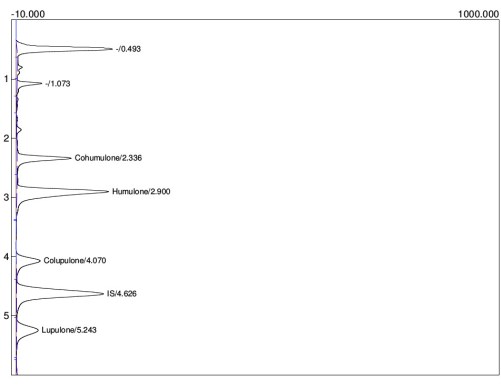
My first order of business was to figure out the chemistry of these things, particularly alpha acids. Because I had a good quantity of the hops, I didn’t mind sending them off for analysis. My go-to place has been BrewLaboratory; they are relatively inexpensive, fast, and supportive of homebrewers. They use HPLC (High Performance Liquid Chromatography), and their turn-around time has been less than 2 or 3 days from receipt of the sample.

I was pleasantly surprised by the alpha acid values–5.8%! Beta acids clocked in at 3.2% and cohumulone at 30%.

2016-washington-state-wild-hops

HPLC Profile for Washington State Wild Hops

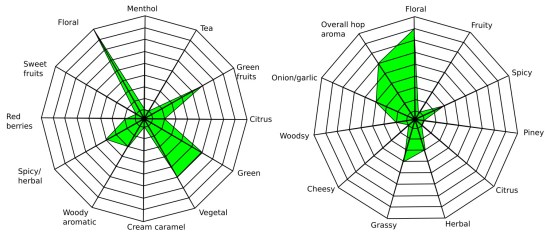
The analysis nicely covered the basic chemistry, but what about the more complex aromas and flavors? When rubbing the hops between my palms, I noted a dominant, very perfume-like aroma! Behind that is a bit of vegetal/allium aroma. To help formalize my thinking on the matter, I roughed out the hop profile using spider diagrams. There are two slightly different formats that I found in my research, included below. Each breaks out the aroma descriptors slightly differently–for instance, one specifically has an “onion/garlic” category, whereas in the other that is lumped in with “vegetal”.

Wild Hop Spider Diagrams

Wild Hop Spider Diagrams, Showing Level of Intensity of Different Aroma Components

With nearly a pound of thoroughly analyzed wild hops in hand, I wanted to put together a nice and simple batch of beer to highlight their flavor and aroma. After consulting with some friends, I settled on an American pale ale. The goal was for something that was clean and not overly malty, to let the hops shine. Because I didn’t want to commit to five gallons of beer for the first round on these hops, I settled on a 3 gallon batch, which will fit into a 2.5 gallon keg that I have on-hand.

The weather is turning cool, and I didn’t want to deal with the thermal loss of brew-in-a-bag. So, I also elected to do a full-volume, no-sparge mash in my mash tun.

Wild Times Pale Ale

  • 5.5 lbs. California Select 2-row malt (Great Western Malting Co.)
  • 0.5 lb. 10°L caramel malt (Briess)
  • 0.25 oz. Galena hop pellets (13.8% alpha), 60 minute boil
  • 1.5 oz. Washington wild hops (5.8% alpha, 3.2% beta), 10 minute boil
  • 1.5 oz. Washington wild hops (5.8% alpha, 3.2% beta), 1 minute boil
  • 1 oz. Washington wild hops (5.8% alpha, 3.2% beta), 5 minute whirlpool
  • 0.5 tablet WhirlFloc, 10 minute boil
  • 1 pkg. Safale American dry yeast (US-05)
  • 1.5 oz. Washington wild hops (5.8% alpha, 3.2% beta), 10 day dry-hop

Target Parameters

  • 152° mash, no sparge, 60 minutes
  • 1.051 o.g., 1.011 f.g., 5.2% abv, 43 IBU, 4 SRM, 3 gallons into the fermenter

Procedure

  • I mashed in with 5.3 gallons of water at 168.8°, to hit a mash temperature of 152.4°. The mash was down to 149.5° after 25 minutes and down to 147° after 50 minutes.
  • After 60 minutes, I drained the mash tun. I collected 4.5 gallons of wort at a gravity of 1.036, for 74% efficiency. Not too bad!
  • I started the boil, and added the hops per the recipe specifications.
  • After 60 minutes, I turned off the flame, added the whirlpool hops, and chilled the beer down to 76°.
  • I transferred the beer to the fermenter while aerating, and pitched the yeast. I’ll be fermenting this at 68°.
  • Starting gravity was 1.046, a bit less than expected. However, I am not surprised because I kept a gentle touch on the flame to avoid overboiling with the smaller volume of wort.
  • I brewed this beer on 21 November 2016.

Beer Tasting: Gondwana Pale Ale 1.3

The latest version of my Gondwana Pale Ale finished recently, but I managed to get a formal tasting in before the keg was emptied. Here’s the review!

  • The Basics
    • Original gravity = 1.045; final gravity = 1.010; abv = 4.6%; estimated IBU = 39
  •  Aroma
    • A strong impression of passionfruit for me, along with other tropical fruits; really nice on the aroma.
  • Appearance
    • Wonderfully clear; there is a tiny bit of hop debris from the dry-hop bag, but that doesn’t get in the way of how nicely this beer has cleared. The beer itself is a light gold color, with a fine off-white head, that sticks around for quite awhile as a decent blanket over the beer, and then subsides to a persistent ring of foam around the edges of the glass.
  • Flavor
    • There is a definite tropical fruit impression on the hops. The malt is clean, and in the background.
  • Mouthfeel
    • This is a pretty dry beer–not overly so, but definitely dry. I’m not a huge fan of the finish on this–it is a bit astringent, and I’m not sure of the cause. Part of this could be due to an overly thin mash, or perhaps the mash-out temperature being too high initially? Or maybe it’s something with the hops? Is the IBU level more than anticipated? Could it be the relatively low starting gravity as compared to previous batches? I’m not sure. In any case, this is a bit different from previous batches, which were quite a bit smoother.
  • Would I brew this again?
    • The aroma and appearance on this are pretty wonderful, and the flavor is decent. Mouthfeel and finish could really be improved, though. I think more careful attention to mash conditions (temperature and volumes) would help. Given my success with previous versions of the recipe, I’ll still be brewing it again.
  • Overall
    • 5/10

Gondwana Pale Ale 1.3 Kegged

Tonight I kegged the latest draft of my Gondwana Pale Ale, after 10 days in the primary fermenter. The beer has a nice malty aroma and a smooth bitterness; this will be augmented further by 2 oz. of Mosaic hops pellets on the dry hop. The beer is still rather hazy, presumably because the yeast haven’t fully dropped out yet. Final gravity is at 1.010, down from 1.045, for 4.6% abv.