Homebrew Con Seminar: The Dinosaur in My Beer!

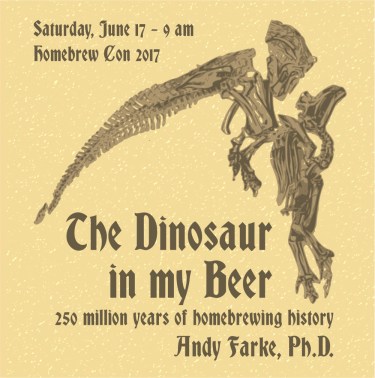
blog_imageI’m excited to be on the schedule for Homebrew Con (aka National Homebrewers Conference) in Minneapolis next month! If you’re at the event, come see my seminar: The Dinosaur in My Beer: 250 Million Years of Homebrewing History.

Of course, most beer enthusiasts are familiar with the overall arc of brewing lore (and some of you could probably recite it in your sleep). Things got rolling in the ancient Middle East around the same time that cereal grains were domesticated, hops made it into the equation during the Middle Ages, and craft breweries got their game going during the late 20th century. This is all interesting–and indeed, numerous books and articles have been published on the topic. Yet, virtually every treatment of brewing that I’ve read neglects the much deeper history of all of our brewing ingredients. We wouldn’t have Burton water without events that happened during the dawn of the age of the dinosaurs. We wouldn’t have hops without an evolutionary innovation in plants more than 120 million years ago. And oddly enough, the production of barley malt led to the discovery of many important fossils.

My seminar (around 45 minutes long, with time for questions) ties together threads that stretch deep into our planet’s history. You’ll gain a better appreciation for just how densely beer and beer ingredients are interwoven with the evolution of life–beer ain’t just a cultural phenomenon! I’ve given versions of this talk at Claremont Craft Ales as well as the Arizona Museum of Natural History, but the Homebrew Con version will have lots of new content, plenty of cool images, and interesting anecdotes. I guarantee that you’ll learn something you didn’t know before!

My seminar starts at 9 am on Saturday, June 17, in Auditorium 1. And even if you can’t make the seminar, I’d love to chat about beer, brewing, and paleontology. Hope to see you in Minnesota!

And for an extra bonus…I’m bringing a replica of the skull from Aquilops americanus, the little dinosaur that inspired Eagle Face Oatmeal Stout, as seen in a recent issue of Zymurgy magazine. If you’ve ever wanted to get your selfie with a dinosaur, now is your chance!

[Image info: The dinosaur skeleton in the logo is modified from a 19th century rendering of Iguanodon by Gustave Lavalette. Also of note: the fossil was found in a part of Belgium that is purportedly home territory for saisons! This fact inspired one of my first attempts at the style.]

Homebrew savings in bulk?

Since I started ramping up my homebrewing two or three years back, I’ve been brewing at least 20 times a year. At five gallon batches, that adds up to a lot of supplies! I soon realized that it might make sense to start buying in bulk as a cost-saving measure, for things like hops, base malts, and some cleaners. But I also realized there are a number of cost/benefit factors that need to be considered. In this post, I outline my thought process.

20170513_102228

  • Do you brew often enough?
    • If you’re the sort of person who only brews a few times a year, it probably doesn’t make sense to buy bulk supplies. They’re likely to go stale before you use them up, and thus are just a waste of money.
  • Do you have space?
    • I’m fortunate to have plenty of storage space to store bulk supplies. Back in the days when I was an apartment brewer, that wouldn’t have been the case.
  • Is the particular supply or ingredient something you use frequently and in large volumes?
    • I brew with American 2-row a lot, so it makes good sense to keep a supply on hand. I can save around 40 to 50% by doing so, which adds up over a few batches. It would not make sense to buy 50 pounds of chocolate malt; I only use a few pounds per year, and a bulk sack would go stale before I could use it all up.
  • What’s the shelf life?
    • A 50 pound bucket of PBW cleaner is nearly two and a half times cheaper than buying the equivalent in 1 pound increments. It will probably take me several years to use this up, but I can’t imagine this stuff ever goes bad, as long as I store it properly. For stuff like yeast or bulk malt, a multi-year shelf life isn’t likely in the cards.
  • Can I pick it up in person or does it have to be shipped?
    • I buy bulk at my local homebrew shop whenever I can. In general, I have found that shipping can swamp out any potential savings otherwise. On those occasions when I do order online, I do a quick calculation on shipping to see if things still add up.
  • Do I really want that in bulk?
    • Although buying in bulk saves money, it also potentially constrains creative exploration of new ingredients. For instance, if I have 50 pounds of a particular brand of pilsner malt, I’m probably not going to try out other brands, at least until I’ve finished out that supply.

Overall, I find bulk purchases to be a good value given my brewing habits. Everyone’s situation is different, though. Think carefully; it might be right for you, too!

The Dinosaur in My Beer: March 8 at Claremont Craft Ales

Beer and science are a natural fit…even more so than beer and pretzels, in my opinion. As a homebrewer, I absolutely love geeking out over the scientific facets of the hobby. The usual history of beer starts a few thousand years ago with the rise of agriculture. But, there is so much more to the story. Every brewing ingredient–water, barley, yeast, and hops–has its own tale to tell. In many cases, the narrative extends back to the time of the dinosaurs!

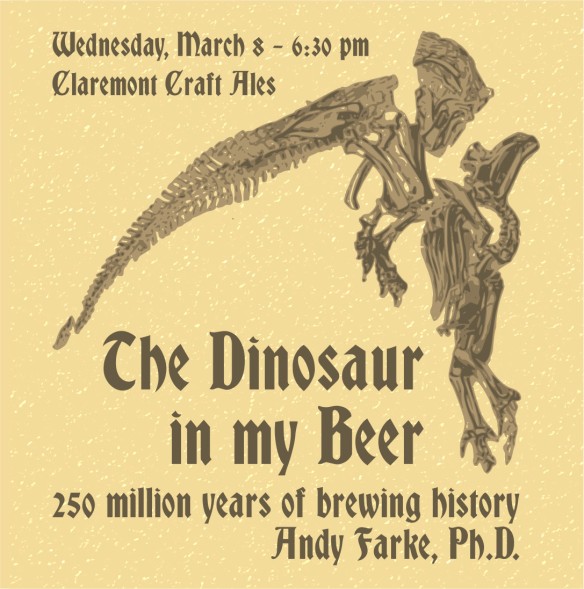
So, if you are in Claremont, California, on Wednesday, March 8, swing by Claremont Craft Ales and catch my talk on the prehistory of brewing ingredients! The event starts at 6:30 pm, but you can swing by before or hang around after for some great beer and also a chance to chat with me about anything you like.

talk_logo

The basic talk will be a preview of my seminar for HomebrewCon in June. I’ll be posting more about that in the upcoming months, too.

If you haven’t been to Claremont Craft Ales (CCA) before, it’s a really great venue. A few things you can look forward to:

  • Their beer is great! I highly recommend the Jacaranda IPA as well as the Raspberry Gose (both are also available in cans).
  • CCA has plenty of options for non-beer-drinkers. In addition to a nice selection of canned dry sodas (the tasty fancy stuff, not just a bunch of Coke products), various food trucks are also there most afternoons and evenings.
  • It’s a very friendly space — kids and dogs are quite welcome. (note relevant to my talk: although dinosaurs have a reputation as a “kids topic”, my talk isn’t really geared for kids. That’s not to say it’s “adult content”–just that the presentation will be at a level where the typical 12 year old might get a little bored, because the combined topic of beer and paleontology probably isn’t in their wheelhouse, or at least it shouldn’t be.)

Interested in having me talk for your event? Drop a line via the contact form!

Image credit: Dinosaur skeleton from Iguanodon rendering by Gustave Lavalette in the public domain.

Are homebrew experiments scientific?

e3ce2-20151107_180604As a professional scientist, I absolutely love any opportunity to meld the art and science of homebrewing. The intersection of chemistry and biology with the senses of taste, smell, touch, and sight creates endless hours of enjoyment. Even more so, I love playing with ingredients and processes to explore this beer landscape.

I’m not alone in this passion for the scientific side of homebrewing, either–two particularly prominent efforts (among others) have a solid hold in our brewing culture. The first of these is Experimental Brewing, by Denny Conn and Drew Beechum. In addition to a great website, they host one of my favorite brewing podcasts. Their mode of experimentation is to recruit IGORs (Independent Groups Of Researchers) who brew parallel batches of beer to test brewing hypotheses. The other major player in the world of homebrew experimentation is Brülosophy. This brewing team regularly investigates single variables (e.g., yeast pitch rate or addition of gelatin finings) of relevance to homebrewers, examining what (if anything) matters for your typical 5-10 gallon batch.

Over the past year or so of following these efforts, I have found some great value and food for thought in all of their experiments. The associated podcasts and blog posts pose interesting questions, and often challenge the received wisdom of homebrew tradition. Yet, the scientific side of me often wonders: Is it really science?

The short answer to this is, in my opinion, both yes and no.

Homebrew experiments are often scientific in that they propose hypotheses, design procedures to test the hypotheses, and collect data for later analysis. This is certainly necessary for science, but it’s not entirely sufficient.

I should preface my explanation on this latter point by saying that my opinions here are not intended as unthinking criticism of some really great homebrew experimentation. I love and appreciate what others are doing. That said, I do notice that the work is sometimes misused or misinterpreted within the broader homebrew culture. Some basic scientific safeguards could help to maximize the value of homebrew experiments and minimize confusion. So, my post is less about breaking down the current “system” (if it even really is a system) and more about what we can add to improve the value of homebrew experiments. Even more so, it’s about how those of us who read the “exbeeriments” should interpret them!

  • Expand the brewing scenariosAs is readily acknowledged by most brewing experiment writers, results of a particular experiment are really only applicable to those experimental conditions. For instance, if you find that there is no difference between a 20 minute and a 60 minute boil for a stout, the results probably shouldn’t be extended to a blonde ale. More experiments at a homebrew scale are needed!
  • Emphasize limitations. This follows pretty logically from the point immediately above. I think that most of the brewing experiment write-ups out there do this pretty well, so it’s more of a caution for those who read and try to apply the results.
  • Record methodology in detail. Brülosophy sets a high bar for this, and is able to do so because their brewing is done typically by a single person. The IGORs do good work, but the distributed nature of the brewing means that a lot of the details on their brewing setups and techniques aren’t immediately available. Different brewers often have very different techniques. Unfortunately, this can raise a lot of basic questions about experimental results and interpretation. Experimental Brewing did a great episode highlighting differences between brewers’ techniques and how it affected an experiment related to bitterness. This was indeed illuminating!
  • Pair sensory perception analysis with laboratory analysis. The aforementioned Experimental Brewing episode did this really well, in terms of evaluating differences in IBU yields across different recipes and setups, as did a Brülosophy exbeeriment related to loose vs. bagged hops in the kettle. This approach really helps to nail down the interpretation of results (especially for those related to bitterness), although I also admit it is potentially expensive.
  • Engagement with the brewing literature. There is an ocean of literature from the commercial brewing world, much of it published in formal scientific journals, yet this is rarely if ever incorporated into the homebrew world in any meaningful way. There are reasons for this, of course…for instance, much of this literature pertains to giant commercial brewing setups and cannot be transferred confidently to the homebrew scale. Also, much of the literature is technical and paywalled, so might as well not exist for most hobbyists.
  • Peer review and formal publication. Is it time for a Journal of Homebrewing Science? If there is a single thing that would improve homebrew experiments, it would be formal, independent peer review and a mechanism for publication of these reviewed results. Comments on blog posts do provide one form of review, but this is not always reflected by modifications in the experiments or changes in interpretation of the experiments. If I were to be really ornery, and I suppose I am because I am writing this post, I would suggest a multi-step peer review process handled by an independent review or editorial board for brewing experiments.
    • Design the experiment, and open it up for input.
    • Modify the experimental design as required.
    • Run the experiment.
    • Write up the results, and open the write-up for review.
    • Following the review, revise the write-up accordingly.

Overall, I love the experimental approach to homebrewing. I think it illuminates some really interesting facets of our hobby, and helps brewers to be more and more thoughtful in their technique. We’re now at the stage where we can push things to the next level–so let’s do it!

Brew Year’s Resolutions for 2017

It’s 2017! After a great year of achieving many brewing goals during 2016, it’s time to set some goals for the next year. What’s on tap for my Brew Year’s Resolutions?

Update: I also sent in one of my resolutions (the sci-comm one) for the Experimental Brewing podcast by Denny Conn and Drew Betchum. The episode is available at their website–my piece of audio starts at the 19:40 mark.

  • Do more science communication with homebrew as a vehicle.
    • Last year, I had the goal of pitching a story idea to a major homebrew magazine–and got an article published in Zymurgy! The short piece focused on the ways in which I blend homebrewing and paleontology, and has led to another article that should (if all goes well) be out early this year. I’ve really enjoyed the research and finding connections between my two passions in life, and find that it’s also an interesting topic for many other people. To that end, I want to do more of this kind of stuff–in particular, I’m hoping to turn some of my research into a presentation on the topic that can be given for a variety of audiences (contact me if you’re interested in having me speak for your group!).
  • Pitch another article for a homebrew publication.
    • I have some ideas for (non-paleontology) articles on homebrewing, and want to get a pitch or two out there early this year.
  • Explore lagers and pilsners in more depth.
    • Last year I started brewing these styles in earnest, encouraged by the Fast Lager schedule that is increasingly popular. I also recently bought a second fermentation chamber, which will be added encouragement (and space) for lagering. After years of doing traditional American ales (and not brewing a lot of most English and Belgian styles), I want to delve much more deeply into European and American lagers. There are a lot of options, and I want to try as many as I can! In just a few days, I’ll be making a Munich Helles that should be ready just in time for Easter.
  • Use water chemistry more effectively.
    • I’ve recently started playing more with my brewing water, in part because I have started making styles such as Bohemian pilsner that don’t mesh well with our super-hard local water. My personal tasting evaluations have found that my blonde ales and a Belgian wit were also a bit “flabby”, which I also attribute (in part) to the tap water. This year, I want to do more with water adjustments on those light-color brews that really need it.
  • Dial in my brewing system parameters more tightly.
    • I’m achieving pretty good predictability on my brewing temperatures and volumes, but want to dial it in to the next level. Mostly, this will entail reviewing past batches and adjusting the settings in BeerSmith.
  • Enter at least three homebrew competitions.
    • I entered two last year, and had decent success. Although I’m still not a regular on the competition circuit (and may never be), I would like to keep getting feedback on my beers via BJCP-type competitions. There are two local ones coming up in the immediate future, and I want to do at least one more beyond that.