Beringea IPA Update

Tonight I transferred my Beringea IPA from the primary fermenter into the keg, where it will be dry-hopped for 14 days before carbonation begins. In a slight switch from original plans, I changed the final hops addition from Simcoe to Amarillo. Although I like the aroma of Simcoe, I’ve heard so many good things about Amarillo that I wanted to try it out. I put the hops pellets (2 ounces total) in a largish nylon hops bag, weighted it with a small ceramic dish, and tied it to the outside of the keg with a piece of thread. Then, I sealed up the keg.

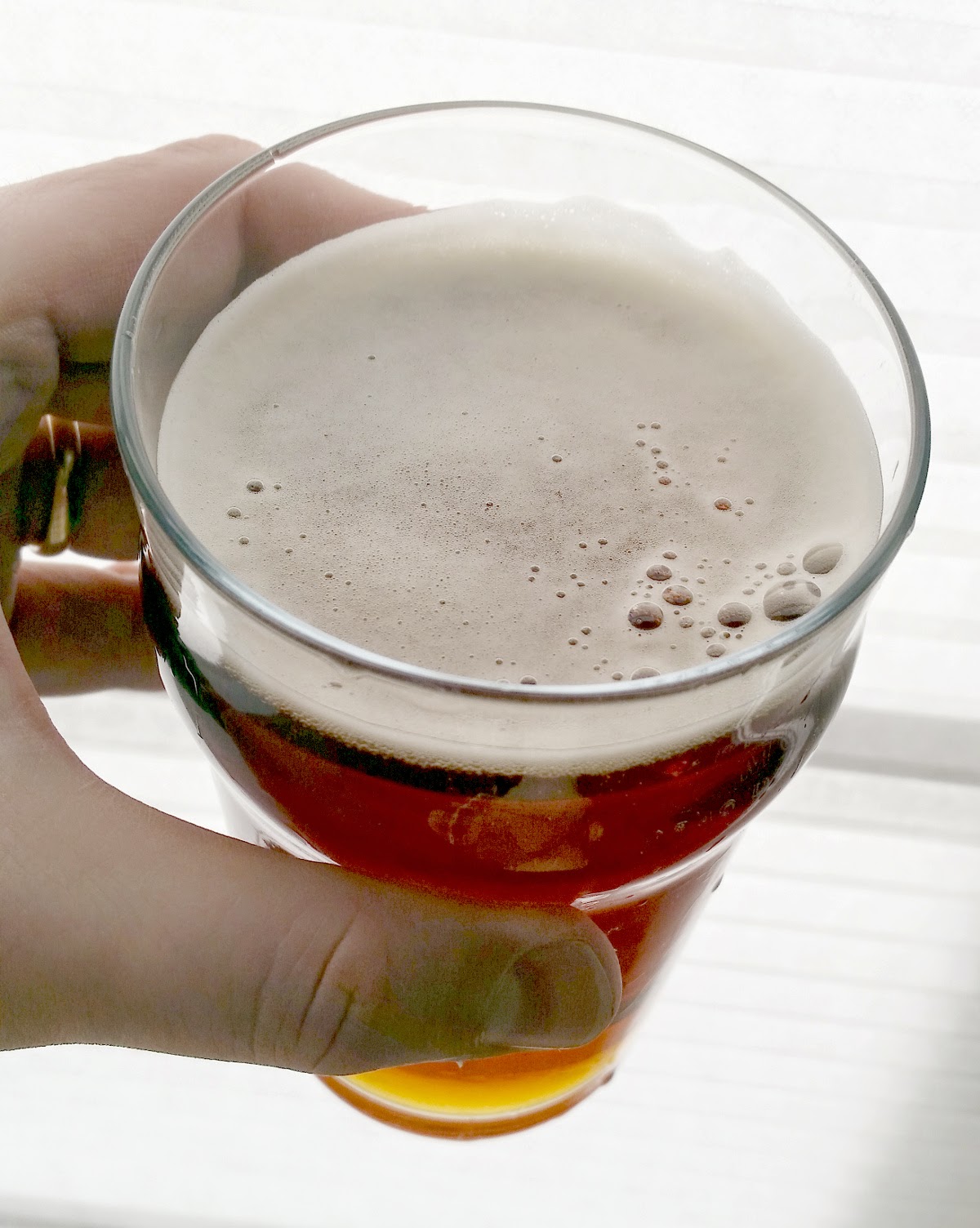
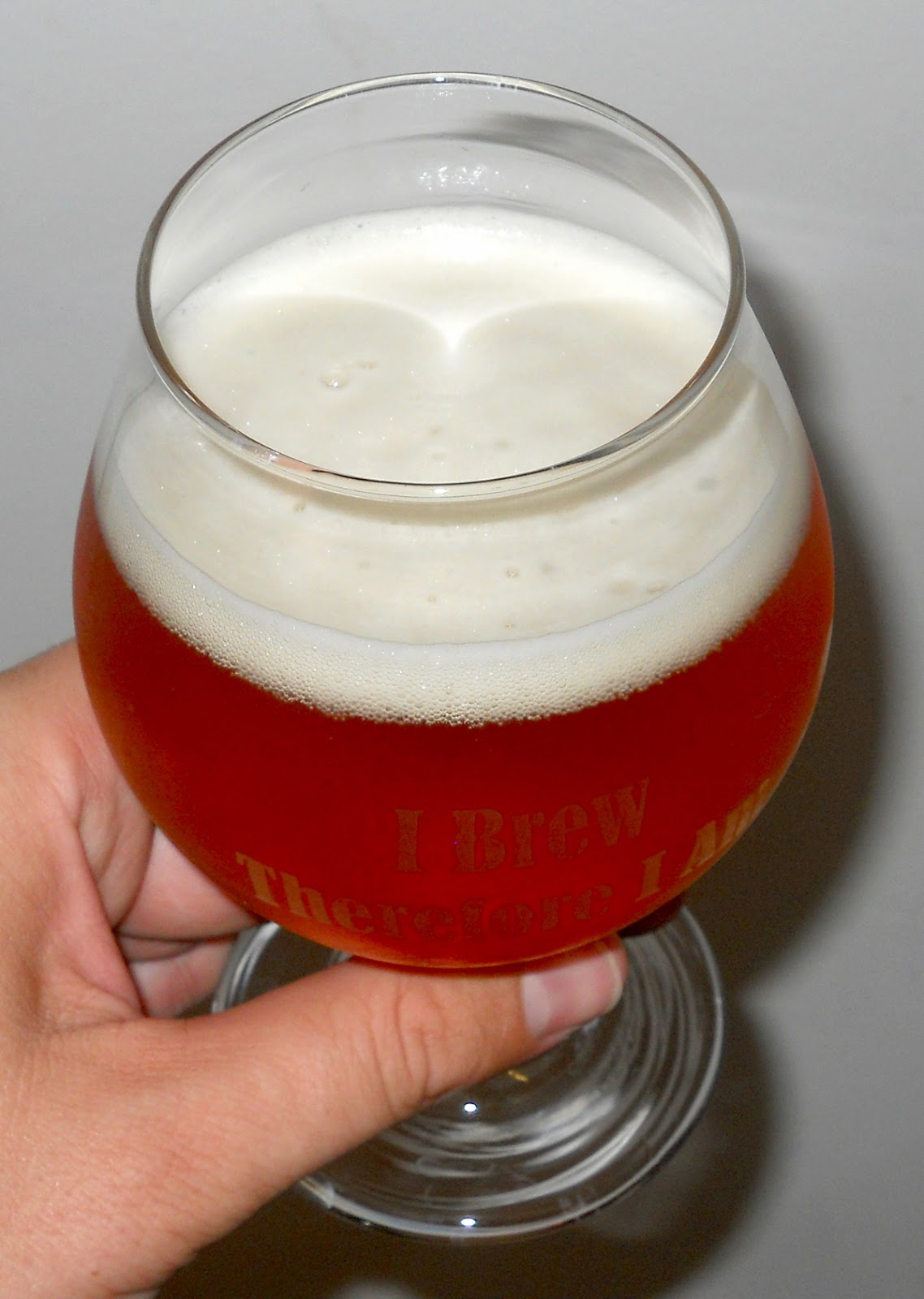
The final gravity for this beer was 1.013, down from 1.060. This works out to 6.2% abv, right on target for the recipe. Taste and appearance for the beer are quite nice–it will be hard to have the patience for my first taste! After my two weeks of dry-hopping at between 60 and 65 degrees, into the keezer it goes for carbonation.

Beringea IPA

Continuing to ramp up brewing for my kegging outfit, I would like a nice IPA on tap later this month. In addition to using up the end of my 50 pound bag of 2 row malt, I also wanted to finish out a partly-used bag of Chinook hops as well as continue working through my supply of South Dakota-grown Cascade hops. Finally, I really like the aroma of Simcoe hops, but I didn’t dry hop my last recipe with them long enough, so the aroma on that batch was a little underwhelming. I decided to give Simcoe another try, with a longer dry hopping period this time around. Note added later: I ended up changing my mind and going with Amarillo hops, which I haven’t used for dry-hopping previously. Simcoe will get saved for later!

At any rate, I’ve designed a recipe that I’m hoping will hit the target for maltiness and hoppiness. The name refers to the adjacent parts of North America and Asia across which many an organism has migrated between continents over the millenia. We’ll see how this recipe works out!

Beringea IPA

  • 10.4 lbs. 2 row malt
  • 1 lb. Carapils malt
  • 0.75 lb. 60° L crystal malt
  • 0.15 lb. chocolate malt
  • 1.25 oz. Chinook hops pellets (11.4% alpha; 3.4% beta), 60 minute boil
  • 1 oz. Cascade whole hops (est. 5.5% alpha), 15 minute boil
  • 2 oz. Simcoe hops pellets (13.0% alpha; 4.5% beta) Amarillo hops pellets (8.2% alpha, 5.7% beta), 2 weeks dry hop
  • California Ale Yeast (White Labs WLP001), prepared 2 days in advance with 1.5 L starter
  • 1 tsp. Irish moss (10 minute boil)
Anticipated statistics
  • 1.060 s.g., 1.013 f.g, 6.2% abv
  • 56.9 IBU
  • 12.4 SRM
Procedure
  • I mashed in with 3.9 gallons of water at ~173°; the mash stabilized at 155° after 5 minutes, and was down to 154° after 30 minutes. After an hour, I added .75 gallons of water at 190°, let it sit for 10 minutes, vorlaufed, and collected ~3.1 gallons of wort.
  • Then, I added 3.14 gallons of 185° water to the mash tun, which brought the mash up to 165°. I let this sit for 10 minutes, vorlaufed, and collected the rest of the wort. This came to a total of 6.75 gallons, with a gravity of 1.049 at 60°, which works out to 75% efficiency.
  • I brought the wort to a vigorous boil, and added the Chinook hops.
  • Because the original wort volume (6.75 gallons) was on track to be more than I anticipated, I aimed for a very vigorous boil to clear out the excess. I was down to 6.25 gallons after 30 minutes, and ~5.75 gallons after 60 minutes of boiling.
  • After 45 minutes, I added the Cascade hops.
  • After 50 minutes, I added the Irish moss.
  • After 60 minutes, I turned off the flame and used my wort chiller to cool the wort. Prior to chilling, I took a sample of wort for specific gravity. This is a minor change in my procedure–by taking the sample now, I figure I reduce the risk of contamination or wort loss due to clumsiness later.
  • I chilled the wort in two stages. The first was by running tap water through the wort chiller. After the wort temperature was around 82°, I siphoned around 3.5 gallons of ice water through the chiller, which brought the temperature down to around 68°.
  • The wort is a beautiful deep copper color, with a smooth bitterness and pleasant flavor. Starting gravity was 1.060 at 60°, exactly on target.
  • I transferred the beer into the carboy while aerating with the Venturi pump, and pitched the yeast starter. I’m fermenting the beer at 65°, in my usual temperature controlled fermentation chamber.
  • This batch was brewed on 3 January 2014.

Beer Update: Gondwana Pale Ale 1.1, Vaalbara Session IPA

Last night (August 29), I bottled up the Gondwana Pale Ale 1.1 and transferred the Vaalbara Session IPA over to the secondary. Details are below.

Gondwana Pale Ale 1.1

  • This beer had been dry hopping for 12 days. It had a final gravity of 1.011, which works out to 4.7% abv.
  • I filled two mini-kegs, which were each primed with 1.5 tbs. of corn sugar. The remaining beer, totaling 1.9 gallons, was bottled and carbonated with 1.65 oz. of corn sugar to reach a target carbonation  of 2.5 volumes.
  • Total yield was 2 5-L kegs, 4 22-oz. bottles, 2 18-oz. bottles, and 8 12-oz. bottles.
  • This beer promises to be really nice — a pretty clean flavor and just the Citra hops aroma I was aiming for.
Vaalbara Session IPA
  • After six days in the primary fermenter, I transferred the beer over to a secondary fermenter.
  • I racked the beer directly onto ~1.75 oz. of Cascade hops pellets, with approximately 3.75 gallons transferred. The carboy went into my temp-controlled fermenting freezer, set to 66°.
  • At the moment, the beer is fairly clear and perhaps a little green in flavor, but there is nothing “off” for flavors relative to what a beer should have at this point in fermentation. Gravity is 1.015, down from 1.045, which calculates to 3.9% abv. I will not be surprised if the gravity drops another point or two in the next two weeks before bottling.

Beer Tasting: Rodinia IPA

Tonight, I wanted to document my Rodinia IPA, brewed way back in April. I have only a few bottles left, so it’s time to formally taste-test the beer.

Rodinia IPA

  • I brewed this on April 12, and bottled it on June 5, 2014.
  • Basics
    • Original gravity = 1.076; final gravity = 1.013; abv = 8.3%.
  • Appearance
    • Quite clear and dark straw color for the beer itself. The head has excellent retention; moderately fine bubbles, white color; thick and as desired for an IPA.
  • Aroma
    • Crisp and slightly sweet, with definite notes of white wine (as promised for the Nelson Sauvin hops used to dry-hopping!) and perhaps even kiwi.
  • Taste
    • Slowly developing bitterness, with lasting edge. Moderate body, but the hops character is much stronger than the malty character.
  • Would I brew this again? 
    • Maybe? It was an interesting to try the Nelson Sauvin hops for dry-hopping, and they behaved pretty much as described; in fact, surprisingly so. The actual white wine aroma was a nice novelty; I was somewhat surprised by the lack of piney or citrusy aroma on this, at least to my nose. That said, I think my overall personal tastes run more towards the citrus/pine end of hops, so although this is a decent enough beer on its own, I probably wouldn’t brew it with this variety of hops again. Maybe as a blend with other dry hops, to add more complex character?
  • Overall rating
    • 6.5/10

Gondwana IPA

After my first experimental all-grain batch, I decided to refine my technique further and attempt an IPA this time. The previous batch had issues with temperature control and poor mash efficiency. The former was resolved by insulating the cooler lid with spray-foam and preheating the cooler/tun with hot water, as well as waterproofing my thermometer leads with silicone tape. I attempted to resolve the second issue by double-milling the grain at the local homebrew store as well as by improving temperature control as noted. Temperature control was much improved, although my efficiency still isn’t where I want it to be (~57% mash efficiency). In any case, brewing science marches on.

Gondwana IPA

  • 9.5 lbs. pale malt (2 row US)
  • 1 lb. Vienna malt
  • 0.5 lb. cara-pils malt
  • 0.5 lb. 40° crystal malt
  • 0.5 lb. 20° crystal malt
  • 3 oz. Cascade whole hops (bittering)
  • 1 oz. Cascade whole hops (late addition aroma, 5 minutes before flame-out)
  • 1 tsp. Irish moss (last 15 minutes of boil)
  • 1 package of Safale American Yeast (US-05)
  • 2 oz. Citra hops pellets (dry hop)
Steps
  • Mash-in with 15.4 quarts of water at 173°. I stirred once, after 30 minutes. The mash temperature ended at 154° after 60 minutes. The mash ended up at about 75 minutes, due to the time required to heat the sparge water.
  • I sparged with 0.62 gallons of water at 170°, stirred, and let it sit for 10 minutes. I collected 2.78 gallons before the tun ran out of liquid. I then sparged with 3.22 gallons of water at 170°, stirred, let it sit for 15 minutes, and decanted. This round collected 3.34 gallons.
  • In total, I collected 6.12 gallons of wort, with a gravity of 1.040 at 60°. This equals a mash efficiency of 56.7% as calculated by BeerSmith.
  • I heated the wort to boiling and added the 3 oz. of whole Cascade hops. At the 45 minute mark, I added the Irish moss. At the 55 minute mark, I tossed in the final Cascade addition.
  • It took about 25 minutes to get the wort down to 70°, using the wort chiller. I then whirlpooled the wort and let it sit for 20 minutes before transferring to the fermenter.
  • In the end, I had 4.75 gallons of wort with a starting gravity of 1.047 at 60° This is a bit lower than conventional style for an IPA, but I figure that is just par for the course as I figure out this new mode of brewing.
  • I pitched the yeast, and left the beer to ferment at an ambient temperature of ~62°.


Notes

  • Mash efficiency is still lower than I like; next time I might aim for hotter sparge water to mobilize more of the sugars, and I will probably adjust my grain bill to compensate for a lower efficiency. I’ll give it another try or two, but I am wondering if the crack I’m getting from the mill at the local homebrew supply is too coarse.