AquiloPils

Concept beers are fun–building a recipe around a story has a mix of constraint and creativity that scratches the brewer’s itch for me. A new opportunity for such a beer popped up recently, when a little dinosaur with which I am very familiar unexpectedly wandered into the spotlight. Aquilops (pronounced “uh-QUILL-ops), a raven-sized cousin of Triceratops that lived in Montana around 106 million years ago, is somehow going to make an appearance in the upcoming Jurassic World movie! As lead author on the original Aquilops publication (along with colleagues Rich Cifelli, Des Maxwell, and Matt Wedel), this was quite a surprise. The 12 year old me who watched Jurassic Park in the theater is pretty geeked out that one of “my” dinosaurs is joining the cast of a Hollywood blockbuster franchise. This dino is in Lego kits, FunkoPops, action figures, Dr. Pepper cans, and even a Scarlett Johansson ASMR video. That’s cool, but what about a beer? I can only guess that the cute dinosaur aimed selling merchandise to kids is not going to be showing up on beer cans anytime soon, so I had to take matters into my own hands.

Aquilops is no stranger to beer recipes–back when we named it, I brewed “Eagle Face Oatmeal Stout” (referencing the translation of the name from its Greek and Latin roots). The beer was served in our club booth at AHA, and even graced the pages of Zymurgy magazine. The oatmeal stout is pretty tasty, but we’re not really in oatmeal stout weather at the moment. I wanted a crisp and quaffable lager to put on tap, and thus AquiloPils was born.

The original fossil skull of Aquilops was found in Montana, and its closest known relative lived in Japan, so a pilsner with nods to classic American lagers and Japanese lagers evolved naturally. Plus, these kinds of beers are a fun technical challenge and always a crowd pleaser. I sourced Montana-grown barley malt, and Sorachi Ace hops were a perfect fit for the recipe (the ones I got from my LHBS were American-grown, which followed the theme nicely). This kind of beer needed an adjunct, so I used 10% flaked rice in the grist. I wanted a perfectly crisp and dry beer, and thus incorporated a long and low mash rest. Finally, because this is supposed to have a very clean yeast profile, I chose Novalager. The brewing process went smoothly, and after some time cold conditioning as well as a dose of Biofine Clear, the beer was brilliantly clear and incredibly tasty.

Matt–one of my co-authors on the paper, a good friend, Aquilops enthusiast, and the person who brought me on to the project in the first place–celebrated a milestone birthday recently, so I was proud to provide a keg for his party. What better way to enjoy AquiloPils than with good friends, co-authors, and a whole ton of paleontologists? It was a crowd pleaser! To celebrate, I also drafted a logo for this beer, of a little Aquilops clutching a glass of the beer. This project was fun from start to finish!

Me (left) and the birthday boy, with our cups of AquiloPils (photo courtesy Matt Wedel). Check out Matt’s musings on our critter in the movies over at the SV-POW! blog.

AquiloPils

  • 9 lb. pilsner malt (Montana Craft Malting Co.)
  • 1 lb. flaked rice (Briess)
  • 2 oz. rice hulls
  • 0.5 tsp. BrewTanB, added to mash
  • 0.4 oz. Sorachi Ace hop pellets (9.7% alpha), 60 minute boil
  • 0.5 tsp. BrewTanB, 10 minute boil
  • 1 Whirlfloc tablet, 5 minute boil
  • 2 pkg. Novalager yeast (Lallemand)
  • 1 pkg. Biofine Clear

Target Parameters

  • 90 minute infusion mash at 146°, full volume mash, with 10 minute mash-out at 168°
  • 1.044 o.g., 1.004 f.g., 5.3% abv, 15 IBU, 3.5 SRM
  • Water profile built with RO water to hit 59 ppm Ca and 105 ppm Cl.

Procedure

  • I built the water up from scratch, using 7.25 gallons of RO water and 6 g of calcium chloride to hit my target water parameters.
  • I heated the strike water to 151°, added the grains, and also added 20 mL of 10% phosphoric acid, holding the mash at 146° for 90 minutes. Then, I raised the temperature to 168° for 10 minutes, before pulling the grains.
  • In total, I collected 6.5 gallons of runnings with a gravity of 1.040, for 72% mash efficiency.
  • I brought the kettle to a boil, adding hops and finings per the recipe.
  • After a 60 minute boil, I turned off the heat and chilled the wort to 70°, before transferring it to the fermenter. I chilled the beer the rest of the way to 50° in the fermentation chamber.
  • I brewed this beer on 15 March 2025, with a starting gravity of 1.049 – well above my target!
  • Fermentation started at 52°; I increased the temperature to 54° on 17 March, and 60° on 20 March. I cold crashed the beer to 33° on 26 March and held it there until I kegged the beer using a closed transfer on 19 April.
  • Final gravity was 1.004, for 5.9% abv.
  • On 15 May 2025, the beer was still fairly hazy, so I added a package of Biofine Clear. Within a day or two, haze had almost entirely dropped out, and within three weeks the beer was brilliantly clear.

Tasting

  • Appearance
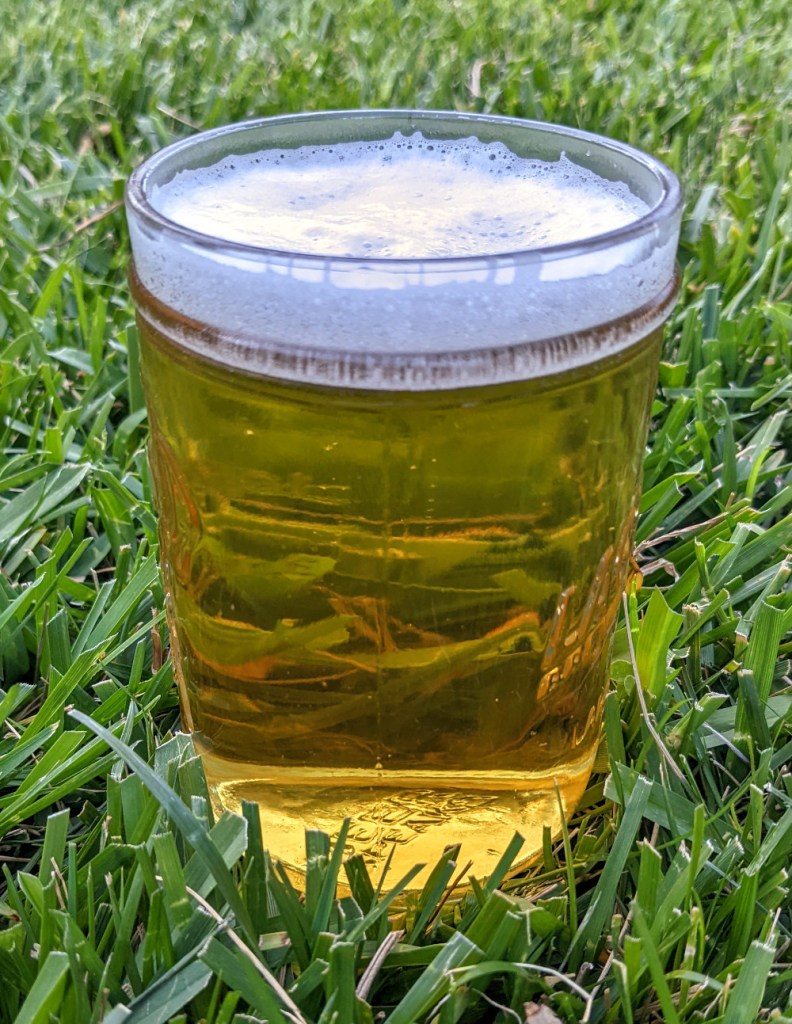
    • Brilliantly clear, straw colored beer with thin white head of low persistence.
  • Aroma
    • Medium-light sweet malty aroma, no hop or yeast character to speak of.
  • Flavor
    • Medium malty character, low bitterness, a bit of that light red apple yeast character.
  • Mouthfeel
    • Medium-high carbonation, light body, dry and crisp finish.
  • Would I Brew This Again?
    • This is pretty close to what I envisioned! It hits the gimmick well and is also super drinkable. The batch yielded a little too high on starting gravity (I was just too efficient in the mash!), so it would be good to notch that back a touch. Otherwise, it’s a perfect beer. I might also try W34/70 for a future iteration, to get more of that apple-like American lager flavor. Finally, I could up the rice percentage some to around 20%, if I wanted a better match with “typical” American lager recipes.
  • Overall
    • 9/10

Dad’s 3P 2024

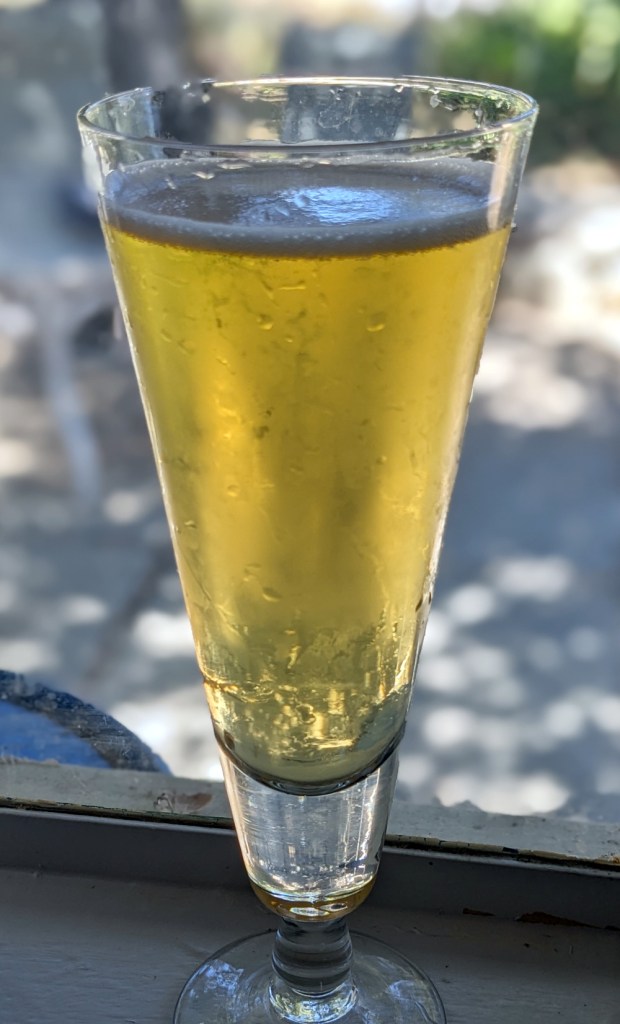
pale yellow beer with white head in conical pilsner glass

I’ve made two previous versions of Pre-Prohibition Pilsners, distinguished as such by having a bit more body and malt character than a typical American macro lager, and distinguished from European pilsners by adjuncts and the frequent use of American hops. My dad’s version originally comes from the April 1999 issue of BYO; it stands out in having a bit of flaked rye in it. Additionally, 6-row malt is nowhere to be seen in my version of this recipe.

This year’s edition is broadly inspired by the 2016 version, but you can check out the last version for differences. I used all American hops (Mt. Hood) instead of German ones, and brought Novalager into the mix, too. The main goal is to have something drinkable for the dog days of summer, but not so inoffensive as to be boring.

Dad’s 3P 2024

  • 6.75 lb. 2-row malt (Briess)
  • 2.25 lb. pilsner malt (Rahr)
  • 1 lb. yellow corn, flaked (Briess)
  • 0.5 lb. rye, flaked (Briess)
  • 0.5 lb. Carafoam (Weyermann)
  • 0.25 lb. rice hulls
  • 0.5 tsp. BrewTanB, in mash
  • 1 oz. Mt. Hood hop pellets (6.0% alpha), 60 minute boil
  • 1 oz. Mt. Hood hop pellets (6.0% alpha), 10 minute boil
  • 0.5 tsp. BrewTanB, 10 minute boil
  • 1 Whirlfloc tablet, 5 minute boil
  • 2 pkg. Novalager yeast (Lallemand)

Target Parameters

  • 1.050 s.g., 1.009 f.g., 30 IBU, 5.5% abv, 4 SRM
  • Full volume mash with recirculation for 60 minutes at 152°, 10 minute mash-out at 168°
  • Water blended from RO and Claremont tap water to hit target of 52 ppm Ca, 10 ppm Mg, 64 ppm Na, 82 ppm SO4, 113 ppm Cl, 5 ppm bicarbonate, alkalinity=4 ppm, RA=-39.

Procedure

  • I built my water the night before with 4 gallons of distilled water and 3.5 gallons of Claremont tap water, adding a Campden tablet and 3.2 mL of 88% lactic acid to drop out the carbonates.
  • I mashed in by heating the strike water to 158°, and then adding the grains and 2.4 mL of 88% lactic acid for pH adjustment.
  • I held the mash, with recirculation, at 152° for 60 minutes, before raising the temperature to 168° for a 10 minute mash-out.
  • At the conclusion of the mash, I removed the grains and let them drain. In total, I collected 6.6 gallons of runnings with a gravity of 1.043, for 69% mash efficiency.
  • As the runnings came to a boil, I added 2.5 g of calcium chloride. Once the runnings boiled, I added the hops and finings per the recipe.
  • After the full 60 minute boil, I chilled the wort to 78° before transferring to the fermenter and letting it chill to 46° in the fermentation chamber.
  • I pitched the yeast at 46°, and then let the fermenter free rise to 52° for fermentation.
  • I brewed the beer on 19 May 2024. Starting gravity was 1.049.
  • I let the beer free rise to 60° on 25 May 2024, and then to 65° on 29 May 2024.
  • The beer was kegged using a closed transfer on 3 June 2024. Final gravity was 1.009, for 5.2% abv.

Tasting

  • Appearance
    • Brightly clear, straw yellow beer, which pours with a fine and persistent white head. It just looks nice!
  • Aroma
    • Grainy sweet malt aroma; no appreciable yeast character or hop character apparent.
  • Flavor
    • Medium-high bitterness at the forefront, with a slightly herbal quality. Malty notes and a light hint of corn sweetness are behind that, but the beer definitely tilts toward bitter. Clean fermentation character, Crisp finish.
  • Mouthfeel
    • Medium body with a rounded feel. Dry finish. Medium carbonation.
  • Would I Brew This Again?
    • This is an interesting American lager, and highly drinkable. It’s a great summer beer! I’ve never done a six-row version of this, and might have to try it sometime in the pursuit of historical accuracy. Relative to the BJCP guidelines for Pre-Prohibition Lager (Category 27, Historical Beer), it hits most of the notes but should have perhaps a bit more hop aroma and a slightly taller head. Overall, though, this is a solid beer and recipe! It’s really enjoyable to drink on a hot afternoon, which is really all I demand from such a beer.
  • Overall
    • 9/10

Dakota Gold Pils

Summer is a great time for pale lagers! For this recipe, I riffed on the Schell’s Pils clone I’ve brewed in the past. It is intended to be a German pils, which is a style I quite enjoy. This recipe uses only 2-row malt, rather than pilsner malt, for the base, with a bit of CaraPils or similar malt.

For this iteration, I tried out Mecca Grade’s pale American malt as the primary base grain, using a bit of Rahr 2-row to finish out that supply. I also subbed in Carafoam instead of Carapils. The hops are entirely whole cones from South Dakota (thanks, Dad!). I had to guess on the alpha based on what is typical for the style, and as you’ll see in the results probably guessed high.

Dakota Gold Pils

  • 7 lb. 9 oz. Lamonta Pale American malt (Mecca Grade)
  • 2 lb. 7 oz. 2-row pale malt (Rahr)
  • 0.5 lb. Carafoam malt (Weyermann)
  • 1.09 oz. Hallertauer whole hops (3.0% estimated alpha), 60 minute boil
  • 1 oz. Sterling whole hops (4.5% estimated alpha), 60 minute boil
  • 1 oz. Saaz whole hops (3.5% estimated alpha), 15 minute boil
  • 0.5 tsp. BrewTanB, 10 minute boil
  • 1 Whirlfloc tablet, 5 minute boil
  • 1 oz. Saaz whole hops (3.5% estimated alpha), 5 minute boil
  • 1 tsp. yeast nutrient (WLN1000, White Labs), 5 minute boil
  • 2 pkg. Diamond Lager dry yeast (Lallemand)

Target Parameters

  • 1.047 s.g., 1.010 f.g., 4.8% abv, 35 IBU, 5 SRM
  • Full volume mash, 149° for 60 minutes, 168° mash-out for 10 minutes
  • RO water with minerals added to hit target of 59 ppm Ca, 8 Mg, 89 SO4, 63 Cl, RA=-47, alkalinity=0.

Procedure

  • Starting with 7.6 gallons of RO water, I added 2.7 g gypsum, 2.2 g epsom salt, and 3.4 g of calcium chloride, to hit the target water profile. I also added half of a sodium metabisulfate tablet, to remove any latent oxygen in the water.
  • I heated the water to 154° and added the grains to hit a target mash temperature of 149°. I did not add any lactic acid, because the pH was calculated to be approximately fine (pH of 5.4) without any additions.
  • After a 60 minute mash, I heated to 168° for the mash-out, and pulled the grains after 10 minutes of this.
  • In total, I collected 6.8 gallons of runnings with a gravity of 1.039, for 70% efficiency.
  • I brought the runnings to a boil, adding hops and finings as indicated by the recipe. After a 60 minute boil, I turned off the heat and chilled to ~70°. I transferred the wort to the fermenter, and chilled down to 50° before pitching the yeast.
  • Starting gravity was 1.047. I brewed the beer on 15 April 2023, fermenting at 52°. I held it here until 13 May 2023, when I cold crashed the beer.
  • I kegged the beer with a closed transfer on 28 May 2023. Final gravity was 1.009, for 5.0% abv.

Tasting

  • Appearance
    • Brilliantly clear, straw-colored beer that pours with a fine and persistent white head. Absolutely beautiful!
  • Aroma
    • Sweet malt aroma. Not really much for hops.
  • Flavor
    • Cracker and sweet malty flavor. Moderately low bitterness, with a very clean fermentation profile. There is not a ton of hop character, surprisingly.
  • Mouthfeel
    • Medium-light body, moderately high carbonation, and smooth finish with a slightly extended bitterness.
  • Would I Brew This Again?
    • This is an excellent beer! A touch more bitterness and hop flavor/aroma would be great, but it is otherwise fantastic in drinkability and appearance. It’s not really a German pils at all–it should be more bitter–but that’s OK. Were I to assign a BJCP category, I would probably put it in International Pale Lager. This is the definition of a lawnmower beer!
  • Overall
    • 10/10 as a beer on its own; 6/10 as a German pils.

Pre-Prohibition Lager

Continuing my journey through the world of lagers, I decided to try a new version of a Pre-Prohibition lager. I’ve made something from this style range before, during my first foray into lagers, and it turned out pretty well. For the current batch, I used a blend of pilsner and 2-row malt to achieve a bit of complexity, layering in some flaked corn to give the “American” component. I got some Triumph hops in a HOPBOX selection, and thought this would be well suited for my American lager. Triumph is an American hop with European parentage, including some noble hops, and it is supposed to bring some noble characteristics along with delicate fruit qualities.

Pre-Prohibition Lager

  • 6.5 lb. Pilsner Malt (Viking)
  • 4 lb. 2-row malt (Rahr)
  • 1 lb. flaked corn
  • 0.25 lb. rice hulls
  • 0.5 oz. Triumph hop pellets (7.9% alpha), 60 minute boil
  • 0.75 oz. Triumph hop pellets (7.9% alpha), 15 minute boil
  • 1 tsp. BruTahB, 10 minute boil
  • 1 Whirlfloc tablet, 5 minute boil
  • 0.75 oz. Triumph hop pellets (7.9% alpha), 5 minute boil
  • 2 pkg. Diamond lager yeast (Lallemand)

Target Parameters

  • 1.051 s.g., 1.008 f.g., 28 IBU, 5.7% abv, 4 SRM
  • Full volume Hochhurz mash, 45 minutes at 144°, 45 minutes at 10 minutes at 160°, 10 minute mash-out at 168°
  • Water built from scratch to hit 59 ppm Ca, 8 ppm Mg, 89 pm SO4, 63 ppm Cl, -47 ppm RA

Procedure

  • I added 2.7 g gypsum, 2.2 g epsom salt, and 3.4 g calcium chloride to 7 gallons of RO water, to hit a target of 59 ppm Ca, 8 ppm Mg, 89 pm SO4, 63 ppm Cl, and -47 ppm RA.
  • I heated the water in the Foundry to 150°, and added the grains to hit a mash temperature of 144°. I added 1.5 mL of 88% lactic acid to adjust pH slightly. I held the mash at 144° with recirculation for 45 minutes, and then raised the temperature to 160°, holding it here for 45 minutes also. Finally, I raised the mash to 168° and held it here for a 10 minute mash-out.
  • After the mash-out, I removed the grain basket and brought the runnings to a boil. I collected 6.3 gallons of runnings with a gravity of 1.048, for 71% mash efficiency.
  • I brought the beer to a boil, aiming for 60 minutes, adding hops and such per the recipe. My Foundry had an issue mid-boil (the power switch was starting to burn out),so it took a bit of work to limp the boil through to the end. I adjusted the length of the boil time slightly to compensate.
  • After approximately 60 minutes of total boil, I turned off the heat and chilled to ~68°, before transferring to the fermenter and chilling down to 48° in the fermentation chamber. I then pitched the yeast.
  • I brewed the beer on 14 February 2022, and fermented at 52°. Starting gravity was 1.053.
  • I kegged the beer on 8 April 2022. Final gravity was 1.013, for 5.3% abv.

Tasting

  • Appearance
    • Brilliantly clear, light yellow beer with moderately persistent head. The head pours fairly thick, but thins out after awhile.
  • Aroma
    • Clean! Slight grainy/corn profile; not much hop character, although there is a bit of a spice hop note.
  • Flavor
    • Malty/grainy, with light corn flavor; moderately high bitterness, but not much for hop character otherwise.
  • Mouthfeel
    • Fairly crisp finish, with moderate carbonation. Medium body. Very smooth drinking!
  • Would I brew this again?
    • YES! This is a nice version of the style; I suppose it doesn’t hit all of the BJCP style notes, but it really is a pretty awesome American lager. A touch more hop aroma would be nice, but not mandatory.
  • Overall
    • 9/10

Mow the Damn Lawn, Farke

I brewed this American lager recipe last summer, and thought I’d give it another go to close out the warm months here. The 2021 version is nearly identical, just with a small hop swap as well as water built (mostly) from scratch.

Mow the Damn Lawn, Farke

  • 8.5 lb. 2-row malt (Great Western, California Select)
  • 2 lb. flaked rice
  • 4 oz. rice hulls
  • 0.6 oz. Vanguard hop pellets (6.5% alpha), 60 minute boil
  • 1 tsp. BruTanB, 10 minute boil
  • 1 Whirlfloc tablet, 5 minute boil
  • 1 tsp. yeast nutrient (WLN1000), 5 minute boil
  • 2 pkg. Saflager Lager Yeast (W34/70)

Target Parameters

  • 1.046 s.g., 1.008 f.g., 5.0% abv, 14 IBU, 4 SRM
  • 148° full volume infusion mash, 75 minutes, with 10 minute mash-out at 168°
  • Water built from 6 gallons RO and 1.5 gallons Claremont tap water, to produce a water of 7 ppm Ca, 2 ppm Mg, 19 ppm Na, 10 ppm sulfate, 21 ppm Cl, 31 ppm bicarbonate, 26 ppm alkalinity; 19 ppm RA

Procedure

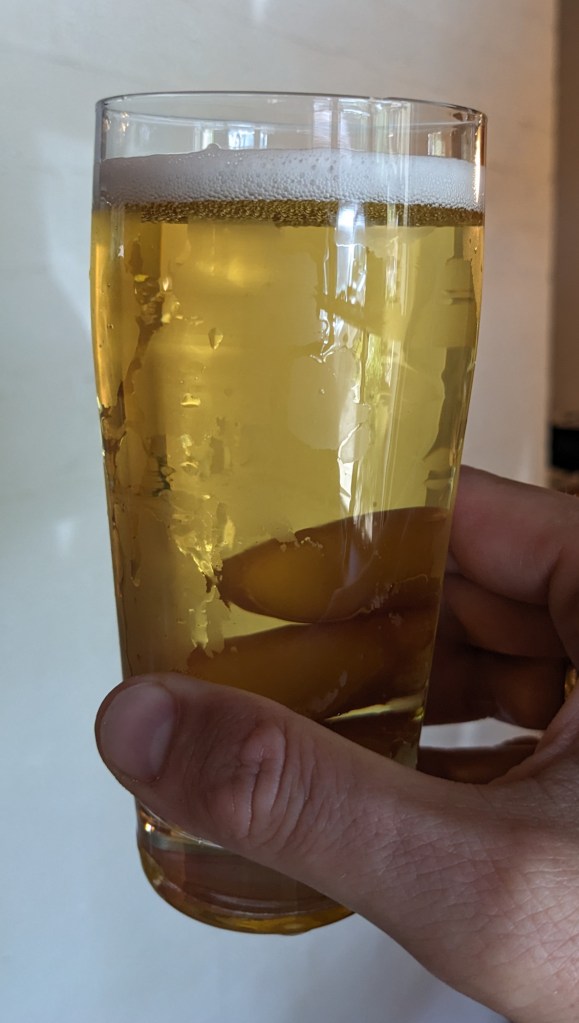
hand holding willi becher glass of yellow beer with white head
  • The night before brewing, I set in the water by mixing 1.5 gallon of tap water with 6 gallons of RO water and a quarter of a Campden tablet, to that it would all be ready to go in the morning.
  • I heated the strike water to 153°, and hit a mash temperature of 148°. I recirculated at this temperature for 75 minutes, noting that the top of the mash read at 147.5°; I was pretty happy with this.
  • After the mash, I heated to 168° for 10 minutes, and then pulled out the grain basket.
  • In total, I had 6.75 gallons of runnings with a gravity of 1.038, for 68% mash efficiency.
  • I brought the kettle to a boil, boiling for 30 minutes before adding the hops, in order to bring the gravity up a bit. Then, I boiled for another 60 minutes while adding hops and finings per the recipe.
  • After the full 90 minute boil, I chilled the wort to 75°, and transferred to the fermenter for the final chill to 48° in the fermentation chamber. Finally, I pitched the yeast directly and let it free rise to 52°.
  • I brewed the beer on 19 June 2021, fermenting at 52°. Starting gravity was 1.044.
  • I cold crashed the beer on 10 July 2021, and kegged it on 14 August 2021.
  • Final gravity was 1.009, which works out to 4.6% abv.
  • The beer was surprisingly hazy at the time of kegging, especially after over a month of lagering.
  • I tasted the beer on 17 August 2021, and it was an acetaldehyde bomb. Ugh. This was a surprise to me, because it had plenty of time to clean up (two months since brewing). I’m not sure why this was; maybe it hadn’t actually cleaned up because I skipped a diacetyl rest? I’ve gotten away without it before, though, and as mentioned it sat on the yeast for plenty of time. My other thought is that maybe if the airlock dried out a bit, this introduced some oxygen and created more acetaldehyde. In any case, I pulled the beer out to room temperature (~75°), and let it sit there for a few days, with occasional keg purges to outgas any unpleasantness, before re-chilling. It still had a decent bit of green apple when I tasted a week later, but it was much improved. After two more weeks, any acetaldehyde had faded to virtually nothing. In any case, a slight green apple quality is acceptable in the American lager style, so let’s just pretend that I meant to do this.

Tasting

  • Appearance
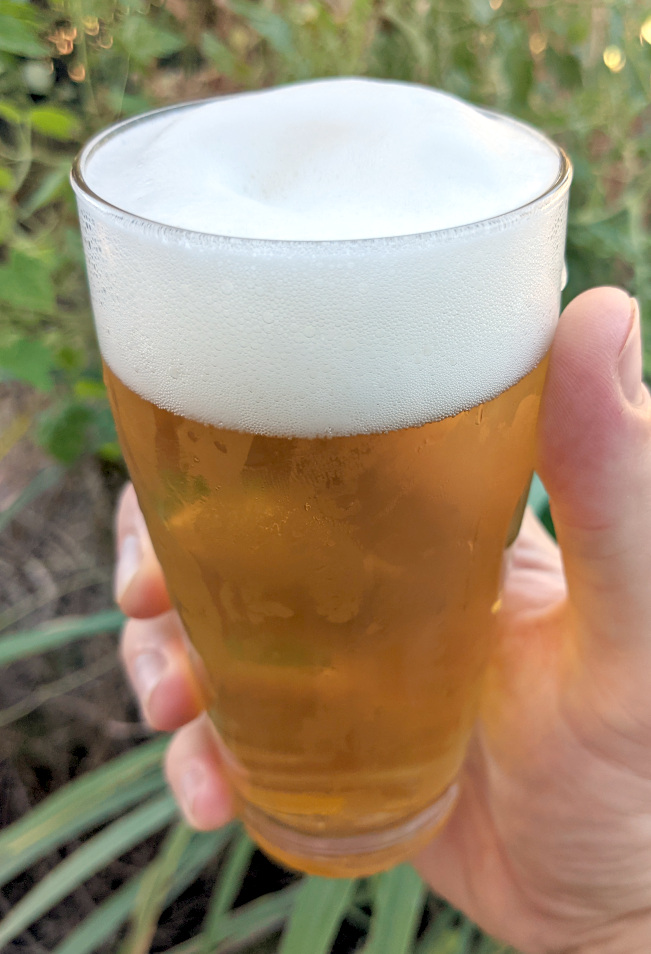
    • Very clear, nearly brilliantly so, with a light yellow color. It pours with a creamy and tall white head that subsides to a modestly persistent thin rim.
  • Aroma
    • Light malty sweetness with a very very slight green apple character (virtually imperceptible), and a crisp, faint hop spice note
  • Flavor
    • Low level of maltiness and light sweetness, and a moderately low and clean bitterness. As with the aroma, there is a very faint green apple character, which has faded considerably since the early days on tap. It is a very drinkable beer.
  • Mouthfeel
    • Light body, moderate carbonation, and slightly dry finish.
  • Would I brew this again?
    • This is a pretty good beer, which is fun as an experiment to see if I can pull off a light, high-adjunct beer. It’s certainly quite drinkable in decent quantity during a hot day, so I’ve hit that goal quite well. It’s not the most exciting beer ever, but then again that’s not what I was aiming for. I’m a bit disappointed by the heavy acetaldehyde in initial servings, and I don’t quite know what led to that. I suspect it was a combination of things, and will likely do a higher temperature fermentation rest on future batches.
  • Overall
    • 6.5/10