Let There Be Rauch!

Smoked beers can be nice as an occasional treat (especially in the winter), and I have made a few over the years. One classic style that has escaped my brew log to date, however, is rauchbier. I remember trying one years ago, from a fellow homebrewing paleontologist, and it is still one of the most memorable beers I have ever sampled! The combination of smoke and maltiness was unlike anything I had tried previously, and the beer lives on in my memory, well over a decade later (and probably closer to 15 or 20 years now).

After years of thinking about rauchbier but never making one, I was spurred into action by Dan Jablow’s article (“Making Friends With Smoked Beer”) in the November/December 2024 issue of Zymurgy. He included a 1 gallon recipe called “Let There Be Rauch!”, and the approach seemed simple enough. So, I scaled it up to 5.5 gallons and adjusted the hops slightly to move the bitterness level into the higher end of the style’s range in the BJCP guidelines.

Let There Be Rauch!

  • 5 lb. beechwood smoked malt (Weyermann)
  • 3 lb. Munich light malt (BESTMALZ)
  • 3 lb. pilsner malt (Rahr)
  • 1 lb. Caramunich II malt (Weyermann)
  • 0.5 tsp. BrewTanB, added to mash
  • 1 oz. Hallertauer Mittelfrueh (5.5% alpha), 60 minute boil
  • 1 oz. Hallertauer Mittelfrueh (5.5% alpha), 15 minute boil
  • 0.5 tsp. BrewTanB, 10 minute boil
  • 1 WhirlFloc tablet, 5 minute boil
  • 3 pkg. SafLager West European Lager dry yeast (Fermentis S-23)

Target Parameters

  • 1.054 s.g., 1.015 f.g., 29 IBU, 11 SRM, 5.2% abv
  • Full volume mash with 60 minutes at 154° and 10 minutes at 168°; 60 minute boil
  • Water built from RO and tap water to hit target water parameters of 59 ppm Ca, 4 ppm Mg, 29 ppm Na, 56 ppm SO4, 88 ppm Cl, 52 ppm CaCO3, RA=-2

Procedure

  • I collected 2.5 gallons of tap water (with Campden tablet) and 5 gallons of RO water, with 3 g CaCl and 2 g gypsum, to hit the target water parameters.
  • I heated the strike water to 161° and added the grains to hit a mash temperature of 154°. I added 2 mL of 88% lactic acid, to adjust the pH. I held the mash at 154° for 60 minutes, with recirculation, before I raised the temperature to 168° for 10 minutes.
  • Upon removing the grains, I had a total of 6.6 gallons at a gravity of 1.045, for 68% mash efficiency.
  • I brought the runnings to a boil and added finings and hops per the schedule.
  • After 60 minute boil, I turned off the heat, did an initial chill to ~70°, and then transferred the beer to the fermenter. I chilled it further to 52° before pitching the yeast.
  • I brewed the beer on 24 November 2024, with a starting gravity of 1.055. I fermented the beer at 54°, and let it free rise to 60° on 3 December 2024.
  • I cold crashed to 35° on 5 December 2024, and kegged the beer with a closed transfer on 8 December 2024. The beer had a very nice and subtle smoke flavor/aroma.
  • Final gravity was 1.018; this works out to 4.9% abv.

Tasting

  • Appearance
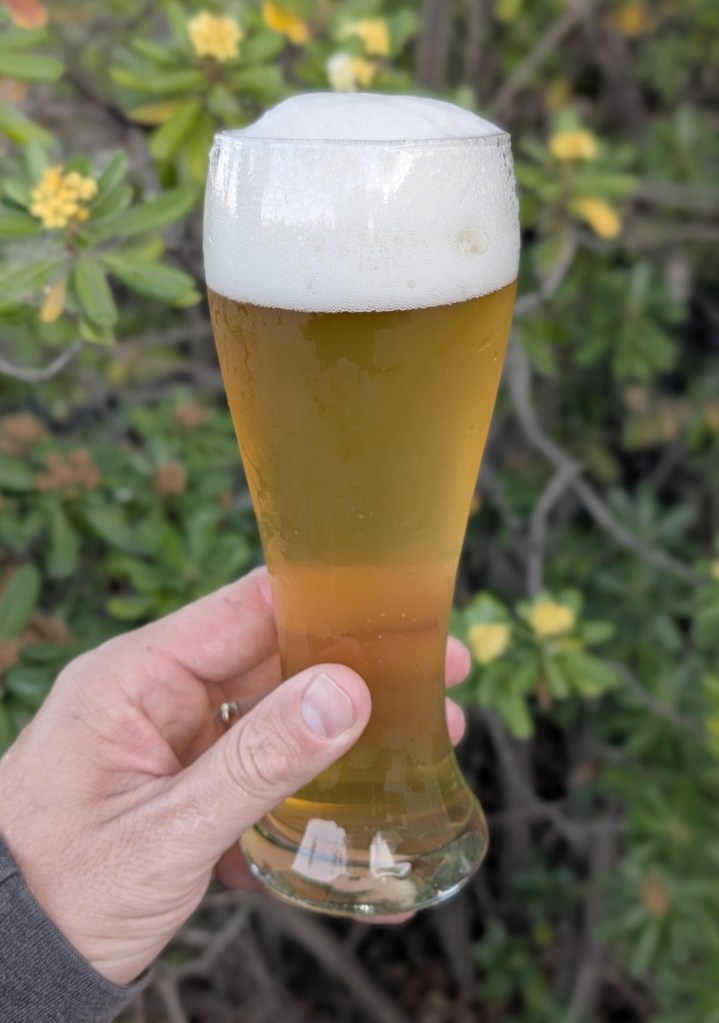
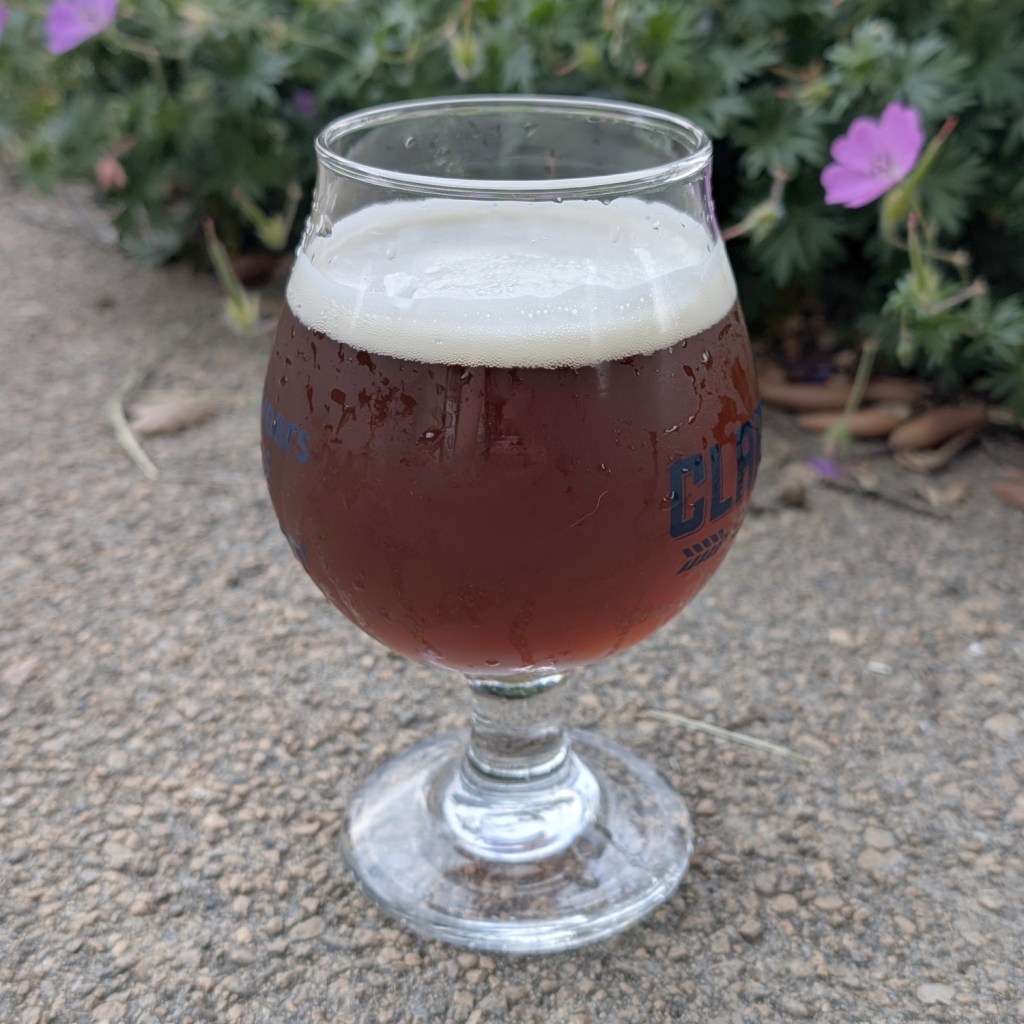
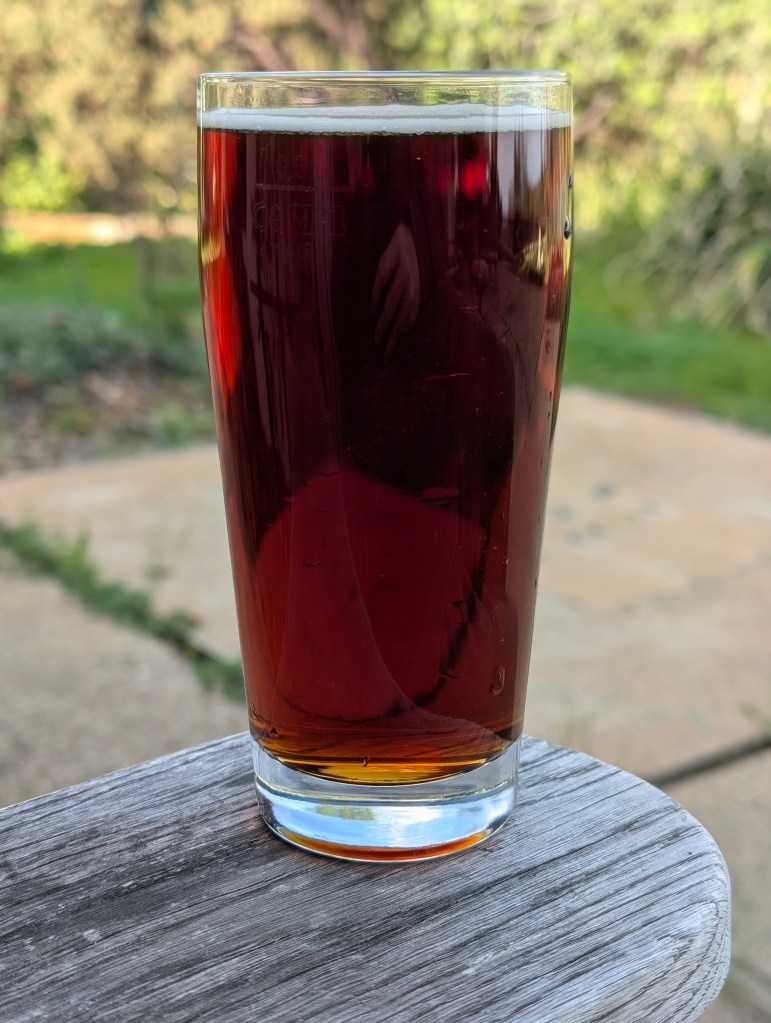
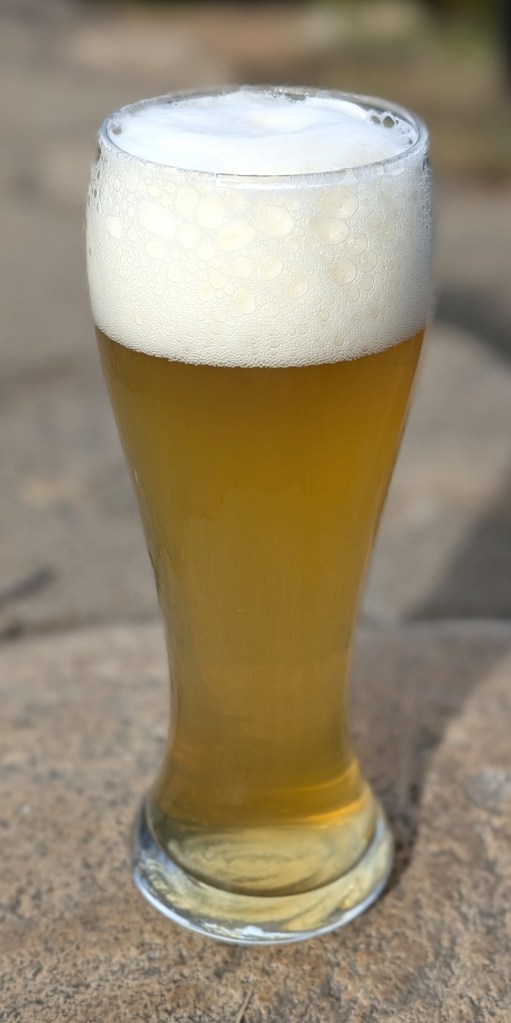
    • Beautiful! It is a brilliantly clear light amber beer, with a creamy and persistent off-white head
  • Aroma
    • Bready malt with a touch of toastiness at a moderate level, a medium level of smoke–almost lightly bacony, Very pleasant balance.
  • Flavor
    • Bread crust and malty flavor at a moderate level; smoky flavor, somewhat bacon-like, at a medium level. Moderate hop bitterness with a slightly spicy quality. The smoke balance is perfect against the malt; not overwhelming at all, but pleasantly alongside each other!
  • Mouthfeel
    • Medium carbonation, medium body, only slightly dry finish.
  • Would I Brew This Again?
    • It’s not often I nail something on the first batch, but this is just a great recipe! It dodges the peaty phenolics of some versions, and is both interesting and drinkable. I am pleased!
  • Overall
    • 10/10

Denny Kong-ish West Coast IPA

I made my first version of this new-style West Coast IPA last year, and learned some lessons about hopping techniques in the process. During that previous batch, I used a hop bag that was too small for the dry hopping addition, and as a result the hop flavor/aroma were pretty underwhelming. This time around, I opted to let the hops float free in the fermenter. I use a BrewBucket 7.5, which has a rotating pickup arm, so I could do a closed transfer into the keg without excessive hop particles clogging things. The hop choices on this version used up some of my hop stash–three-quarters of a pound of hops went into the final recipe!

Denny Kongish West Coast IPA

  • 12 lb. 5 oz. pilsner malt (Rahr)
  • 1 lb. Vienna malt (Weyermann)
  • 0.5 tsp. BrewTanB, added to mash
  • 4 oz. dextrose, added to boil
  • 0.85 oz. Enigma hop pellets (17.9% alpha), 60 minute boil
  • 0.5 tsp. BrewTanB, 10 minute boil
  • 1 Whirlfloc tablet, 5 minute boil
  • 2 oz. LUPMOMAX Cashmere hop pellets (13.5% alpha), 30 minute whirlpool
  • 1 pkg. California ale dry yeast (WLP001, White Labs)
  • 4 oz. Idaho #7 hop hash (31.4% alpha), dry hop in primary fermenter
  • 2 oz. Azacca hop pellets (12.2% alpha), dry hop in primary fermenter
  • 2 oz. LUPOMAX Sabro HBC 438 hop pellets (19.0% alpha), dry hop in primary fermenter
  • 1.15 oz. Enigma hop pellets (17.9% alpha), dry hop in primary fermenter

Target Parameters

  • 1.063 s.g., 1.010 f.g., 7.0% abv, 64 IBU, 5 SRM
  • Full volume infusion mash, held at 149° for 120 minutes and 168° for 10 minutes
  • Neutralized Claremont tap water with Campden tablet, RO water, and mineral salts added to mash to achieve 51 ppm Ca, 8 ppm Mg, 33 ppm Na, 104 ppm SO4, 53 ppm Cl, 8 ppm CO3.

Procedure

  • Starting with 3 gallons of tap water, I added 2.5 mL of 88% lactic acid as well as a Campden tablet, along with 5 gallons of RO water, 0.75 CaCl, 1.5 g epsom salt, and 3.5 g gypsum to hit the target water parameters.
  • I heated the water to 155° and added the grains, along with 17.2 mL of 10% phosphoric acid for pH adjustment, to hit an estimated pH of 5.35.
  • I held the mash at 149° for 120 minutes, with recirculation, and then raised the mash to 168° for 10 minutes before pulling the grains.
  • In total, I collected 6.9 gallons of runnings with a gravity of 1.050, for 69% mash efficiency.
  • I brought the runnings to a boil, with a 90 minute total boil. After 30 minutes, I added the first round of hops, and then proceeded following the recipe.
  • After the 90 minute boil, I chilled to 170° before adding the whirlpool hops and letting them sit for 30 minutes while whirlpooling.
  • Next, I chilled to 68°, transferred to the fermenter, and chilled down to 64° before pitching the yeast.
  • I brewed the beer on 1 January 2025, and it had a starting gravity of 1.066.
  • I added the dry hops on 11 January 2025, loose into the fermenter.
  • I cold crashed the beer on 15 January 2025.
  • I kegged the beer on 18 January 2025, into a CO2 purged keg. Final gravity was 1.007–that’s wonderfully dry and works out to 7.8% abv. I had a similar experience last batch, so this mash regime works wonders!

Tasting

  • Appearance
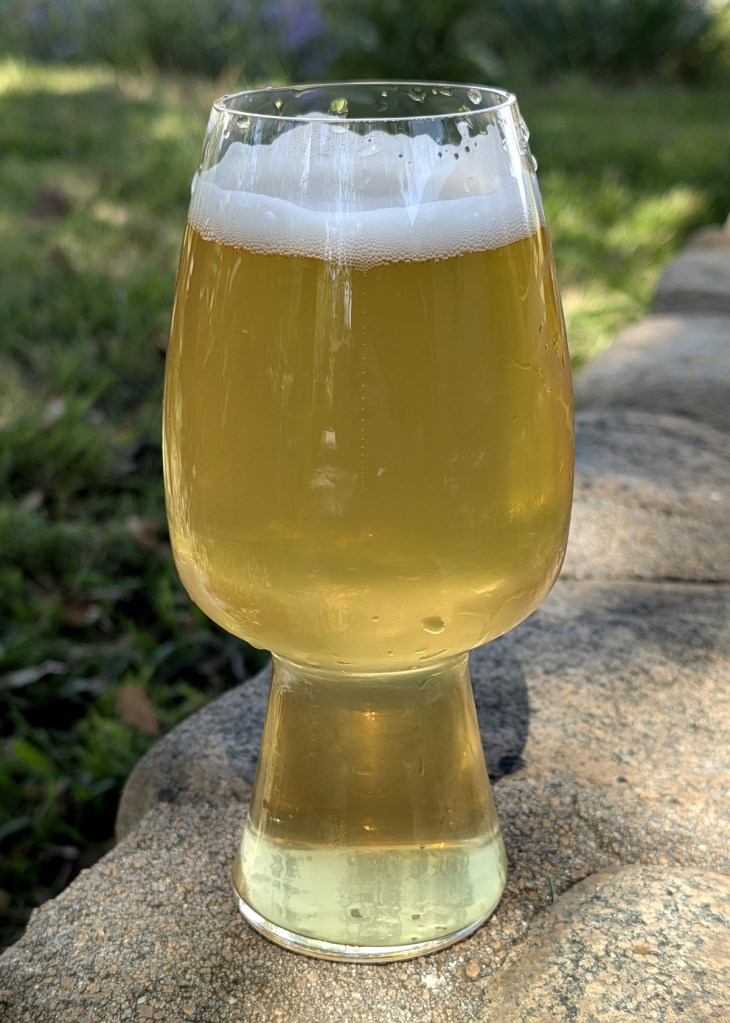
    • Light gold beer, slight haze, which pours with an exceptionally persistent and creamy white head–it’s like a meringue! This head leaves beautiful lacing down the side of the glass. The beer is surprisingly clear. As a result, I am feeling good about my decision not to use post-fermentation finings; this likely helped with oxidation reduction.
  • Aroma
    • Citrus and dank hop aroma at a high level, neutral yeast profile, and no malt character to speak of in the aroma.
  • Flavor
    • Very bitter, citrus pith and dank hop character, with a bit of grapefruit along the way, and a long-lingering hop aftertaste. The hop flavor is a bit one-note; it has the usual issue with Azacca to my tastebuds, which is an orange pith quality on the edge of rotten orange. I’ve never understood the appeal of that hop! Low level of maltiness, but it is there. Clean fermentation character.
  • Mouthfeel
    • Medium-high carbonation, medium-light body, very dry finish.
  • Overall
    • 7.5/10
  • Would I Brew This Again?
    • I really like this recipe as a template for a double IPA; it is a clean background to let the hops shine. This is the first time in awhile that I have let the hops float free for dry hopping, and with the Brew Bucket’s rotating pickup arm, things worked well. Thanks to the closed transfer (and perhaps the BrewTanB?), the hop character has held up well. The beer is clear enough without finings, so I think there is no need to use Biofine Clear as the original recipe stipulates. Azacca, as usual for my experience, gives a harshness in the citrus note that I don’t care for. This formulation is a bit one-note on the hops. But, it’s okay overall! In a beer like this, a different hop combo would be the ticket to hoppiness.
      • Interesting note: when I tasted this again last night, after a rauchbier, I got more tropical notes, and the unpleasant orange wasn’t as apparent. I would rate the beer higher in that case – perhaps a 8.5/10.

Unruly Gnome Belgian Blond Ale

La Chouffe is a darned good beer, and I will often get a pour if I find it on-tap at a quality alehouse (shout-out to The Back Abbey!). Belgian Blond Ale (or Belgian Blonde Ale) is not a style I have brewed previously, so it’s time to rectify that! I did a bit of research to find a clone recipe for La Chouffe, and a version from Brewer’s Friend inspired my own version, along with “The Gnome” recipe in Gordon Strong’s Modern Homebrew Recipes. The original recipe on Brewer’s Friend used decoction, but I decided to just put a little melanoidin malt into the grist instead. I also included a mash rest at 126°, in an attempt to improve the head.

Because this is an experimental beer, and a high alcohol one at that, I decided to make a small (3 gallon) batch.

Unruly Gnome Belgian Blond Ale

  • 7.75 lb. pilsner malt (Rahr)
  • 3 oz. melanoidin malt (Weyermann)
  • 0.5 tsp. BrewTanB (mash)
  • 12 oz. clear candi sugar (added to boil)
  • 1 oz. Styrian Goldings hop pellets (3.2% alpha), 60 minute boil
  • 0.5 oz. Saaz hop pellets (2.0% alpha), 15 minute boil
  • 0.25 tap. BrewTanB, 10 minute boil
  • 0.5 Whirlfloc tablet, 5 minute boil
  • 0.5 oz. Saaz hop pellets (2.0% alpha), 5 minute boil
  • 0.5 tsp. yeast nutrient WLN1000 (White Labs), 5 minute boil
  • 6 g. coriander seeds (Turkish), 5 minute boil
  • 1 pkg. Abbaye Belgian ale yeast (Lallemand)

Target Parameters

  • 1.068 s.g., 1.009 f.g., 7.9% abv, 6 SRM, 21 IBU
  • Full volume step mash, with 15 minutes at 126°, 90 minutes at 146°, and 10 minutes at 168°; 60 minute boil
  • Water built up from RO and Claremont tap water, to hit water target parameters of 50 ppm Ca, 4 ppm Mg, 45 ppm Na, 56 ppm SO4, 82 ppm Cl, 10 ppm bicarbonate, RA=-30.

Procedure

  • To get my strike water, I mixed 2.5 gallons Claremont tap water and 2.5 gallons distilled water, added 2.1 mL of 88% lactic acid, 1/4 Campden tablet, 1 g CaCl, and 1 g CaSO4.
  • I heated the strike water to 131°, added the grains and 1 tbs. of 10% phosphoric acid, and held the mash at 126° for 15 minutes, before raising the temperature to 146° for 90 minutes. Then, I raised the mash to 168° for 10 minutes before pulling the grains.
  • In total, I collected 4.5 gallons of runnings at a gravity of 1.050, for 75% mash efficiency.
  • I brought the runnings to a boil, adding finings per the recipe. After a 60 minute boil, I turned off the heat and chilled to 74° before transferring to the fermenter and pitching the yeast.
  • I brewed this beer on 7 December 2024. Starting gravity was 1.070.
  • I had vigorous fermentation within 18 hours of pitching the yeast; temperature was down to 72°, and so I moved the fermenter into the fermentation chamber on 8 December 2024, and set it at 74°.
  • Fermentation (as evidenced by bubbling) was pretty much done by 10 December 2024.
  • I kegged the beer on 23 December 2024, adding 1 oz. of corn sugar in 0.5 cups of water for carbonation, and let it sit at room temperature.
  • Final gravity was 1.011, for 7.8% abv.

Tasting

  • Appearance
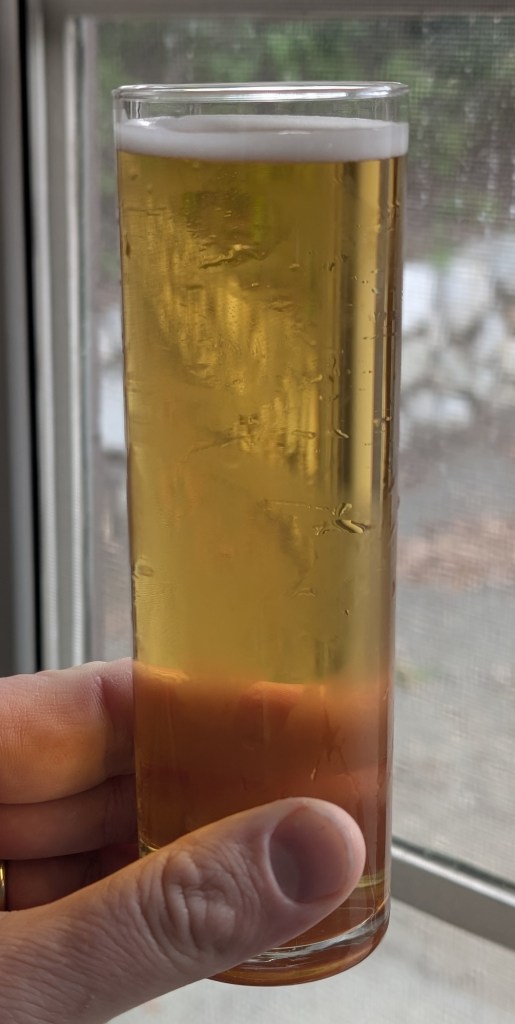
    • Very clear gold beer that pours with a creamy and persistent white head of foam. It’s quite pretty! I’ll note that it clarified a bit more after the photos were taken (about 10 days before this post).
  • Aroma
    • Moderate spicy phenolic notes, but overall pretty clean. A little light caramel malt comes through, and some citrus quality with light alcohol notes as it warms.
  • Flavor
    • Moderately high bitterness, crackery malt at a moderate level, with a touch of candy. Balance is towards the hops a bit. Orange peel citrus comes through as the beer warms. The yeast is perhaps a touch more prominent than what I remember in the commercial beer.
  • Mouthfeel
    • Highly carbonated, light body, dry finish. It drinks very easily!
  • Would I Brew This Again?
    • This is a good start. The yeast was perhaps a bit forward in the early samplings of the beer, but it has mellowed considerably over time. It might benefit from lower temperatures with this dry yeast strain, or a different strain at least relative to the style ideal (probably Ardennes for my next version, which isn’t available in dry yeast form; Belle Saison is another dry yeast I’m considering). Even so, this beer is dangerously drinkable! I might dial hops back a touch, perhaps to 15 IBU or so. The bitterness on the finish is just a touch harsher than I like. The coriander doesn’t come through, so I could safely ditch it; I don’t think anything would be lost. I might also try a fresher coriander from a different source area, which could also help.
    • Note added 10 February 2025: The beer has cleared to brilliant now!
  • Overall
    • 8/10

Pfriem Pilsner 2024

I have done a version of this three times previously, usually with some minor variations for hops or yeast. This time, I decided to do the hop varieties and timings exactly as written (with adjustments for alpha acid), to follow the original Pfriem Pilsner clone recipe from Dave Carpenter’s Lager book. Without further ado, here’s what I did.

Pfriem Pilsner 2024

  • 9.75 lb. pilsner malt (Rahr)
  • 6 oz. Carafoam malt (Weyermann)
  • 0.5 tsp. BrewTanB, in mash
  • 0.75 oz. Perle hop pellets (6.3% alpha), 60 minute boil
  • 0.5 oz. Tettnang hop pellets (2.4% alpha), 60 minute boil
  • 0.5 oz. Tettnang hop pellets (2.4% alpha), 10 minute boil
  • 0.75 oz. Saphir hop pellets (2.3% alpha), 10 minute boil
  • 0.5 oz. Spalt Spalter hop pellets (4.3% alpha), 10 minute boil
  • 0.5 tsp. BrewTanB, 10 minute boil
  • 1 Whirlfloc tablet, 5 minute boil
  • 1.5 oz. Tettnang hop pellets (2.4% alpha), 10 minute whirlpool
  • 0.75 oz. Saphir hop pellets (2.3% alpha), 10 minute whirlpool
  • 0.5 oz. Spalt Spalter hop pellets (4.3% alpha), 10 minute whirlpool
  • 2 pkg. Diamond dry lager yeast (Lallemand)

Target Parameters

  • 1.046 s.g., 1.007 f.g., 5.1% abv, 4 SRM, 38 IBU
  • Full volume step mash, with 45 minutes at 142°, 45 minutes at 156°, and 10 minutes at 168°; 70 minute boil
  • Water built up from RO, to hit target parameters of 62 ppm Ca, 11 ppm Mg, 121 ppm SO4, and 51 ppm Cl, with RA=-50 ppm

Procedure

  • I built up my mash water from 7.5 gallons of RO water, with 3 g calcium chloride, 3 g epsom salt, and 4 g gypsum. Then, I heated it to 146° before adding the grains and holding at 142° for 45 minutes, with recirculation. Then, I raised the mash to 156° for 45 minutes and finished up at 168° for 10 minutes.
  • After the mash, I pulled the grains. I collected 6.8 gallons of runnings with a gravity of 1.041, for 74% mash efficiency.
  • I brought the runnings to a boil, boiling for 10 minutes before adding the first round of hops and proceeding with the rest of the recipe as written. In total, this was a 70 minute boil.
  • At the end of the boil, I turned off the heat, added the whirlpool hops, and whirlpooled for 10 minutes before continuing with the rest of the chill.
  • Once the beer was down to 72°, I transferred to the fermenter and chilled down to 46° in my fermentation chamber, before pitching the yeast.
  • I brewed this beer on 28 October 2024, and the starting gravity was 1.049.
  • The starting fermentation temperature was 48°, and I held it here until 3 November 2024, when I raised the temperature to 52°. On 17 November, I raised the temperature to 54°, and then to ambient (~62°) on 24 November 2024.
  • I kegged the beer on 25 November 2024. Final gravity was 1.009, for 5.3% abv.

Tasting

  • Appearance
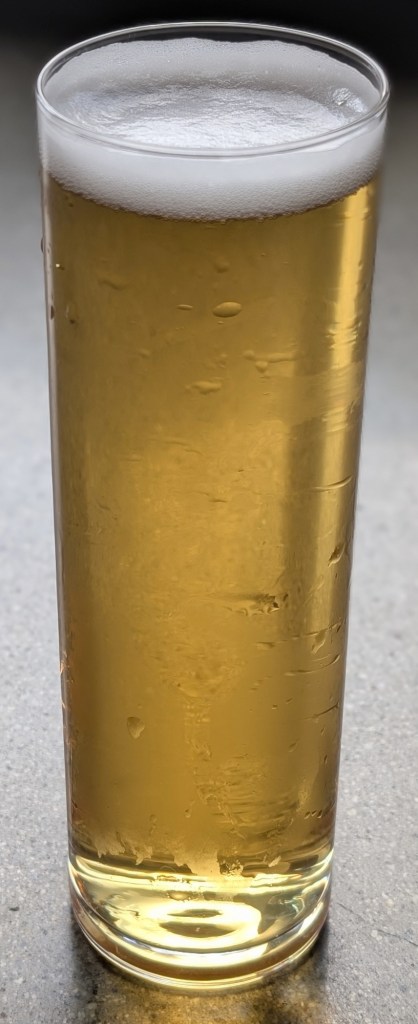
    • Clear, but short of brilliant; there is just a tiny touch of barely visible haze. It is a straw-colored beer that pours with a fine and persistent white head, which leaves some nice lacing on the glass.
  • Aroma
    • Light notes of cracker and honey in the malt, and a pleasant light floral hop aroma, with a touch of fresh hay. This beer smells awesome!
  • Flavor
    • Medium-high bitterness, grainy sweet malt character; hop flavor is lightly herbal. Minerally feel to finish out the flavor.
  • Mouthfeel
    • Medium carbonation, medium light body, dry finish. Minerally, but not unpleasantly so.
  • Would I Brew This Again?
    • I am feeling pretty good about this recipe overall. It is perhaps a touch more bitter than I prefer in all of my pils, but I like the hop aroma and malt character; the overall aroma is amazing! I wouldn’t mind a touch taller head (but that may be in the pour), and I also must ding the beer a bit for its clarity. I wonder if the persistent light haze is from the large dose of whirlpool hops? I could have used some finings, and might do that next time for a pilsner-type beer, because clarity is something important to me for these.
  • Overall
    • 8/10

Collaboration Brews – Citra Blonde Ale and Andy’s Pilsner

This past summer, I got to brew with my dad, who first got me thinking about brewing many years ago (I remember helping him way back as a teenager, even if I couldn’t enjoy the product at the time). He started as an extract brewer decades ago, took a break, got back into it, and then eventually switched to all-grain brewing (alongside wine making). Dad makes almost exclusively lagers, with his regular rotation including a Pre-Prohibition PIlsner and a Vienna Lager.

Dad currently brews on an Anvil Foundry 10.5 (gifted by us kids a few years back), doing a handful of batches annually to keep his cellar stocked. Awhile back, I shared my Citra Blonde Ale recipe with him, and he liked it enough to add a version into his repertoire. I also helped him put together a simple German pils, which is made with hops he grows himself.

We’ll usually brew something when I’m visiting, but I almost never get to sample the results due to the distance. So, it was extra nice to get a shipment with a bottle of each of the beers we made this summer. I was also able to get my hands on the notes (thanks, Dad!), which are presented in only lightly edited format.

Citra Blonde Ale

  • 5.25 lb. Briess Pilsen malt
  • 5 lb. Briess 2-row malt
  • 0.75 lb. Munich malt
  • 0.5 lb. Vienna malt
  • 0.5 lb. Carapils malt
  • 0.5 oz. Citra hops (boil 10 min.)
  • Whirlfloc tablet (boil 1- min.)
  • 0.5 oz. Citra hops (boil 5 min.)
  • 1.0 oz. Citra hops (steep for 5 min. after shutting the heat off).
  • BRY-97 American West Coast Ale (dry) and Safale US-05 (dry) yeast, 1 packet each

Procedure

Double-milled grains with 0.035 in. gap.  Steeped grains at 152 degrees.  Mashed out at 168 degrees for 10 minutes.  Boiled for 50 minutes.  Added 0.5 oz. Citra hops, Whirlfloc.  Boiled for 5 minutes.  Added 0.5 oz. Citra hops. Boiled for 5 minutes.  

Shut off heat.  Added 1.0 oz. Citra hops.  Steeped for 5 minutes.  Removed hops and cooled to 69 degrees.  S.G.=1.054.  Added American West Coast Ale yeast BRY-97 (best by 08-2024) and Safale US-05 (best by 01-24).

Fermented in the basement at approx. 65 degrees for 12 days.  S.G.=1.006.  Continued to ferment in the basement for 3 more weeks, then moved to 34-degree fridge.  Chilled for about 3 weeks, then filtered, force carbonated and bottled.

Brewed July 18, 2024.

Tasting

  • Appearance
    • Medium yellow color, relatively clear. A touch of chill haze. Thin white head that subsides after pouring.
  • Aroma
    • A nice orange/ citrus hop aroma at a moderate level; moderate/low malty aroma
  • Flavor
    • Citrus hop flavor, low bitterness level, grainy malt character, no yeast to speak of. Nice round maltiness.
  • Mouthfeel
    • Medium-light body, moderate carbonation, smooth finish.
  • Would I Brew This Again?
    • This is a great recipe, even after a few months. Clean, drinkable, interesting but not overpowering.
  • Overall
    • 8/10

Andy’s Pilsner

This is a SMaSH-esque recipe, based on various SMaSH pilsners that I have made over the years. The closest equivalent would be Farke’s Best Pils.

  • 10 lb. Briess Pilsen malt
  • 1.0 oz. Saaz (2023) hops in boil (60 minute boil)
  • 1.0 oz. Mt. Hood (2023) hops (10 minute boil)
  • Whirlfloc tablet, 10 minute boil
  • 2 pkg. DIamond Lager dry yeast (Lallemand)

Procedure

Double-milled grain at 0.035 in. gap.  Steeped grain at 150 degrees for 50 minutes.  Mashed out at 168 degrees for 10 minutes.  Brought to a boil and added Saaz hops.  

Boiled for 60 minutes.  Added Whirlfloc tablet and Mt. Hood hops.  Boiled for 10 minutes.  Cooled to 70 degrees.  S.G.=1.051.  Added 1-1/2 qts. tap water.  S.G.=1.047.

Chilled to 52 degrees.  Added 2 packages of Diamond Lager yeast (BB 08-2024 & 09-2023).  Fermented for 10 days.  S.G.=1.006.  Racked to 5 gal. carboy.   Continued to ferment at 52 degrees for 12 days.  Warmed to 74 degrees for diacetyl rest for 4 days.  Chilled to 34 degrees for approximately one month, then cold filtered, force carbonated and bottled.

Brewed July 18, 2024.

Tasting

  • Appearance
    • Very clear, straw color, with thin white head that subsides fairly quickly.
  • Aroma
    • A bit of spicy hop at the forefront, and some grainy maltiness behind that. Very nice!
  • Flavor
    • Malty sweetness at the front, and medium level of spicy hopping. Clean fermentation profile.
  • Mouthfeel
    • Medium-low carbonation level; medium mouthfeel; smooth and slightly dry finish.
  • Would I Brew This Again?
    • This is a great recipe! Carbonation might help with giving a touch more head. Malt and hop levels are perfect. This is a nice pilsner.
  • Overall
    • 8/10