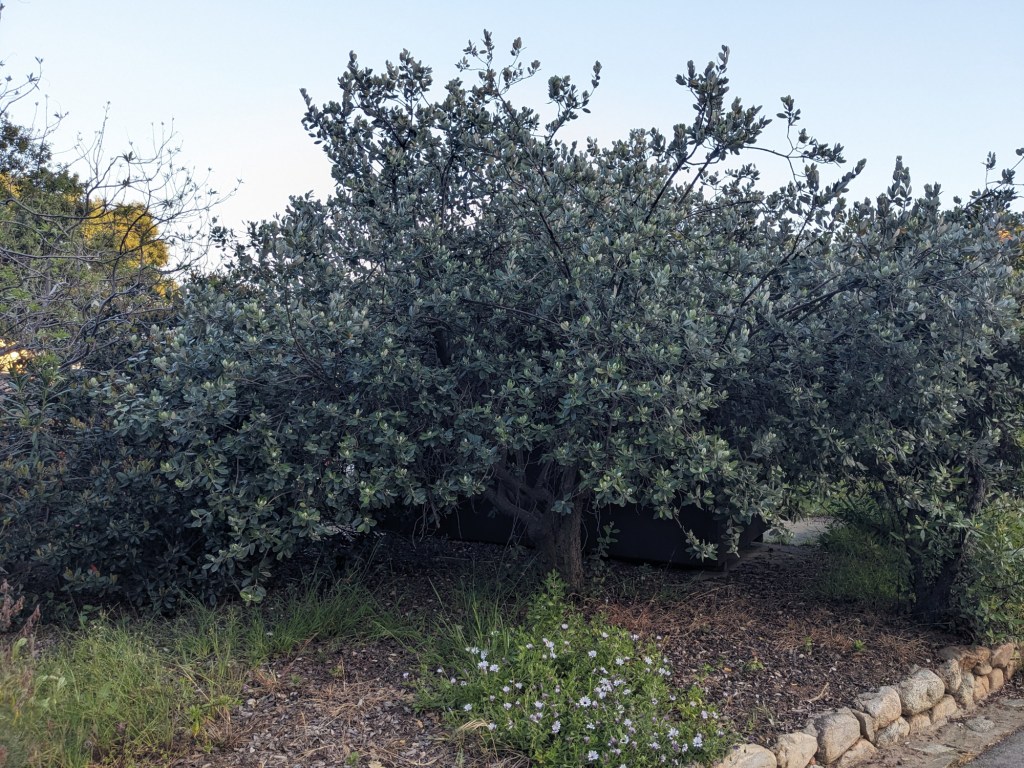
Even though I have lived here for nearly 16 years, I didn’t grow up in southern California, and so I’m always learning something new about the the kinds of fruits and vegetables that grow in this climate. Last fall, I noted a bunch of fruit on a tree adjacent to our home, and upon examination found that it was rather tasty in aroma. A little internet research revealed the source–feijoa, or pineapple guava!

Pineapple guava (I’ll use that name throughout) are native to parts of South America, including Brazil, Argentina, Uruguay, and Paraguay, and have been cultivated in many areas with appropriate climate (apparently they are particularly popular in New Zealand). A member of the myrtle group, rather than a true guava, pineapple guavas produce a small (one to two inch across), green-skinned fruit that tastes and smells almost exactly how the name sounds. Somewhat counter-intuitively, they are not ready to eat until they drop from the tree and onto the ground!
Once I found this fruit, I knew that it would be perfect for enhancing a sour beer–something low abv, refreshing, and spritzy. I chose a Berliner Weisse-style grain bill (50% pilsner, 50% wheat malt), aiming for ~1.030 s.g. I didn’t want a highly hopped beer, so I used ~1 oz. of South Dakota Saaz hops. I didn’t know the alpha acid, but if I added them late enough it didn’t really matter. For this beer, I wanted an easy sour, with a clean character that would let the fruit shine through. Wildbrew Philly Sour was an obvious choice, enhanced by the fact that I wouldn’t have to worry as much about contamination of other batches. The fruit is a fair bit of effort to pick and process, so I stuck with a 2.5 gallon batch, aiming for one pound of fruit per gallon of beer.
The results were totally worth it! This is one of the best experimental brews I made in a long time, and it was really fun to highlight something that I picked from our yard.
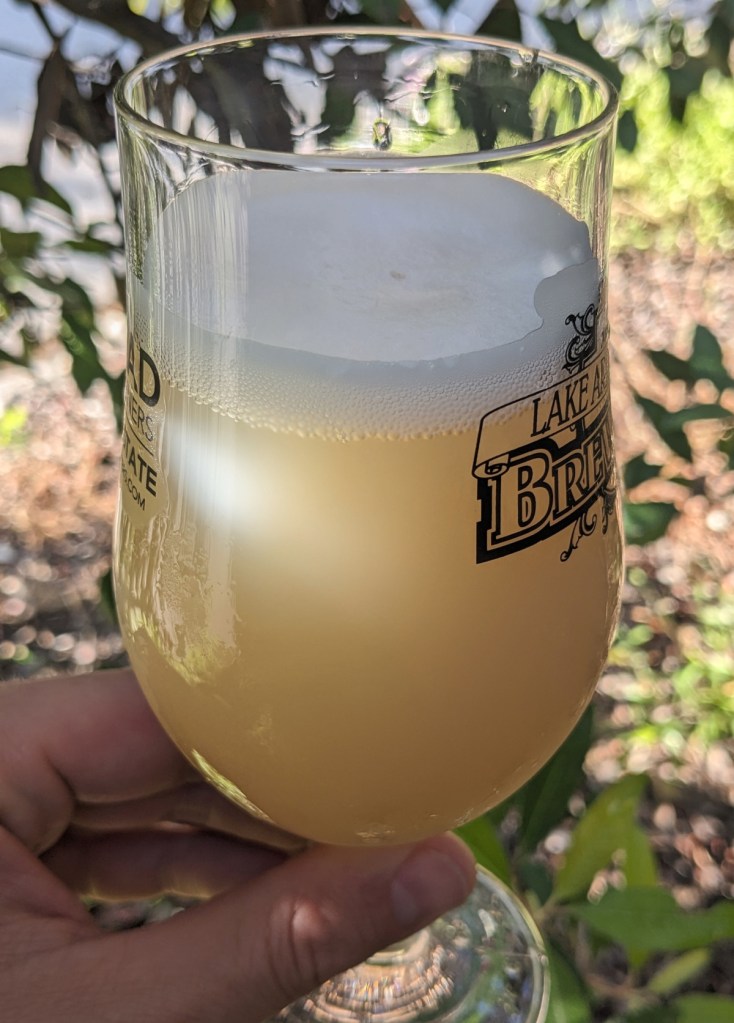
Rated “PG” for Pineapple Guava
- 2 lb. pilsner malt (Rahr)
- 2 lb. red wheat malt (Briess)
- 2 oz. rice hulls
- 1 oz. Saaz whole hops (est. 3.5% alpha), 10 minute boil
- 0.5 tsp. BrewTanB, 10 minute boil
- 0.5 tsp. yeast nutrient (WLN1000), 5 minute boil
- 0.5 pkg. Wildbrew Philly Sour yeast (Lallemand)
- 2.5 lb. pineapple guava puree
Target Parameters
- 1.031 o.g., 1.006 f.g., 3.2% abv, 8 IBU, 3 SRM
- Full volume mash, no sparge, 152° mash for 60 minutes, 10 minute mash-out at 168°
- Claremont tap water, neutralized with 88% lactic acid and treated with Campden tablet
Procedure
- Starting with 4.75 gallons of tap water, I added 1/4 Campden tablet and 3.2 mL of 88% lactic acid to remove the carbonates. I heated the strike water to 156°, before adding the grains along with 0.7 mL of 88% lactic acid. I held the mash at 152° with recirculation for 60 minutes.
- After the 60 minute mash, I raised the temperature to 168° for 10 minutes, before pulling the grains.
- Overall, I collected ~4.5 gallons of runnings with a gravity of 1.025, for 76% mash efficiency.
- I boiled for 60 minutes, adding finings and hops per the recipe.
- After turning off the heat, I chilled the wort to 85° and transferred to the fermenter. I pitched a half packet of Philly Sour and sealed up the fermenter.
- I brewed this beer on 2 April 2024. Starting gravity was 1.033, and I fermented the beer at 80°.
- I picked the fruit way back in December, peeled it, and put everything into the deep freezer until beer time. I thawed the fruit or a day or two, pureed it, and then pasteurized at 161° for 30 seconds. I let it cool a bit, and then added to the fermenter. All of this happened on 3 April 2024, very early in fermentation.
- I kegged the beer on 18 April 2024. Final gravity was 1.009, for 3.1% abv.
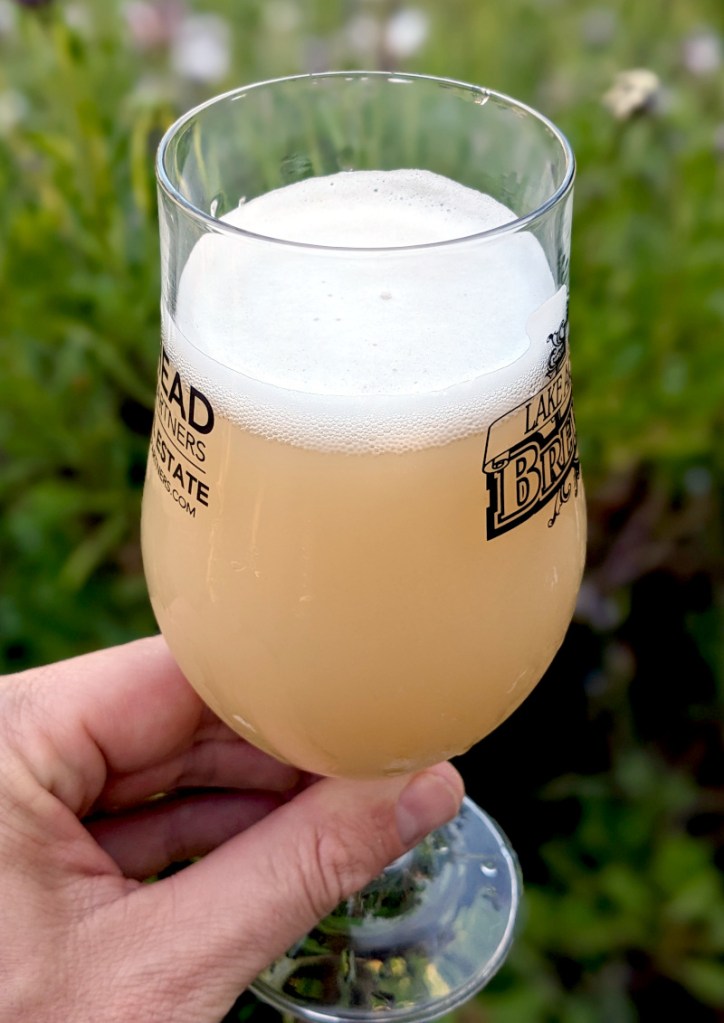
Tasting
- Appearance
- Hazy straw color, like the appearance of grapefruit juice. Pours with a thick white head that persists well.
- Aroma
- Quite prominent guava fruit aroma at the forefront, with a little doughy character behind that.
- Flavor
- The beer is fairly tart, but not puckeringly sour, at first impression. The tropical fruit character is definitely there, but it’s subtle–notes of guava (unsurprisingly) dominate. Some doughy wheat character hides behind it all, at a low level. Barely perceptible bitterness.
- Mouthfeel
- Light body, spritzy carbonation, slightly dry finish.
- Would I Brew This Again?
- Yes! This is a perfectly refreshing beer, well suited for the warming afternoons of spring. It is crisp, but not watery. The fruit is gorgeous on the aroma and perfectly restrained on the flavor. It’s that rare fruited beer where you can pick up the fruit character, but it takes a few seconds to process the flavor. This batch was a good bit of extra work in the fruit process, but absolutely worth it. I have sometimes seen some dismissive comments about Philly Sour being too one-note in character, but that is perfect for this beer as a way to let the subtle fruit notes take center stage. I know that I’ll never find a beer like this commercially, and that’s so much of the fun of homebrewing!
- Overall
- 10/10
 Andy's Brewing Blog