
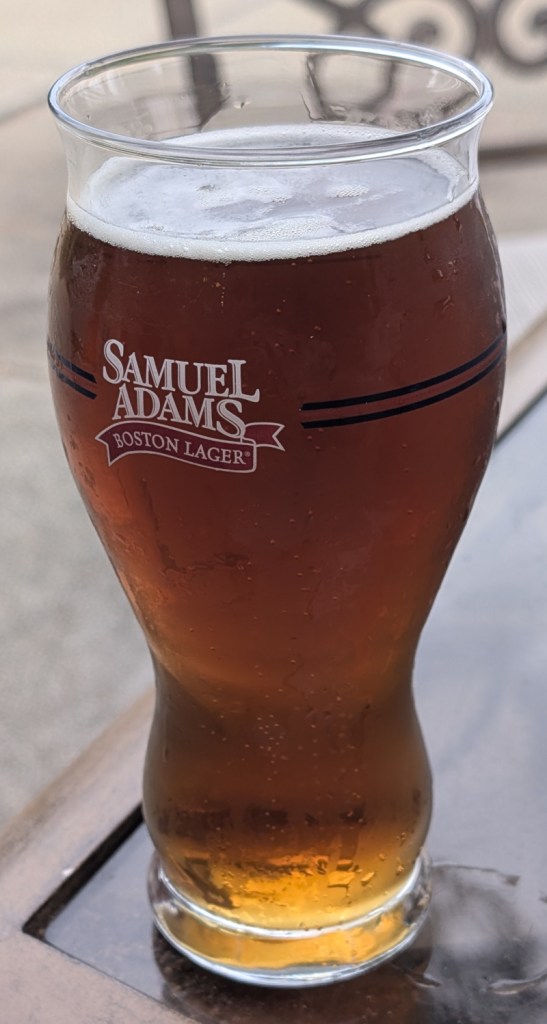
My dad got me started in homebrewing (and he has been brewing for over 50 years!), so it’s always fun to brew together when I’m back home. Planning for a recent session, he mentioned that he would like to make a red lager following a recipe he had previously made. His old version, though, was extract, and he now brews all-grain, so a conversion was in order.
The original version, of unknown origin, called for the following:
- Red Lager (extract version)
- 8oz. dark crystal malt (75-85L)
- 8oz. med. crystal malt (50-60L)
- 5.5lb. DME
- 0.75 oz. Cascade, 45 minute boil
- 0.25 oz. Cascade, 15 minute boil
- Lager Yeast
- Notes
- “I think it was the lightest DME I could get at the time. Starting gravity was 1.042. I think I would like the S.G. to be about 1.050.”
- Hops are whole, homegrown Cascade hops – a past test showed around 5.5% alpha
The conversion was pretty straightforward. I subbed in pilsner malt for the DME, adjusting to hit the target gravity, and used crystal 60 and crystal 80. According to BeerSmith, the color was a little lighter than a “red” lager, so I added a tiny bit of roasted barley for reddish color adjustment.
Although Dad and I planned to brew a five gallon batch, I wanted to test it with a 2.5 gallon batch first.
Greg’s Red Lager (2.5 gallon batch)
- 5 lb. Synergy Select Pilsen malt (Briess)
- 4 oz. 80L caramel malt (Briess)
- 4 oz. 80L crystal malt (Great Western)
- 0.5 oz. roasted barley (Crisp)
- 0.35 oz. Cascade whole hops (est. 5.5% alpha), 60 minute boil
- 0.25 oz. Cascade whole hops (est. 5.5% alpha), 10 minute boil
- 0.25 tsp. BrewTanB, 10 minute boil
- 0.5 Kick carrageenan tablet
- 1 pkg. Diamond lager yeast (Lallemand)
Target Parameters
- 60 minute infusion mash, 149°, full volume mash
- 1.051 o.g., 1.007 f.g., 5.8% abv, 16 IBU, 13 SRM
- Claremont tap water; 110 ppm Ca, 8 ppm Mg, 97 ppm Na, 75 ppm sulfate, 110 ppm Cl, 132 ppm bicarbonate
- 2.5 gallon batch
Procedure
- I heated 3.9 gallons of water to .154°, adding a Campden tablet to remove chloramines. I then added the grains and 2 mL of 88% lactic acid to adjust pH, and then held it at 149° while recirculating for 60 minutes. Next, I raised the temperature to 168° for 10 minutes before pulling the grains.
- In total, I collected 3.5 gallons of runnings with a gravity of 1.043, for 72% mash efficiency.
- I brought the runnings to a boil, adding hops and finings per the recipe. After 60 minutes, I turned off the heat and chilled to 85° before transferring to the fermenter, chilled to 68°, and then pitched the yeast. I continued to chill down to 53° in the fermentation chamber.
- Starting gravity was 1.053. I brewed this beer on 8 May 2026.
- I raised the beer to 54° on 10 May 2026, and then to ambient on 23 May 2026.
- I kegged the beer on 27 May 2026, using an open transfer and adding 3 oz. of corn sugar to carbonate in the keg.
- Final gravity was 1.011, for 5.5% abv.
- I found the pressure to be 32 psi at 70° on 5 June 2026 – perfect.
- At this point, I transferred the beer to the conditioning chamber, in order to lager.
Tasting
- Appearance
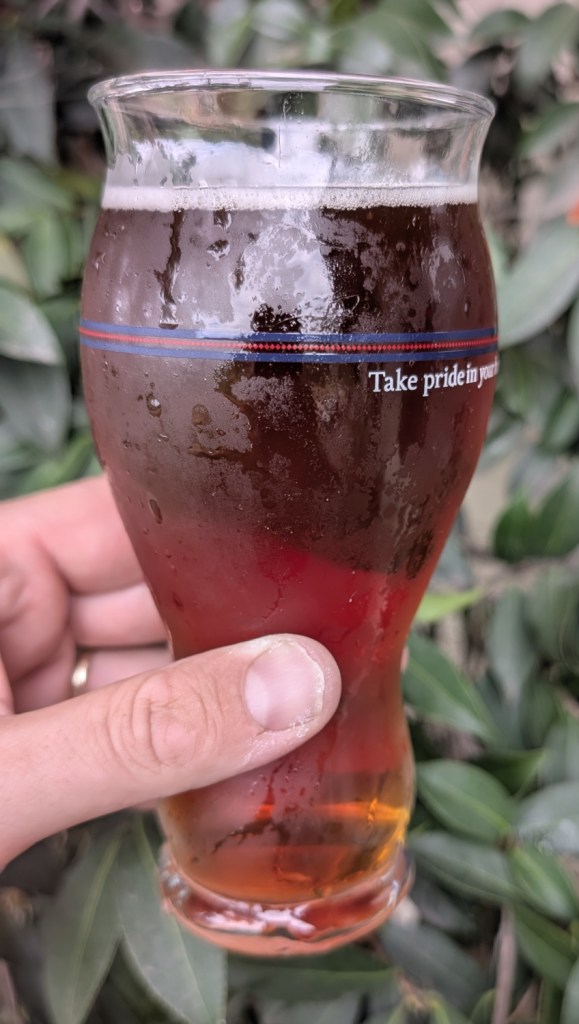
- Brilliantly clear, reddish amber beer, with a modest, reasonably persistent ivory-colored head.
- Aroma
- Caramel malty aroma at a medium-low level; no hop or yeast character to speak of.
- Flavor
- Light caramel flavor; dried fruit at a very slight level. Medium level of bitterness.
- Mouthfeel
- Medium-light bodied, moderate carbonation, off-dry finish.
- Would I Brew This Again?
- This was fun to try as an exercise, and I think it captured the American craft red lager experience of “microbreweries” and homebrewers circa 1996. It’s not my cup of tea as a beer overall; I think a traditional Vienna lager hits some of the same notes but with more drinkability. Even so, this recipe was worth the experience. And Dad enjoyed it, which was the main goal! If I were to do it again for myself, I’d probably dial back the crystal malts by about 50 percent, to lighten up the mouthfeel and flavor.
- Overall
- 6/10

