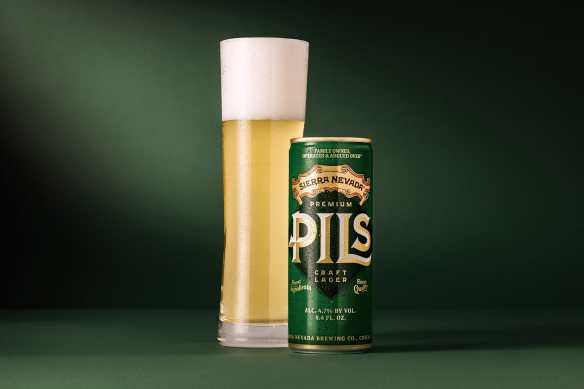
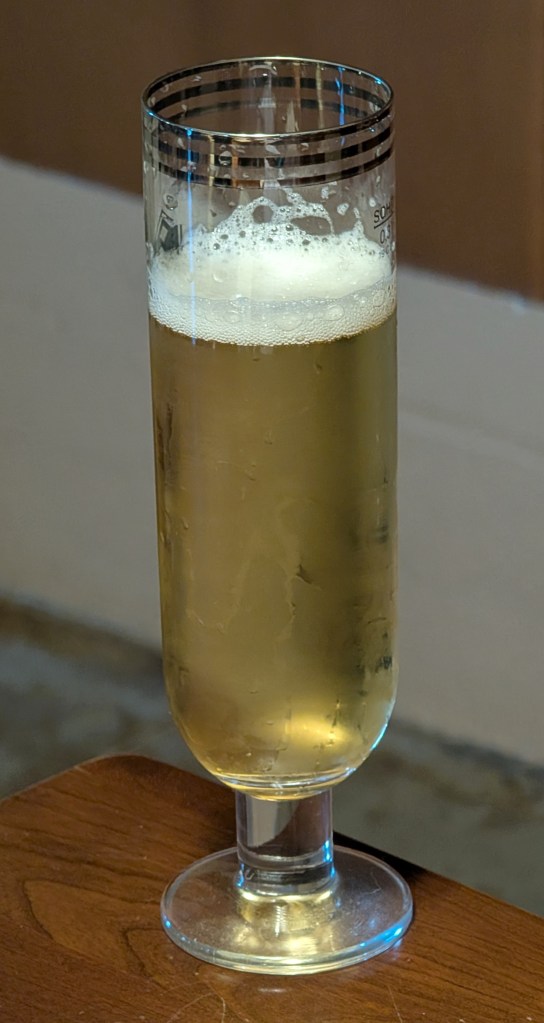
I love a good German pils, and it’s no surprise that this has been one of my most-brewed styles. Many North American breweries are now doing versions of this classic, and a handful stand out. For what I’ve tasted to date, this includes pFriem Pilsner (for which I have brewed an homage on several occasions) and Slow Pour Pils from Bierstadt Lagerhaus (a brewery that is on my must-visit list any time I am in Denver, and which offers some of the most beautiful pours I have seen at any craft brewery). I can now add a third to this list: Sierra Nevada’s Pils.
First, a salute to the packaging and marketing folks at Sierra Nevada – I hadn’t intended to buy any beer when I was at the grocery store, but a package of the Pils caught my eye in the crowded cooler case. Anything by Sierra Nevada is generally worth a look. I was further intrigued when I saw it wasn’t the typical 12 or 16 oz. cans! Instead, I found an 8-can package of 8.4 oz. cans–although it’s ostensibly to match European-sized pours and keep the beer cold and crisp through the entire can, it really melds with my desire to have smaller serving sizes.
The marketing copy is great – “A smooth malt body with upfront sweetness, pleasant hop character, and hints of citrus peel create a soft, dry finish that’s refreshing sip after sip,” and “Aromas of citrus, tangerine, and a touch of sweet malt dance in the air thanks to the addition of Crystal Lupulin Hops.” This marketing fluff matches surprisingly well with what I actually taste–in the aroma, I also get a bit of fresh hay (in the good way, not the rotten barnyard way). It’s a smooth and drinkable lager, and not overly flinty or bitter, as some of the more aggressive versions can be.
Based on the website, the recipe seems quite simple–pilsner malt, lager yeast, with Saphir and Crystal Lupulin hops, to hit 4.7% abv and 25 IBU. I’ve done a little looking to investigate a clone-type recipe; Crystal Lupulin doesn’t seem to be readily available for homebrewers; Loral Cryo might be roughly in the ballpark, although not identical. To approximate the Sierra Nevada brew, I would aim for 100% of a good North American pilsner malt with a Hochhurz mash, use Saphir in the full length of the boil and perhaps at ~15 minutes, and then use a small dose of Loral Cryo in the last 5 minutes or for a brief whirlpool addition.
To wrap this up, Sierra Nevada Pils is a phenomenal example of a German pils, and well worth sampling if you can find it! What do you readers think?