
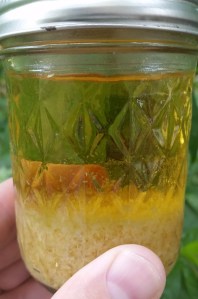
Lemon extract
I’ve been having a lot of fun tooling and re-tooling my white IPA recipe. Because it has been some time since I last brewed up a batch, I wanted to bring this brew on-line again, with a few tweaks to inch ever closer to perfection.
The grain bill is essentially the same as my most recent batch, with the primary change being a switch to 2-row alone as the base malt. Hops are modified slightly in line with my current inventory, with Amarillo hops pellets instead of whole Cascade hops. The final component that I felt the beer was missing was a nice lemon background and aroma. One option was to use Lemondrop hops, but these are rather hard to get. Instead, I elected to craft some lemon extract (see photo at right). With the zest from four lemons and four shots of cheap vodka, I combined it all into a jar and did the “set and forget” routine. Once the beer fermentation is done, I’ll strain the mixture and toss it into the keg.
Pannotia White IPA 1.6
- 7.75 lbs. 2-row malt (Great Western Malting Co.)
- 3 lbs. white wheat malt
- 1 lb. flaked wheat
- 0.5 lbs. flaked quick oats
- 0.5 lbs. rice hulls
- 8 g. gypsum
- 1 oz. Amarillo hops pellets (7.0% alpha, 5.6% beta), added to wort prior to boil and boiled for 60 minutes
- 1 oz. Amarillo hops pellets (7.0% alpha, 5.6% beta), 35 minute boil
- 2 oz. Amarillo hops pellets (7.0% alpha, 5.6% beta), added at flame-out and steeped during chill
- 1 oz. Citra hops pellets (14.1% alpha, 3.6% beta), added at flame-out and steeped during chill
- 1 oz. Galaxy hops pellets (13.8% alpha, 5.9% beta), added at flame-out and steeped during chill
- 1 oz. Citra hops pellets (14.1% alpha, 3.6% beta), dry hop
- 1 oz. Galaxy hops pellets (13.8% alpha, 5.9% beta), dry hop
- 1 oz. Mosaic hops pellets (11.3% alpha, 3.2% beta), dry hop
- 1/8 tsp. yeast nutrient, 10 minute boil
- 8 g gypsum (added to boil)
- 0.35 oz. bitter orange peel, 1 minute boil
- 0.15 oz. coriander seed (crushed), 1 minute boil
- 1 pkg. Belgian Wit Ale yeast (WLP400, White Labs), prepared in 1.25L starter, chilled and decanted
- Lemon extract, zest of four lemons infused in four shots of vodka (~6 oz., resulting in 5 oz. of extract).
Procedure
- Eight days in advance, I prepared a 2L starter, with an aim to overbuild my yeast culture for an upcoming Belgian wit. On the third day, I decanted 0.75L into a jar and cold-crashed the remaining 1.25L. I ended up delaying my brew day a bit, due to illness.
- On brew day, I mashed in with 4.5 gallons of water at 167°, to hit a mash temperature of 152°. The temperature was down to about 150° after 30 minutes.
- After 60 minutes of mashing, I collected the first runnings and then added 4.25 gallons of water at 185°. This raised the mash bed to 165°. I let it sit for 10 minutes, vorlaufed, and collected the remainder of the wort.
- Altogether, I collected 6.75 gallons of wort at a gravity of 1.051, for 75% efficiency.
- I had an outside meeting, so had to leave the wort sitting for two hours. Upon my return, I added the first round of hops and brought the mixture to a boil (approximating a first-wort hopping technique).
- As the wort boiled for 60 minutes, I added the various ingredients per the schedule in the recipe.
- After 60 minutes, I turned off the heat, added the final charge of hops, and chilled the beer. Once the beer was chilled down to 77°, I transferred it to the fermenter and pitched the yeast. A krausen started forming within 12 hours.
- Starting gravity was 1.060. I am fermenting this at 68°, and plan to keep it in the primary for around 10 days before transferring to the keg.
- This beer was brewed on Tuesday, May 10.
 The diverse Belgian styles don’t always appeal to me, but I think that’s because they’re often either done badly or overdone in the latest souring craze. I’m actually quite fond of the various witbiers and their cousins (including my white IPA). But, because I have another iteration of my white IPA planned, saison had a bit more appeal for the moment. I’ve had a number of good ones over the years, and they aren’t afflicted by the funky bacteria that seem to dominate so many US-brewed salutes to Belgian beers these days. Why not, then?
 Time to make a classic summer beer! For this batch, I wanted to try something different, by mixing techniques used on two previous blonde ales that have turned out well. Firstly, following my Summer Blonde Ale, I elected to keep a simple grain bill. This meant mostly 2-row malt, with a touch of dark Munich malt (somewhere in the 10 to 20 lovibond range). However, I wanted a slightly more complex hops character, so I followed a version of the hopping schedule from my
