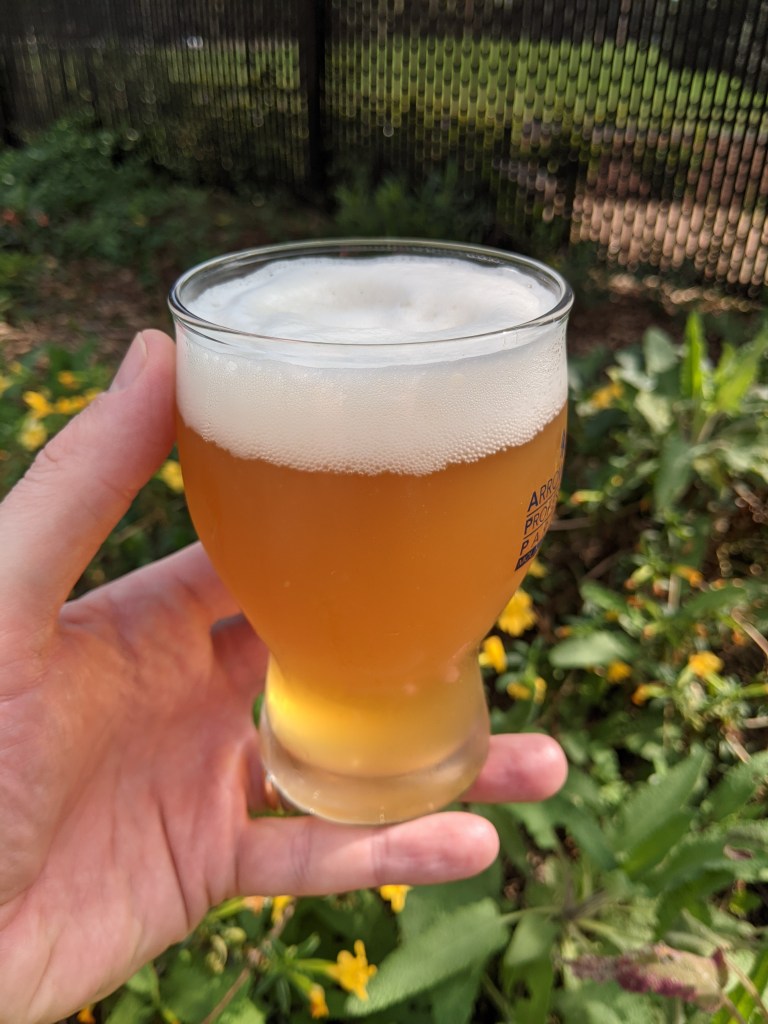
Kveik Pale Ale

It happened…I’ve given in to a brewing trend, and am trying a recipe with kveik. As you’ll see in some upcoming posts, I’ve in fact tried a few kveik recipes at this point. This is my first one, and admittedly not my favorite.

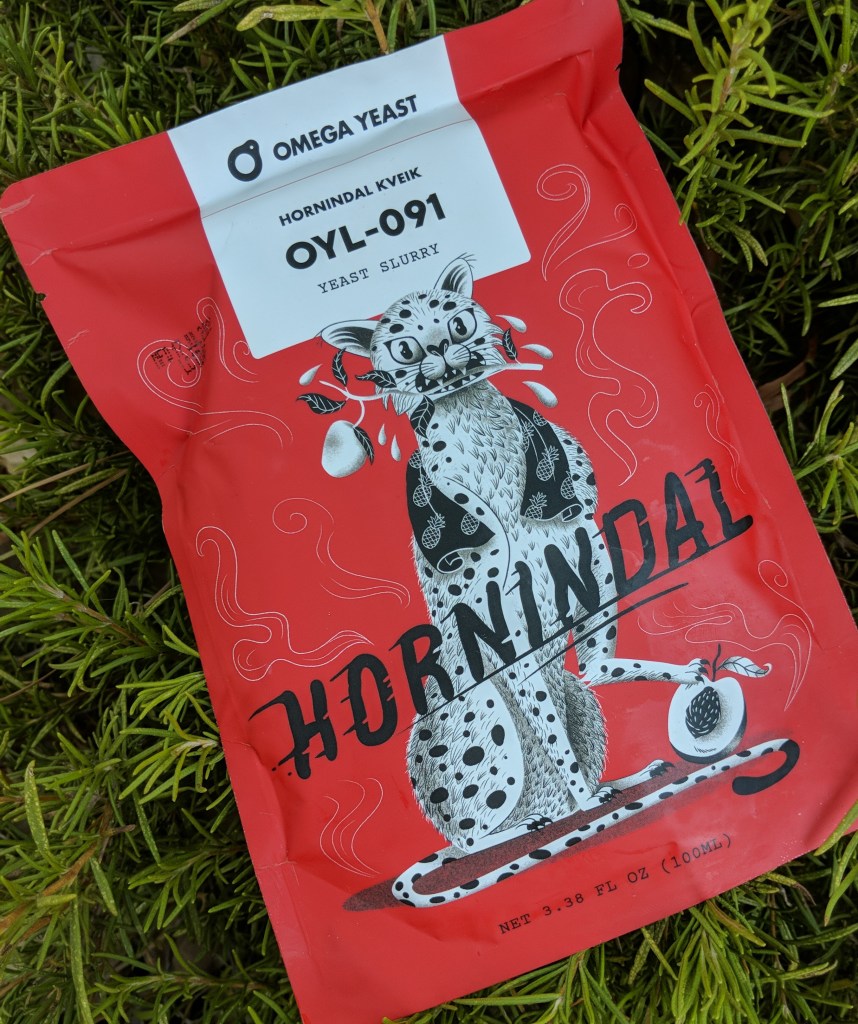
red package of yeast from Omega Yeast, Hornindal Kveik strain, with cartoon of cat on front
Kveik culture from Omega

For those not familiar with it, kveik is essentially a Norwegian farmhouse ale culture, with a rich cultural history that has likely been over-analyzed by those outside of the original neighborhoods where the yeast originated. I’ve been intrigued by their stated qualities of fermenting cleanly in excess of 90°, which almost sounds too good to be true. It wasn’t, in the end!

The recipe is inspired by a kit recipe from Atlantic Brew Supply, with major adjustments to pretty much everything. Many of the kveik-centered recipes out there are super-high alcohol, and that just doesn’t interest me. Session ales forever! I looked around at a few different kveik strains, and Hornindal from Omega seemed to hit the balance of a citrusy character that I wanted. I went with my usual session pale ale strategy of Vienna plus some Munich and a little crystal malt. For the hops, I grabbed a South African experimental variety, U1/108, from my local homebrew shop.

Kveik Pale Ale

  • 8 lb. Vienna malt (Weyermann)
  • 1 lb. Munich light malt (Chateau)
  • 0.5 lb. Crystal 40 malt (Great Western)
  • 0.75 oz. Magnum hop pellets (13.2% alpha), 30 minute boil
  • 1 tsp. Fermax yeast nutrient, 10 minute boil
  • 1 Whirlfloc tablet
  • 1 oz. African Experimental U1/108 hop pellets (15.0% alpha), 5 minute boil
  • 1 oz. African Experimental U1/108 hop pellets (15.0% alpha), 15 minute whirlpool
  • 3 oz. African Experimental U1/108 hop pellets (15.0% alpha), dry hop in keg
  • 1 pkg. Hornindal Kveik (Omega OYL-091)

Target Parameters

  • 1.043 s.g., 1.011 f.g., 4.3% abv, 6 SRM, 41 IBU
  • Infusion mash, 156°, batch sparge; 45 minute boil
  • Claremont water, with Campden tablet to remove chloramines and 2 g of gypsum added to boil kettle.

Procedure

  • I mashed in with 3.25 gallons at 168°, to hit a 158° mash temperature. I also added 4 mL of 88% lactic acid to the mash, to adjust pH.
  • The mash temperature was down to 156° after 45 minutes. At this point, I added 1.5 gallons for the first sparge, which raised the temperature to 162°. After 10 minutes, vorlaufed and collected the first runnings. Next, I added 3.6 gallons for the second sparge, with a vorlauf after 10 minutes.
  • In total, I collected 7 gallons with a gravity of 1.039, for 77% mash efficiency.
  • In the kettle, I added 2 g gypsum, and the broil everything to a boil. I boiled for 45 minutes, adding hops and other items per the schedule.
  • After flame-out, I chilled the wort to below 185° and then added 1 oz. of whirlpool hops. Hops were between 175° and 180° for 10 minutes. Then, I continued chilling.
  • After I chilled the wort down to 90°, I let it settle for 1 hour and then transferred to the fermenter and pitched the kveik.
  • The fermenter showed minor activity within 6 hours, and vigorous bubbling within 18 hours. At this point, I measured ~85° degrees for fermenter temperature, with 80° degrees ambient in the garage. I started fermentation on September 5, and fermentation seemingly was done by 9 Sept 2020.
  • I kegged the beer on 13 September 2020, adding dry hops in a baggie at that time. As has been my usual practice lately, I did a mixture of keg priming and force carbonation, targeting 2.7 volumes of CO2. I added 2.8 oz of corn sugar dissolved in one cup water for this first stage, and after a week topped up the CO2 using my cylinder.
  • Final gravity is 1.017, for 3.6% abv.

Tasting

  • Appearance
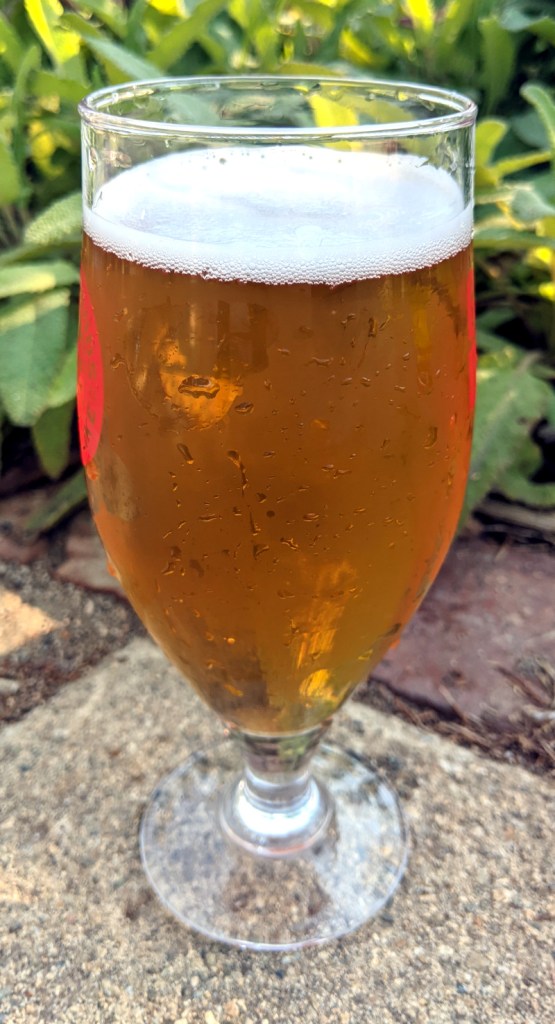
    • A hazy gold beer, with a pillowy, fine, and very persistent white head
  • Aroma
    • Aroma is malt-centered, very bready and showing a bit of caramel. Hop aroma is surprisingly low.
  • Flavor
    • Very hoppy, with a slightly rough bitterness. The malt in the background has a bready and toasty quality.
  • Mouthfeel
    • Light bodied, slightly astringent finish, probably from the dry hops. Moderately high carbonation.
  • Would I brew this again?
    • Not with this particular hopping regimen. The malt character is fine, and the yeast character is fantastically clean for having been fermented at high temperature, but the hops just don’t do it for me. I wonder if it’s a combination of the hop variety with the low starting gravity, so that the hops aren’t balanced more by the malt. I also think I overhopped on the dry-hopping, so I can’t blame it all on the hop variety. Honestly, the beer was far better before I added the dry hops! That said, I’m super impressed by the yeast, and harvested a ton for use in some upcoming batches.
  • Overall
    • 4/10

What’s Brewing? October 2020 Edition

The past month has been a quiet one for the blog, but not necessarily a quiet one for brewing. I’ve gotten a few batches started, got some awesome new equipment, and enjoyed some of the fruits of my labors. Admittedly, I am not turning over kegs as often as I would like, if only because I’m not having people over. I make up the gap a little bit by doing growler swaps!

The Anvil Foundry, my new brewing toy.

Beer Batch Updates

  • My first kveik-fermented beer is now history. It was a super interesting beer, and pretty drinkable, although the dry hopping unfortunately ended up a little harsh. At ~3.5% abv, it was also possible to have a few without getting woozy-headed. The keg just kicked last night!
  • I repitched the kveik culture from my pale ale, to do a sessionable brown ale. It came in around 3.6% abv, a bit lower than expected. I’m somewhat surprised by the fairly low attenuation on the Hornindal strain, with ~61% attenuation on both batches so far. This is probably due to the intentionally high mash temperatures I’m using, at around 156° for each. The beer is now on tap,
  • I’ve been brewing a sequence of lagers, as mentioned last month. The German pils is now on tap, and a Vienna lager just went on tap also. I just did a rebrew of my Stygimoloch Bock, repitching the yeast from the German pils. Finally, I’ve done another German pils, using the Pfriem Pilsner from Dave Carpenter’s lager book.
  • Finally, I made a small (3 gallon) batch of a spiced Christmas beer. It uses Vienna, Munich II, and honey malt, along with a smattering of crystal and chocolate malts as well as some honey. A mixture of “holiday spices” went in, with cinnamon, nutmeg, allspice, vanilla, and coriander. It’s fermenting with another repitch of the kveik (probably the last pitch for this one

What’s On Tap?

  • Dog Days Pilsner has been drinking exceptionally well. It’s just a great German pils–I feel like I have finally mastered this style!
  • I just put a Vienna lager on tap, after about a month of lagering. It’s a super-simple SMaSH beer, with just Vienna malt (Weyermann) and Saaz. Vienna is still one of my favorite malts, and this recipe is no exception!
  • Finally, I have a session brown ale fermented with kveik. “Kveik the Keg Brown Ale” is a super interesting and super drinkable beer, clocking in at only 3.6% abv. It has a really delightful chocolate and citrus character. I’m in love with this beer!

What’s Coming Up?

  • I’m thinking a stout of some sort is in order…not sure what yet, but probably a recipe that has a fairly dry, sharp character at a sessionable alcohol level.
  • It’s always lager time! I might do a “winter lager” of some sort, emphasizing a mix of Vienna and Munich malt.

Equipment Notes

  • I recently purchased the Anvil Foundry 10.5 gallon electric brewing system, and am loving it so far. Given the pandemic, I’m trying to avoid unnecessary trips out for propane, and it seemed like a good time to look at moving to electric. The Foundry system hit all of my interest points, with solid reviews, reliable reputation, and simple operation. To date, I’ve brewed a German pils as well as the holiday ale.

Commercial Beer Notes

  • I’ve been cutting back my alcohol consumption some, and so have been exploring non-alcoholic options with interest. I recently tried Partake Brewing’s line of 0% alcohol beers. Unfortunately, they were a bit disappointing. There were things I liked about each, but the character was just way too thin, and they all had a bit of a “twang” reminiscent of some of my early extract brews. I’ll continue to try some other brands, but probably not this one again.

Summer RyePA

My latest session IPA was a bit of a kitchen sink beer, but also one where I wanted to create a slightly more “traditional” northwest IPA. That means citrus and pine for the hops, and no fear of the crystal malt. To ground my malt character, I used Vienna malt as the base, with a healthy dose of rye malt on top of that. I used about 7% crystal malt to add some body and depth. The overall results were pretty fantastic!

Summer RyePA

  • 8 lb. Vienna malt (Weyermann)
  • 1.5 lb. rye malt (Viking)
  • 0.5 lb. crystal 40 (Great Western)
  • 0.25 lb. crystal 60 (Great Western)
  • 2 oz. rice hulls
  • 0.5 oz. Warrior hop pellets (15.8% alph), 60 minute boil
  • 0.4 oz. Chinook hop pellets (13.0% alpha), 60 minute boil
  • 1 oz. Cascade whole hops (5.5% alpha), 3 minute boil
  • 1 tsp. Fermax yeast nutrient, 10 minute boil
  • 1 Whirlfloc tablet, 5 minute boil
  • 1 pkg. American West Coast Ale yeast (BRY-97)
  • 1 oz. Amarillo hop pellets (9.2% alpha), dry hop in keg
  • 0.5 oz. Cryo-Cascade hop pellets (12.0% alpha), dry hop in keg
  • 0.4 oz. Columbus/Tomahawk/Zeus (CTZ) hop pellets (15.5% alpha), dry hop in keg

Target Parameters

  • 1.047 s.g., 1.012 f.g., 4.5% abv, 7 SRM, 46 IBU
  • Infusion mash, 156°, batch sparge; 60 minute boil
  • Claremont water, with 3 g gypsum and 5 g epsom salts added to kettle during chilling, to hit approximate mixture of 51 ppm Ca, 32 ppm Mg, 71 ppm Na, 156 ppm SO4, 75 ppm Cl, ~100 ppm HCO3

Procedure

  • I mashed in with 3.75 gallons of water, heated to 167°. Once it had cooled down to 163°, I added the grains, and hit a mash temperature of 153°. I added ~2 mL of 88% lactic acid to bring the mash pH down a touch.
  • Around 30 minutes in, I added 2 gallons of water at 175°, to raise the mash temperature to 157°.
  • After 60 minutes of mashing, I collected the first runnings. Then, I added 3 gallons of water with 2.5 mL of 88% lactic acid, to neutralize carbonates. This should result in around ~100 ppm HCO3.
  • I brought the kettle to a boil, adding hops and such per the recipe.
  • After 60 minutes, I began the chilling process. At this point, I realized that I had forgotten to add the gypsum and epsom salts I had intended to add earlier, so boiled them in a cup of water and put this into the wort.
  • Once I had chilled a bit, I transferred to the fermenter and then chilled the rest of the way, down to 68°, in my fermentation chamber.
  • I brewed this beer on 8 August 2020, and fermented at 66°. Starting gravity was 1.048.
  • I brought the beer up to ambient garage temperature (78° to 80°) on 15 August 2020, to finish out fermentation.
  • I kegged the beer on 21 August 2020, adding 2.85 oz. of corn sugar for natural carbonation along with the dry hops in a bag. I let it sit at ambient for about a week, before chilling and finishing carbonation via forced CO2.

Tasting

  • Appearance
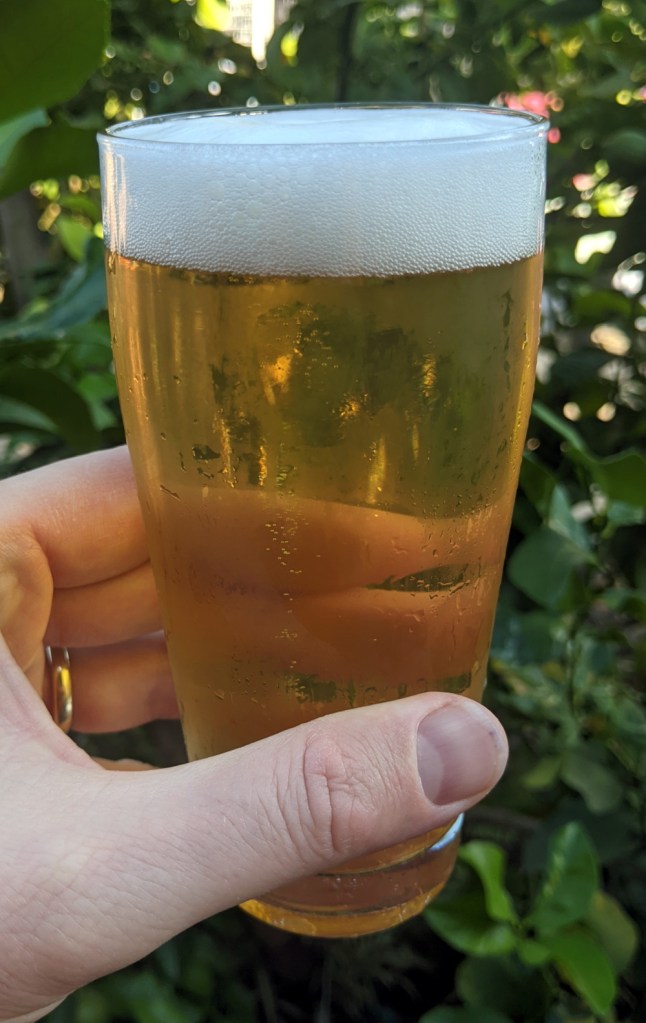
    • Deep gold in color, with an orange tinge, and only a slight haze. This beer dropped surprisingly clear after ~2 weeks in the keezer! A persistent off-white head holds modest lacing along the side of the glass.
  • Aroma
    • Hop forward, with citrus/orange at the front, and a bit of earthiness behind that. Yeast character is clean, and not much in the way of malt is noticeable.
  • Flavor
    • Bitterness level is moderately high, with an orange/citrusy character. It’s distinctly tilted towards the hops, with the malt in the background in terms of balance. Malt character is grainy with only a hint of caramel notes, and avoiding any perception of sweetness. I get a touch of rye spice as the beer warms up, but I’m surprised the rye doesn’t come through more prominently. That’s probably an okay thing, though, in that it doesn’t overwhelm the beer. As I finish more of the glass, the pine character of the hops starts to shine through.
  • Mouthfeel
    • Medium-light bodied, with an extended dry finish and a lingering bitterness. Moderate carbonation.
  • Would I brew this again?
    • This is one of the better session IPAs I’ve done over the years. It’s got sufficient character to be interesting, and enough body to keep it from seeming thin. The citrus character is very nice, and I think the blend of hops is spot-on for this kind of beer. It’s squarely in the northwest IPA tradition, with plenty of citrus and not much of the tropical fruit character so common in IPAs nowadays. It’s interesting that the pine character manifests a bit late as I drink the beer, and same for the rye notes. That’s okay by me, though. I could certainly play with the hops more, but the grain bill is pretty close to perfect.
  • Overall
    • 9/10

What’s Brewing? September 2020 Edition

The past month of brewing has been a bit scattershot, with various styles in progress and various styles on tap. I’ve not been bored, though!

Beer Batch Updates

  • Last weekend (September 5), I took the leap and fermented a batch with kveik. This yeast culture of Norwegian origin has been all the rage lately, but I’ve been a bit hesitant to dip my toes into the water. Nearly all of the recipes I’ve found have been in the 7 to 10% range of abv, which just doesn’t interest me that much, at least in keg-sized quantities. Also, I have a love/hate relationship with many very “character-rich” yeasts (e.g., some Belgian strains). Eventually, I found a pale ale recipe that was ~5%, which I modified further for hops and gravity. In the end, I am making a session-strength American pale ale using experimental African hops. I brewed on 5 September 2020, right in the midst of a major heatwave. It was over 110° on brew day, so a natural fit for kveik. The yeast packet (an Omega Yeast strain, Hornendal) had a really intriguing citrus aroma–this bodes well! I pitched at 90°, and the blow-off tube showed slow activity within 8 hours, and it was vigorously bubbling along less than 18 hours later. Visible fermentation activity had ceased within about 5 days, and I pulled a sample yesterday. It seems to be dropping surprisingly clear already! The yeast character is less strong than I expected, too, with not much in the way of esters. I’ll probably keg it either this weekend or in the next few days.
  • I’ve got two lagers in progress at the moment, the German-style pilsner mentioned last time as well as a Vienna lager. The Vienna lager is a historical-type recipe, using strictly Vienna malt and Saaz hops. It will be a bit lighter than what is usually sold as Vienna lager, but I’m honestly okay with that. The German pilsner had around 18 days at fermentation temperatures around 54°, and the Vienna lager had about 10 days at those temperatures. I raised the fermenters to 60° over a multi-day period, with a 12 hour rest at 60° before cycling back down with ambient temperature drops of ~5° per day. Right now, they’re both sitting at around 33°, and will be kegged fairly soon.
red package of yeast from Omega Yeast, Hornindal Kveik strain, with cartoon of cat on front
Omega Yeast’s packaging is gorgeous!

What’s On Tap?

  • The session RyePA just went on tap (I finally kicked the amber ale keg!)…it had about two weeks of cold conditioning, and initial samples taste really good. If I didn’t know, I would have expected the beer was much richer than the 4.5% abv that it clocked in at. Expect a full tasting on this one soon.
  • My Berliner weisse is drinking really well on summer afternoons. I’ll be a bit sad when this keg is gone, but I think I’m also just as glad I don’t have five gallons of the stuff, no matter how tasty it is. A small 6 to 10 ounce pour is usually plenty for me or my wife at any one time, so we’re definitely savoring the beer as we go along. Perhaps it will become an annually brewed recipe!
  • The Munich helles has cleared up absolutely perfectly, and is such a delicious lager. Two weeks after my post on this, the beer is definitively brilliant in appearance. It really was worth the extra lagering time!

What’s Coming Up?

  • I’m….not sure what I want to do next. I should probably do an ale or something relatively quick turn-around before going back to a sequence of lagers. I’ll be looking through my recipe books to see what’s good! At the moment, I’m leaning towards a brown ale, but we’ll see.
  • I’ll be repitching the yeast from my German pils (WLP820) once the beer is kegged. I’m thinking a Munich malt-dominated lager, and/or a rebrew of Stygimoloch Bock.

Other Than Beer

  • I’ve been experimenting with some of the non-alcoholic spirits and mixers out there, to have flavorful alternatives for mixed drinks. Here are some quick reviews:
    • Monday Non-Alcoholic Gin is pricey, but one of the better ones I’ve tried. It’s not a perfect gin substitute, but it is interesting in many of recipes. I find it doesn’t work well in a martini, because it just seems a little thin (I used real vermouth in that attempt). Straight-up on ice, it gets watered down pretty quickly, too. But…as a G&T, it’s quite good (esp. with my homemade tonic), and it did well in a Bee Sting as well as a blackberry-balanced drink (see the picture below). So, the short assessment is that if you have other interesting ingredients, the Monday N-A gin does well; on its own it’s just not quite the same.
    • Ritual is one of the more affordable (i.e., cheaper) lines of non-alcoholic spirits, and also pretty variable.
      • The whiskey equivalent is…not terribly great. It’s just a little too cloying, and the wood flavor needs to be very carefully balanced to avoid too intense of a peat flavor. The consistency is almost (but not quite) syrupy, which is a bit disconcerting on the tongue.
      • The gin is the better of the ones I’ve sampled. Cucumber is the dominant note on this one, and like the Monday “gin” it really needs to be mixed with other stuff rather than enjoyed on its own. It makes for a nice variant on gin and tonic.
      • I have a bottle of the tequila substitute, but haven’t used it in any drinks yet. The taste and aroma are in the ballpark, I suppose.
  • My go-to mid-afternoon refresher is a bit of Amoretti craft puree in some carbonated water. I’ve got both the blood orange and peach flavors on hand right now…the blood orange one is my favorite of the two!
    • The cost per bottle of puree is somewhat pricey (~$29), but assuming you get about 90 12-oz. servings of sparkling water, it’s far cheaper than the flavored waters at the store. I figure it’s around 24 cents of ingredients per 12-oz. serving of flavored water made at home (12 cents puree, 12 cents carbonated water made by Soda Stream), versus between 37 and 72 cents to buy flavored sparkling water, depending on brand. So, it’s cheaper and generates far less waste!
Non-alcoholic gin mocktail, with a heavy dose of blackberries! It was really tasty.

Claremonter Weisse 2020

As summer and summer temperatures drag on here in southern California, I’m spending my brewing energy on light, flavorful, and refreshing beers. This often means lagers, but sometimes it’s nice to play on the sour side of the street. A few years back, I brewed an award-winning Berliner Weisse, which tasted fantastic. I’ve been wanting to revisit that style and that recipe for awhile, and finally made some time this summer.

For my 2020 brew, I rolled with a similar recipe to my 2016 version, except for the sour pitch. Last time, I used Omega Labs OYL-605 lacto blend. This time around, I had a satchet of Lallemand’s Wildbrew Sour Pitch, which had already been opened for my Raspberry Belgian. Not wanting to waste a good culture, I made the decision to use this instead. I didn’t have to make a starter, which was a nice bonus. I switched in 2-row for pilsner malt, to up the malt character a little for such a low gravity beer. Finally, for the main fermentation, I made the very minor substitution of US-05 instead of WLP001.

Claremonter Weisse 2020

  • 2.25 lb. premium 2-row malt (Great Western)
  • 2.25 lb. pale wheat malt (Weyermann)
  • 2 oz. rice hulls
  • 0.5 pkg. Wildbrew Sour Pitch dry culture (Lallemand)
  • 1 tsp. Fermax, 10 minute boil
  • 0.5 oz. Cascade whole hops (5.5% alpha), 8 minute boil
  • 1 Whirlfloc tablet, 5 minute boil
  • 1 pkg. Amercan Ale Yeast (US-05)

Target Parameters

  • 1.031 s.g., 1.007 f.g., 3.2% abv, 3 SRM, 5 IBU
  • Full volume, no-sparge infusion mash, 152°; 10 minute initial boil, kettle sour; 60 minute secondary boil with hops, nutrients, and finings
  • Claremont water, unadjusted

Procedure

  • I mashed in with 4.8 gallons of water at 155°, to hit 151° in the mash. I added 2 mL of 88% lactic acid to adjust mash pH.
  • After 20 minutes, the mash was down to 149°. After 60 minutes of total mash time, I vorlaufed and collected the runnings. I only had a gravity of 1.026, for 65% efficiency.
  • I boiled for 10 minutes, chilled the wort down to 102°, and added 2.5 mL of 88% lactic acid to bring down the pH. Then, I added 5 g of Sour Pitch culture, and let it sit on a heating pad for ~100° temperature maintenance. This was started on 24 July 2020.
  • After 24 hours, I sampled the wort. It wasn’t quite tart enough yet, so I decided to let it go another 24 hours. When I sampled it on 26 July 2020, it was less tart than expected, but I figured 48 hours at 100° was enough time for the bacteria to work their magic.
  • I boiled the soured runnings for 60 minutes, and added the hops and other finings per the recipe. After 60 minutes, I chilled the wort and transferred it to the fermenter.
  • Starting gravity was 1.031, with ~3.25 gallons into the fermenter on 26 July 2020. I started fermenting at 66°.
  • I moved the beer to ambient temperature on 8 August 2020, to let it finish up.
  • I kegged the beer on 13 August 2020, putting it in one of my 2.5 gallon kegs. I added 3.95 oz. of corn sugar for natural carbonation, sealed it up, and let it sit for awhile.
  • Final gravity was 1.008, down from 1.031, for 3% abv. At the time of kegging, the beer had a gorgeous floral aroma, almost like orange blossom honey.
  • I checked on the natural keg pressure over a few days, as the keg sat at ambient temperatures. On 21 August (8 days post kegging), the keg had hit 32 psi (~2.4 volumes of CO2). On 23 August, the keg had hit 40 psi (~2.8 volumes of CO2). I gave it another day or two, there was no change in pressure, so I put the keg in the lagering chamber and topped up the carbonation level.
  • I measured the final pH at around 3.6.

Tasting

  • Appearance
    • Pale straw color and hazy, with a creamy white head that completely subsides after a few minutes.
  • Aroma
    • Tart, citrus blossom aroma, with a bit of floral honey. Really pleasant! There is a bit of a raw bread dough character behind all of it.
  • Flavor
    • Lemony tartness dominates, with the doughy malt character in the background. The level of sourness is moderately high, and it is a clean sour. I don’t really pick up any hop notes, which is expected given the low level of hopping.
  • Mouthfeel
    • Crisp and dry, but not astringent. Effervescent and highly carbonated, with a light body that makes this very easy to drink.
  • Would I brew this again?
    • Yes! This isn’t a style I want all of the time, or in massive quantities, but it’s really nice every once in awhile. This is a different take on the beer from the 2016 version I made, as expected with a different sour culture. It seems a bit less sour, but is still really nicely balanced. The aroma really is fine on this one, and a true highlight of the beer.
  • Overall
    • 9/10