Levitation Ale Homage

I like my session beers, and I’m always looking for something creative and interesting. This is the core philosophy of Stone Brewing, so I was excited to see a recipe for their Levitation Ale. I’m not sure I’ve ever sampled it “in the wild,” but a session amber ale sounded pretty neat.

A few versions of Levitation Ale are floating around, and I used a version from Jennifer Talley’s Brewing Session Beers book. My version is a parallel rather than a clone, with some different hops and malts. The original recipe called for crystal 75, so I mixed crystal 60 and crystal 80, tilting towards the former because I was running low on the latter. I also adjusted the hops, so that I had Mt. Hood and Mandarina Bavaria, rather than Simcoe and Crystal. I also dropped the black malt, because it made the beer too dark. Finally, I used WLP001 versus an English ale yeast. With all of those changes, I should definitely deem this an homage (a la Denny Conn) rather than a clone. Either way, it was an interesting beer.

Levitation Ale Homage

  • 8.5 lb. 2-row malt (Briess)
  • 12.5 oz. caramel malt 60L (Briess)
  • 12 oz. caramel malt 120L (Briess)
  • 1.4 oz. caramel malt 80L (Briess)
  • 0.5 tsp. BrewTanB (mash)
  • 0.7 oz. Magnum hop pellets (12.6% alpha), 60 minute boil
  • 0.5 oz. Amarillo hop pelletrs (10.4% alpha), 10 minute boil
  • 0.5 tsp. BrewTanB, 10 minute boil
  • 1 Whirlfloc tablet, 5 minute boil
  • 1 oz. Mandarina Bavaria hop pellets (6.7% alpha), 10 minute whirlpool
  • 1 oz. Mt Hood hop pellets (4.0% alpha), 10 minute whirlpool
  • 1 pkg. American West Coast Ale Yeast (Lallemand BRY-97)
  • 1.5 oz. Amarillo hop pellets (10.4% alpha), dry hop in keg

Target Parameters

  • 1.046 s.g., 1.011 f.g., 4.5% abv, 48 IBU, 15 SRM
  • Full volume infusion mash, held at 154° for 60 minutes and 165° for 10 minutes
  • Claremont tap water adjusted to hit 72 ppm Ca, 12 ppm Mg, 87 ppm Na, 127 ppm SO4, 110 ppm Cl, 156 ppm bicarbonate, RA=69

Procedure

  • I started with 7.75 gallons of water, treated with a Campden tablet and 4 g gypsum, heated to 159° before mash-in. I added the BrewTanB just before adding the grains, and then added 6 mL of 88% lactic acid to adjust the mash pH.
  • I held the mash at 154° for 60 minutes, with recirculation, before raising to 165° for a 10 minute mash-out. Then, I pulled the grains and brought the runnings to a boil.
  • I collected 6.9 gallons of runnings with a gravity of 1.039, for 72% mash efficiency.
  • I brought the runnings to a boil, adding hops and other finings per the schedule. The boil was 90 minutes long total, so the first hop addition wasn’t until 30 minutes in.
  • After the full 90 minute boil, I turned off the heat and added the whirlpool hops, whirlpooling for 10 minutes at just below boiling. Of course, it chilled down into the 180s relatively quickly.
  • After the whirlpool finished, I removed the hops and continued chilling.
  • I transferred the wort to the fermenter, chilled down to 68°, and pitched the yeast.
  • Starting gravity was 1.050. I brewed the beer on 24 August 2024.
  • I kegged the beer on 4 September 2024, with a final gravity of 1.014 for 4.8% abv. I added the dry hops in a bag, intending to remove them after a few days and add gelatin. Unfortunately, I forgot that they would sink, and so I couldn’t recover them. Ah well.

Tasting

  • Appearance
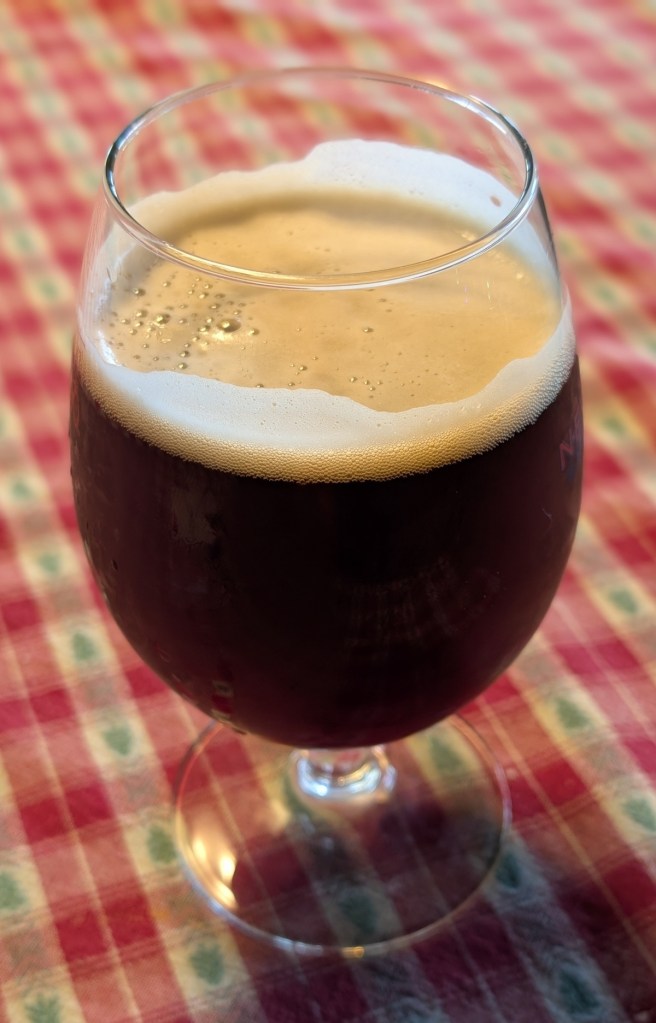
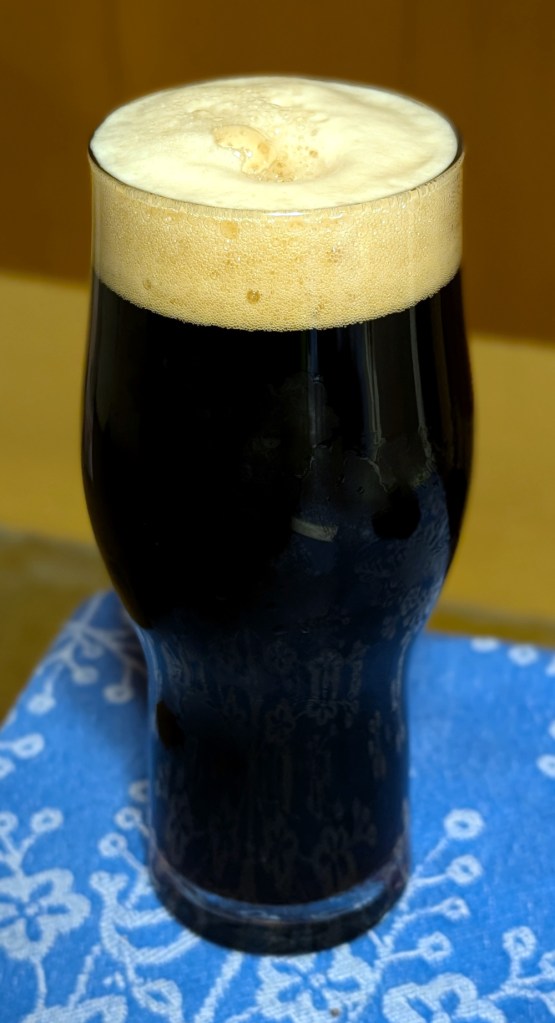
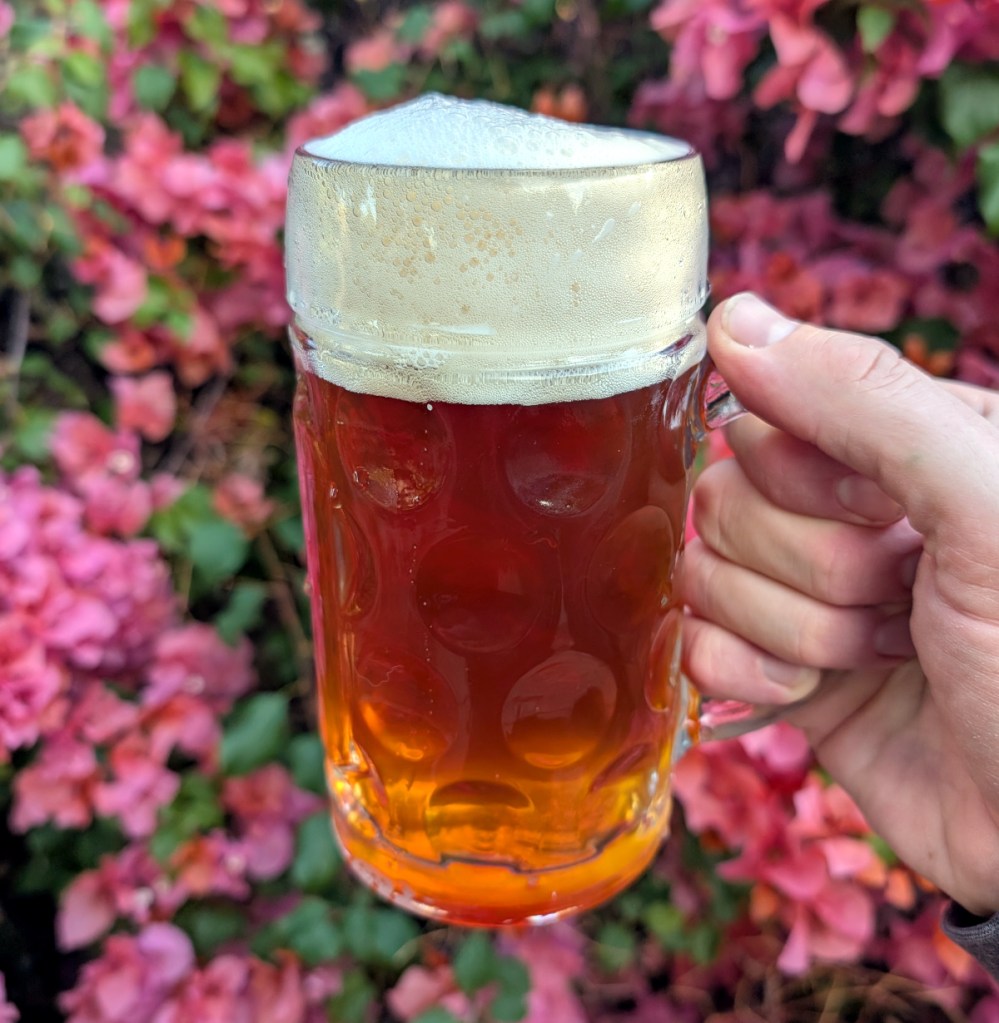
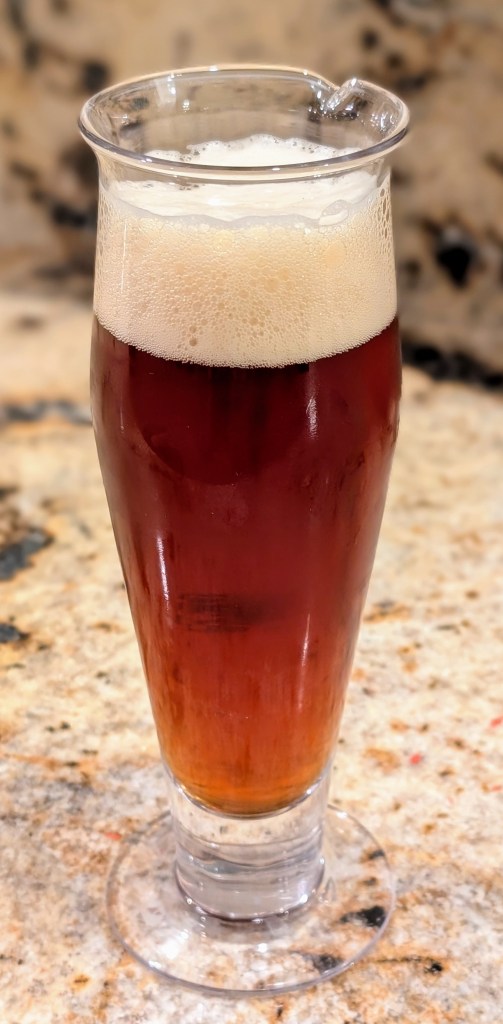
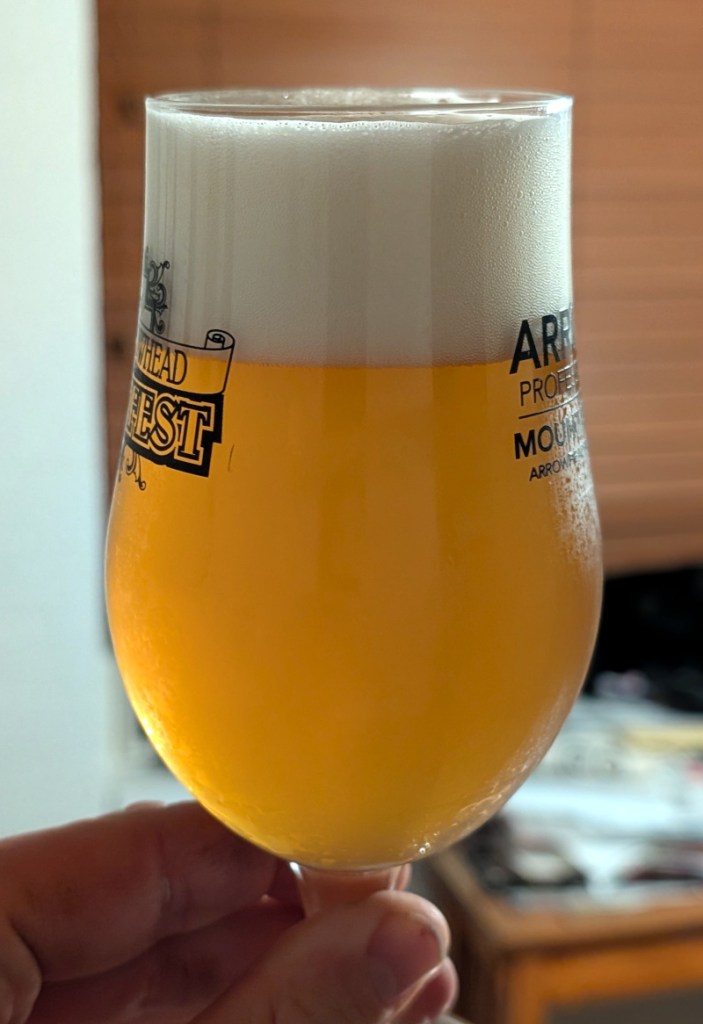
    • Deep amber beer with moderate haze; persistent but thin ivory head
  • Aroma
    • Light caramel malt notes with a good dose of citrus. a touch of pine
  • Flavor
    • Medium caramel malt flavor, against a strong orange/citrus and moderate pin character from the hops. Delicious! Medium-high bitterness.
  • Mouthfeel
    • Medium-light body, moderate carbonation, slightly dry, somewhat thin finish.
  • Would I Brew This Again?
    • This is a wonderful session amber ale, bursting with hop flavor and aroma. The haze is a minor flaw, but the flavor and aroma totally make up for it. I would love to try this with the original malt and hop combos, to see how it is. I might also add the black patent back in, to darken the beer. The malt body comes across as a little thin, so for a future version I might try Vienna or Maris Otter instead of plain 2-row, and/or mash at a higher temperature. Overall, this is a very drinkable beer!
  • Overall
    • 8/10

Beam Me Up Pale Ale 2024

I love pale ales, and I love this recipe! I made this last year and decided to give it another try. I upped the hops a touch to get a little more bitterness, and the malt brands are slightly different. Either way, it’s basically the same beer – simple grist, simple hops, simple yeast.

Beam Me Up Pale Ale

  • 12 lb. 2-row pale malt (Briess)
  • 0.5 lb. Viking caramel 100 (crystal 40) malt – (Viking)
  • 0.5 tsp. BrewTanB, in mash
  • 2.0 oz. Cascade whole hops (5.5% estimated alpha acid), 60 minute boil
  • 1.0 oz. Cascade whole hops (5.5% estimated alpha acid), 15 minute boil
  • 0.5 tsp. BrewTanB, 10 minute boil
  • 1 Whirlfloc tablet, 5 minute boil
  • 2.0 oz. Cascade whole hops (5.5% estimated alpha acid), 5 minute boil
  • 2 pkg. BRY-97 (Lallemand)

Target Parameters

  • 1.057 s.g., 1.015 f.g., 5.5% abv, 55 IBU, 6 SRM
  • Full volume mash, 156° for 60 minutes, 168° mash-out for 10 minutes
  • Claremont tap water adjusted with lactic acid

Procedure

  • I mashed in with 7.6 gallons of water at 162°, to hit a target rest of 156°. I added 5.5 mL of 88% lactic acid to adjust the pH.
  • I recirculated for 60 minutes during the mash, raising it to 168° for a 10 minute mash-out.
  • After the mash, I removed the grains. In total, the mash yielded 6.6 gallons of runnings with a gravity of 1.047, for 67% mash efficiency.
  • Once the runnings were boiling, I added hops and kettle finings per the recipe. After 60 minutes, I turned off the heat and chilled to 82° and transferred the wort to the fermenter. I continued chilling down to 66° before pitching the yeast, holding the fermenter at 66° for the primary fermentation.
  • I brewed the beer on 17 August 2024. Starting gravity was 1.057.
  • I kegged the beer using a closed transfer, on 1 September 2024. Final gravity was 1.013, for 5.8% abv.

Tasting

  • Appearance
    • Deep gold beer, clear, with a fairly persistent white head
  • Aroma
    • Slight caramel malty note, and a moderate citrus aroma. It has a very orange-like quality.
  • Flavor
    • Medium bitterness, with a floral orange quality. Light caramel maltiness. This is a tasty beer!
  • Mouthfeel
    • Medium body, moderate level of carbonation, smooth and slightly dry finish.
  • Would I brew this again?
    • This is a wonderful American pale ale recipe! I see no need to make any changes – it’s just plain tasty. The citrus character is fantastic!
  • Overall
    • 10/10

Alstadt Altbier 2.2

I love it when I have honed a house recipe, and altbier is one of my annual favorites. This is largely similar to what I made previously; the 2024 version is my fifth brew of the recipe! Compared to last year, I altered the CaraMunich addition to include a blend of Caramel Munich 60L (Briess) and Caramunich II, versus just Caramunich I as I did last year. Because the 2023 version was a bit harsh on bitterness, I swapped out the Magnum hops and went with Spalt alone for the hop additions. Finally, I used a blend of K-97 and Köln dry yeasts; sadly, Köln’s days are numbered in my brewery, because it has been discontinued by Lallemand.

Alstadt Alt 2.2

  • 6.5 lb. pilsner malt (Rahr)
  • 1.5 lb. Munich I malt (Weyermann)
  • 1.5 lb. Vienna malt (Weyermann)
  • 0.5 lb. Caramel Munich 60L (Briess)
  • 0.5 lb. Caramunich II malt (Weyermann)
  • 2 oz. Carafa Special I malt (Weyermann)
  • 0.5 tsp. BrewTanB, added to mash
  • 2.0 oz. Spalt Spalter hop pellets (4.3% alpha), 60 minute boil
  • 0.5 tsp. BrewTanB, 10 minute boil
  • 1.0 oz. Spalt Spalter hop pellets (4.3% alpha), 5 minute boil
  • 1 Whirlfloc tablet, 5 minute boil
  • 1 pkg. Köln Kölsch Style Ale Yeast (Lallemand)
  • 1 pkg. SafAle German Ale yeast K-97 (Fermentis)

Target Parameters

  • 1.048 s.g., 1.011 f.g., 4.9% abv, 35 IBU, 14 SRM
  • 60 minute infusion mash, full volume, 152°
  • Claremont tap water treated with Campden tablet

Procedure

  • I mashed in with 7.5 gallons of water at 157°, to hit a mash temperature of 152°. I added 4 mL of 88% lactic acid and held the mash here (with recirculation) for 60 minutes, before raising to 168° for the 10 minute mash-out.
  • After removing the grain basket, I had 6.5 gallons of wort with a gravity of 1.043, for an efficiency of 71%.
  • I brought the runnings to a boil, adding malt and finings per the recipe. After the 60 minute boil, I chilled to 80° and transferred to the fermenter. I let it chill a bit down to 60° in the fermentation chamber, before pitching the yeast and setting the fermentation temperature to 64°. I ended up using a mix of yeast, because the K-97 was a year past expiration.
  • I brewed the beer on 11 August 2024, and it had a starting gravity of 1.051.
  • I let the beer free-rise to 66° on 22 August 2024, when I started fermenting a pale ale. Finally, I let the beer finish at ambient on 22 August, around 75° to 80°.
  • I kegged the beer on 23 August 2024, and it had a final gravity of 1.011. This works out to 5.3% abv.

Tasting

  • Appearance
    • Deep copper color, very clear, with a fine and reasonably persistent ivory colored head.
  • Aroma
    • Bread crust malt aroma at the front, along with dark caramel. A slight touch of spicy hop aroma.
  • Flavor
    • Relatively bitter beer; malt flavor is of dark breadcrest and rich mattiness. I pick up some dried fruit character, from the malt/yeast interplay.
  • Mouthfeel
    • Medium body, medium carbonation, slightly dry finish.
  • Would I brew this again?
    • This remains a wonderful althier recipe, despite slight tweaks over the years. It took a bit of time to clear, but is now fantastic! I love this beer!
  • Overall
    • 10/10

Dad’s 3P 2024

pale yellow beer with white head in conical pilsner glass

I’ve made two previous versions of Pre-Prohibition Pilsners, distinguished as such by having a bit more body and malt character than a typical American macro lager, and distinguished from European pilsners by adjuncts and the frequent use of American hops. My dad’s version originally comes from the April 1999 issue of BYO; it stands out in having a bit of flaked rye in it. Additionally, 6-row malt is nowhere to be seen in my version of this recipe.

This year’s edition is broadly inspired by the 2016 version, but you can check out the last version for differences. I used all American hops (Mt. Hood) instead of German ones, and brought Novalager into the mix, too. The main goal is to have something drinkable for the dog days of summer, but not so inoffensive as to be boring.

Dad’s 3P 2024

  • 6.75 lb. 2-row malt (Briess)
  • 2.25 lb. pilsner malt (Rahr)
  • 1 lb. yellow corn, flaked (Briess)
  • 0.5 lb. rye, flaked (Briess)
  • 0.5 lb. Carafoam (Weyermann)
  • 0.25 lb. rice hulls
  • 0.5 tsp. BrewTanB, in mash
  • 1 oz. Mt. Hood hop pellets (6.0% alpha), 60 minute boil
  • 1 oz. Mt. Hood hop pellets (6.0% alpha), 10 minute boil
  • 0.5 tsp. BrewTanB, 10 minute boil
  • 1 Whirlfloc tablet, 5 minute boil
  • 2 pkg. Novalager yeast (Lallemand)

Target Parameters

  • 1.050 s.g., 1.009 f.g., 30 IBU, 5.5% abv, 4 SRM
  • Full volume mash with recirculation for 60 minutes at 152°, 10 minute mash-out at 168°
  • Water blended from RO and Claremont tap water to hit target of 52 ppm Ca, 10 ppm Mg, 64 ppm Na, 82 ppm SO4, 113 ppm Cl, 5 ppm bicarbonate, alkalinity=4 ppm, RA=-39.

Procedure

  • I built my water the night before with 4 gallons of distilled water and 3.5 gallons of Claremont tap water, adding a Campden tablet and 3.2 mL of 88% lactic acid to drop out the carbonates.
  • I mashed in by heating the strike water to 158°, and then adding the grains and 2.4 mL of 88% lactic acid for pH adjustment.
  • I held the mash, with recirculation, at 152° for 60 minutes, before raising the temperature to 168° for a 10 minute mash-out.
  • At the conclusion of the mash, I removed the grains and let them drain. In total, I collected 6.6 gallons of runnings with a gravity of 1.043, for 69% mash efficiency.
  • As the runnings came to a boil, I added 2.5 g of calcium chloride. Once the runnings boiled, I added the hops and finings per the recipe.
  • After the full 60 minute boil, I chilled the wort to 78° before transferring to the fermenter and letting it chill to 46° in the fermentation chamber.
  • I pitched the yeast at 46°, and then let the fermenter free rise to 52° for fermentation.
  • I brewed the beer on 19 May 2024. Starting gravity was 1.049.
  • I let the beer free rise to 60° on 25 May 2024, and then to 65° on 29 May 2024.
  • The beer was kegged using a closed transfer on 3 June 2024. Final gravity was 1.009, for 5.2% abv.

Tasting

  • Appearance
    • Brightly clear, straw yellow beer, which pours with a fine and persistent white head. It just looks nice!
  • Aroma
    • Grainy sweet malt aroma; no appreciable yeast character or hop character apparent.
  • Flavor
    • Medium-high bitterness at the forefront, with a slightly herbal quality. Malty notes and a light hint of corn sweetness are behind that, but the beer definitely tilts toward bitter. Clean fermentation character, Crisp finish.
  • Mouthfeel
    • Medium body with a rounded feel. Dry finish. Medium carbonation.
  • Would I Brew This Again?
    • This is an interesting American lager, and highly drinkable. It’s a great summer beer! I’ve never done a six-row version of this, and might have to try it sometime in the pursuit of historical accuracy. Relative to the BJCP guidelines for Pre-Prohibition Lager (Category 27, Historical Beer), it hits most of the notes but should have perhaps a bit more hop aroma and a slightly taller head. Overall, though, this is a solid beer and recipe! It’s really enjoyable to drink on a hot afternoon, which is really all I demand from such a beer.
  • Overall
    • 9/10

Snowdrop Kölsch 2024

Kölsch is a simple style in so many ways, but a hard one to do well. After a few iterations, I perfected a recipe that works well for me. I first brewed Snowdrop Kölsch in 2023, and it’s a definite winner. I made a batch earlier this year, but it unfortunately (and frustratingly!) got infected, so I did a deep cleaning in the fermenters for my second attempt. This one succeeded!

Other than slight changes in malt brand (Rahr pilsner instead of Viking) and building up my water from scratch, this is identical to the 2023 edition of the recipe. There is no sense in messing with perfection! Sadly, Lallemand has discontinued their German ale yeast, so I will have to search for a different strain in future years. This is a shame, because I quite like it! I suppose it’s back to liquid yeast whenever my dry yeast supply runs out.

Snowdrop Kölsch

  • 9.5 lb. pilsner malt (Rahr)
  • 0.5 lb. Munich I malt (Weyermann)
  • 0.5 tsp. BrewTanB (mash)
  • 1 oz. Edelweiss hop pellets (5.8% alpha), 45 minute boil
  • 0.5 tsp. BrewTanB, 10 minute boil
  • 1 Whirlfloc tablet, 5 minute boil
  • 1 oz. Edelweiss hop pellets (5.8% alpha), 5 minute boil
  • 1 pkg. Köln Kölsch-style yeast (Lallemand)

Target Parameters

  • 1.046 s.g., 1.010 f.g., 24 IBU, 4 SRM, 4.6% abv
  • Full volume mash, 60 minute mash at 152°, 10 minute mash-out at 168°
  • RO water with added minerals to hit target of 50 ppm Ca, 6 ppm Mg, 6 ppm Na, 54 ppm SO4, 72 ppm Cl, 0 ppm HCO3, -39 ppm RA

Procedure

  • Starting with 7.25 gallons of RO water, I added 0.4 g of sea salt, 1.4 g of epsom salt, 1.7 g of gypsum, and 3.6 g of calcium chloride, in order to reach my target water parameters. I heated the water to 157° before adding the grains and holding the mash at 152° (with recirculation) for 60 minutes. Next, I heated the mash to 168° for a 10 minute mash-out, before pulling the grains.
  • In total, I collected 6.6 gallons of runnings with a gravity of 1.041, for 73% mash efficiency.
  • I brought the runnings to a boil, adding hops and finings per the recipe. After 60 minutes, I chilled the wort to 78°, let it settle for a bit, and transferred to the fermenter. I chilled the wort to 60° in the fermentation chamber before pitching the yeast, and fermented at 64°.
  • I brewed this beer on 23 June 2024. Starting gravity was 1.048.
  • I kegged the beer on 12 July 2024, using a closed transfer.
  • Final gravity was 1.009, for 5.2% abv.

Tasting

  • Appearance
    • Exceptionally clear, light yellow beer with somewhat persistent white head. It is pretty in the glass!
  • Aroma
    • Grainy sweet aroma, light fruity character. Very subtle floral hop note.
  • Flavor
    • Light malty character, medium-low bitterness. Slight fruitness, of the pear/apple variety (but not strictly apple; it has more depth than that!). Slight floral hop quality.
  • Mouthfeel
    • Medium-light body, moderate carbonation, smooth and pleasant finish.
  • Would I Brew This Again?
    • This is a very good kölsch! I don’t know that it’s my best–the hop aroma is a little more subdued than last year’s version–but this one still hits the notes!
  • Overall
    • 9/10