Beer Tasting: Red Star Imperial Stout

More than two months after brewing and about 5 weeks after kegging, I wanted to do a taste-test of my imperial stout. This tasting was done prior to our club competition, so as to not bias my opinion on it one way or another. In the competition itself, it was at the top for the homebrewed entries, although just barely! A two year old entry from another club member was just behind mine in the overall scoring.

  • The Basics
    • Original gravity = 1.098; final gravity = 1.031; abv = 9.1%; estimated IBU = 66.5.
  • Aroma
    • Aroma is rich and moderately roasty, with a faint earthy note and a very slight alcohol tinge in the background. As the beer warms up, the booziness comes a little more to the forefront, but is not overwhelming. The aroma is rich enough that it blows out the smell receptors pretty quickly. I don’t pick up any level of fruitiness.
  • Appearance
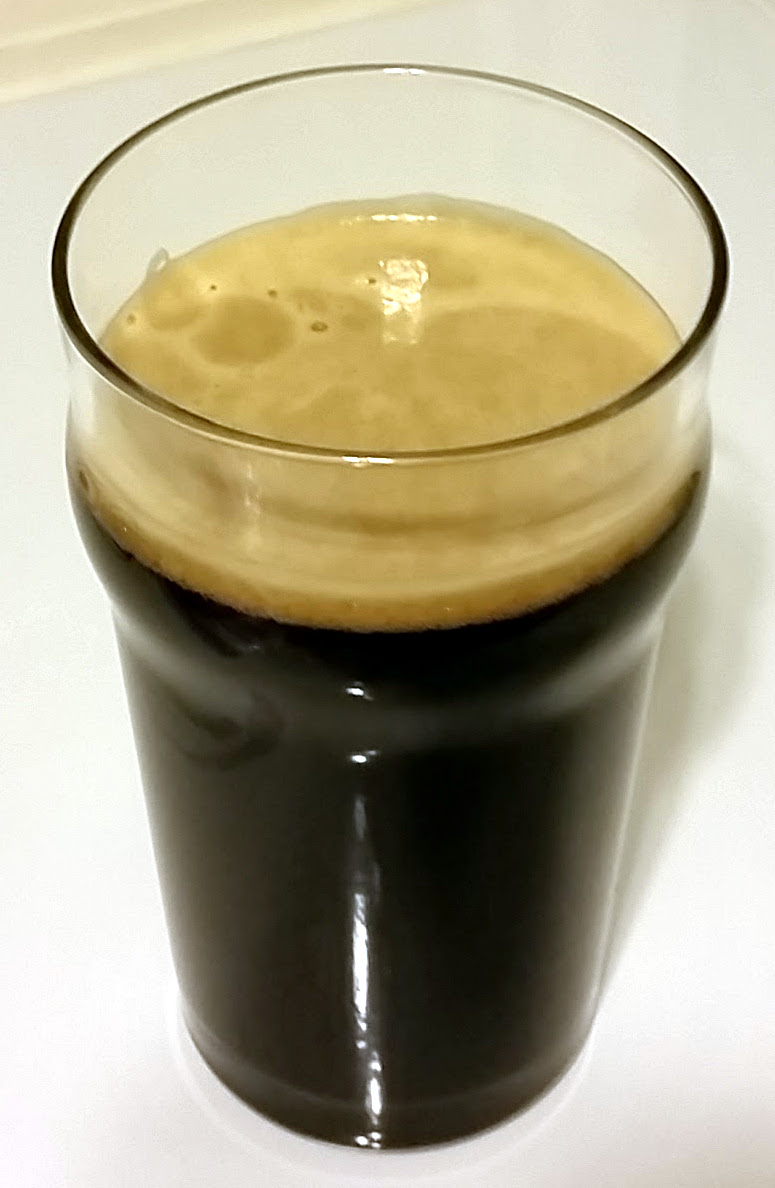
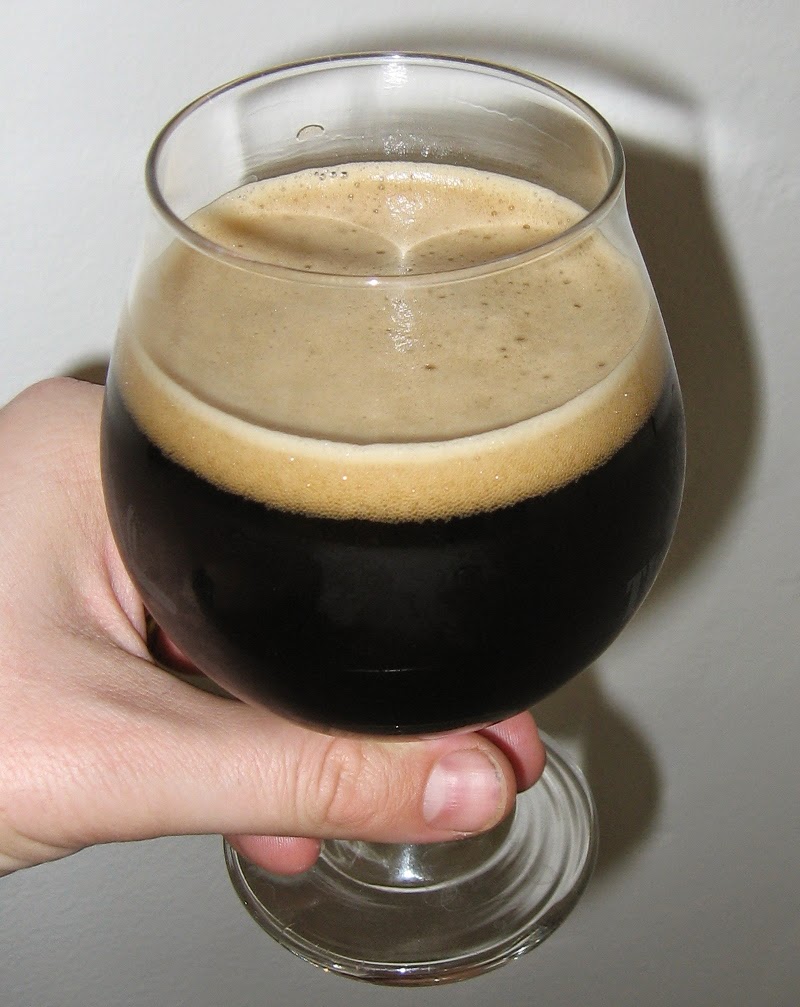
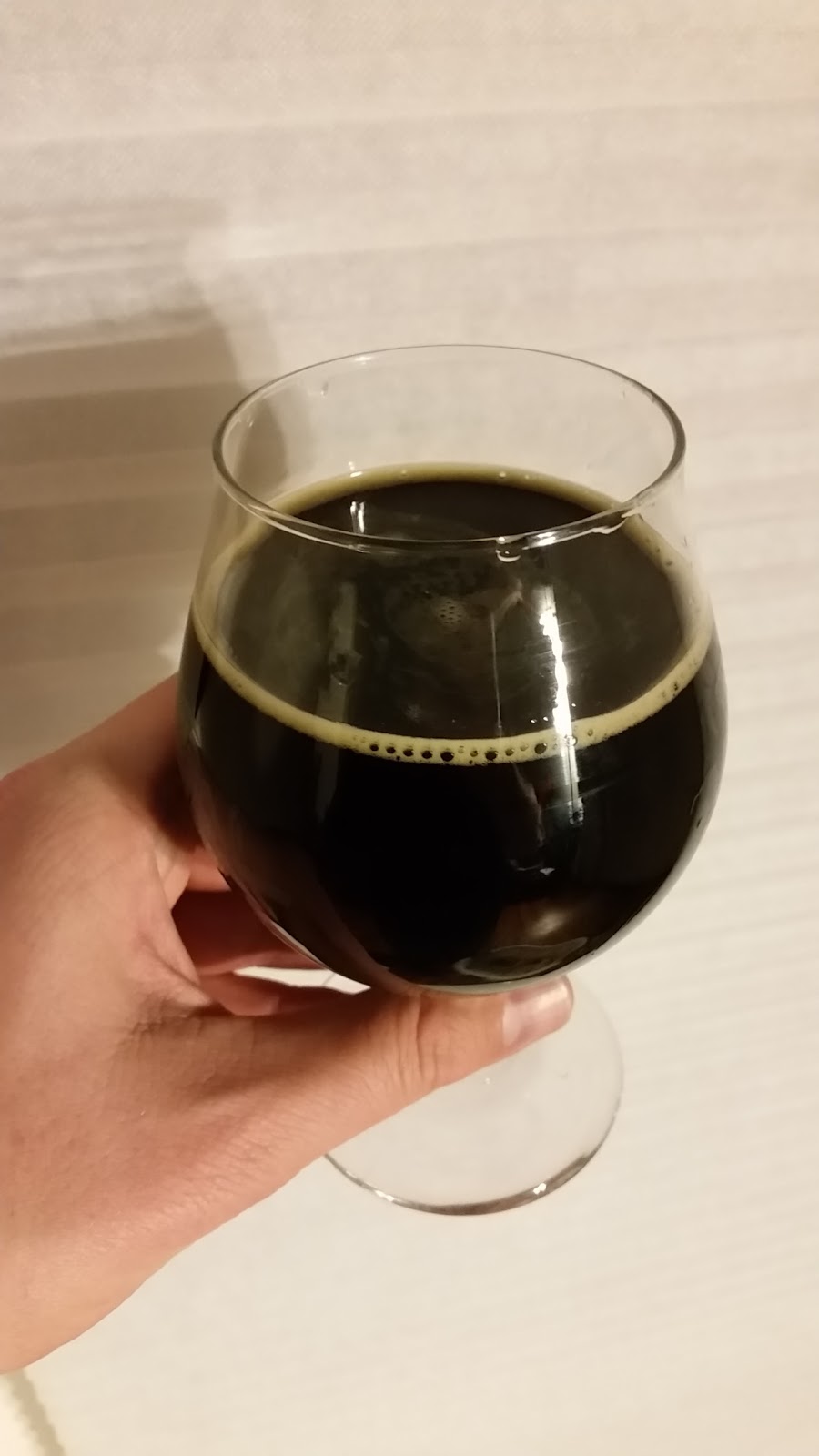
    • This beer is black, or a rich chocolate brown when viewed at an angle. The head is low, thin, and brown, which rapidly subsides to a ring around the edge of the glass. This bit of head is pretty persistent, though.
  • Flavor
    • Flavor-wise, this beer has a prominent malt character that is distinctly roasty (coffee-like) and a tad burnt on the finish. As the beer warms up, I get some chocolate notes, too. There is a tinge of alcohol heat, but that is definitely in the background. This is balanced against a hefty dose of bitterness.
  • Mouthfeel
    • This beer has really great body, and a slightly creamy feel on the tongue. The finish is medium-dry, with a lingering roasty finish. It has maybe a touch more bitterness on the extended finish than I care for, but this is fairly minor in the overall beer. Carbonation is moderate and seems appropriate for the style.
  • Would I brew this again?
    • This beer turned out pretty well, particularly for a “big” style that I haven’t attempted previously. For what it is (imperial stout), it’s a pretty good beer. I’m missing out on a bit of the malt complexity in the flavor (I think), but that also could be my unrefined palate. Attenuation seems spot on–I was worried this might have underattenuated or ended up a bit cloying, but that is definitely not the case. So would I brew this again? Sure, I think it’s a pretty good recipe, although not so exceptional that I wouldn’t try others, too. I’ll be curious to see how that assessment changes as the beer ages. I also should say I don’t see myself making imperial stouts that often–I just don’t care for “big” beers, and it’s a lot of effort for a beer that I’m only moderately interested in (even if I think it tastes pretty decent).
  • Overall score: 7/10

Beer Tasting: The Celtic Elk Stout

My Irish stout (“The Celtic Elk Stout”) has been on tap for a few weeks now, and is definitely ready for a tasting.

  • The Basics
    • Original gravity = 1.048; final gravity = 1.018; abv = 3.9%; estimated IBU = 36
  • Aroma
    • Strong and ever-so-slightly sweet coffee aroma, with a roasty chocolate note behind it. 
  • Appearance
    • Clear as near as I can tell, but pitch-black in the glass. When you hold it up to the light, you can glimpse a dark brown color with a red tinge to it, but that’s only if you have the thinnest sliver of beer against strong backlight. The head is dark tan and thin, with a fine texture and good retention.
  • Flavor
    • This beer has a very coffee-like quality, in terms of being quite roasty in flavor with a bitter finish (more from the barley than the hops, though, in terms of the bitterness character).
  • Mouthfeel
    • The stout has a moderate-low body, with moderate and fine carbonation. It is a pretty dry (but not puckering) beer, as befits the style. 
  • Would I brew this again?
    • This beer is a darned good Irish stout, and I’d definitely use the recipe again in the future. It hits exactly what I was looking for, in terms of dryness, drinkability, fairly low alcohol content, and intangibles. I like this one!
  • Overall
    • 9.5/10
And a label!
On a whim, I drafted a beer label in honor of the original “Celtic Elk,” Megaloceras. It brings in one of the “Irish elk” skulls along with a Celtic knot. Maybe it will make a good t-shirt someday?

The Celtic Elk Stout

Dark grains set aside to add during vorlauf

As we inch closer to the dark days of winter, I’m in a mood for some good, robust beers. Robust for me usually doesn’t require high alcohol content (although it can)–I think of it more as something with a strong malt backbone, prominent flavors from specialty grains, and perhaps some nice yeast character. Following on the heels of last weekend’s 80 shilling ale, tonight I brewed an Irish stout.

The recipe is based on Gordon Strong’s recipe from Modern Homebrew Recipes, with some modifications for the grains and hops I had on hand. My goal with this batch is to get a robust beer, but one that clocks in lower on the alcohol side of things (in this case, 4.3%). The beer is actually a bit outside the 2015 BJCP guidelines for the Irish Stout style, in terms of original gravity and color. The latter point surprised me–the BJCP lists 40 SRM as the maximum for this style, and to me it seems a little silly to set an arbitrary maximum for a beer explicitly described as “black” in the style guidelines.

The name for the batch stems from the famed Irish Elk, Megaloceras. Because why not?

The Celtic Elk Stout

  • 6.5 lbs. Maris Otter malt (Thomas Fawcett)
  • 1.25 lbs. flaked barley
  • 0.25 lbs. Carapils malt
  • 0.75 lbs. 80° crystal malt (added at vorlauf)
  • 0.67 lbs. roasted barley (Simpsons, 550 SRM, added at vorlauf)
  • 0.5 lbs. pale chocolate malt (225 SRM, added at vorlauf)
  • 0.375 lbs de-bittered black malt (Dingemans, added at vorlauf)
  • 1 oz. Newport hops pellets, 40 minute boil (10.7% alpha, 6.4% beta)
  • 1 Whirlfloc pellet (10 minute boil)
  • 1 pkg. Irish Ale Yeast (WLP004), prepared 12 hours in advance in 1 L starter
Procedure
  • I mashed in with the Maris Otter, flaked barley, and Carapils, using 4.1 gallons of water at 168°. The mash stabilized at 157°, and was down to 153.5° after 40 minutes. [note: I did not use 5.2 pH stabilizer in this batch]
  • I added the dark grains (cystal malt, roasted barley, chocolate malt, and black malt) along with 0.75 gallons of water at 160°, let the mash sit for 10 minutes, vorlaufed, and collected 3 gallons of wort.
  • I then added 4 gallons of water at 180°, which raised the mash temperature to 164°. I let the mash sit for 10 minutes, vorlaufed, and collected the rest of the wort.
  • All told, I collected 6.75 gallons of wort at a gravity of 1.040. This works out to ~73% efficiency, right where I had been hoping.
  • I brought the wort to a boil, and added the hops and Whirlfloc at the appropriate times (aiming for 40 minute boil and 10 minute boil, respectively). After 60 minutes of boiling, I turned off the flame and chilled the wort down to 78° using my copper coil chiller.
  • I transferred ~5.5 gallons of wort into the fermenter and pitched the yeast in its starter. I plan to let the temperature slowly equilibrate with the fermentation chamber overnight.
  • The beer had a starting gravity of 1.048, exactly where expected. It was brewed on Saturday, November 21, 2015.

Beer Tasting: Eagle Face Oatmeal Stout

My Eagle Face Oatmeal Stout ended up as another fine brew–it’s been a great winter brewing season so far. I took a sample to my homebrew club meeting last week, and it actually placed highest in our informal beer tasting competition (out of eight entries, many of them quite good)! 

At any rate, I thought I would do my own, self-critical tasting while the beer is still in its prime. The results are below.

  • Basics
    • Starting gravity = 1.057; final gravity = 1.022; abv = 4.6%
  • Aroma
    • Slightly chocolatey / roasty; no hops detectable. Very nice.
  • Appearance
    • Head retention excellent (in fact, amazing! it keeps going until I finish the glass); light brown head with fine foam and nice lacing on the side of the glass; color of beer is black to dark brown (the latter only in the thinnest part of the glass). Clarity is quite good (at least as can be determined for the color)
  • Flavor
    • Malty and rich; balance between bitterness and maltiness is good; a tad thin on the finish; flavor is primarily coffee and just a light hint of cocoa
  • Mouthfeel
    • Moderate body, carbonation perfect for style; just a touch creamy/silky, but not overly so; no astringency or any off flavors.
  • Would I brew this again?
    • Absolutely! The recipe turned into a really nice beer! I might up the oatmeal on this just a tad next time to give it just a hint more mouthfeel, but otherwise it’s quite good.
  • Overall rating: 9/10

Burning Hills Cacao Stout Bottled

After 15 days in the secondary fermenter, my Burning Hills Cacao Stout was ready to bottle. Its gravity was unchanged since the transfer (1.026, from a starting gravity of 1.062), resulting in a final abv of 4.7%. The beer still has a smooth taste and mild chocolate finish (with a hint of vanilla), although the feel of the beer seems to have thinned just a touch since my last sampling. We’ll see how that turns out when carbonated.

I transferred about 4.75 gallons of beer into the bottling bucket and primed the beer with 3.5 oz. (~2/3 cup) of corn sugar boiled in 2 cups of water. The yield was 43 12-oz. bottles and 3 22-oz. bottles.

One minor change with this session is that I attached the bottling wand to the bucket with a much shorter piece of tubing, rather than the 3 foot length I used previously. The result is that it is much easier to bottle, and I’ve eliminated the risk of accidentally getting the bottling wand on the floor.