The Celtic Elk Stout 1.1

Nearly five years ago, I made an Irish stout that tasted great and did well in competition. I gave another go this year, seeking a dark beer with lots of flavor but not a lot of booziness. It was a success!

The recipe is basically the same as last time, just with some minor ingredient adjustments.

The Celtic Elk Stout 1.1

  • 6 lb. Maris Otter malt (Crisp)
  • 1.5 lb. flaked barley
  • 13.6 oz. crystal 75 malt (Great Western)
  • 12 oz. roasted barley (Briess)
  • 10 oz. chocolate malt (Briess)
  • 4 oz. crystal 10 malt (Briess)
  • 3 oz. Blackprinz malt (Briess)
  • 3 oz. Carafa Special III malt (Weyermann)
  • 3 oz. rice hulls
  • 0.65 oz. Warrior hop pellets (15.8% alpha), 60 minute boil
  • 1 Whirlfloc tablet, 5 minute boil
  • 1 pkg. Irish Ale Yeast (WLP004)

Target Parameters

  • 1.045 o.g., 1.014 f.g., 4.1% abv, 35 IBU, 39 SRM
  • Infusion mash, 156° for 60 minutes, batch sparge
  • Claremont tap water

Procedure

  • The night before brewing, I made a 0.75 L starter, and let it run on the stir plate.
  • I mashed in with 3.5 gallons of water at 168°, to hit a mash temperature of 156°.
  • After 60 minutes of mashing, I added 1.5 gallons of water at 185°, let sit for 10 minutes, vorlaufed, and collected the first runnings. Next, I added 3.75 gallons of water at 185°, let sit for 10 minutes, vorlaufed, and collected the second runnings.
  • In total, I collected 7.5 gallons of runnings with a gravity of 1.045, for 87% efficiency! This was way too high, so I removed 0.5 gallons of runnings and added 0.5 gallons of tap water, to hit 1.041. This was much better. I saved 2 cups of this to use in bread (and it made tasty bread!).
  • I brought the kettle to a boil, adding hops and finings per the schedule. After 60 minutes, I turned off the flame and chilled the wort.
  • Once the wort was down to around 75°, I transferred to the fermenter and chilled the rest of the way down to 66°. Finally, I pitched the yeast.
  • I brewed this beer on 18 April 2020. Starting gravity was 1.050.
  • I fermented the beer at 66°, and kegged the beer on 25 April 2020. To save some CO2 and try keg conditioning, I primed the keg with 2.1 oz. of corn sugar in boiling water.
  • Final gravity was 1.019, for 4.1% abv.

Tasting
  • Appearance
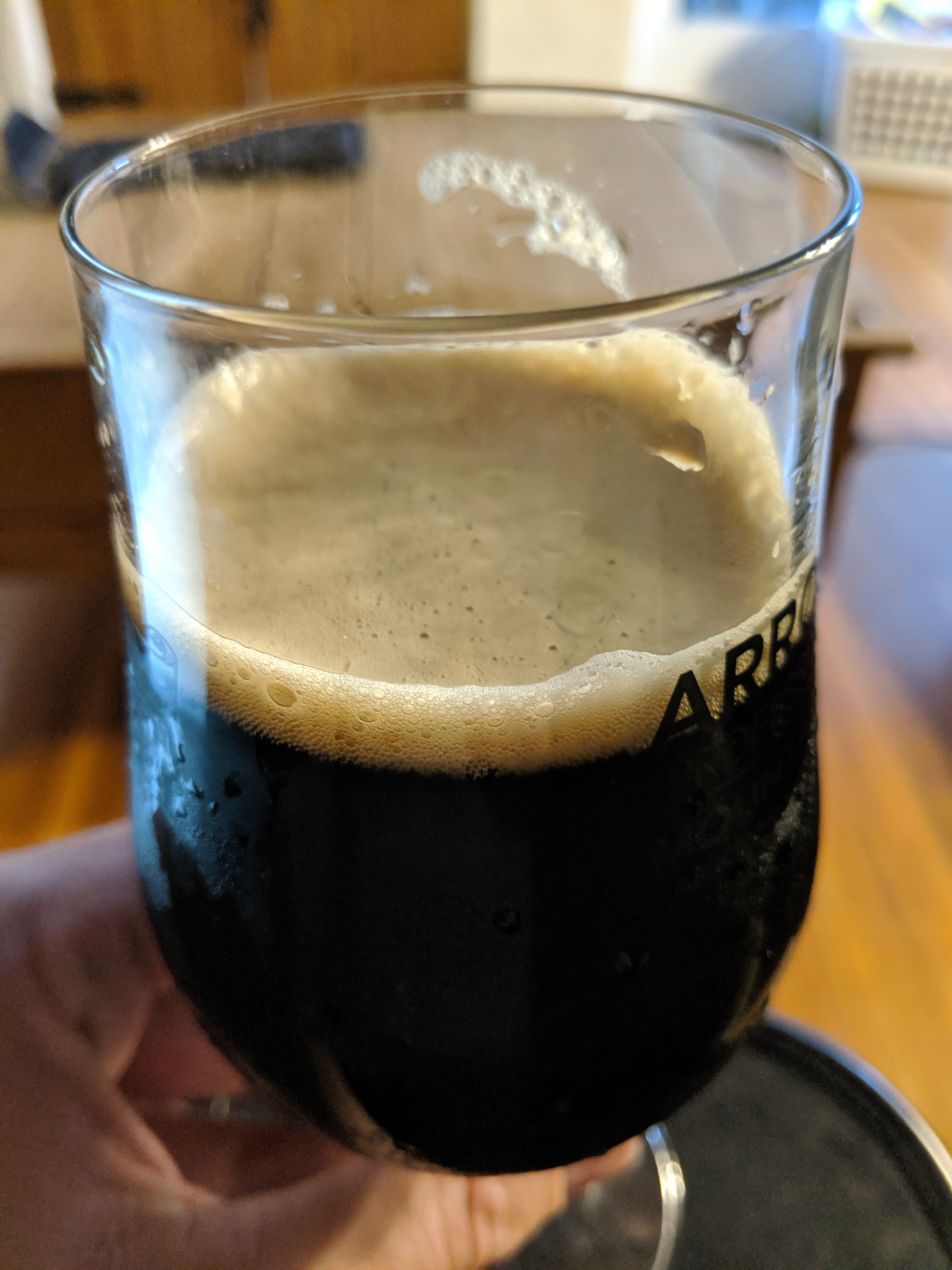
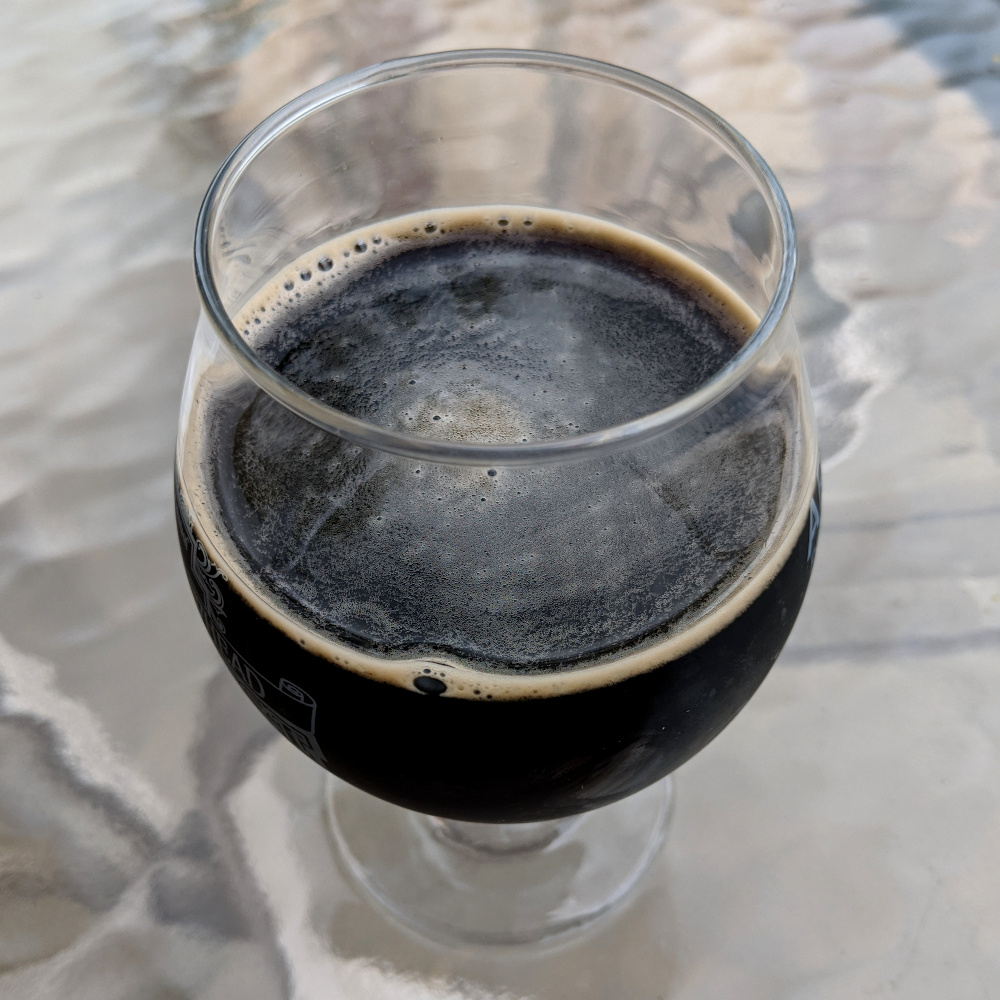
    • Dark! Black in the glass, and a deep, dark brown if you get a thin sliver of beer. Thin but persistent brown head.
  • Aroma
    • Rich aroma of chocolate with a touch of roasted coffee. There are hints of dried cherry behind that; I don’t think it’s esters (because the flavor of the beer is pretty clean in terms of yeast character), but a synergistic effect of the dark malts. I like it!
  • Flavor
    • Roasted coffee character at the outset, with a touch of dark chocolate behind that. There is a really nice coffee-type bitterness from the malt than creeps in alongside the hop bitterness. Hop bitterness is clean. The flavor is malt forward, with hops secondary, until the finish. There is an extended, slightly bitter (but not unpleasant) finish.
  • Mouthfeel
    • Dry, medium-light body, moderate carbonation.
  • Would I brew this again?
    • This is a great recipe, and a fine interpretation of the style. I think my modifications were okay overall, although I’ll replace the Carafa III with all debittered black malt next time, and use pale chocolate instead of regular chocolate malt, because the malt was just a little too much chocolate and not enough roast. As the beer matures, it has really come into its prime. I rushed it just a touch to get it on-tap, and so it had a hint of sweetness at first from the corn sugar used for priming (at least I think that’s what I was experiencing). That’s gone away now. This recipe produces a really quaffable beer, and the low alcohol level (4.1% abv) isn’t really a flavor/mouthfeel detriment thanks to the malt character.
  • Overall
    • 9/10

No Latitude Tropical Stout

IMG_20190519_191408Summer fun doesn’t mean I have to be limited to light lagers (and I do love light lagers!). I think there is a place for dark beers in the warm weather, given the right recipe and the right mindset. So, a “tropical stout” seemed like a good ticket. I had initially thought I would make something with coconut, but realized I didn’t necessarily want a full batch of a coconut beer. Why not just a simple, clean(ish), flavorful stout? So, I checked out Gordon Strong’s Modern Homebrew Recipes book and found his Jamaican Eclipse recipe. The general concept is to take a stout recipe and ferment it with lager yeast at ale temperatures. In my reading, there seems to be a lot of lore around tropical/Caribbean stouts and yeast type, and I wonder to what extent any of it is true. Either way, even a “Fantasy Island” version of the recipe is intriguing to me.

I followed Strong’s grain bill only loosely, making many substitutions and adjustments. I had no idea how much I might like this, so I scaled it for a 3 gallon batch. The result? Pretty flavorful, and a definite re-brew candidate!

No Latitude Tropical Stout

  • 6.25 lb. Maris Otter malt (Bairds)
  • 8 oz. crystal 80° malt
  • 6 oz. roasted barley
  • 4 oz. chocolate malt (Briess)
  • 2 oz. Blackprinz malt, 2-row (Briess)
  • 10 oz. corn sugar (dextrose), added to kettle before boil
  • 0.5 oz. Warrior hop pellets (15.8% alpha), 60 minute boil
  • 1 Whirlfloc tablet, 10 minute boil
  • 1 tsp. Fermax
  • 2 pkg. Saflager (W34/70) lager yeast, Fermentis

Target Parameters

  • 60 minute infusion mash, 152°, batch sparge
  • 1.064 o.g., 1.011 f.g., 7.1% abv, 39 IBU, 32 SRM
  • Claremont water, treated with Campden tablet

Procedure

  • I mashed in with 2.75 gallons of water at 163°, to hit a mash temperature of 153°. It was down to 149° after 20 minutes, likely due to the smaller thermal mass involved here.
  • After 60 minutes, I added 0.75 gallons of water at 185°, let sit for 10 minutes, vorlaufed, and collected the first runnings. I then added 2.5 gallons of water at 185°, let sit for 10 minutes, vorlaufed, and collected the second runnings.
  • In total, I collected 4.65 gallons of runnings with a gravity of 1.044, for 75% mash efficiency. I added the corn sugar prior to the boil.
  • I brought the runnings to a boil, adding hops and other ingredients per the schedule.
  • After 60 minutes, I turned off the flame and chilled down to 67°. I transferred to the fermenter and pitched the yeast.
  • I fermented the beer at 67°. Starting gravity was 1.060.
  • I brewed the beer on 15 April 2019 and cold crashed on 28 April 2019, kegging on 29 April 2019.
  • Final gravity was 1.013, which works out to 6.3% abv.

Tasting

  • Aroma
    • Roasty, chocolatey malt aroma, but not much in the way of hops. Really nice! As it warms up, I pick up a slight alcohol note, but this is permitted within the bounds of the BJCP style description.
  • Appearance
    • Thick and persistent brown head; the beer itself is fairly clear, and brown with a faint reddish tinge
  • Flavor
    • Chocolate-forward, with a bit of roast behind that. The bitterness is moderate and clean, but not over the top. Not much in the way of hop flavor. The finish is evenly balanced between hoppiness and maltiness. This is a very smooth, highly drinkable beer.
  • Mouthfeel
    • Moderate body, but not so much as to kill drinkability. Moderate carbonation.
  • Would I brew this again?
    • Yes! Maybe it’s a bit of a psychological thing, but this definitely does seem like a good warm-weather stout. It’s smooth, quite drinkable, and doesn’t taste like it is 6.3% alcohol. I don’t see much in the way of improvement needed, although I could kick the fruitiness and body up a notch. A bit of crystal 120 might help with that.
  • Overall
    • 8/10

Session Stout II

A little over a year ago, I brewed a batch of Irish stout based on a recipe in Jennifer Talley’s wonderful book, Brewing Session Beers. The result was pretty enjoyable, so I wanted to revisit the recipe. The main changes from the previous version was a different base malt (Maris Otter instead of American two-row) and using pale chocolate instead of full-on chocolate malt.

The end result was something that is almost there, but in need of a few last tweaks. I love it as a low-alcohol session beer, but feel it still needs a bit more body. I’ll certainly be coming back to this in the future!

Session Stout II

  • 6 lbs. Maris Otter Malt (Bairds)
  • 1 lb. flaked barley
  • 12 oz. roasted barley (Bairds)
  • 7.5 oz. pale chocolate malt (Crisp)
  • 4 oz. black barley (Briess)
  • 2 oz. rice hulls
  • 1 oz. Helga hop pellets (5.6% alpha), 60 minute boil
  • 1.09 oz. East Kent Goldings (6.0% alpha), 10 minute boil
  • 1 Whirlfloc tablet
  • 1 pkg. Safale American ale yeast (US-05)

Target Parameters

  • 1.042 s.g, 1.009 f.g., 4.4% abv, 31 IBU, 42 SRM
  • Infusion mash with batch sparge
  • Water built from Claremont tap water with Campden tablet.

Procedure

  • I mashed in with 166° strike water to hit a target temperature of 152°. After 60 minutes, I added 1.4 gallons of water at 185°, waited 10 minutes, vorlaufed and collected the first runnings. Next, I added 3.3 gallons of water at 185°, waited 10 minutes, vorlaufed, and collected the second runnings.
  • In total, I collected 6.25 gallons of water with a gravity of 1.035, for 71% efficiency.
  • I brought the kettle to a boil, adding hops and finings per the schedule. After 60 minutes, I turned off the heat and cooled down to yeast pitching temperature (combination of cooling coil and time in fermentation chamber after transfer).
  • I transferred the beer to the fermenter and pitched the yeast. I brewed this beer on 4 December 2018, and fermented at 66°. Starting gravity was 1.042.
  • I kegged the beer on 4 Janaury 2019, when it had a final gravity of 1.014. This equates to a measured abv of 3.7%.

Tasting Notes

  • Aroma
    • Chocolatey, roasty, very clean
  • Appearance
    • Deep deep brown, black in the glass; very fine light brown head with excellent persistance; brilliantly clear
  • Flavor
    • Deceptively light flavor, that tilts towards the roasted side with a hint of chocolate. Not a terrible amount of malt backbone. The roastiness is balanced well against the hoppiness. Moderately bitter beer.
  • Mouthfeel
    • Dry, light-bodied beer, with moderately high carbonation as perceived in the mouth.
  • Would I brew this again?
    • This is a pretty tasty, very drinkable beer. I feel like it is just a touch lighter on base malt character and mouthfeel than I like, although this is a pretty easy fix (a bit more base malt or perhaps use full octane chocolate malt instead of pale chocolate). The base recipe itself is pretty solid.
  • Overall
    • 6/10

Beer Tasting: Session Stout

stoutI’ve had this beer on tap for about a month; it has been really enjoyable!

Session Stout

  • The Basics
    • 1.042 s.g., 1.012 f.g., 3.9% abv, 31 IBU, 42 SRM
  •  Appearance
    • Clear, black beer, with a fine tan head that is moderately persistent. It looks awesome!
  • Aroma
    • The aroma has a prominent roasted character, with a tiny hint of chocolate behind that.
  • Flavor
    • The beer has a forward roasted/slightly burnt character with a dark coffee tone, as expected from the roast barley. The hop bitterness is smooth, in the background behind the malt.
  • Mouthfeel
    • The beer is fairly light bodied with moderate carbonation. The finish is dry, but smooth.
  • Would I brew this again?
    • I think so! It’s a very drinkable beer, both in terms of its flavor/mouthfeel as well as the low alcohol. I’ve been enjoying it quite a bit. If I were to make any minor changes, I would probably up the body just a little (it can tend to slightly thin after awhile). I might also experiment with a version that has more chocolate malt, to richen the  profile and make it a bit more complex than just roast barley.
  • Overall
    • 8/10

Session Stout

The past few months have been exceedingly packed for a variety of reasons, and so I’ve had little time to brew and even less time to blog! Here is a quick report on an Irish-like stout I brewed up around a month ago.

The intention for this recipe was to create an Irish-like stout; note that I say “Irish-like” because I didn’t go completely authentic with all ingredients. I also wanted something that was fairly low in alcohol and quite drinkable. Thus, I aimed for something <4.5% abv and fairly dry.

The recipe is modified (slightly) from a recipe in Jennifer Talley’s Session Beers book.

Session Stout

  • 6.46 lb. 2-row malt (Rahr)
  • 1 lb. flaked barley
  • 0.75 oz. roasted barley (Bairds)
  • 4.2 oz. black malt (Bairds)
  • 3 oz. chocolate malt (Briess)
  • 1 oz. pale chocolate malt (Crisp)
  • 4 oz. rice hulls
  • 0.5 oz. Warrior hops (15.8% alpha), 60 minute boil
  • 1 Whirlfloc tablet, 10 minute boil
  • 1 pkg. Irish ale yeast, prepared in 0.75L starter

Target Parameters

  • Infusion mash to hit target of 152°. Batch sparge.
  • Claremont tap water.
  • 1.043 o.g., 1.012 f.g., 4.2% abv, 31 IBU, 42 SRM, 5 gallons into fermenter

Procedure

  • I mashed in with 2.83 gallons of water at 162°, to hit a target temperature of 151°.
  • After 60 minutes, I added 1.65 gallons of water at 185° for the first batch sparge, let it sit for 10 minutes, vorlaufed, and collected first runnings. Then, I added 3.5 gallons of water at 185°, let sit for 10 minutes, vorlaufed, and collected the second runnings.
  • In total, I collected 6.5 gallons of wort at a gravity of 1.037. To this, I added 0.25 gallons of RO water to bring the volume up to 6.75 gallons.
  • I boiled for 60 minutes, adding hops and other ingredients at the times indicated in the recipes.
  • After flame-out and chilling, I aerated while transferring into the primary fermenter.
  • Starting gravity was 1.042, and I fermented at 67°. The beer was brewed on 9 October 2017.
  • I kegged this beer on 2 November 2017. The yeast had settled into a nice dense cake at the bottom of the fermenter.
  • Final gravity was 1.012, for 3.9% abv. This was pretty close to my target, so I’m happy. I force carbonated at high pressure with a little bit of shaking, and was drinking the beer within a day after kegging.
  • In my initial tasting, this beer pretty much hits all the notes I wanted. It’s a highly drinkable Irish-type stout with a good bit of flavor. I think this will be a good beer to kick off fall!