Bierstadt Pils Clone 1.1

I brewed this recipe nearly a year ago, and found the result to be super enjoyable. Why not give it another try? I made a few modifications for hopping rate, and ditched the whirlpool hops, which were apparently a mistake in the originally published recipe (now corrected at the link).

Bierstadt Pils Clone 1.1

  • 9.75 lbs. Barke Pilsner malt (Weyermann)
  • 0.5 lb. Acidulated malt (Bestmalz)
  • 1.25 oz. Hallertauer Mittelfrueh hop pellets (3.0% alpha), first wort hopping, 90 minute boil
  • 1.5 oz. Hallertauer Mittelfrueh hop pellets (3.0% alpha), 70 minute boil
  • 1.25 oz. Hallertauer Mittelfrueh hop pellets (3.0% alpha), 5 minute boil
  • 1 Whirlfloc tablet, 10 minute boil
  • 1 tsp. Fermax yeast nutrient, 10 minute boil
  • 2 pkg. Saflager lager yeast (W34/70)

Target Parameters

  • 1.048 s.g, 1.007 f.g., 5.4% abv, 34 IBU, 3.4 SRM
  • Infusion step mash with decoction
  • Water built from 8.75 gallons of RO water, with 4.3 g CaCl, 3.4 g gypsum, 2.7 g epsom salts, to achieve -47 RA, 59 ppm Ca, 8 ppm Mg, 89 ppm SO4, 63 ppm Cl

Procedure

  • I mashed in with 12 quarts of water at 140°, to hit 132°. After 10 minutes, I added 3.5 quarts of water just below boiling, to hit 145°. I let it rest here for 30 minutes. Finally, I added 5.5 quarts just below boiling, to hit 158°. After 40 minutes, I pulled 1.66 gallons of thin decoction and boiled it for 10 minutes. I added it back to the mash, which raised the temperature to 164°.
  • Next, I let the mash sit for 10 minutes, vorlaufed, and collected the first runnings. I added the first hop charge to the kettle at this time.
  • Next, I added the remaining sparge water (3.5 gallons) at ~170°, to hit a 164° mash temperature. I let it sit for 10 minutes, vorlaufed, and collected the second runnings.
  • In total, I collected 7 gallons at a gravity of 1.041, for 77% mash efficiency. I added 0.25 gallons of RO water to raise the volume to 7.25 gallons.
  • I brought everything to a boil, adding hops and other ingredients per the schedule.
  • After a 90 minute boil, I chilled and transferred. Gravity at this point was 1.052, a bit above my target. So, I added 7 cups of water heated to near boiling to top up and hit a gravity of 1.049.
  • I chilled in the fermenter down to 48°, before oxygenating and pitching the yeast.
  • I brewed this beer on 14 September 2019, fermenting at 50°.
  • I raised the beer to 60° on 30 September 2019. I cooled down to 50° on 4 October 2019, and down to 35° on 5 October 2019.
  • I kegged the beer on 11 October 2019, with a partially closed transfer. Gravity at this point was 1.010, for 5.2% abv.

Tasting

  • The Basics
    • 1.049 o.g., 1.010 f.g., 5.2% abv
  • Appearance
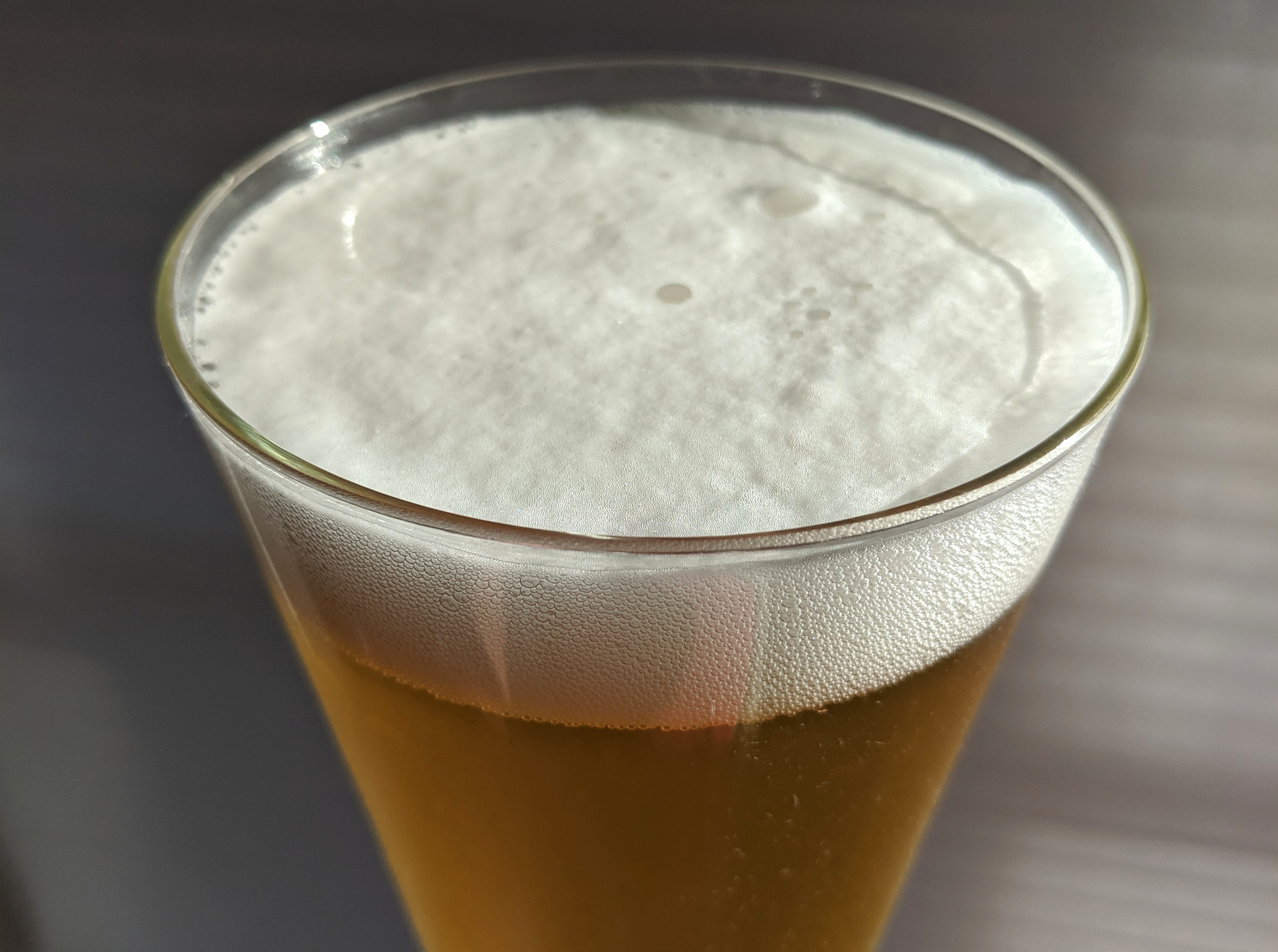
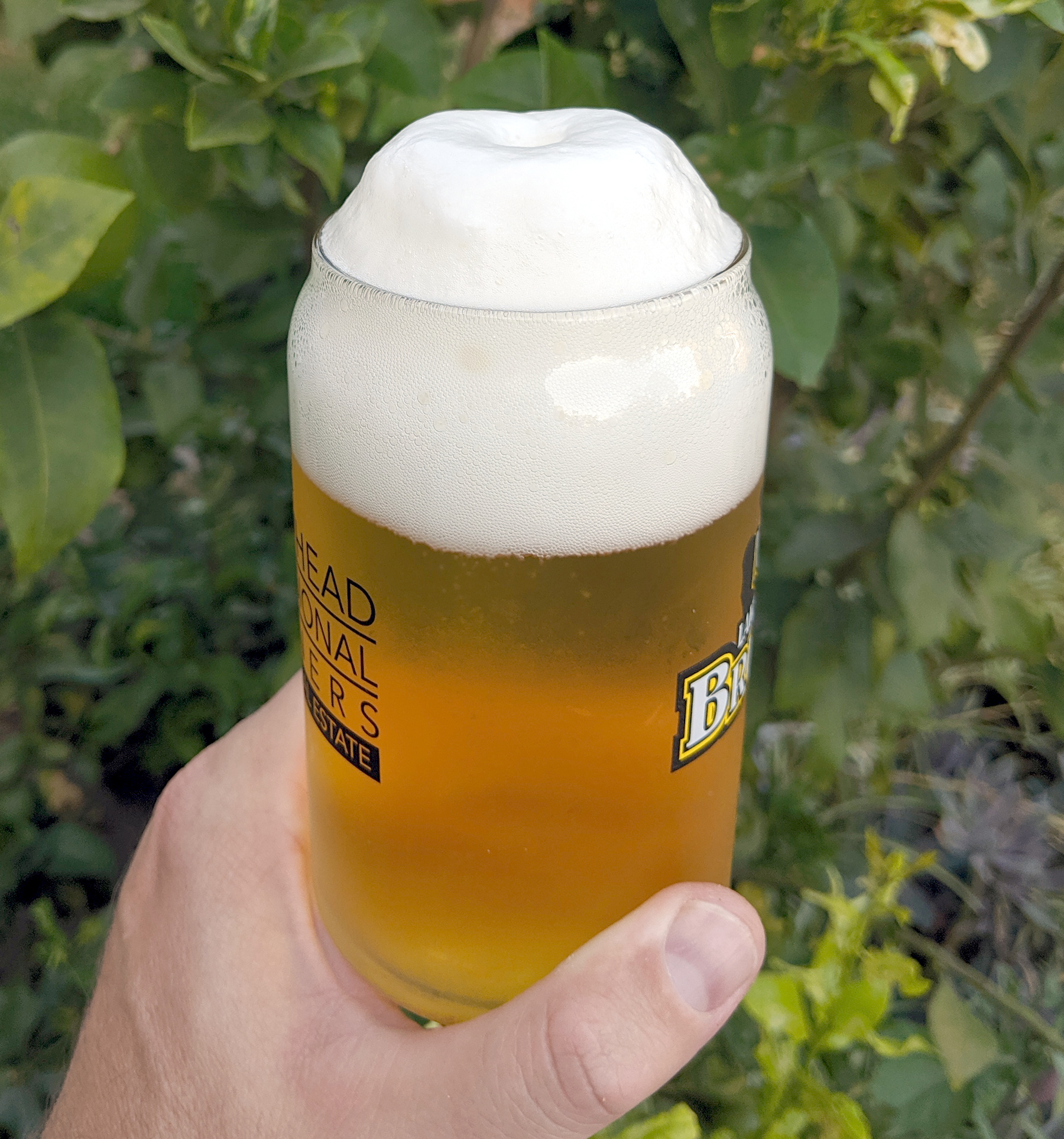
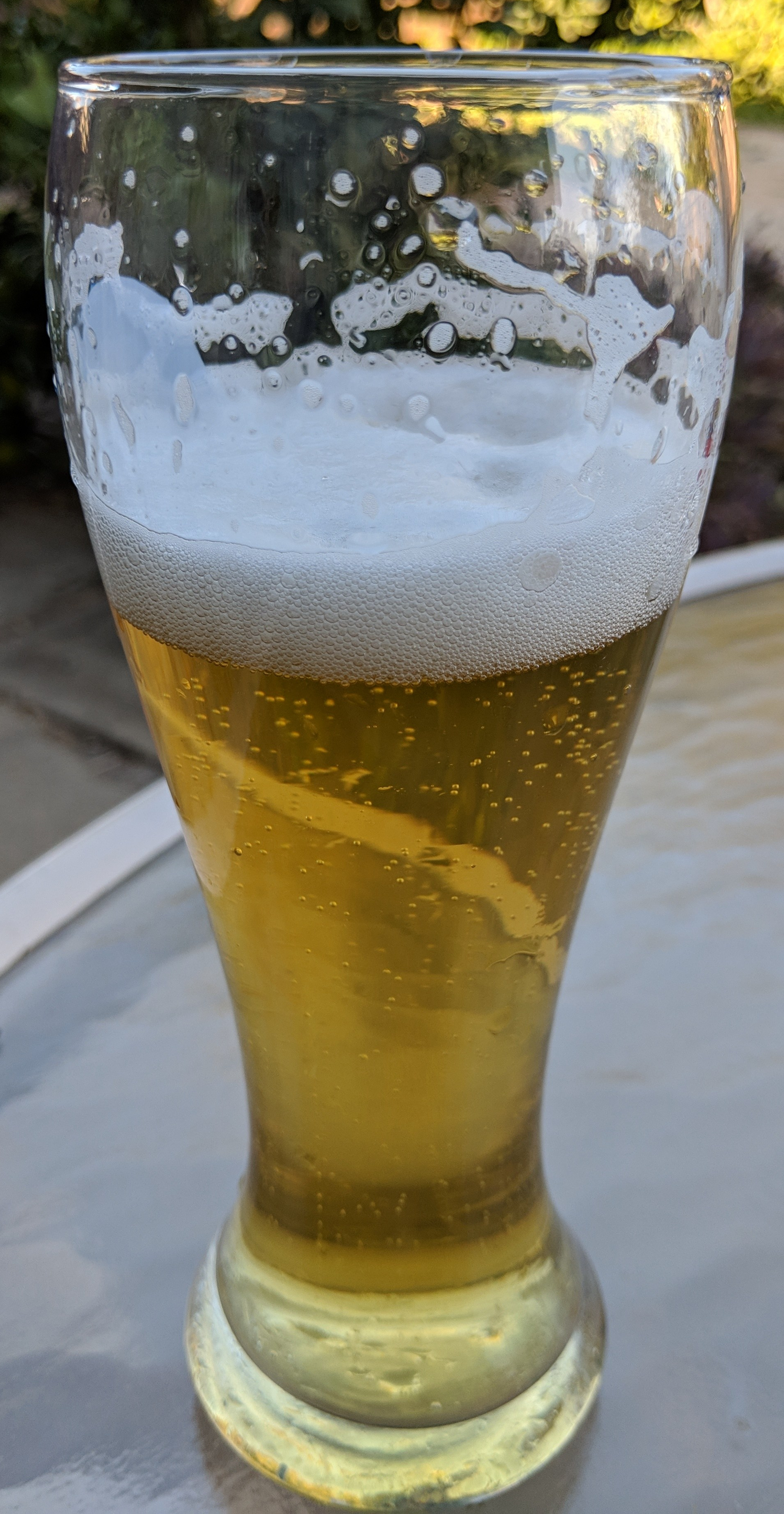
    • Clear, nearly brilliantly so, light yellow beer, with a fine, white, and persistent head.
  • Aroma
    • Clean, lightly malty aroma, with slight floral hop presence.
  • Flavor
    • Light, slightly sweet, and grainy malt character, with a crisp bitterness against that. The balance tilts slightly towards bitter, but not overly so.
  • Mouthfeel
    • Crisp and light-bodied, with moderate carbonation and a smooth finish.
  • Would I brew this again?
    • This is a great recipe. It’s a really smooth and drinkable beer, and was worth repeating from last time. I enjoy the grainy malt character, and the pleasant German hops alongside that. The head isn’t quite as firm and frothy as I might like (that honor belongs to the last German pils I did), but I’m not sure if that is a recipe flaw or something else. I think it will be worth playing with malts some more to see what happens when I switch those up. This recipe lacks some of what makes my other recent pils great, but in all it’s pretty decent.
  • Overall
    • 8/10

Schell’s Pils Clone

It’s always lager season, and especially so during the warm opening days of fall here in SoCal. I’m continuing to explore the morphospace of pilsners, with my latest foray following a recipe in Craft Beer for the Homebrewer: Recipes from America’s Top Brewmasters. I was particularly interested by a clone recipe for a pilsner from Schell’s Brewing, based out of Minnesota. One notable thing about the provided recipe is that it used American 2-row instead of European pilsner malt. They’re not too far off each other in terms of color, so I thought it would be a neat test of malt character.

The recipe itself closely matches that in the book; my main adjustment was to modify the hop schedule slightly for amounts and time to account for the hops I had on hand.

Close-up of pilsner beer foam in conical glass

Schell’s Pils Clone

  • 10.5 lb. 2-row pale malt (Rahr)
  • 0.25 lb. Carapils malt (Briess)
  • 1.9 oz. Mt. Hood hop pellets (4.6% alpha), 60 minute boil
  • 1 Whirlfloc tablet, 10 minute boil
  • 1 tsp. Fermax yeast nutrient, 10 minute boil
  • 1.1 oz. Mt. Hood hop pellets (4.6% alpha), 5 minute boil
  • 1 oz. Sterling hop pellets (7.9% alpha), 5 minute boil
  • 1 pkg. Harvest liquid yeast (Imperial Yeast #L17), prepared in 1.5L starter
  • 1 oz. Sterling hop pellets (7.4% alpha), 7 day dry hop

Target Parameters

  • 1.050 o.g., 1.013 f.g., 4.8% abv, 38 IBU, 3 SRM
  • 60 minute infusion mash, 152°, batch sparge
  • Water built up from RO, to hit target water profile of 59 ppm Ca, 8 ppm Mg, 89 ppm SO4, 63 ppm Cl; RA=-47ppm

Procedure

  • I made a 1.5L starter a few days in advance, let it run for 48 hours, and then cold crashed it (and decanted the spent wort).
  • To create my brewing water, I added 3.3 g gypsum, 2.7 g epsom salt, and 4.2 g calcium chloride to 8.5 gallons of RO water.
  • I mashed in with 3.5 gallons of water at 162°, to hit a mash temperature of 152.2°. I added 7.5 mL of 88% lactic acid to the mash, to help hit a target pH of ~5.3.
  • After 50 minutes, I added 1.25 gallons of water at 185°, in order to raise the mash temperature o 156°. I let the mash sit for 10 more minutes, vorlaufed, and collected first runnings. Then, I added 3.75 gallons of water at 185°, let sit for 10 minutes, vorlaufed, and collected second runnings.
  • In total, I collected 6.9 gallons of wort with a gravity of 1.042, for 74% efficiency.
  • I brought the runnings to a boil, adding hops and other kettle additions per the schedule. After 60 minutes, I turned off the flame and chilled down as far as I could (~80°) before transferring.
  • I chilled the wort down to 57°, before pitching the yeast and continuing to chill down to 52°. I completed the fermentation at 52°.
  • A good krausen was built within 24 hours.
  • I brewed the beer on 11 August 2019.
  • On 18 August 2019, I raised the temperature of the beer to 56°.
  • On 21 August 2019, I raised the temperature of the beer to 66°.
  • I added the dry hops on 24 August 2019.
  • I cold crashed the beer to 33° on 29 August 2019.
  • I kegged the beer on 1 September 2019. Final gravity was 1.008 (via refractometer), for 5.5% abv.

IMG_20191009_171317

Tasting

  • Appearance
    • Pours with a thick, fine, frothy head, that is quite persistent. The beer itself is light yellow and fairly clear (but just a touch away from brilliant clarity).
  • Aroma
    • Light grainy aroma, with a nice spicy hop note alongside it. Very clean!
  • Flavor
    • Grainy and ever-so-slightly sweet malt profile, with a firm, clean, and slightly spicy bitterness. Balance is tilted modestly in the hoppy direction.
  • Mouthfeel
    • Crisp, with a slightly dry finish. Moderately high carbonation.
  • Would I brew this again?
    • YES! This is a really nice German-American pilsner, all the more interesting because I got such a nice malt flavor profile using American 2-row rather than European pilsner malt. The Rahr 2-row is pretty light (1.8 SRM), not too far from typical pilsner malt (Weyermann Barke pilsner is actually 1.9 SRM), so I guess it shouldn’t be too surprising, at least on the basis of color. I’m particularly pleased with the head retention on this beer; it pours with a beautiful foam that sticks around for quite awhile. If I had a little more patience, I would let it condition a bit longer to clarify to brilliant, but that’s pretty much the only (minor) flaw in this beer.
  • Overall
    • 9.5/10

Czech Pilsner

My homebrew club recently had a competition centered around Bohemian-style pilsners. I’ve done a few iterations, but haven’t quite hit where I want to yet. The primary issue concerns hop aroma–it’s really, really hard to get good Saaz as a homebrewer. Gotta keep trying.

Czech Pilsner

  • 10.5 lbs. Barke Pilsner malt (Weyermann)
  • 2.4 oz. melanoidin malt (Weyermann)
  • 0.3 oz. Carafa Special III malt (Weyermann)
  • 2 oz. Saaz hop pellets (3.0% alpha), 60 minute boil
  • 1 oz. Saaz hop pellets (3.5% alpha), 60 minute boil
  • 1 Whirlfloc tablet, 10 minute boil
  • 1 tsp. Fermax yeast nutrient, 10 minute boil
  • 2 oz. Saaz whole hops (2.8% alpha), 5 minute boil
  • 1 pkg. WLP800 Pilsner Lager yeast, prepared in starter

Target Parameters

  • 1.050 o.g., 1.010 f.g., 5.2% abv, 35 IBU, 5 SRM
  • 60 minute infusion mash, 150°, batch sparge
  • Water built from RO, to hit target of 20 ppm CA, 8 ppm Na, 15 ppm SO4, 35 ppm Cl, -61 ppm RA

Procedure

  • I made a 2L yeast starter a few days in advance, and cold crashed it, followed by decantation of the spent wort.
  • I built up the mash water using 0.6 g baking soda, 0.4 g CaCl, 0.4 g gypsum, added to 8.5 gallons of RO water.
  • I mashed in with 3.5 gallons of water at 161°, to hit a mash temperature of 150.2°. I added 7 mL of 88% lactic acid, to adjust the pH of the mash.
  • After a 60 minute mash, I batch sparged in two steps (first of 1.25 gallons, second of 3.6 gallons). At each step, I let the mash sit for 10 minutes, vorlaufed, and collected the runnings.
  • In total, I collected 6.9 gallons of runnings with a gravity of 1.043, for 75% mash efficiency. Right on target!
  • I boiled for 60 minutes, adding stuff per the recipe, and then chilled after flame-out.
  • I transferred the wort to my fermenter, and put it in the fermentation chamber to drop down to 48°. This took a few hours. Then, I oxygenated for 30 seconds and pitched the yeast.
  • I fermented the brew at 50°. The brew date was 25 May 2019.
  • After three weeks, I raised the temp to 65° for a few days, then cold crashed. After a few more days, I kegged the beer using a semi-closed transfer (CO2-flushed keg, but just air-pushed the beer into the keg). Alas, I neglected to take a final gravity!

Tasting

  • I didn’t get to do a formal tasting before the keg kicked, but did get a few quick observations.
  • The beer flavor was a bit too forward on the melanoidin; I will just ditch that in the future! I am still in search of good hop aroma…overall, the beer is just OK with good clarity, decent head; not quite there yet. Bitterness level is about right. Malt body is about right.
  • Overall, 6/10.

GBP70 – Bohemian Pilsner Recipe & Tasting

In honor of my dad’s 70th birthday (he introduced me to homebrewing, after all!), I brewed a Bohemian-style pilsner. It was pretty tasty, and sadly didn’t last long enough even for me to do a formal tasting. I made the mistake of serving it at a party, and the keg was finished before I could blink!

GBP70 (Greg’s Birthday Pilsner 70)

  • 10.5 lbs. Barke pilsner malt (Weyermann)
  • 2.3 oz. melanoidin malt (Weyermann)
  • 0.3 oz. Carafa Special III malt (Weyermann)
  • 2 oz. Saaz hop pellets (3.0% alpha), 60 minute boil
  • 0.75 oz. Saaz hop pellets (3.5% alpha), 60 minute boil
  • 1 Whirlfloc tablet, 10 minute boil
  • 1 tsp. Fermax yeast nutrient, 10 minute boil
  • 2.25 oz. Saaz hop pellets (3.5% alpha), 5 minute boil
  • 2 pkg. W34/70 Saflager Lager Yeast (Fermentis)

Target Parameters

  • 60 minute infusion mash, 150°, no sparge
  • 1.049 o.g., 1.010 f.g., 5.2% abv, 38 IBU, 5 SRM
  • Water built from RO to hit targets of 7 ppm Ca, 2 ppm Mg, 2 ppm Na, 5 ppm SO4, 5 ppm Cl, 15 ppm HCO3

Procedure

  • To 7.75 gallons of RO water, I added 0.6 g baking soda, 0.4 g CaCl, and 0.3 g gypsum.
  • I heated the mash water to ~160°, added to the mash tun, allowed to cool to 155.4°, and then added the grains along with 10 mL of 88% lactic acid.
  • I hit 150.7° on the mash temperature–not too bad! It was down to 148.7° after 45 minutes.
  • After 60 minutes, I collected 6.5 gallons of wort with a gravity of 1.041. This works out to 67% efficiency. That’s a fair bit lower than my typical efficiency (73 to 75%), but not unexpected given the no-sparge methods. I added 0.25 gallons of RO water to bring up the volume in the kettle.
  • I boiled for 60 minutes, adding hops and other ingredients per the schedule.
  • I chilled the wort to 75° in the kettle, and chilled the rest of the way down to 49° after transferring to the fermenter. I oxygenated for 60 minutes at this point, and then pitched the dry yeast directly into the wort.
  • Starting gravity was 1.046 on 12 January 2019.
  • I raised the brew temperature to 64° on 26 February 2019, and cold crashed on 28 February 2019. I kegged the beer (using a closed-transfer technique, directly into the CO2-purged keg) on 9 March 2019.
  • Final gravity was 1.010, down from 1.046. This equates to 4.9% abv.

IMG_20190327_202833General Tasting Impressions

I didn’t get to do a formal tasting for this one, and it was finished before it really hit its ultimate peak, but overall I’m pretty happy with it. The malt flavor was spot-on, and I think I’ve finally iterated into a good balance of melanoidin malt within my no-decoction Bohemian pilsner recipes. The beer was pretty clear, but would have cleared to brilliant with another week or two in the keg. The head and head retention were fairly good also, but not the best I’ve ever had. Not sure why that was. I’m still chasing a perfect Saaz hop aroma in my Bohemian pilsners; it’s just a matter of finding the right hops with the right freshness. The ones I used in this batch weren’t awful, but they weren’t awfully exceptional, either. Overall, I would give this recipe 8/10, with targeted improvements to mainly chase the best possible hop flavor.

Bierstadt Pils Clone

It’s pils time again, as I continue my exploration of European lagers. The July/August 2018 issue of BYO magazine had a tasty looking clone recipe, for Bierstadt Lagerhaus’ Slow Pour Pils. Its simplicity was beautiful–pilsner malt, acidulated malt, Hallertau Mittelfrueh hops, and lager yeast. Additionally, it gave me a chance to play around with more step mashes and decoctions.

I followed the published recipe pretty closely, adjusting just slightly on my additions to ensure that the bittering hops would still hit my target of ~33 IBU. But, I then saw a correction in a later issue that the whirlpool addition should instead be a late hop addition. I figure this probably won’t mess things up too much, giving a bit more hop aroma, although also leaving slightly more potential for haze. In any case, the official recipe is posted at the BYO website.

Because I don’t have direct-fire capabilities for my mash tun, all of the steps had to be accomplished via infusions. This took a bit of creativity, but I managed reasonably well. As another wrinkle in the process, I tried for the first time a closed-transfer technique. In the past, I found that my pilsners tended to get that honey-like taste of oxidation after 6-8 weeks, which detracted from my overall enjoyments towards the end of the keg. As noted below, my attention to technique paid off pretty well!

Bierstadt Pils Clone

  • 8 lbs. Barke pilsner malt (Weyermann)
  • 0.5 lb. acidulated malt (BEST)
  • 1 oz. Hallertauer Mittelfrueh hop pellets (4.0% alpha), first wort hop and 60 minute boil
  • 1 oz. Hallertauer Mittelfrueh hop pellets (2.7% alpha), 40 minute boil
  • 1 oz. Hallertauer Mittelfrueh hop pellets (2.7% alpha), 10 minute boil
  • 1 oz. Hallertauer Mittelfrueh hop pellets (4.0% alpha), 10 minute whirlpool
  • 2 pkg. W34/70 Saflager lager yeast
  • 1 Whirlfloc tablet, 10 minute boil

Target Parameters

  • 1.048 s.g, 1.011 f.g., 4.9% abv, 33 IBU, 3.4 SRM
  • Infusion step mash with decoction
  • Water built from 8.12 gallons of RO water, with 1.6 g CaCl, 1.25 gypsum, 1 g epsom salts in 3.25 gallons of mash water, and 2.4 g CaCl, 1.9 g gypsum, 1.5 g epsom salts in 5 gallons of sparge water, to achieve -47 RA, 59 ppm Ca, 8 ppm Mg, 89 ppm SO4, 63 ppm Cl

Procedure

  • I mashed in with 2.5 gallons of water at 150° (1.054 quarts/pound of grain), aiming for a protein rest temperature of 131°. Instead, I hit 141°, and stirred frequently to get it down to 136° by the end of the 10 minute protein rest.
  • I next added 1.5 quarts of boiling water to achieve a mash rest of 144°. After 30 minutes, the temperature was down to 140°. I then added 1.5 quarts of boiling water, to hit 152°. This was below my target of 160°, so I added another 2 quarts of boiling water, to finally hit 160°. I let it sit here for 40 minutes before proceeding to the next step. In total, I added 4.5 gallons of water for the mash.
  • Next, I pulled a thin mash of 2.75 gallons, and boiled it for 10 minutes. Next, I added it back to the mash tun, to hit 168°. I let this sit for 10 minutes, vorlaufed, and collected the first runnings.
  • Next, I added 3.25 gallons of water at 180°, let it sit for 10 minutes, vorlaufed, and collected the second runnings.
  • In total, I collected 6.75 gallons of runnings with a gravity of 1.053, for 87% mash efficiency.
  • I brought the runnings to a boil, adding hops and kettle finings per the schedule. To keep bitterness closer to my calculated numbers, I removed the boil hops before adding the whirlpool charge.
  • I chilled the wort to 85°, and then transferred it to the fermenter, where it was further chilled to 49° in my fermentation chamber. I oxygenated with 60 seconds of pure O2, and then pitched the two packets of dry yeast directly.
  • Starting gravity was 1.053, with brewing on 31 August 2018. I fermented at 50°, until 25 September 2018, when I cold crashed to 36°.
  • I did a closed transfer to the keg (under CO2 pressure) on 27 October 2018.
  • Final gravity was 1.012; down from 1.053, this works out to 5.4% abv.
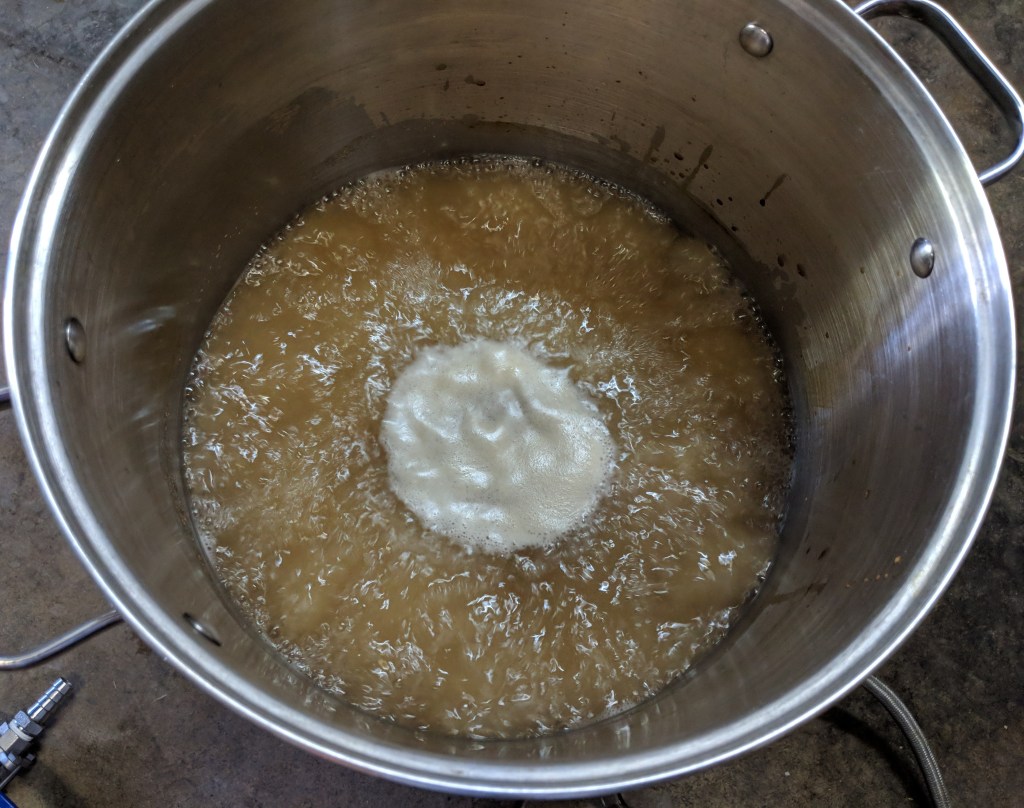
Boiling the decoction

Tasting Results

  • The Basics
    • 1.053 o.g., 1.012 f.g., 5.4% abv
  • Appearance
    • Brilliantly clear, light yellow beer, with a fine, white, and persistent head
  • Aroma
    • Slight spicy hop aroma, with a pleasant and gentle maltiness behind that
  • Flavor
    • Robust hop character nicely balanced against a grainy/sweet malt profile. Really nice!
  • Mouthfeel
    • Moderately dry, with a smooth finish that tilts toward the hoppy end in a gentle yet firm way.
  • Would I brew this again?
    • Absolutely! This has matured into a wonderfully drinkable, really delightful beer. I’m pleased with how such a simple recipe can produce excellent results.
  • Overall
    • 9/10