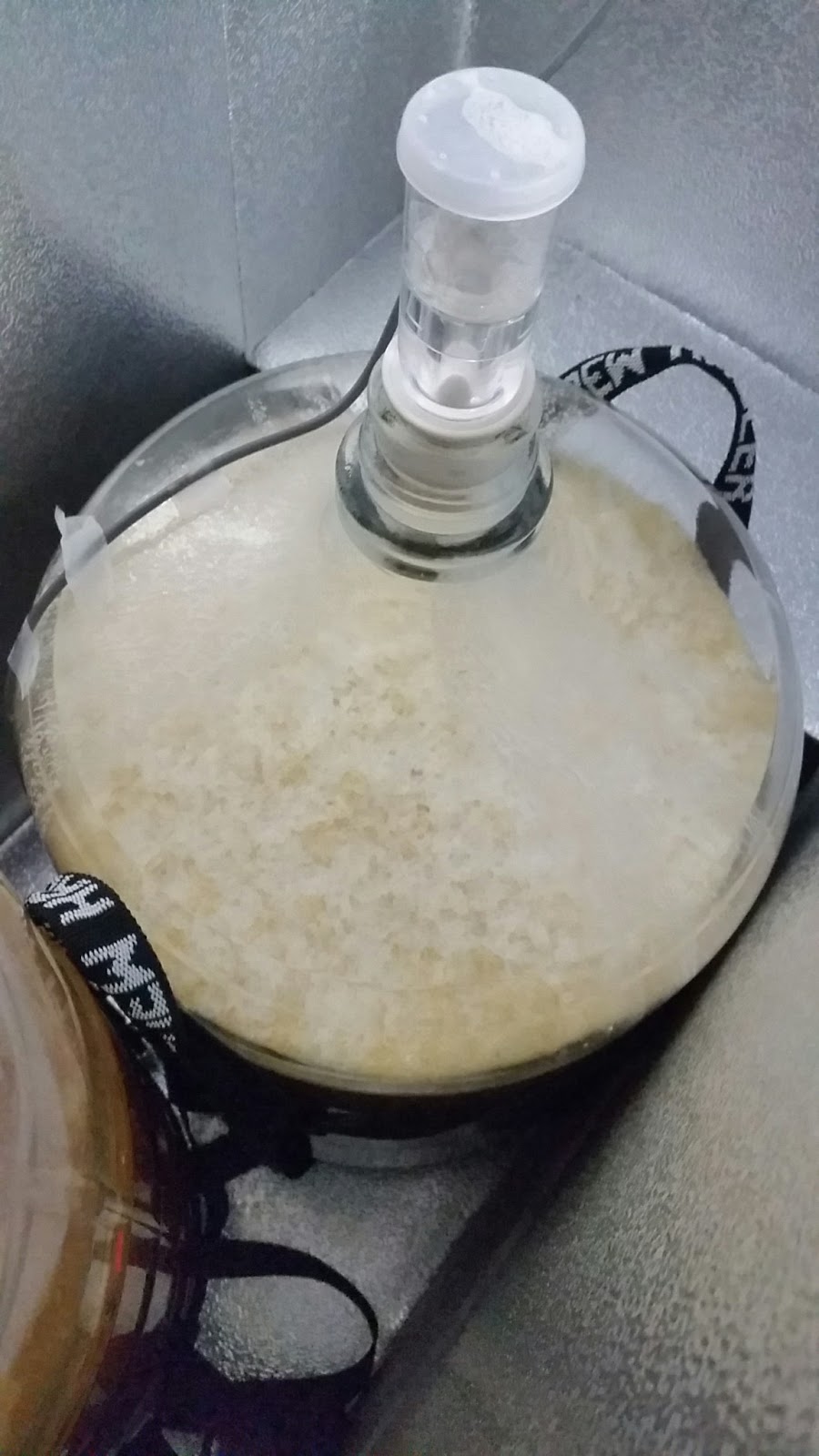
Beer Tasting: Transatlantic IPA

My Transatlantic IPA seems to be at its peak–no better time to give it a close look!

  • The Basics
    • Original gravity = 1.064; final gravity = 1.015; abv = 6.5%; estimated IBU = 64
  • Aroma
    • The aroma is very hop-forward and pleasant, but not overwhelming. I pick up citrus (orange) and floral aromas, with a hint of fresh apricot. There is a faint malty aroma that comes through as the beer warms up.
  • Appearance
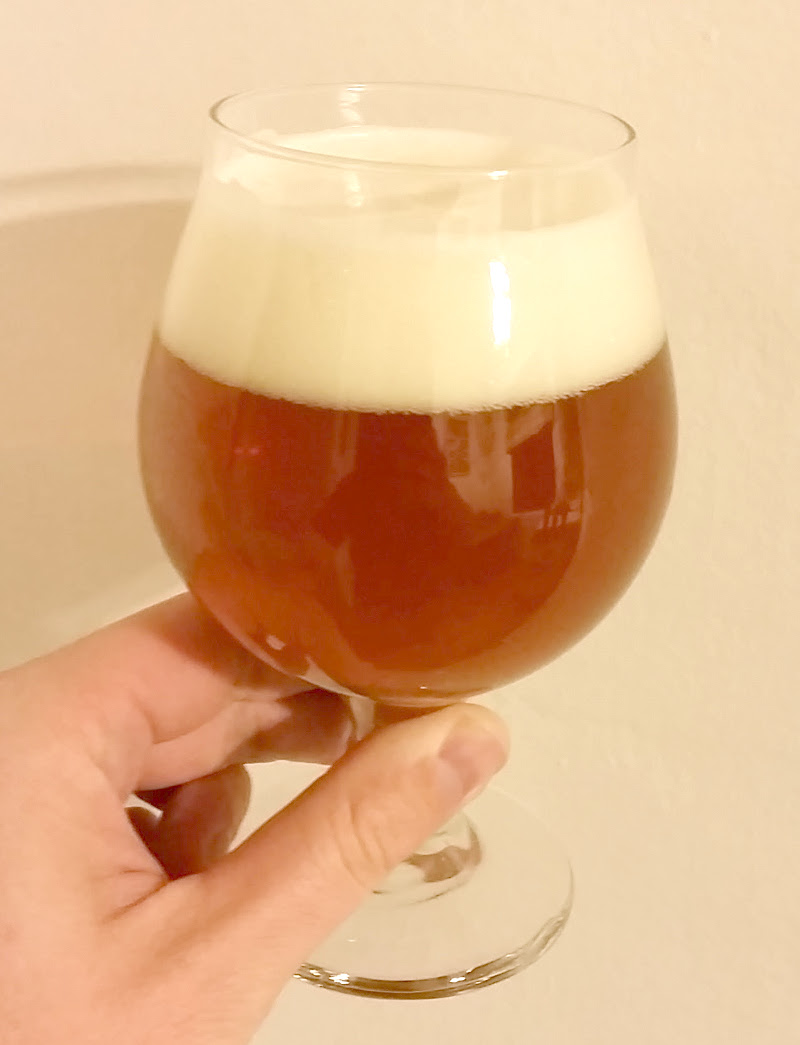
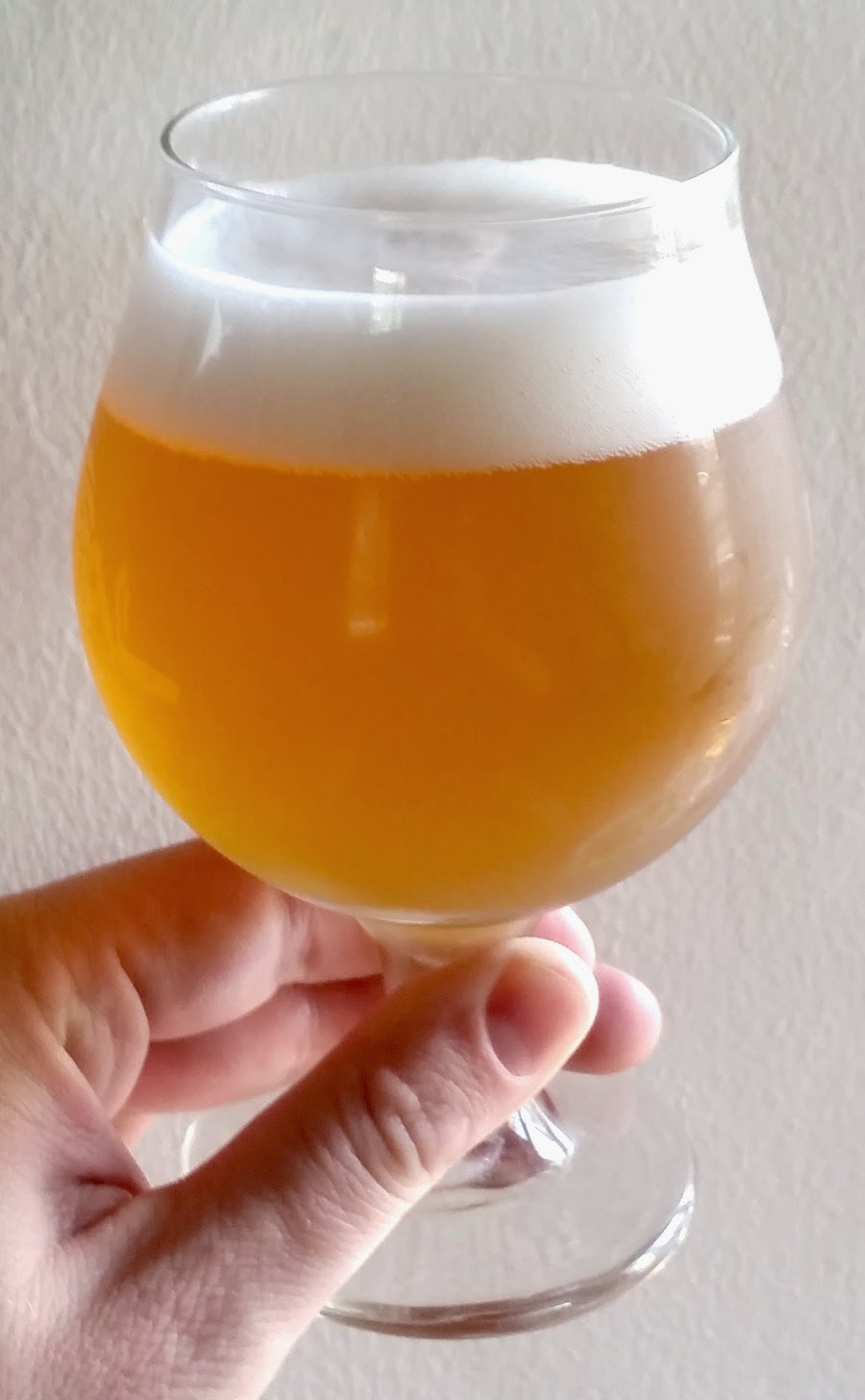
    • Relatively clear, with a minor bit of haze. The head is quite prominent, white in color, and fine-bubbled, with excellent retention. The beer itself is a beautiful gold color.
  • Flavor
    • This is a pretty well-balanced IPA. There is a low degree of malty flavor, with a slight caramel note to it, but not enough to take it out of character for what I intended. The hops are of course prominent, tending towards the floral and piney side of things. The bitterness is strong but not over the top, and it definitely has a piney and slightly resinous finish. I detect a very modest ester background, perhaps some of the stone fruit (peach/apricot) that characterizes the yeast strain.
  • Mouthfeel
    • The beer has a medium body, with an appropriately moderate degree of carbonation. The finish is slightly dry, but not ridiculously so.
  • Would I brew this again?
    • Yes! This is a really nice “winter IPA”, and nails pretty much everything I was hoping for in the beer. I really like how the Conan strain plays against the hops and malt. Additionally, the hops combo stands up pretty well too. It’s complex, but not muddled. The beer is probably a bit heavier than I would want outside of the cold months, but that isn’t a flaw in my view. I was a little curious when formulating this recipe as to how much the Maris Otter base malt would show through–not much, in the end! It provides a good base, but doesn’t get in the way of the other ingredients.
  • Overall rating
    • 9/10

Transatlantic IPA

“Conan! What is best in life?”
“Crush your malted grains.
See them mashed before you.
Hear the fermentation of their wort.”


It has been a long time since I’ve done a straight-up, full-strength American IPA (January, in fact). I’ve also been itching to try out some new yeast strains, particularly after hearing good things about “Conan.” I found the Vermont ale yeast via Yeast Bay, which is supposed to be just that. Most local shops don’t carry it, so I mail-ordered and planned out my brew.
The name for this batch honors its ingredients’ roots spanning North America and Europe. This batch is aiming to be an “East Coast” style IPA, with a little more malt character as well as an interesting yeast. So, I designed a recipe that had Maris Otter and Vienna as its backbone, with a bit of Belgian Caravienne to round things out and some pale chocolate malt for color. I’ve been doing a lot of ultra citrusy-type hops lately (especially Citra), and I worry that they would clash with the malts and yeast, so I’ve switched things up a touch. The bittering hops are all Columbus, with an aroma/flavor addition of Cascade. I plan to dry hop with Simco and Galaxy.

Transatlantic IPA

  • 9 lbs. Maris Otter malt (Thomas Fawcett)
  • 3 lbs. Vienna malt (Weyermann)
  • 1 lb. Caravienne malt
  • 0.15 lb. pale chocolate malt
  • 1 oz. Columbus hops pellets (13.4% alpha, 4.4% beta), 60 minute boil
  • 1.3 oz. Columbus hops pellets (13.4% alpha, 4.4% beta), 5 minute boil
  • 1 oz. Cascade whole hops (est. 5.5% alpha), 5 minute boil
  • 2 oz. Cascade whole hops (est. 5.5% alpha), steep/whirlpool
  • 2 oz. Simcoe hops pellets (13% alpha), 2 week dry-hop in keg
  • 1 oz. Galaxy hops pellets (13.7% alpha), 2 week dry-hop in keg
  • 1 Whirlfloc tablet (10 minute boil)
  • 1 pkg. Vermont Ale Yeast (The Yeast Bay), prepared in 1.25 L starter

Procedure

  • I mashed in with 5 gallons of water at 165°, to hit a mash temperature of 151°. The mash was down to 150° after 30 minutes, and 147° after 60 minutes.
  • After 60 minutes, I added 0.5 gallons of water at 180°, let rest for 10 minutes, vorlaufed, and drained the mash tun to collect 3.25 gallons of wort.
  • Next, I added 3.75 gallons of water at 185°, which raised the overall mash temperature to 165°. I let it rest for 10 minutes, vorlaufed, and collected the remainder of the wort.
  • All together, I collected 6.8 gallons of wort with a gravity of 1.053. This translates to a mash efficiency of 73%, nearly exactly on the nose for my calculations.
  • I brought the wort to a boil, and added the bittering charge. After 50 minutes, I added the Whirlfloc tablet. After 55 minutes of boiling total, I added the additional Columbus and an ounce of Cascade hops. At flame-out, I removed the Columbus hops and added the remainder of the Cascade hops, to steep while I chilled the wort.
  • I chilled the wort down to 80°, transferred it to the fermenter, and pitched the yeast starter. Approximately 5.5 gallons of wort went into the primary.
  • The starting gravity for this beer is 1.064, exactly where calculated by my software. I’ll ferment this at 68° for two weeks (perhaps with a slight temperature increase at the end to maximize attenuation, as suggested by Yeast Bay).
  • I brewed this beer on November 23, 2015.

Azacca Session IPA

A few weeks back, I attended the National Homebrewers Conference in San Diego. One of the highlights (among many) was a lecture on “Brewing Session Beer” by New Belgium Brewing’s Andy Mitchell, focused on brewing low-alcohol but high-flavor beers. My overall tastes (particularly for stuff I am going to put on tap in 5 gallon quantities) tend towards beers in this domain. I like to be able to enjoy a beer or two without ending up completely buzzed (and I want my liver to hold up for a few more decades of enjoying homebrew). One of the really interesting parts of Mitchell’s lecture focused on brewing session IPA’s, with a particular eye towards getting a beer with some nice body and flavor while avoiding watery mouthfeel.

Tips for brewing a session IPA (taken from my notes) included:

  • Malt
    • Less malt means less flavor! Instead of reducing the amounts of all malts in the beer (relative to a higher gravity grain bill), just scale back the base malt and leave the specialty malt as usual. If you scale back everything, it may result in a watery beer. 
    • As another alternative, use a more flavorful base malt, with as Vienna or Maris Otter.
    • Use a higher temperature mash rest, up to 158°. This will result in a greater proportion of unfermentable sugars, which will result in a bigger body for the finished beer.
    • Consider a shorter mash time. [my question is if the mash is cut too short, is there a risk of an over-starchy beer?]
  • Hops
    • Balance is key; due to the lower starting gravity of session beers, you don’t want to overhop. A smaller addition of hops in a session IPA can result in perceived bitterness equivalent to that of a higher gravity IPA with more hops.
    • The bitterness ratio (IBU/SG) can be a useful tool to guide you. For an IPA, you might want to aim for a ratio of around 0.8 (e.g., 35 IBUs / 1.044 s.g.).
    • Use a “hop burst” technique instead of a bittering addition. This gives increased aroma and avoids over-bittering the beer. In practice, this means adding hops only for the last 10 to 15 minutes of the boil.
  • Water
    • Avoid adding sulfate to the water; adding chloride can be OK. (oops, I forgot to follow this guideline in my recipe)
  • Yeast
    • A strain with relatively low attenuation is worth using. For this, consider stepping outside the box of what you normally brew. For instance, if you normally are aiming for American yeasts, look into the British yeast toolbox, because many of these finish less dry.
      • Thames Valley strains are good for fermenting at lower temperatures with good character and relatively low attenuation.
Using these guidelines, I set out to design my own session IPA. Thanks to the AHA and BSG Craftbrewing, I had recently acquired 5 oz. of (free!) Azacca hops. It is a very North American strain, with lots of tropical and citrus (according the descriptions I’ve read). Additionally, the American Dwarf Hop Association suggests that it fares well in a single-hop beer. That’s all the excuse I need to center my beer around this variety!
While designing this recipe, I used a few basic principles: 1) a simple malt bill utilizing a strong supplement to my usual 2-row base malt; 2) a high temperature mash to maintain a robust body for the beer; 3) hop bursting to maximize aroma and achieve a balanced bitterness; and 4) a British ale strain selected for comparatively low attenuation. In short, maximum body with balanced hoppiness. Thanks in part to all of the free hops, this batch was also pretty inexpensive: only $15 in raw materials. I’ll find out how successful I was in a few weeks!

Azacca Session IPA

  • 6.5 lbs. 2-row malt (Great Western Malting Co.)
  • 3 lbs. 10° Munich malt 
  • 1 oz. Azacca hops pellets (10.3% alpha), 15 minute boil
  • 1 oz. Azacca hops pellets (10.3% alpha), 10 minute boil
  • 1 oz. Azacca hops pellets (10.3% alpha), added at flame-out, steep for 5 minutes before cooling
  • 2 oz. Azacca hops pellets (10.3% alpha), 2 week dry-hopping
  • British Ale yeast (White Labs, WLP005), prepared in 0.75 L starter
  • 1 tbs. 5.2 pH stabilizer (added to mash)
  • 1 tbs. gypsum (added at first hops addition)
  • 1 Whirlfloc tablet (10 minute boil)
Procedure
  • I mashed in with 15 quarts of water at 169.8° and stirred for two minutes. The mash stabilized at 159°. After 50 minutes, the mash temperature was down to 157°.
  • I added 1.1 gallons of water at 180°, to bring the mash temperature up to 160°. I let it sit for 10 minutes, vorlaufed, and collected 3.25 gallons of wort.
  • Then, I added 3.75 gallons of water at 180°, to bring the mash up to 165°. I let it sit for 10 minutes, vorlaufed, and collected the remainder of the wort.
  • All told, I collected 7 gallons of wort with a gravity of 1.038. This works out to 77% efficiency.
  • I brought the mixture to a boil, adding the hops per the hopping schedule in the recipe (at 45 minutes, 50 minutes, and flame-out). This is essentially the “hop-burst” method, to gain all of the bittering units (with extra aroma) at the end of the boil.
  • At flame-out, I let the beer sit for 5 minutes before starting cooling. This was with the intent of maximizing the hops aroma from the final addition.
  • I cooled the wort and transferred it into the fermenter, aerating per usual with the Venturi pump. I pitched the yeast, sealed up the fermenter, and placed it in my fermentation chamber. The initial setting was for 68°. I had visible fermentation when I checked it seven hours later, and vigorous fermentation within 12 hours. At this point, I dropped the fermentation temperature to 66°.
  • I brewed this beer on July 3, 2015. Starting gravity was 1.045, with an estimated 6 gallons of wort into the fermenter.
Azacca IPA reaching high krausen

Beer Tasting: Pannotia White IPA

My Pannotia White IPA has been on tap for about two weeks; it seems like a great time to evaluate the beer and reconfigure it for its next iteration (and there will be another iteration!).

  • The Basics
    • Starting gravity = 1.057; final gravity = 1.012; abv = 5.9%; IBU = 50 (estimated)
  • Appearance
    • Hazy, light golden hue; head is tall and persistent, with a creamy appearance and off-white color. The beer has gotten slightly less hazy since the first tastes a week or two ago.
  • Aroma
    • Dominated by citrus, secondarily with some floral and passionfruit aroma; very clean and fresh
  • Flavor
    • Hop-dominated; very citrusy and slightly floral. Any maltiness is subtle at best. There is an extended, smooth, and slightly sweet finish for the hops.
  • Mouthfeel
    • Nicely carbonated; body is perhaps a touch thin
  • Would I brew this again?
    • Absolutely! The white IPA style is a delightful and very drinkable variant change from the overbearing single/double/triple/quadruple American IPAs that are the norm for many microbreweries. My original goal was to recapture my memories of the Italian-made Vergött White IPA. I got partway there–particularly in its appearance and refreshing drinkability–but am lacking the somewhat lemony aroma and flavor that I recall from the original. Some more sleuthing on Italian-language websites revealed indications that they dry-hopped with Galaxy hops (and possibly some Mosaic), that the alcohol clocks in at 5.5% (rather than 5.9%), and that oats are part of the mix too. I would also like a little more body in my beer. So, I think for the next iteration I will use 2-row malt instead of pilsner malt, mash at a slightly higher temperature (perhaps ~152°), add some oats, notch the alcohol down a touch, and dry-hop with Galaxy instead of Citra. I will likely maintain the first wort hopping with American hops (probably Cascade), because the background hopping on this one is about perfect.
  • Overall rating
    • 8/10

Beer Tasting: Beringea IPA

The Beringea IPA has been on tap for about three weeks now, and has matured and clarified beautifully. Before it’s all gone, I figured I should do an official tasting!

A few notes–it was dry-hopped at around 60 degrees for 10 days. I chose to leave the hops in while carbonating and serving, and haven’t noted any negative effects on the beer.

  • Basics
    • Starting gravity = 1.060; final gravity = 1.013; abv = 6.2%. Estimated IBU = 56
  • Aroma
    • Pleasantly and moderately floral.
  • Appearance
    • Off-white, creamy head that is pretty persistent, with modest lacing. The beer itself is a clear, moderate copper in color. No chill haze. Really pretty!
  • Flavor
    • Nicely balanced with a hint of maltiness. The beer is modestly bitter but not overly so. The finish is gently bitter but not harsh at all. The hops come through nicely…not just bitter, but flavorful.
  • Mouthfeel
    • Smooth; carbonation is about perfect for the style.
  • Would I brew this again?
    • Yes! It’s a nicely balanced IPA; very drinkable, and not so ridiculously bitter that it blows out your taste buds from the first sip. I’m pleased.
  • Overall rating
    • 9/10