Centennial IPA

In preparation for my rather sporadic brewing during the summer months, I’m laying in a store of (filled) kegs for future tapping. Pannotia White IPA is going online shortly, so it seems a good idea to have another IPA waiting in the wings.

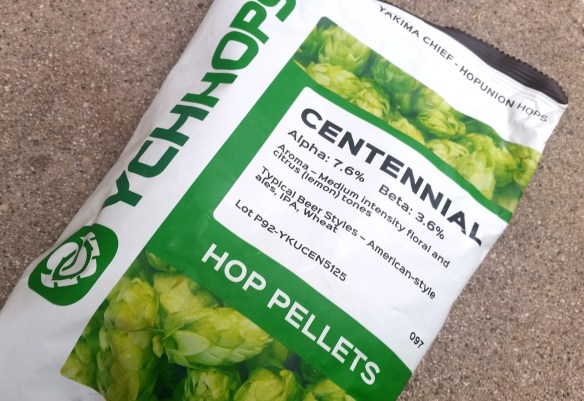
I’ve been playing a lot lately in the world of “East Coast IPA’s” (whatever those are), and three things moved me back west for this batch. First, I was getting a bit bored with the East Coast style (even though my recipe is definitely tasty!). Second, my Conan culture seemed to be wandering a bit, and I deemed it wise to dump it. Finally, I wanted to explore some classic hops–a full pound of Centennial hop pellets that recently arrived at my brewery provided incentive.
Centennial Hop Pellets

It’s been over three years since my last record of brewing with Centennial, and that seems like a bit of a shame. They are such a classic within the annals of American craft brewing (one of the “3 C’s” along with Cascade and Columbus), and I don’t really know them as well as I should. Time to rectify that with a single-hop brew.

The recipe is modified from one of Gordon Strong’s, in his excellent book Modern Homebrew Recipes. I’ve been really pleased with the beers from the book I’ve done so far, and wanted to try out another one. Ironically, this is his “East Coast IPA”–my main modifications have been in the yeast (Safale US-05 instead of Wyeast 1272 / White Labs WLP051) and also the hopping schedule. Given how the East Coast IPA “style” has developed, I can’t say I would consider his recipe to really be in the spirit of that right now. The hops and yeast are squarely West Coast (in my opinion), although arguably the malt bill could be East Coast (again, whatever that means).

Last year’s crop of Centennial from YCH Hops was on the low end of alpha acids for the variety (7.6% alpha vs. the 7 to 12% alpha considered typical for YCH). So, I modified the timing of the hop additions to get into the ballpark IBU for the recipe. Additionally, I will add a small dry hop charge (1 oz.) upon kegging, just to bump up the hop aroma a touch more.

Centennial IPA

  • 10.5 lbs. 2-row malt (Great Western Malting Co.)
  • 1.75 lbs. Vienna malt
  • 0.5 lbs. Caravienne malt
  • 0.25 lbs. Carahell malt
  • 1 oz. Centennial hops pellets (7.6% alpha, 3.6% beta), first wort hop and 90 minute boil
  • 1 oz. Centennial hops pellets (7.6% alpha, 3.6% beta), 15 minute boil
  • 1 oz. Centennial hops pellets (7.6% alpha, 3.6% beta), 10 minute boil
  • 1 oz. Centennial hops pellets (7.6% alpha, 3.6% beta), 1 minute boil
  • 1 oz. Centennial hops pellets (7.6% alpha, 3.6% beta), 5 minute steep
  • 2 oz. Centennial hops pellets (7.6% alpha, 3.6% beta), dry hop in keg
  • 0.5 tsp. gypsum (added to boil kettle)
  • 1 tsp. Irish moss (10 minute boil)
  • 0.5 tsp. BSG Fermax yeast nutrient (10 minute boil)
  • 1 pkg. Safale American ale yeast (US-05)

Brewing Targets

  • Mash temperature = 149°
  • Original gravity = 1.062 (actual = 1.048)
  • Color = 6 SRM
  • IBU = 59

Procedure

  • I mashed in with 4.3 gallons of water at 160.5°, to hit an initial mash temperature of 150°. The mash was down to 146.8° after 45 minutes.
  • After 60 minutes, I added 1 gallon of water at 200°, which brought the mash temperature up to 156°. I let this sit for 10 minutes, vorlaufed, and collected the first runnings. At this point, the first ounce of hops were in the hop spider.
  • Next, I added 3.75 gallons of water at 185°, to raise the mash bed up to 168°. This sat for 10 minutes, at which point I vorlaufed and collected the second runnings.
  • All told, I collected 7 gallons of wort with a gravity of 1.052, for 76% mash efficiency.
  • I started the boil, adding the hops and other ingredients per the schedule. The wort had boiled down to 6.1 gallons after one hour.
  • After the full 90 minute boil, I removed the hop spider, added the final ounce of hops (in a small hop sack), let it sit for a minute or two, and then started to cool the wort. Once it was down to 75°, I transferred it to the fermenter. I then cooled it down to 68° in the fermentation chamber (which took ~2 hours) and pitched the yeast.
  • I brewed this beer on May 28, 2016. The starting gravity is 1.063, and I am fermenting at 66°.

Beer Tasting: Jarrylo Session IPA

I brewed this one waaay back, and haven’t gotten around to posting my tasting (completed in early March). Here it is!

  • The Basics
    • Original gravity = 1.047; final gravity = 1.017; abv = 3.9%; estimated IBU = 53.
  • Appearance
    • Very fine and persistent off-white heady with a creamy character; the beer itself is a medium copper color with a mild haze.
  • Aroma
    • The aroma is hop-centered but fairly mild, with notes of tropical fruit, pear, and perhaps a hint of pepper.
  • Flavor
    • The flavor is quite clean, with a subdued and smooth hop bitterness. The bitterness is way lower than I was expecting though, and probably pushes this more into pale ale than IPA territory. The hops themselves come across as citrusy and slightly floral. There is a very slight maltiness at the back end of this one.
  • Mouthfeel
    • The body is fairly thin, unfortunately, and the beer comes across as a bit watery. The finish is relatively dry.
  • Would I brew this again?
    • I was, unfortunately, rather disappointed with how this beer turned out. Even though it is intended as a session IPA, the bitterness and body miss the mark. I think the hops I used just aren’t suited for the style, and the initial wort was thinner than desirable too. Jarrylo seems like a nice hops variety, but probably better suited for less “hefty” styles, such as a blonde ale or even a pale ale. In fact, I’ve taken to thinking of this beer as a pale ale rather than an IPA, and that helps a bit with my perception of it.
  • Overall rating
    • 4/10

Pannotia White IPA 1.6

Lemon extract

Lemon extract

I’ve been having a lot of fun tooling and re-tooling my white IPA recipe. Because it has been some time since I last brewed up a batch, I wanted to bring this brew on-line again, with a few tweaks to inch ever closer to perfection.

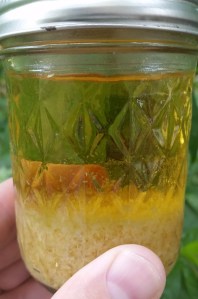
The grain bill is essentially the same as my most recent batch, with the primary change being a switch to 2-row alone as the base malt. Hops are modified slightly in line with my current inventory, with Amarillo hops pellets instead of whole Cascade hops. The final component that I felt the beer was missing was a nice lemon background and aroma. One option was to use Lemondrop hops, but these are rather hard to get. Instead, I elected to craft some lemon extract (see photo at right). With the zest from four lemons and four shots of cheap vodka, I combined it all into a jar and did the “set and forget” routine. Once the beer fermentation is done, I’ll strain the mixture and toss it into the keg.

Pannotia White IPA 1.6

  • 7.75 lbs. 2-row malt (Great Western Malting Co.)
  • 3 lbs. white wheat malt
  • 1 lb. flaked wheat
  • 0.5 lbs. flaked quick oats
  • 0.5 lbs. rice hulls
  • 8 g. gypsum
  • 1 oz. Amarillo hops pellets (7.0% alpha, 5.6% beta), added to wort prior to boil and boiled for 60 minutes
  • 1 oz. Amarillo hops pellets (7.0% alpha, 5.6% beta), 35 minute boil
  • 2 oz. Amarillo hops pellets (7.0% alpha, 5.6% beta), added at flame-out and steeped during chill
  • 1 oz. Citra hops pellets (14.1% alpha, 3.6% beta), added at flame-out and steeped during chill
  • 1 oz. Galaxy hops pellets (13.8% alpha, 5.9% beta), added at flame-out and steeped during chill
  • 1 oz. Citra hops pellets (14.1% alpha, 3.6% beta), dry hop
  • 1 oz. Galaxy hops pellets (13.8% alpha, 5.9% beta), dry hop
  • 1 oz. Mosaic hops pellets (11.3% alpha, 3.2% beta), dry hop
  • 1/8 tsp. yeast nutrient, 10 minute boil
  • 8 g gypsum (added to boil)
  • 0.35 oz. bitter orange peel, 1 minute boil
  • 0.15 oz. coriander seed (crushed), 1 minute boil
  • 1 pkg. Belgian Wit Ale yeast (WLP400, White Labs), prepared in 1.25L starter, chilled and decanted
  • Lemon extract, zest of four lemons infused in four shots of vodka (~6 oz., resulting in 5 oz. of extract).

Procedure

  • Eight days in advance, I prepared a 2L starter, with an aim to overbuild my yeast culture for an upcoming Belgian wit. On the third day, I decanted 0.75L into a jar and cold-crashed the remaining 1.25L. I ended up delaying my brew day a bit, due to illness.
  • On brew day, I mashed in with 4.5 gallons of water at 167°, to hit a mash temperature of 152°. The temperature was down to about 150° after 30 minutes.
  • After 60 minutes of mashing, I collected the first runnings and then added 4.25 gallons of water at 185°. This raised the mash bed to 165°. I let it sit for 10 minutes, vorlaufed, and collected the remainder of the wort.
  • Altogether, I collected 6.75 gallons of wort at a gravity of 1.051, for 75% efficiency.
  • I had an outside meeting, so had to leave the wort sitting for two hours. Upon my return, I added the first round of hops and brought the mixture to a boil (approximating a first-wort hopping technique).
  • As the wort boiled for 60 minutes, I added the various ingredients per the schedule in the recipe.
  • After 60 minutes, I turned off the heat, added the final charge of hops, and chilled the beer. Once the beer was chilled down to 77°, I transferred it to the fermenter and pitched the yeast. A krausen started forming within 12 hours.
  • Starting gravity was 1.060. I am fermenting this at 68°, and plan to keep it in the primary for around 10 days before transferring to the keg.
  • This beer was brewed on Tuesday, May 10.

Transatlantic IPA 1.1

My Transatlantic IPA recipe turned out really well–in fact, I probably count it as the best full-strength (non-session) I’ve ever brewed. I wanted to give it another go, both to keep my yeast culture active and also to use up some of the hops I have on-hand. Although I really liked the

This batch is slightly modified from the last version, with the modifications nearly entirely in the hops. I also added a bit of gypsum to the boil.

Transatlantic IPA 1.1

  • 9 lbs. Maris Otter malt (Thomas Fawcett)
  • 3 lbs. Vienna malt (Weyermann)
  • 1 lb. Caravienne malt
  • 0.15 lb. pale chocolate malt
  • 1 oz. Bravo hops pellets (13.2% alpha, 3.5% beta), 60 minute boil
  • 1 oz. U.S. Fuggle hops pellets (4.5% alpha, 3.1% beta), 20 minute boil
  • 1 oz. Cascade whole hops (est. 5.5% alpha), 5 minute boil
  • 2 oz. Cascade whole hops (est. 5.5% alpha), steep/whirlpool
  • 2 oz. Falconer’s Flight 7C’s hops pellets (13% alpha), 2 week dry-hop in keg
  • 1 oz. Galaxy hops pellets (13.7% alpha), 2 week dry-hop in keg
  • 1 tsp. Irish moss (10 minute boil)
  • 1 tsp. yeast nutrient (5 minute boil)
  • 1 tsp. gypsum (added at beginning of boil)
  • 1 pkg. Vermont Ale Yeast (The Yeast Bay), prepared in 1 L starter

Procedure

  • I made a two-step yeast starter, with the first step initiated on 14 February, 2016. This used 0.5L of water with 55 g of extra light DME and a bit of yeast nutrient. On 16 February, I cold-crashed the starter. On 17 February, I decanted most of the spent wort and then added another 1.5L of starter (165 g DME dissolved in the appropriate amount of water). On 20 February, I decanted 0.6L of the starter to a jar for storage (assuming this reached a little over 100 billion cells), and the remainder was set aside for the beer.
  • Because my software calculated such a small addition for the first round of batch sparging (0.43 gallons), I figured I would just skip the first sparge round. I did notice that my wort had a little more grain material coming in from the mash tun than normal; I will have to check my crush. I also noticed on the past few batches that I’ve been drawing off a bit more water than anticipated (approximately an extra half-gallon); I’ll have to adjust my dead-space downward on the software, too.
  • I mashed in with 5.3 gallons of water at 165°, to hit a mash temperature of 152.5°. The mash was down to 149° after 40 minutes.
  • After 60 minutes, I vorlaufed collected the first runnings.
  • Next, I added 3.75 gallons of water at 185°, which raised the overall mash temperature to 165°. I let it rest for 10 minutes, vorlaufed, and collected the remainder of the wort.
  • All together, I collected 7.1 gallons of wort with a gravity of 1.050, for a mash efficiency of 73%.
  • I added all of the hops and other goodies per the schedule above, and turned off the heat after 60 minutes.
  • I chilled the wort down to 76°, transferred it to the fermenter, and pitched the yeast starter. Approximately 6 gallons of wort went into the primary.
  • The starting gravity for this beer is 1.060, a bit lower than calculated. I had the boil set a bit less vigorous than typical, so that along with the larger-than-anticipated wort volume likely contributed. I’m starting fermentation at ambient (65°), and will move it to my fermentation chamber once that frees up. I brewed this on 20 February. When I checked on the beer the next morning, about 8 hours after pitching the yeast, fermentation had already started.


Special Beer Review: Heady Topper

A friend was out east recently, and brought me back a can of Heady Topper! I’ve never had this legendary beer before, so I thought I would really slow down and savor the experience by doing a formal tasting. Here it is!

I disobeyed the directions on the can, and poured most of the contents into a glass. I left a bit in the can, though, and talk about the distinctions at the end of the post.

  • Appearance
    • Hazy light gold beer, with a thick and sticky cream-colored head that leaves some fine lacing on the glass.
  • Aroma
    • Piney and slightly dank aroma, with a hint of peach/apricot behind it. As the beer settles down, the aroma is milder.
  • Flavor
    • Definitely hop-forward, with a smooth and well-rounded bitterness that ramps up as I drink it. The hop character is quite resiny and piney. I don’t pick up much in the way of other flavors, but that might just be my palate. Malts are in the background; I can’t say anything in particular about them.
  • Mouthfeel
    • The beer has a medium body, with a slick mouthfeel; it really coats the tongue. I’m guessing that must be the hops.
  • Overall
    • This beer definitely lives up to the hype, although I am curious how I would view it in a blind tasting. The hype is probably part of the experience, and definitely set me up to want to enjoy it. It’s interesting reading reviews on Beer Advocate and places like that…there is a very subjective element (I think the technical term is “BS”). Really…passionfruit and cracker alongside 20 other flavors? I suppose…

Is it that different in the glass versus from the can? Not in flavor, certainly. I perceive the aroma as different, but I think that’s largely because of the metallic aroma from the can itself. This shifts the overall aroma more towards the citrusy side–very interesting, but definitely not a “real” character of the beer.