
Update: Dunkel-Osteus, Raspberry Belgian

20170326_143559

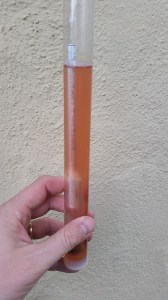
Raspberry Belgian Ale sample

During the past week, I kegged both my Munich Dunkel (“Dunkel-Osteus“) as well as my raspberry Belgian ale. Let’s take a look at the details since brew day for each.

Dunkel-Osteus

This pun-fully named beer in the Munich Dunkel style fermented at 54° for 17 days, before it was raised to 68° on February 28. On March 6, I cold crashed it to 33°, and let it sit for an additional 16 days before kegging on March 22. At this point, the final gravity was 1.016, for an abv of 4.5%. I set to carbonating immediately–the sample I pulled a few days later is really, really tasty. I’m liking this beer so far, and it should be pretty exceptional once it has conditioned for another week or two.

Raspberry Belgian

I brewed this beer on March 10, and added the raspberry puree on March 14. To make the puree, I added about 1 cup of vodka and 18 oz of frozen raspberries to a blender. Then, I blended them until they were nice and pureed, before tossing them into the fermenter. I figured the vodka (which I ran first) would kill anything nasty in the blender (or anything remaining on the berries). I let this mixture ferment for another 12 days; by this point, the raspberry seeds, etc., had dropped to the bottom and the beer had cleared pretty nicely.

I kegged the brew on March 26. Final gravity was 1.011, down from 1.039. This works out to an abv of 3.8%. The beer has a nice pale pink color and a beautiful raspberry aroma. The raspberries come through nicely on the flavor, too, although the beer as a whole could use a bit more tartness and body. I’ll see if that perception remains accurate after carbonation. I was tempted to throw in some lactic acid, but figured it would be best to carbonate first and test if that helps.

Raspberry Belgian

Our brew club is focusing on fruit beers for the April meeting, so I wanted to have something ready to go. Thumbing through the recently published Brew Your Own book, I saw a tasty-looking recipe for a clone of Funkwerks Raspberry Provincial.

One interesting thing about the BYO recipe is that it uses acidulated malt rather than kettle souring to achieve the sourness. I vacillated on which approach I would take, but in the end went for acidulated malt for simplicity.

I modified the recipe slightly for the hop bill, and also scaled it down from 5 gallons to 3 gallons. I figured I didn’t really want 5 gallons of a raspberry beer, tasty though it might be. I also will be using a home-made puree from frozen raspberries, rather than canned raspberry puree. The cans are huge, more than twice the volume I need for this recipe, and a bit expensive, so it didn’t make sense to waste the money buying a whole ton of extra raspberry. Per recommendations on the fruit puree company website, I upped the quantity of fruit by 12 percent a bit to account for all of the stuff that doesn’t make it into a typical puree can (seeds, etc.). The final modification was to go with a full-volume mash, to save a bit of time.

Raspberry Belgian

  • 2.5 lb. floor-malted Bohemian pilsner malt (Weyermann)
  • 1.25 lb. white wheat malt (Great Western Malting Co.)
  • 0.75 lb. acidulated malt (Weyermann), added to last 20 minutes of mash
  • 0.3 lb. flaked oats
  • 0.3 lb. flaked wheat
  • 0.25 lb. Carapils malt
  • 0.16 lb. rice hulls
  • 0.12 oz. Warrior hops (15.8% alpha), 60 minute boil
  • 0.20 oz. Willamette hops (5.1% alpha), 15 minute boil
  • 1 pkg. Belgian Wit Ale yeast (WLP400, White Labs), prepared in 0.5L starter
  • 17 oz. raspberry puree, added after 4 days of fermentation

Target Parameters

  • 155° mash, 60 minutes
  • 1.043 o.g., 1.011 f.g., 4.1% abv, 15 IBU, 3 SRM, 3 gallons into the fermenter

Procedure

  • I added 5.25 gallons of water at 170°, and let it cool down until it hit a temperature of 159.5°. Then, I mashed in with my grains (except for the acidulated malt) and hit a temperature of 155.4°.
  • After 40 minutes, the mash temperature was down to 150.4°. At this piont, I added the acidulated malt.
  • At the end of the 60 minute mash, the temperature was down to 148.7°. I vorlaufed and collected 4.2 gallons of wort with a gravity of 1.030. This equated to 64% efficiency. That is a fair bit below my normal efficiency in the upper 70s, but I figure that was probably due to the full volume mash, no sparge technique, as well as the high number of adjuncts.
  • I added hops per the schedule, over the course of a 60 minute boil.
  • After 60 minutes, I chilled to 70°, transferred to the fermenter while aerating, and pitched the yeast.
  • Starting gravity was 1.039, a bit below target. I think I’m okay with that, given how new this brew is to my experience. I find it interesting that, at least in a casual tasting, the flavor isn’t that prominently sour or tart. I wonder how that will come through in the finished beer?
  • I brewed this on 10 March 2017, and will be fermenting at 71°. On March 14, I will add the raspberry puree.