Yikes and Away! Diving into All-Grain Brewing (with Fake Tire Amber Ale 3.0)

With a whole bunch more brew space, and over five years of solo brewing under my belt(!), I’ve been rapidly diversifying from the tried-and-true partial volume, extract with steeping grains, brews. The quality (in my humble opinion) on many of these beers has been pretty good (the Rainy Day IPA, Vanilla Voay Porter, and Fake Tire Amber Ale being particularly successful), but I do feel like I’ve gotten the handle of many aspects of extract brewing. I’m looking for a bit of a challenge and to expand my brewing skill set. The first step was full-volume boils, and the logical next step was to try all-grain. But, I had been a little intimidated by the complexity of the all-grain setups I had seen. Three-part towers, hoses everywhere, sparge arms, and the like seemed like a lot of equipment investment just to try a new technique. But then I learned about batch-sparging. Basically, all I would need was a converted cooler. Done and done!

With a converted 10 gallon cooler (ball valve and screen installed at the bottom), I was ready to go. I thought a good first beer would be to try a new iteration of my amber ale.
Fake Tire Amber Ale 3.0
  • 7.5 lbs pale malt (2 row)
  • 0.5 lbs. Victory malt
  • 0.5 lbs. Munich malt
  • 0.5 lbs. 40° crystal malt
  • 0.5 lbs. 20° crystal malt
  • 0.5 lbs. Cara-Pils malt
  • 0.25 lbs. chocolate malt
  • 1 oz. Cascade whole hops (60 minute boil)
  • 1 oz. Cascade whole hops (5 minute boil)
  • 1 tsp. Irish moss
  • 1 pkg. Safale American ale yeast US-05
Steps
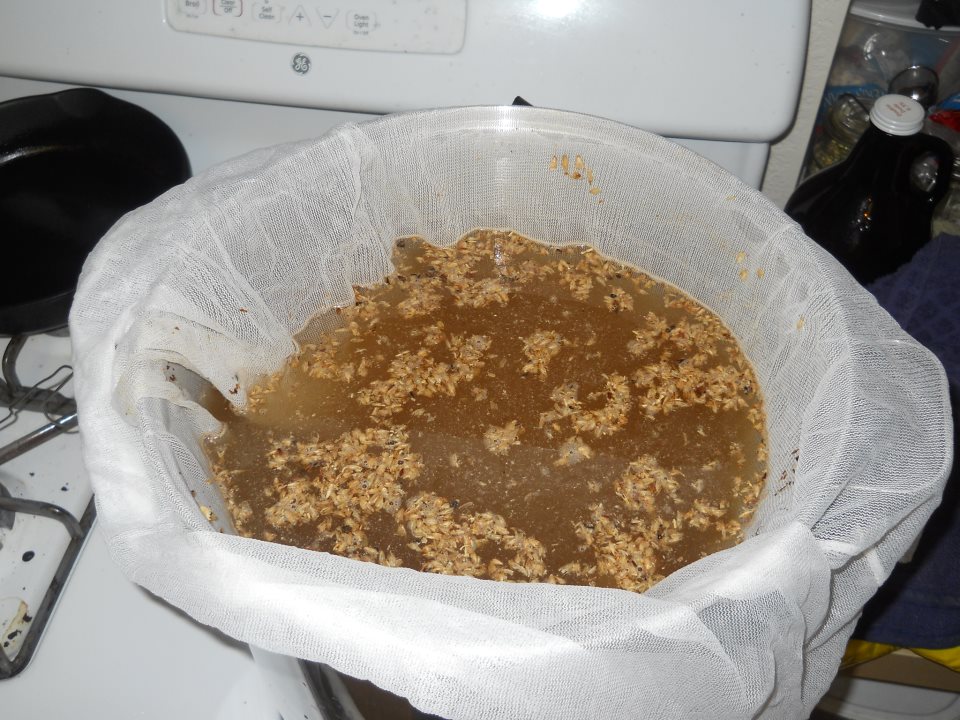
  • Mash in ~13 qts. of water at 165° with malt for 1 hour. This resulted in a temperature of 154 degrees within 5 minutes, but it ended up at 145° by the end of the hour.
  • Decanted liquid, added 1 gallon of water, brought temperature up to 146°.
  • Decanted liquid, added 3 gallons water, brought temperature to 148°.
  • Decanted liquid, which had a specific gravity of 1.034 at 60 degrees. The volume in the kettle was around 5 gallons.
  • Heated to boil, added first addition of Cascade hops, boiled for 45 minutes, added Irish moss, boiled for another 10 minutes, added second addition of Cascade hops.
  • After the 60 minute boil, I turned off the flame and chilled the wort to around 70 degrees.
  • I transferred the wort to the fermenter, and pitched the yeast (which had been rehydrated in 1 cup of water). The wort fermented at ~68°.
  • The starting gravity was 1.045 at 60°, with a starting volume of 4 gallons.
Notes
This was definitely a learning experience! I had done a fair bit of reading on all of this, but even so there were a few bumps along the way. For starters, I learned that my “trusty” digital thermometer reads about 20° too low! This happened hard way when I mashed the grains to discover a ridiculously low-gravity wort–perhaps 1.020. A little investigation with other thermometers revealed that my main digital thermometer had a bad sensor (maybe from moisture?). In any case, I tossed that wort and started over. It sucks to have wasted the time and materials, but it was a useful lesson.
Even after all of that, my efficiency in sugar extraction was still not great (~50%, where I should be hitting ~70% at least). I attribute this in part to the fairly low temperatures that the mash ended at (145°, on the very lowest end of where I should be). Next time, I am going to preheat my cooler/mash tun to mitigate some cooling. I also pulled off all of the “liquor” after each water addition, which I later realized I shouldn’t have…so, I will aim for pulling off equal amounts of liquor next time, rather than draining the whole thing.
Despite all of that, I am eager to improve my technique and make the next batch. The amber ale really took off in the fermenter, and should be ready to go to the secondary very soon.

Fake Tire Amber Ale 1.2 Update

Having brewed my Fake Tire Amber Ale 1.2 on October 7, I transferred the beer into the secondary fermenter on October 14. Due to various life events, I did not get around to bottling until Monday, November 26. So, the beer sat in the secondary for nearly six weeks. This is longer than I normally go, but the result seems to be an exceptionally clear beer.

Final gravity is 1.010 at 68° F, down from an original gravity of 1.052 at 60° F. Adjusting for temperature, this gives an a.b.v. of 5.5%. The flavor is quite clean, and I think will match Fat Tire pretty well.

I primed the beer with 3/4 cup of priming sugar, and bottled it. The result was 14 12-oz. bottles, 11 18-oz. bottles, and 7 22-oz. bottles.

Fake Tire Amber Ale 1.2

One of my favorite beers from last year was my Fake Tire Amber Ale (a clone of Fat Tire). The first batch was so good that I brewed it again! The second batch was largely the same as the first, except I used pelletized hops instead of whole hops. The unfortunate effect was that the beer was slightly more bitter. Thus, I decided to further refine my pelletized recipe for this brew session. Following advice elsewhere, I reduced the overall hops amounts by 10 percent, to compensate for the greater surface area (and contribution of bitterness) from the pellets versus the whole cones. I also changed the yeast, from Wyeast 1272 (American Ale II) to White Labs WLP051 (California V Ale), based on what was available at my local homebrew supply shop.

The result is:

Fake Tire Amber Ale 1.2

  • 5 pounds plain extra-light DME
  • 0.5 lb Munich light malt
  • 0.5 lb Carapils malt
  • 0.5 lb biscuit malt
  • 0.5 lb crystal malt (20° Lovibond)
  • 0.5 lb crystal malt (40° Lovibond)
  • 1.0 oz chocolate malt
  • 0.9 oz. Cascade hops (60 minutes boil)
  • 0.9 oz. Mt. Hood hops (5 minutes boil)
  • 1 tsp. Irish moss (15 minutes boil)
  • White Labs WLP051 Yeast (California V Ale)

Steps

  • I heated 3.5 gallons of tap water to 154° F, and steeped the grains for 45 minutes. Then, I sparged the grains with 0.5 gallons of tap water at 154°.
  • After bringing the mixture to a boil, I turned off the heat and added the malt. I brought it back to a boil, and threw in the Cascade hops.
  • After boiling for 45 minutes, I added 1 tsp. of Spanish moss.
  • After boiling for another 12 minutes (for 57 minutes total boil), I added the Mt. Hood hops.
  • After 3 more minutes (60 minutes total of boiling), I cooled the wort with my chiller, added cold tap water to a total of 4.5 gallons, and pitched the yeast. Pitching temperature was 76° F, and starting gravity was measured at 1.052 (gravity is recalculated to what it would be at 60° F).
Steeping the grains for Fake Tire Amber Ale 1.2

    Fake Tire Amber Ale 1.1 Bottled

    After conditioning the beer in the secondary fermenter for three weeks, I decided to bottle the second batch of Fake Tire Amber Ale. The gravity was unchanged from when I racked it to the secondary fermenter, at 1.012. This results in a final ABV of 5.0%. I added 3/4 cup of corn sugar for priming. The yield was 22 12-oz. bottles, 11 18-oz. bottles, and 4 22-oz. bottles. Thanks to my buddy Eric for assisting!

    Fake Tire Amber Ale 1.1

    My first batch of Fake Tire Amber Ale is amazing. In my (non-humble) opinion, it’s probably one of the best recipes I’ve done yet. A genuinely biscuit-ish flavor (just like Fat Tire!), clear appearance, and nice head combine deliciously. The downside of this is that I have finished most of the batch. Watching my dwindling supply, I decided to take action and brew up another batch today. I made some small changes, largely on account of what was available for ingredients.

    Changes from first batch
    Nothing major – instead of whole hops, I used hops pellets. This presumably has the effect of upping the hops utilization a little bit, but according to BeerSmith it’s not a major amount. 21.9 IBU’s versus 24.1 IBU’s for the whole and pellet hops, respectively. Given the margin of error in IBU measurements for hops, as well as the margin of error inherent to home brewing, I decided not to mess with the recipe.

    The only other major variation was that I topped up to just a hair under 5 gallons, with a starting gravity of 1.050. I presume the larger amount of water was needed to get close to last time’s gravity (1.051) because I decanted a little more of my wort into the brewing bucket than I did previously.

    In any case, I will be curious to see how this one turns out!