Beer Tasting: Countdown IPA

20170827_131705This recipe isn’t my best IPA, but it’s a pretty darned good IPA.

  • The Basics
    • 1.064 o.g., 1.011 f.g., 7.1% abv, 68 estimated IBU, 9 SRM
  •  Appearance
    • Light copper color with a slight haze, pouring with a dense white head that leaves lacing on the side of the glass as it subsides to a persistent ivory colored blanket.
  • Aroma
    • Moderately prominent dank, piney aroma; quite nice and classic! I could up the aroma a touch, but it’s generally OK.
  • Flavor
    • This beer is dominated by a smooth, piney bitterness, backed up by a smooth and doughy malt profile.
  • Mouthfeel
    • Moderately dry, with a smooth and extended bitter finish. Carbonation is moderate and appropriate for the style.
  • Would I brew this again?
    • Probably. This is a nice, middle-of-the-road American IPA. The hops are nice, although I should I say I don’t find the CryoHops notable one way or another. I was perhaps expecting a bit more hop character from them, given they were touted as providing twice the aroma for a given mass of hop. Maybe it’s more like 1.5x? I might up the aroma a touch, with perhaps a bit more Simcoe. As usual, the general base recipe is pretty solid.
  • Overall
    • 8.5/10

Festivus Simplex

Time for another lager! I’ve been doing a decent number of fairly simple and light German and Bohemian style lagers; with the changing seasons, why not try something more fall-appropriate? I put together a “simple” recipe that is in the general vicinity of a festbier/Oktoberfest, with a focus on Munich malt. It doesn’t precisely fit the BJCP category, though. So, it gets a pseudo-Latin name of Festivus Simplex!
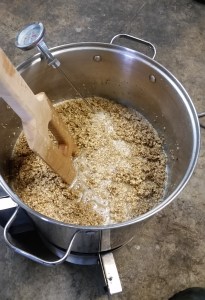
20170826_075936 (1)One goal of this recipe was to really highlight Munich malt–I had initially considered 100% Munich, but thought that might be a bit overboard. So, the grist was balanced out with pilsner and Vienna malt, along the lines of some festbier recipes I found.

For the hops, I used US Tettnang (sourced from YCH Hops)–they are absolutely delicious smelling! This is the first time I’ve sampled a hop purported to be “spicy” that really was what I think of as spicy…almost like a spice poundcake, or something. I’ll be using more of this in the future.

I was on the fence about whether or not to do a decoction, right up until the point of mash-in, but in the end I went for it! For simplicity, though, I did just a single 15 minute decoction at the end; the goal is to burnish up the color and add a bit of extra flavor character.

Festivus Simplex

  • 4.5 lbs. Château Pilsen malt (Castle Malting)
  • 4 lbs. Munich I malt (Weyermann Malting)
  • 2.25 lbs. Vienna malt (Great Western Malting)
  • 1.5 oz. U.S. Tettnang hop pellets (3.5% alpha), 60 minute boil
  • 0.5 oz. U.S. Tettnang hop pellets (3.5% alpha), 10 minute boil
  • 1 Whirlfloc tablet, 10 minute boil
  • 0.5 tsp. Fermaid-K, 10 minute boil
  • 2 pkg. Saflager lager dry yeast (W34/70)

Target Parameters

  • Infusion mash to hit target of 150°, 60 minutes, 15 minute thick decoction at mash-out, batch sparge
  • 1.056 o.g., 1.012 f.g., 5.9% abv, 21 IBU, 6 SRM
  • Water adjusted to hit target of 85 Ca, 10 Mg, 13 Na, 39 SO4, 105 Cl, 115 HCO3, RA 47 ppm.

Procedure

  • I built up the water, using RO with minerals for the mash and plain Claremont tap water (with Campden tablet) for the sparge. For the mash water, I used 3.75 gallons of RO water with 1 g Epsom salt and 6 g calcium chloride, along with 2.5 mL of 75% phosphoric acid (for pH balance).
  • I mashed in with the strike water at 160°, to hit my target of 150° nearly spot-on (it was about 0.4° high, but I didn’t worry because I figured it would drop over the course of the mash).
  • After 45 minutes, I pulled ~2 gallons of thick mash, raised it to 160°, and let it sit for 15 minutes. Then, I brought it to a boil and boiled for 15 minutes before adding it back to the mash. This raised the mash temperature to 161°.
  • I let the mash rest for a few more minutes before adding 1.25 gallons of sparge water at 165°. I let this sit for 10 minutes, vorlaufed, and drained the mash tun.
  • Then, I added 3.4 gallons of water at 165°, let it sit for 10 minutes, vorlaufed, and drained the mash tun again.
  • In total, I collected 6.6 gallons of wort with a gravity of 1.051–this equates to 84% efficiency! A higher efficiency than usual is pretty typical of my decoction mashes.
  • I brought the wort to a boil, and added ingredients per the schedule in the recipe.
  • After 60 minutes, I turned off the heat and chilled down to 85°. I couldn’t get much cooler with the current tap water, and completed the rest of the chill in the fermentation chamber. Once I was down to to 52°, I pitched the yeast.
  • Starting gravity was 1.056. I will be fermenting at 53° for ~2 weeks before doing a diacetyl rest.
  • I brewed this beer on 26 August 2017.
Citra Blonde Ale 1.1

I desperately needed to get my taps fully filled before a new baby arrived (I was down to only two armed and operational faucets, and one of those was ready to give out at any moment!). I had a schwarzbier and an IPA spooling up within the next few weeks, but wanted to have a light and drinkable beer to replace my wheat ale once that keg kicked. Something with fast turn-around and tasty, interesting drinkability.
Time for another batch of my Citra blonde ale! This beer turned out excellent last time (nearly two years ago), and is worth another go.

Compared to my last batch, I made some very minor edits for my ingredient stockpile (different brands of malt, etc.). I also went with a single infusion, rather than multiple infusions to hit different temperature rests.

Citra Blonde Ale 1.1

  • 5 lbs. Château Pilsen malt (Castle Malting)
  • 5 lbs. 2-row pale malt (Rahr)
  • 0.75 lb. Munich II malt (Weyermann)
  • 0.5 lb. caramel malt 20L (Briess)
  • 1 Whirlfloc pellet, 10 minute boil
  • 0.5 oz. Citra hop pellets (14.1% alpha), 10 minute boil
  • 0.5 oz. Citra hop pellets (14.1% alpha), 5 minute boil
  • 1 oz. Citra hop pellets (14.1% alpha), 5 minute whirlpool
  • 1 package American ale dry yeast (US-05, Safale)

Target Parameters

  • Full volume infusion mash to hit target of 152°, 60 minutes, no sparge
  • 1.050 o.g., 1.011 f.g., 5.1% abv, 20 IBU, 5 SRM, 5 gallons into fermenter
  • Water adjusted to hit 83 ppm Ca, 5.4 ppm Mg, 5.6 ppm Na, 79.4 ppm SO4, 87 ppm Cl, 50.7 ppm HCO3

Procedure

  • For the mash water, I mixed 1.8 gallons of Claremont tap water with 6 gallons of RO water, in addition to 3 g gypsum, 1 g epsom salt, and 5 g calcium chloride. I also added 3.1 mL of 75% phosphoric acid, to adjust the calculated pH.
  • I heated the sparge water to 160°, added it to the mash tun, and added the grain when the water hit 156.6°.
  • After 60 minutes, I vorlaufed and then collected 6.25 gallons of runnings. These had a gravity of 1.047 (a bit higher than expected), so I added 0.25 gallons of RO water to bring the gravity down to 1.045 and increase the overall volume a bit.
  • I boiled for 60 minutes, adding ingredients per the schedule.
  • After flame-out and the whirlpool addition, I chilled to 80° and finished the rest of the chilling in my fermentation chamber. Once the wort hit 66°, I pitched the dry yeast directly.
  • I brewed this beer on 15 July 2017, and fermented at 66° for two weeks. Starting gravity was 1.052.
  • I kegged the beer on 29 July 2017. It had a final gravity of 1.008, which works out to 5.8% abv. Then, I force carbonated.

Tasting

  • The Basics
    • O.G. = 1.0542; f.g. = 1.008; 5.8% abv; 5 SRM; 20 estimated IBU
  • Appearance
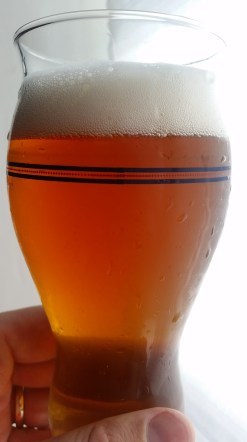
    • Light gold and beautifully clear. The beer pours with a thick white head that settles to an even blanket.
  • Aroma
    • Lightly grainy and slightly sweet malty aroma; a hint of citrus behind that.
  • Flavor
    • Light, very slightly sweet and candy-like aspect, with gentle maltiness; there is a bit of orange citrus behind that. Very clean flavor, with a mild and smooth bitterness.
  • Mouthfeel
    • Moderate carbonation, light body, with a gentle and moderately dry finish.
  • Would I brew this again?
    • As always, this is a very nice beer! I slightly prefer Great Western 2-row as a base malt, but Rahr is also respectable. I target mash-in a touch higher if doing a single infusion mash, or else follow the multi-rest schedule, because the beer ended up a bit more attenuated than expected, but that’s a minor point. The late-hopped Citra comes across really nicely, and this is a winner. As an additional variant for next time, I might follow the original Gordon Strong recipe a bit more closely and mix some Galaxy hops in with the Citra.
  • Overall
    • 8.5/10

Pumpkin Patch Imperial Stout

I have a more-or-less annual tradition of making a pumpkin beer, and I was looking for something a bit different this time around. Although to be honest, I’m always looking for something different on pumpkin beers! Each brewing year brings something unique–for 2017, I’m doing a pumpkin imperial stout!

The recipe is patterned after a BYO clone recipe for Southern Tier’s Warlock Imperial Stout, in the September 2017 issue. I scaled it down from 5 gallons to 3 gallons, because I didn’t really want a massive quantity of a ~10% abv beer. To up the malt complexity, I subbed in Vienna malt for the recipe’s 2-row, and subbed Warrior in for Chinook hops. Because this is such a high gravity beer, I assumed 70% mash efficiency (which turned out to still be a bit high). My local shop didn’t have WLP022 (Essex Ale yeast) in stock, so I opted for Mangrove Jack’s M15 (Empire Ale).

Pumpkin Patch Imperial Stout

  • 6.25 lbs. Vienna malt (Great Western)
  • 5 lbs. 2-row pale malt (Rahr)
  • 0.6 lb. flaked barley
  • 0.5 lb. de-bittered black malt (Dingemans)
  • 0.3 lb. caramel malt 60L (Briess)
  • 0.25 lb. Munich II malt (Weyermann)
  • 0.19 lb. chocolate malt (Briess)
  • 0.15 lb. rice hulls
  • 0.6 lb. pumpkin puree (homemade)
  • 1 oz. Warrior hops (15.8% alpha), 60 minute boil
  • 1 Whirlfloc tablet, 10 minute boil
  • 1 tsp. Fermax yeast nutrient, 10 minute boil
  • 1 pkg. Empire ale yeast (Mangrove Jack’s M15)
  • Cinnamon, vanilla, nutmeg, and ginger extracts to taste (3:1 ratio of cinnamon to others)

Target Parameters

  • Infusion mash to hit target of 150°, 60 minutes. Batch sparge.
  • Claremont tap water, with Campden tablet.
  • 1.095 o.g., 1.022 f.g., 9.7% abv, 70.5 IBU, 38 SRM, 3 gallons into fermenter

Procedure

  • I mashed in with 4.4 gallons of water at 162°, to hit a mash temperature of 151.4°. Given the big bulk of grain, the mash temperature held pretty well for the full 60 minutes.
  • After 60 minutes, I vorlaufed and collected the first runnings. I had a very slow run-off for this step.
  • I then added 2.45 gallons of sparge water at 185°, let it sit for 10 minutes, and vorlaufed again. I did a gentler (slower) vorlauf, which seemed to help with the sparging issue.
  • In total, I collected 4.9 gallons of water with a gravity of 1.065, for 67% mash efficiency. Given the high target gravity versus the volume of water, I’m not incredibly surprised. Nonetheless, I’ll want to remember to adjust efficiency accordingly for my next high gravity recipe.
  • I brought the wort to a boil and added the various hops, etc., at the designated time. After 60 minutes, I turned off the heat and chilled the wort to around 80°. I transferred while aerating, and then pitched the yeast directly.
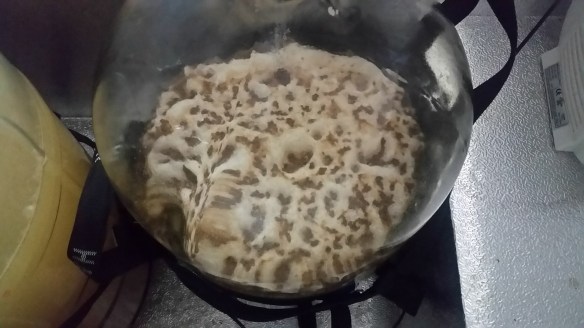
  • Starting gravity was 1.085. I’ll be starting fermentation at 66°. I brewed the beer on 19 August 2017, and had visible yeast activity within 9 hours after pitching.
  • After around two weeks, I’ll add the appropriate spice extracts. I plan to make these myself, using a vodka infusion. Although the original recipe calls for clove extract, I am going to leave that out, because (as I read once from Gordon Strong) clove is too often an off flavor and might detract from the overall taste on the final product.
20170820_104709

Fermenting happily, ~12 hours after yeast pitching

Countdown IPA

So named because we’re on the countdown to a new baby in the household…gotta brew while I can! This recipe is basically a minor tweak of my Centennial IPA, just mixing up the hops a little bit both for variety and complexity as well as to burn through a bit more of my stash. I also swapped in the US equivalent of the Belgian crystal malts, so that I didn’t have to buy more malt. Finally, I added a touch of Carafa Special II to deepen the color a bit.

Countdown IPA

  • 10.5 lbs. 2-row pale malt (Rahr)
  • 1.75 lbs. Vienna malt (Great Western)
  • 0.5 lbs. 20° caramel malt (Briess)
  • 0.25 lbs. 10° caramel malt (Briess)
  • 1.5 oz. Carafa Special II (Weyermann)
  • 1 oz. Amarillo hop pellets (7% alpha), first wort hop and 90 minute boil
  • 1 oz. Amarillo hop pellets (7% alpha), 15 minute boil
  • 2 oz. Amarillo hop pellets (7% alpha), 10 minute boil
  • 1 oz. Centennial hop pellets (7.6% alpha), 5 minute boil
  • 1 oz. Amarillo hop pellets (7% alpha), 5 minute whirlpool
  • 1 oz. Centennial hop pellets (7.6% alpha), 5 minute whirlpool
  • 1 oz. Ekuanot (HBC 366 aka Equinox) hop pellets (13.6% alpha), dryhop in keg
  • 1 oz. Simcoe LupuLN2 (23.8% alpha) cryohop pellets (23.8% alpha), dryhop in keg
  • 1 Whirlfloc tablet, 10 minute boil
  • 1 tsp. Fermax yeast nutrient, 10 minute boil

Target Parameters

  • Infusion mash to hit target of 149°. Batch sparge.
  • Claremont tap water with RO and salt additions to hit targets of 113 Ca, 22 Mg, 24 Na, 194 SO4, 42 Cl, 207 HCO3, 170 ppm alkalinity, 76 ppm RA.
  • 1.066 o.g., 1.012 f.g., 7.2% abv, 68 IBU, 9 SRM, 5 gallons into fermenter

Procedure

  • My base water for this beer was all Claremont tap water. I added 3.2 g of gypsum, 1.8 g of epsom salts, and 0.6 g of calcium chloride to 4.3 gallons of mash water, along with 45 mL of 10% phosphoric acid. I used the same masses of salts for 4.75 gallons of sparge water, with 50 mL of 10% phosphoric acid there.
  • I mashed in with 4.3 gallons of water at 157.3°, to hit a mash temperature target of 149°. I mashed for 90 minutes; at the end, temperature was down to 145°. I collected the first runnings after a vorlauf, and then added 4.75 gallons of sparge water at around 185°. I let the mash sit for 10 minutes before vorlaufing and collecting the remaining runnings.
  • In total, I collected 7.2 gallons of runnings with a gravity of 1.052, for 78% efficiency.
  • I boiled the hops per the schedule, adding the kettle finings and yeast nutrients appropriately. After the full 90 minute boil, I turned off the heat, added the final hops, whirlpooled for 5 minutes, and began chilling.
  • Groundwater is pretty warm this time of year, so I could only chill the beer down to around 85°. I transferred to the fermenter and then let it chill overnight (~10 hours) down to 66°. I pitched the yeast, and things had begun to take off within 18 hours.
  • Starting gravity was 1.064. I brewed the beer on 14 July 2017 and pitched the yeast early on the morning of 15 July 2017. I’ll be fermenting at 66°.
