Gondwana Pale Ale 1.1

Back in March, at the start of my all-grain brewing, I brewed up Gondwana IPA. The resulting beer turned out unexpectedly tasty, and hooked me on Citra hops (especially for dry-hopping). Because I was still figuring out my techniques at the time, my mash efficiency was a little low (~57%), and the result was closer to a pale ale than a traditional IPA in some respects. Thus, I retooled the original recipe as a pale ale, cutting back some of the malt and utilizing Citra as the only hops for the brew. As before, I want a prominent hops aroma, so this beer will get a nice dry-hopping.

Gondwana Pale Ale (version 1.1)
  • 9 lbs. 2 row malt
  • 1 lb. Vienna malt
  • 0.5 lb. cara-pils malt
  • 0.5 lb. 40° crystal malt
  • 1 oz. Citra hops (bittering, first addition; pellet form; 14.5% alpha, 3.9% beta)
  • 1 oz. Citra hops (bittering, second addition)
  • 1 tsp. Irish moss
  • 1 pkg. Safale American dry yeast (US-05, 11 g)
  • 2 oz. Citra hops (dry hopping)
Steps
  • First, I preheated the mash tun with 9 gallons of water that was as hot as possible from the tap.
  • In my brew pot, I heated 14 quarts of water to 170°. I added the milled grains to the mash tun with 1 tbs. of pH 5.2 stabilizer, and mashed in. The temperature stabilized at 154°. After 30 minutes, the temperature was 153°.
  • After 60 minutes, added 1 gallon of water at 185°, and let it sit for 10 minutes or so. I drained the tun, extracting ~2.9 gallons of wort.
  • Next, I added 3.2 gallons of water at 195°. This raised the mash temperature to ~175°, a little warmer than I wanted. So, I added 1 quart (.25 gallons) of ice cubes. This dropped the temperature down to 168°. I let the mix sit for 10 minutes before draining.
  • I collected a total of 6.7 gallons of wort, with a preboil gravity of 1.043. This works out to a mash efficiency of ~73%.
  • I heated the wort to boiling, aiming for a total of 60 minutes at boil. After 30 minutes, I added the first addition of hops.
  • After 50 minutes, I added the Irish moss.
  • After 58 minutes, I added the second addition of hops.
  • After 60 minutes of boiling, I turned off the heat, removed the hops (they were all bagged), and chilled the wort to ~80°.
  • Once the wort was chilled, I transferred it to the primary fermentation vessel. Along the way, it was oxygenated using my Venturi pump.
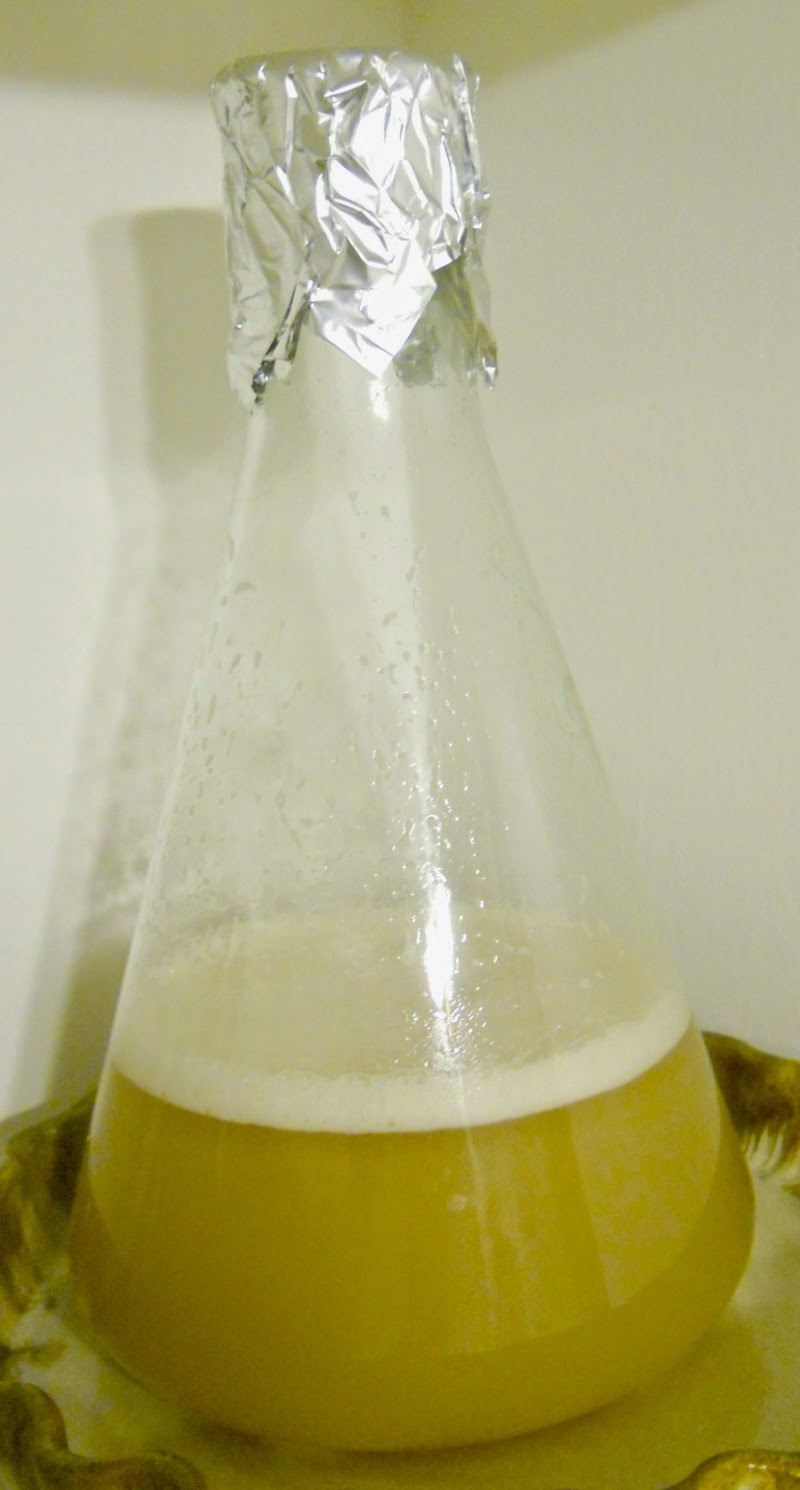
  • The yeast was rehydrated in 2 cups of preboiled water at ~90°, and pitched into the wort.
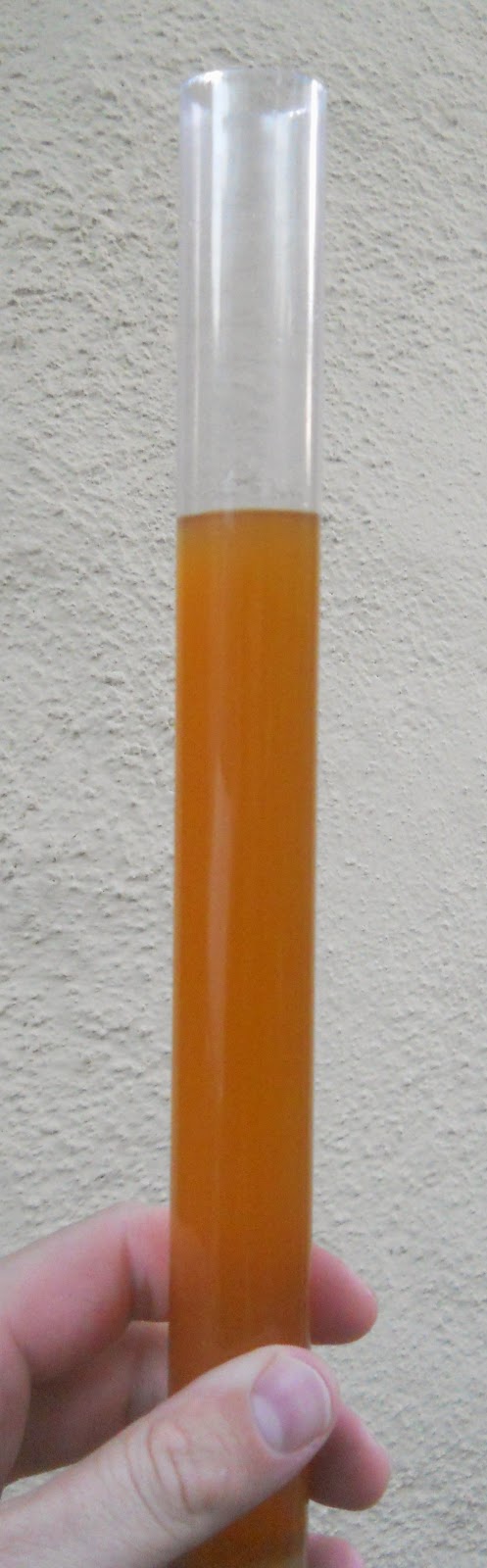
  • Starting gravity was 1.048 at 60 degrees, with ~5.3 gallons of wort. I can probably expect around 5% abv in the end.
  • The beer is fermenting at 64°; after 1 week I will transfer it to the secondary fermenter and dry-hop for 2 weeks, prior to bottling.
Notes
  • Total ingredient cost for this was $27.65. Assuming around a 5 gallon yield in the end, the cost per 12-oz. bottle will be around $0.55.
  • In order to maximize extract efficiency, I have been using a double crush on the mill at my local homebrew shop. Based on a visual inspection of the milled grain, and on conversations with the owner, I decided to try just a single pass through the mill this time. Based on my efficiency, that was an okay decision.
  • In the past, I had been a little frustrated by trying to raise the temperature of the grain bed during the second collection of wort. Thus, I tried adding much hotter water (~195°) than recommended by BeerSmith (168°), and got much better results both in terms of temperature as well as mash efficiency. There was a little fiddling to keep the temperature below 170°, so I might aim for around 185° to 190° next time.

Summer Blonde Ale Bottled

Success! My experiment with summer brewing (using a temperature-controlled freezer) has gone well, so last night I bottled my summer blonde ale. Here are the stats:

  • I fermented it from June 28 to July 7 at 62°. I didn’t see quite as much krausen as I’m used to, but I suspect that is because of the lower temperatures and thus a less vigorous fermentation.
  • On July 7, I raised the temperature to 64°, so that the yeast could clean up any stray diacetyl.
  • I bottled on July 12. Final gravity was 1.008, down from a starting gravity of 1.046. This works out to 5.0% abv, and an apparent attenuation of 82% (right in line with the expectations for the yeast, Safale-05).
  •  I kegged 5 L in a mini-keg, with 1.5 tbs. of corn sugar.
  • The remainder (3.75 gallons) was bottled. I wanted a target carbonation of 2.5 volumes, which worked out to 3.1 oz. of corn sugar boiled in 2 cups of water.
  • Bottling yield was 22 12-oz, 6 18-oz Grolsch, and 4 22-oz. bottles.
The flavor was somewhat malty with a touch of hops bitterness (but not overly bitter). No off flavors were detected, thankfully. The beer is hazy in appearance, but not overly so. I expect this will settle out during conditioning and refrigeration.

Summer Blonde Ale

One of the primary limitations of brewing in southern California is the weather…there is a short window indeed where ambient air temperature–even in a basement–is within the happy zone for ale yeast. You can brew when it’s warmer, of course, but there is more danger of off-flavors developing (well, unless it’s a Belgian…off-flavors are the default there). So, I’ve been mostly limited to brewing between November and March, with maybe a little wiggle room on either end. It also meant I had to get as much brewing as possible during that window, to have a good supply for the long summer months.

Well, those days are now at an end. The parents shipped me a Ranco temperature controller for my birthday, which regulates a fridge or freezer into appropriate fermentation temperatures. I bought a cheap 7 cubic foot chest freezer, hooked it all up, and now I’m ready to go! First up…a good, drinkable summer blonde ale. This recipe is ever-so-slightly modified from one that originally appeared in BYO.

Summer Blonde Ale

  • 10 lbs. 2-row pale malt
  • 8 oz. 20° crystal malt
  • 1 oz. Willamette hops pellets
  • 1 tsp. Irish moss
  • 1 pkg. (11 g) Safale American US-05 yeast
Steps
  • I preheated the mash tun and added the grains with 1 tbs. of 5.2 pH stabilizer.
  • I mashed in with 3.25 gallons of water at 165°. I adjusted the water slightly by adding 1 gallon distilled water (and another gallon when I did the sparge).
  • The mash temperature stabilized at 152.3°, was down to 151.5° within 30 minutes, and was at 149° after 60 minutes.
  • After 60 minutes, I added 1.08 gallons of water at 170°, stirred, and let it sit for 10 minutes. I then decanted ~3.15 gallons of wort.
  • I added 3.14 gallons of water at 170°, stirred, and let it sit for 10 minutes. This raised the temperature of the mash to 160°.
  • In the end, I collected 6.5 gallons of wort. Pre-boil gravity was 1.040, which works out to around 67.5% mash efficiency.
  • After heating the wort to a boil, I added the hops pellets and boiled the wort for 60 minutes. 10 minutes prior to flame-out, I added the Irish moss.
  • I cooled the wort down to ~78°, and transferred it to the carboy. Total volume is 5 gallons. 
  • After rehydrating the yeast in 1 cup of water, I pitched it and sealed up the fermenter.
  • In order to gain a clean flavor profile, I’ll be fermenting at ~62°. The plan is to ferment for around a week before bottling. Starting gravity was 1.046.
  • The beer was brewed and yeast pitched on Saturday, June 28. By the next morning, visible fermentation had started.

Beer Updates: El Dorado Amber Ale, Rodinia IPA

Mopping up some loose ends from the brewing season…

El Dorado Amber Ale

  • After 20 days of dry-hopping, I bottled this on April 27.
  • Final gravity was 1.010 at 60 degrees; down from 1.053 original gravity, this works out to 5.6% abv.
  • Total yield was 2 mini-kegs (5 L), 15 12-oz. bottles, and 2 22-oz. bottles. The former was carbonated with 1.5 tbs. of corn sugar each; the latter with carbonation drops.

Rodinia IPA

  • It took almost 2 days before I saw activity in the primary fermenter. I suspect this was a combination of high gravity and a slow start typical for the BRY-97 yeast strain.
  • After 15 days in the primary fermenter, I transferred this to the secondary fermenter on 27 April 2014. Gravity at this point was 1.022, down from 1.076.
  • I let the beer sit in the primary for around 3 weeks, and added 1 oz. of Nelson Sauvin hops on Sunday, May 18, for dry-hopping.
  • Bottling day was June 5, so I had a total of 18 days dry-hopping. Gravity at this point was 1.013 at 60 degrees, working out to a final abv of 8.3%.
  • I ended up with 3.5 gallons of beer. This was primed with 3 oz. of corn sugar dissolved in 2 cups of water, to reach a target of 2.5 volumes CO2.
  • I sampled a bottle after a week; it is shaping up quite nicely. The aroma is sweet and quite reminiscent of the white wine aroma I expected for Nelson Sauvin hops. Taste so far is pleasantly bitter with just a touch of sweetness (the hops again, I think).

Beer Updates: El Dorado Amber Ale, California Vanilla Porter, Gondwana IPA

Over the past two weeks, there has been some action on various batches. This is all summarized below.

  • On April 7, one week after brewing, I transferred the El Dorado Amber Ale over to the secondary fermenter. Gravity at this point was 1.014, down from 1.053; this equals 6.5% abv and 72.6% apparent attenuation.
  • I added 0.5 oz. of El Dorado hops pellets, aiming for two weeks of dry hopping prior to bottling
  • After seven days of vanilla beans in the secondary fermenter, this beer was ready to bottle. I recently got a second-hand set of “PhilTap” minikegs (thanks, Dad!), and this was the first batch to get the PhilTap treatment, along with the Gondwana IPA.
  • At bottling, gravity was 1.014, down from 1.064. This indicates 6.6% abv and 77.0% apparent attenuation.
  • The kegs were each carbonated with 1.5 tbs of corn sugar. The remaining 1.9 gallons were carbonated with 1.65 oz. of corn sugar boiled in 0.5 cup of water (target carbonation=2.6 volumes).
  • The total yield for this batch was: 2 5-L mini-kegs, 11 12-oz bottles, 3 22-oz. bottles, and 1 16-oz. grolsch bottle.
  • After 17 days of dry hopping with 2 oz. of Citra hops pellets, this beer was ready to package. As I was transferring it out, I was hit with a fantastic hops aroma – a fantastic bouquet of passionfruit with a little citrus. These also held up in the tasting.
  • At bottling, gravity was 1.008, down from 1.047. This equals 5.1% abv, and an apparent attenuation of 82.3%.
  • The kegs were carbonated with 1.5 tbs of corn sugar. The remaining 1.5 gallons was primed with 1.45 oz. of corn sugar boiled in 0.5 cup water.
  • The total yield for this batch was 2 5-L mini-kegs, 8 12-oz bottles, 2 22-oz. bottles, and 1 16-oz. Grolsch bottle.
  • After a week, I tapped one of the mini-kegs. The result is beautiful! The hops aroma is still fantastic, although the beer doesn’t have a lot of body (not surprising given the high fermentability). Even so, the flavor is quite clean, which is nice after my early worries.
Gondwana IPA, first pour from the mini-keg