What’s Brewing? January 2020 Edition

Awhile back, I changed my blogging habits to condense each batch into a single post, rather than split across multiple updates. Some of this was to save time, and some of this was to make it easier to find the full story on a particular batch later on. I’ve (personally) liked this switch overall, but feel that it also can lead to a drought in posting.

So, I’m introducing a new, occasional series–“What’s Brewing?” These will be quick, informal posts to highlight planned batches, currently fermenting batches, and other bits that don’t quite warrant a full write-up.

What’s Brewing? January 2020 Edition

Over the holidays, I brewed up a storm! I’ve been doing a ton of lagers, and hope to have enough backlog that I can let some of them condition for a good stretch of time.
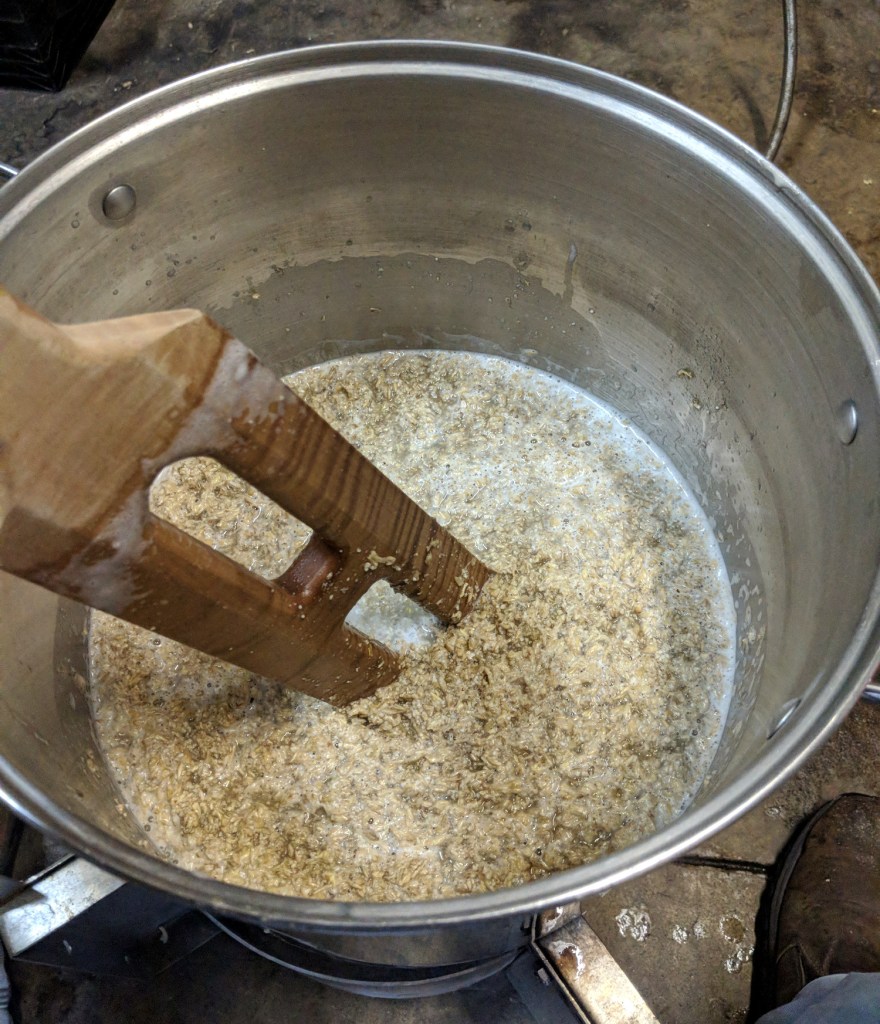
Decoction mashing for my German-style pils

December kicked off with a festbier, which is now lagering in the keg. I brewed it as a fairly traditional version of the style. I followed that up with a German pils, but made with American pilsner malt (from Great Western) and Crystal hops. This one got the double decoction treatment, as I work on perfecting that technique. Finally, I did a rebrew of my Red Rye Lager, an American-style amber lager made with California common yeast (in this case, Imperial Yeasts Cablecar version). The nice thing on the latter is that it’s cool enough that I can just ferment it at ambient, without having to tie up fermentation chamber space!

With so many lagers in production, I was a bit worried about taps sitting vacant while I waited for beers to ferment and condition. So, I kicked off 2020 with two quick-and-dirty kitchen sink brews. One was an English-style porter, the other an American(ish) pale ale. I took some shortcuts with ingredients, using up odds-and-ends that were on hand. I also adopted the “Short & Shoddy” format of Brulosophy, with abbreviated, 30 minute full-volume mashes and 30 minute boils. Those batches should be ready to keg in a few days.

Over the break, I did a full cleaning of my keezer lines. On tap, I currently have my ESB, the smoked Scottish ale, and a cider. The Scottish ale has cleared up and conditioned beautifully, and has been absolutely enjoyable. My cider was made with Treetop brand Honeycrisp apple juice from the shelf and Mangrove Jack cider yeast. It’s dry, hazy, and perfect for winter evenings. Both the Scottish ale and cider are in 2.5 gallon kegs, and will probably get kicked pretty soon. I’m aiming to have the Short & Shoddy porter and pale ale ready to go in their place.
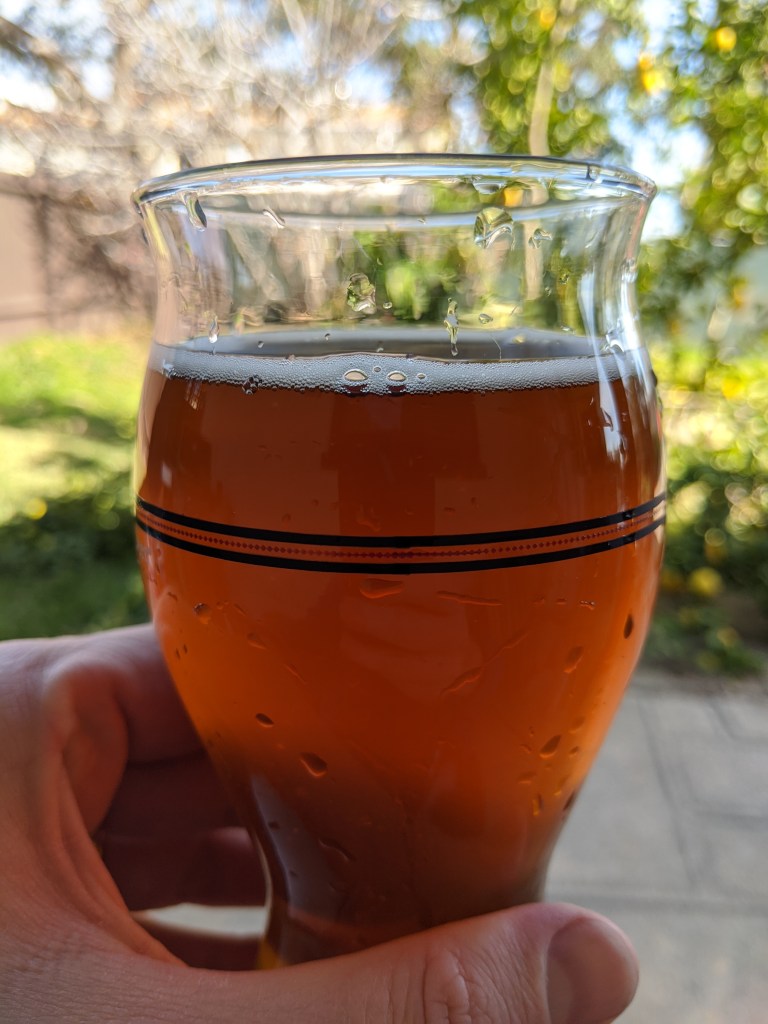
Farke’s ESB 1.1

Early in 2019, I made an English bitter that turned out exceptionally. Hoping to capitalize on that success, I did a second iteration at the end of November. The overall recipe is pretty similar, although the base malt brand was Crisp instead of Bairds. Also, I dropped the crystal 90 and used just crystal 80. Finally, I fermented a very slight touch warmer, at 67° instead of 66°.

The beer, a few days after adding gelatin

Farke’s ESB 1.1

  • 8.5 lb. Maris Otter malt (Crisp)
  • 0.75 lb. 80°L 6-row caramel malt (Briess)
  • 0.25 lb. 80°L caramel malt (Briess)
  • 1 oz. East Kent Goldings hop pellets (6.0% alpha), 60 minute boil
  • 1 Whirlfloc tablet, 10 minute boil
  • 1 oz. East Kent Goldings hop pellets (6.0% alpha), 5 minute boil
  • 1 pkg. London ESB English Style Ale Yeast

Target Parameters

  • 60 minute full volume infusion mash, 152°
  • 1.043 o.g., 1.012 f.g., 4.2% abv, 28 IBU, 11 SRM
  • Claremont tap water

Procedure

  • I mashed in with 7.5 gallons of water at 168°, to hit a mash temperature of 153°.
  • After 1 hour, I vorlaufed and collected the runnings.
  • In total, I collected 6.5 gallons of wort at 1.040 s.g., for 73% mash efficiency. This was a bit better than expected for a full-volume mash, so I adjusted the boil accordingly to try and hit my target starting gravity.
  • I boiled for 60 minutes, adding hops and whirlfloc as scheduled. Then, I chilled down to ~75°, pitched the yeast, and put it in the fermentation chamber. The temperature was set at 67°.
  • Starting gravity was 1.045, with the batch brewed on 25 November 2019.
  • I kegged the beer on 23 December 2019. Final gravity was 1.008, a bit lower than I expected. This works out to 82% attenuation and 5.0% abv.
  • This yeast is described as poorly flocculent–and it was. For the first week or so, the beer poured as a hazy, yeasty mess. It wasn’t terribly pleasant to drink, although it got a bit better as the yeast started to settle somewhat. On January 3, I decided to speed things along and add gelatin, with 1 tsp. in 1 cup of water. Within two days, the beer was pouring (and tasting) much better. It wasn’t perfectly brilliant, but it was much clearer.

Tasting

  • Appearance
    • Light amber color, somewhat hazy, with thin off-white head.
  • Aroma
    • Slight caramel aroma, bready, with light fruity ester. Not much for noticeable hop aroma.
  • Flavor
    • Light caramel and toffee notes on the flavor, with modest (but not over-the-top) bitterness.
  • Mouthfeel
    • Off-dry, light bodied, moderate carbonation.
  • Would I brew this again?
    • Although I really liked this recipe last time I brewed it, I am less of a fan this time around. I’m not sure why it ended up so dry (1.008 final gravity); maybe the mash temperature dropped too quickly, maybe it’s the brand of malt, or maybe I got some contamination that took off on fermenting the sugars? I don’t really taste any off flavors, but the beer is indeed a bit drier than I might like. I think the overall malt character is pretty good, and the ester character is a bit more where I want it on this batch. However, the ESB yeast is a horrible flocculator. I noticed this last time I brewed it, too, and it’s a bit on the ridiculous side, especially for a beer that I think should be drunk more fresh than not. For any future use, I would definitely cold crash and throw in gelatin right at the start, or else try a different yeast strain. I do think the overall package would be better, too, with going back to the original malt bill.
  • Overall
    • 5/10

Brew Year’s Resolutions 2020

I missed doing this last year, but might as well try again for 2020.

  • Patience.
    • I often bring my lagers on-line before they are as conditioned as well as they could be. That means that the keg is okay when I start, pretty good for the middle part, and might reach fantastic only during the last third. This is often a planning issue, and sometimes a space issue. For 2020, I will try to better plan my brew cycles so that I can hold off on tapping lager kegs until they are better conditioned. A month (minimum) of lagering would be great…and if I can get to 6 or 8 weeks, even better!
  • Practice.
    • I want to rebrew a few recipes, such as my Raspberry Belgian and my Alta California Lager. I never did my oatmeal stout last year, and will try that, too.
    • 2020 will be a year to explore the world of North American “noble hops”, for purposes of pilsners and such: Crystal, Liberty, Mt. Hood, Sterling, Vanguard, and U.S. versions of Hallertau and Tettnang. In the last week of 2019, I made a German-style pils with Crystal and a red rye lager with Mt. Hood, so I’ve got a head start!
  • Prose.
    • I want to do something, either large or small, for beer communication this year. Maybe pitch a new article. Maybe just submit a small note. 2019 was fairly dormant on this front, so I want to do better in 2020. I enjoy talking and writing about beer, and would like to do more.
  • Prost!
    • I want to keep brewing fun! This means sharing more beer with friends (both at my home and by sending growlers out into the world), taking some quiet moments to truly savor a beer, and experimenting with new recipes and new-to-me styles. Small-batch (3 gallon) brews have been a good strategy in the past, and I might keep that up as a way to continue experimentation on styles and recipes of uncertain drinkability. No resolution should get in the way of my enjoyment of beer, and I’m usually pretty good at holding to this. On to 2020!