Christmas Warmer 2020

My beer tastes run towards the lighter, lower-alcohol side, but I sure do like a nice and robust beer in that stretch between Thanksgiving and New Year’s. I just finished the keg of Stygimoloch Bock, and this year’s Christmas Warmer went on tap in its place.

The goal for this batch was to have something with a bit of character and a bit of kick. I wanted a rich malt character, alongside a bit of spice. I looked through Gordon Strong’s Modern Homebrew Recipes, and found “Christmas Beer” as an inspiration. The malt proportions in my version are pretty similar to Strong’s recipe, but I did a ton of swapping for brand and even malt type. Golden Promise got replaced by Vienna, and Belgian Aromatic got swapped out for Honey Malt, among other things. The original recipe is far more English in character, including the hops and yeast, and I did away with that entirely! Instead of English ale yeast, I brought in Hornindal kveik. My logic was that its orange/citrus qualities would fill that space of orange zest in Strong’s recipe. Plus, I had the kveik on-hand, and thought it would be a fun variation.

Because this was a pretty experimental batch, and because I didn’t want ridiculous amounts of a spiced beer, I knocked the recipe back to 2.5 gallons. This gave me a chance to do a test-run for a small batch on my Foundry system. I quite like the result, but am glad that I don’t have endless quantities of it. Even a good spiced ale is best as a treat in moderation!

Christmas Warmer 2020

  • 3.5 lb. Vienna malt (Weyermann)
  • 1 lb. Munich II malt (Weyermann)
  • 1 lb. honey malt (Gambrinus)
  • 0.5 lb. Caramunich I malt (Weyermann)
  • 0.5 lb. caramel 40° malt (Briess)
  • 0.5 lb. flaked barley
  • 2 oz. chocolate malt (Briess)
  • 1 lb. honey, 1 minute boil
  • 1 oz. robust molasses (Grandma’s Brand)
  • 1 oz. Cascade whole hops (5.5% alpha), 30 minute boil
  • 1 tsp. Fermax yeast nutrient, 10 minute boil
  • 1 Whirlfloc tablet, 5 minute boil
  • Steeping spices (steeped for 10 minutes after boil)
    • 2 vanilla beans, cut and scraped
    • 3 cinnamon sticks
    • 6 coriander seeds, crushed
    • 1 whole nutmeg, chopped
    • 4 allspice berries, crushed
  • Hornindal kveik (repitched from previous batch)

Target Parameters

  • 1.068 s.g., 1.009 f.g., 7.7% abv, 19 SRM, 25 IBU, 3 gallon batch
  • Infusion mash, 154°, full volume; 60 minute boil
  • Claremont water, with Campden tablet to remove chloramines.

Procedure

  • I mashed in (using my Anvil Foundry) with 4.5 gallons of water at 160°, adding 2.5 mL of 88% lactic acid to adjust pH. I let this settle down to 154°, mashing for 50 minutes with recirculation. I then raised the mash to 168° over 10 minutes, let it rest for 10 minutes, removed the grains, and brought the runnings to a boil.
  • The mash yielded 4 gallons of wort at 1.041, for 62% mash efficiency. This was a bit below where I wanted to be, so I added 0.5 lb. of extra light DME, to raise the gravity.
  • I boiled for 60 minutes, adding the hops and other ingredients per the schedule.
  • After the boil but before chilling the wort, I steeped the spices in a bag for 10 minutes.
  • I cooled down to ~80°, transferred to the fermenter, and let it run at ambient. Because it was later in fall when I brewed this, ambient was around 70° or so for the start.
  • Starting gravity was 1.061. I brewed the beer on 20 October 2020.
  • I kegged the beer on 6 November 2020, and force carbonated.
  • Final gravity was 1.017, which works out to 5.8% abv. I’ve noticed that this kveik strain seems to underattenuate, measuring 61% to 71% in the batches I’ve done.

Tasting

  • Appearance
    • Deep amber beer with some haze; pours with a persistent beige head.
  • Aroma
    • Candied ginger, general spice, with a touch of citrus peel. Slight malty/biscuity character, and a slight tartness. There is a hint of cinnamon/spice as the beer warms up.
  • Flavor
    • Medium-low bitterness, and a light tartness (from the kveik?). There is a subtle spice character, with a bit of cinnamon and molasses that become more prominent as the beer warms.
  • Mouthfeel
    • Medium body, moderate carbonation. The finish is off-dry and fairly smooth.
  • Would I brew this again?
    • This is a pretty good beer, but still needs a little work. For my personal conception of a “holiday beer,” I’d like a bit more base malt character. For a rebrew, I might use all Munich I as the base, and also add some dark crystal malt (maybe crystal 80 or crystal 120?). The beer could also use a little more sweetness–perhaps from lactose or crystal malt–to round out the profile. The level of bitterness is about perfect. Finally, I might change the yeast to an English ale yeast rather than kveik. In sum, this is a perfectly drinkable experiment, and will be worth a future revision.
  • Overall
    • 6/10

Gingerbread Winter Warmer Kegged

Today (October 16, 2016), I kegged my Gingerbread Winter Warmer. It has been fermenting for just about a month, so it seemed like a good time to keg it. I roused the yeast three or four times during primary fermentation (about once a week), to keep things moving along. Even so, the brew was a bit underattenuated–it had a final gravity of 1.030, or 10.3% abv. I think two factors might explain the relatively high gravity. First would be the high mash temperature, which should limit overall fermentability. Second, and probably most important, was the high gravity of the beer. I aerated as best I could, but am guessing that a shot of oxygen would have helped out. Now that the beer has been agitated on the ride over to the keg, I might expect a little more fermentation (but probably not much). For now, I’ll let the 2 gallons of beer in my mini-keg condition and carbonate at room temperature for about a month before tapping.

Gingerbread Winter Warmer

We’ve only barely hit fall, but I do need to start looking ahead to winter beverage selections. For the past two years, I’ve done a pumpkin ale, both of which turned out fairly nice. Although I was tempted to rebrew a new version of last year’s recipe, I instead decided to switch course altogether. This meant: winter warmer!

The recipe is pretty much entirely my own,with an aim towards creating a rich, flavorful sipping beer that evokes gingerbread cookies. This should be something to enjoy by the fireplace, while the California winter rains pour down outside. (I know, it should be snowfall in some quaint northeastern town, but I much prefer my California winters.) I kept the hops on the lower end, because I figured that the extensive spice roster would up the perceived bitterness sufficiently.

For the yeast, I ended up using two freebie dry yeast packets from the 2015 San Diego homebrewers convention. They were both Belgian Abbaye / Abbey yeasts, one from Danstar and the other from Fermentis. The packets were a few months past their expiration dates, so I upped the yeast pitching rate accordingly. The Danstar variety is supposed to tend towards the clove and fruit end of the spectrum, whereas the Fermentis strain is a little more subtle. So, I elected to pitch a greater quantity of the Danstar, in hopes that its yeast character will dominate.

Because this is such a high alcohol beer, and a very experimental recipe, I didn’t really want five gallons worth. So, I elected for a 2.5 gallon batch. And with that small size, it really lent itself well to brew-in-a-bag. My plan is to ferment for 4-6 weeks, and then keg, with a few weeks of additional conditioning before serving.

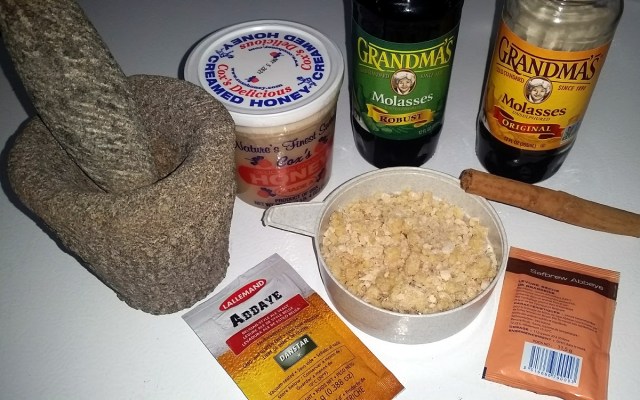
honey, molasses, cinnamon, ginger, and yeast, with mortar & pestle, for the winter warmer

Spices, sugars, and yeast, ready to go for a winter warmer.

Gingerbread Winter Warmer

  • 7 lbs. Vienna malt (Weyermann)
  • 1.28 lbs. honey malt
  • 0.6 oz. de-bittered black malt (Dingemans)
  • 6.4 oz. dark brown sugar (added to wort before boil)
  • 0.5 oz. Nugget hop pellets (13.3% alpha acid), 60 minute boil
  • 1 cup molasses (Grandma’s brand, 1/3 cup of this original, 2/3 cup of this robust), 60 minute boil
  • 0.5 Whirlfloc tablet, 10 minute boil
  • 1 tsp. yeast nutrient (Fermax), 10 minute boil
  • 1 lb. 4 oz. honey, 1 minute boil
  • Spice blend, 10 minute steep after boil
    • 4.75 oz. crystallized ginger, chopped finely
    • 1 cinnamon stick (0.35 oz.), ground
    • 5 g (0.17 oz.) of ground nutmeg
    • 2.5 g (0.085 oz.) of ground mace
    • 2.5 g (0.085 oz.) of ground allspice
  • 1 pkg. Abbaye Belgian dry yeast (Danstar)
  • 0.5 pkg. Safebrew Abbey Ale dry yeast (Fermentis)

Brewing Targets

  • 60 minute mash at 156°
  • Brew-in-a-bag, no sparge
  • Original gravity = 1.110 (actual = 1.107)
  • Color = 22 SRM
  • IBU = 35
  • 60 minute boil

Procedure

  • I mashed in with 4.75 gallons of water at 169°, to hit a mash temperature of 159°. This was down to 152° after 30 minutes, so I added a bit of heat to raise the mash up to 154° during the last 15 minutes.
  • Once I removed the grains in their bag from the kettle, the gravity was 1.056. This was a bit lower than I wanted, so I added 0.4 lbs. of dark brown sugar. This raised the gravity up to 1.064.
  • I boiled per the schedule above, with hops and other items added at the appropriate time. After 60 minutes, I turned off the heat and added the spices, letting it all sit for 10 minutes before chilling.
  • I chilled the wort down to 80°, and then transferred it to the fermenter. I aerated with the in-line Venturi pump as well as the line-end wort sprayer during the transfer. Then, I capped the carboy and sloshed it all around for about 5 minutes, to aerate further.
  • I brewed this beer on 17 September 2016. Starting gravity was 1.107, and I did the first 5 days of fermentation at 68°. I roused the yeast three times during the first five days, to ensure steady fermentation. Because I needed to use my fermentation chamber for cold-crashing of my Vienna lager, I removed the gingerbread ale on 22 September 2016, and let it sit at ambient temperature (around 72°). I’ll leave it here for at least two more weeks, before kegging and letting the beer condition for at least a month. As of this writing, the main evidence of fermentation seemed to have wrapped up. I gave it an additional shake today (24 September 2016), to rouse the yeast one last time.