
“Farmhouse beers” are a huge and fuzzy category, in my mind including everything from saison to many kveik-based concoctions to some kellerbiers. Although a character-rich and slightly wild yeast is most common, I would also think some “rustic” lagers should also qualify. Farmhouse, like so many things in homebrewing and craft beer, is a moderately mythological concept, and one built more around feelings than strict history. I suppose that’s why it’s fun to play in the space! It can stir a different set of emotions from by-the-books or paint-by-numbers brewing; it allows creativity (and I suppose role-playing) in a way that many other styles don’t, or at least in ways that differ from other styles.
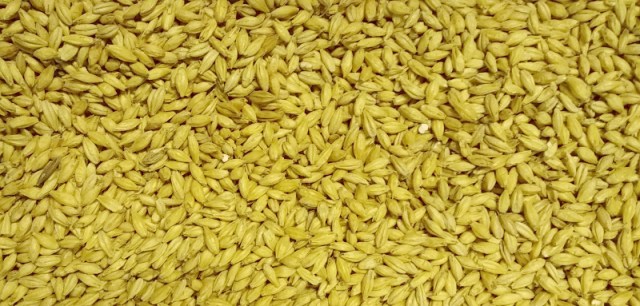
I recently ran across a supplier for Isaria 1924 malt by Weyermann (William’s Brewing). I am often interested in trying base malts outside my norm, and this was a fun opportunity to experiment. The descriptions / marketing material from Weyermann state that the malt is “made from the oldest German malting barley variety Isaria, which was officially approved for the beer production in 1924. Brewers used Isaria to brew traditional, unfiltered and flavorful traditional German Lagers.”
Colorwise, Isaria 1924 weighs in at 3.5 SRM and is thus closest to most Vienna malts (3-5 SRM, depending on supplier; the Weyermann version is 3 SRM). Relative to the Weyermann flavor wheel, Isaria 1924 reads as a subdued Vienna, with similar locations of flavor/aroma peaks, but different magnitudes (e.g., a peak at “sweet” taste but an arbitrary value of 2.5 versus 4.5).
Among the recommended styles from Weyermann, Franconian landbier was near the top. This intrigued me, because I had recently read about the “style” in the Spring 2025 issue of Craft Beer and Brewing (including recipe). Why not try something in that vein?
My version is not really based on anything in particular, other than crafting a general story–something to emphasize malt and lean into a story of a rustic beer that plausibly would originate in Franconia (which primarily overlaps with northern Bavaria). I wanted to use 100 percent Isaria 1924 malt, particularly because this was my main point of the brew session. I only had 10 pounds, which might be a bit lower on gravity than I wanted for my usual 5.25 gallon batch, so I scaled down to 4.5 gallons. Spalt Spalter hops were my hop selection, because they provide a nice earthy and spicy quality that fit well with my intended “rustic” results. Finally, I wanted to give WLP860 Munich lager dry yeast another spin; as a strain that would emphasize the malt character, and that also would be consistent with my Franconian/Bavarian theme (although Munich itself is to the south of historical Franconia–we’re going for “vibes” and not authenticity here!). During my last brew with it, I learned that a bit of patience was key–WLP860 is a slow starter, and so I shouldn’t fear if signs of fermentation are delayed.
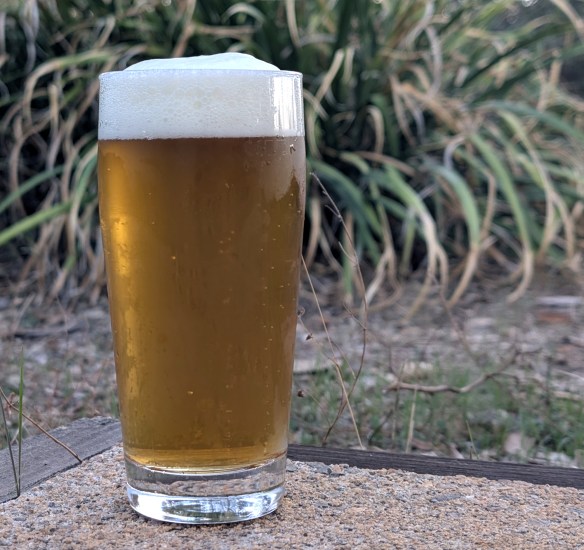
Old Franconia Lager
- 10 lb. Isaria 1924 malt (Weyermann)
- 0.5 tsp. BrewTanB, added to mash
- 1.25 oz. Spalt Spalter hop pellets (4.3% alpha), 60 minute boil
- 0.5 tsp. BrewTanB, 10 minute boil
- 1 Whirlfloc tablet, 5 minute boil
- 1.75 oz. Spalt Spalter hop pellets (4.3% alpha), 5 minute boil
- 2 pkg. Munich Lager dry yeast (White Labs WLP860)
Target Parameters
- 60 minute infusion mash, 154°, full volume mash
- 1.051 o.g., 1.016 f.g., 4.7% abv, 29 IBU, 6 SRM
- Claremont tapwater, neutralized to remove bicarbonates. Roughly 40 ppm Ca, 18 ppm Mg, 102 ppm Na, 50 ppm SO4, 130 ppm Cl, RA=-31
- 4.5 gallon batch
Procedure
- I treated 6.75 gallons of water with a Campden tablet and 6.9 mL of 88% lactic acid, in order to drop out the bicarbonates.
- Next, I heated the strike water to 159°, added the grains, and held at 154° with recirculation for 60 minutes. After that, I raised the mash temperature to 168°, held it there for 10 minutes, and then pulled the grains.
- In total, I collected 6 gallons of runnings with a gravity of 1.038, for 64% mash efficiency.
- I brought the runnings to a boil, adding hops and finings per the recipe. Because my gravity was a bit lower than intended, I boiled a bit harder to bring the gravity up. After 60 minutes, I turned off the heat and chilled the wort to 69° before transferring to the fermenter.
- I chilled the wort down to 50° in the fermentation chamber, pitching the yeast when the beer was at 60° (night of the brew day).
- This beer was brewed on 21 September 2025; it had a starting gravity of 1.049.
- I fermented the beer at 50 degrees; small bubbles were visible on the surface by 22 September 2025, 24 hours after pitching. By 29 September, there was a good layer of krausen on the surface. Given the slow start the last time I used this yeast, I wanted to confirm that things were moving along. I noted an aroma of sulfur in the fermentation chamber on 30 September 2025.
- I raised the temperature of the beer to 56° on 2 October 2025, and moved the beer to ambient on 7 October 2025.
- Using a closed transfer, I kegged the beer on 18 October 2025. At the time, it had an amazing malt flavor!
- Final gravity was 1.013, for 4.7% abv.
Tasting
- Appearance
- A deep gold beer, with a very slight haze, which pours with a thick, white, and persistent head. Beautiful!
- Aroma
- Medium malty-rich aroma, with moderate spicy hop character. Delicate hoppiness.
- Flavor
- Moderate malty rich character, against a medium level of hop bitterness. Clean yeast character.
- Mouthfeel
- Medium-light body, moderately high carbonation, off-dry finish. There’s may be a tiny bit of astringency.
- Would I Brew This Again?
- This is super nice as something a little different from the “usual” lagers. Isaria 1924 stands well as a solo malt, making an interesting and highly drinkable beer. I might dial the bitterness back a touch, or else increase the gravity slightly; the aroma is amazing, but I feel that the malt character is slightly obscured. I would also do a 90 minute mash or a decoction mash in order to improve efficiency, given the lower mash yield for this particular malt.
- Overall
- 8/10
Update: Around Christmas, I noted an increasingly heavy protein precipitation in this beer. I’ve never experienced something like it previously, at least in my homebrew. I didn’t have anything unusual with handling or technique, so I wonder if it’s caused by the malt. Or maybe just a fluke?



 Andy's Brewing Blog
.jpg)