Polacanthus Porter

IMG_20190829_193848Dark beers! They’re seemingly banished from the summer months, and yet I often have a craving for one even on the hottest days. Not a triple imperial barrel aged chocolate stout, of course–that’s best dumped in the sink during the month of December. I’m thinking of those more drinkable dark beers, a bit lower on the alcohol but still robust on flavor.

An end-of-summer porter seemed like a good way forward. They’re flavorful, but not necessarily gut bombs. They’re relatively easy to brew, and turn around fairly quickly. Also, they’re a “traditional” style that’s just a bit harder to find, overwhelmed by trendier beers on tap lists. If I want a mediocre hazy IPA, I don’t need to make my own; there is no shortage in area breweries!

This recipe is based on the American porter from Gordon Strong’s Modern Homebrew Recipes. My version fairly closely follows that by Strong, with the modifications primarily on the hopping and malt brands. The name recognizes the combination of American and English ingredients, because Polacanthus is a type of armored dinosaur that had relatives on both sides of the Atlantic.

Polacanthus Porter

  • 11 lb. 2-row pale malt (Rahr)
  • 12 oz. 1823 Heritage Crystal Malt (Bairds), 75°
  • 10 oz. chocolate malt (Bairds), 500°
  • 5 oz. roasted barley (Bairds), 600°
  • 0.65 oz. Magnum hop pellets (13.2% alpha), 60 minute boil
  • 1 Whirlfloc tablet, 10 minute boil
  • 1 oz. Cascade whole hops (~5.5% alpha), 10 minute boil
  • 1 oz. Cascade whole hops (~5.5% alpha), 5 minute boil
  • 1 pkg. Safale American Ale Yeast (US-05)

Target Parameters

  • 1.058 o.g., 1.014 f.g., 5.8% abv, 36 IBU, 34 SRM
  • 60 minute infusion mash, 154°, batch sparge
  • Claremont tap water

Procedure

  • I mashed in with 4.25 gallons of water at 164.5°, to his a mash temperature of 155°. After 45 minutes, I added 1 gallon of water at 185°, and collected first runnings after a 10 minute rest and vorlauf. I then added 3.5 gallons of water, let rest for 10 minutes, vorlaufed, and collected second runnings.
  • In total, I collected 7.1 gallons of runnings with a gravity of 1.048, for 73% efficiency.
  • I brought the runnings to a boil, adding hops and such per the recipe.
  • After 60 minutes, I turned off the flame, chilled, and transferred to the fermenter (with aeration). I had to let the wort rest in the fermenter for a few hours, to chill down to the fermentation temperature of 66°.
  • I brewed this beer on 13 July 2019. Starting gravity was 1.057.
  • I kegged the beer on 14 August 2019. Final gravity was 1.013, for 5.8% abv. This was exactly on the dot for my targets!

Tasting

  • Appearance
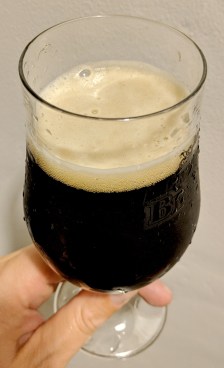
    • Deep brown, with garnet tones when illuminated from behind; clear; persistent tan head
  • Aroma
    • Roasty, chocolately aroma; very nice.
  • Flavor
    • Roast malt character at the front, with a slight chocolate and coffee tinge; slight citrus aspect; moderately bitter, with a finish that tilts towards the bitter rather than the malty side.
  • Mouthfeel
    • Medium body, medium carbonation; off-dry finish (probably due to the roast character). It could maybe have a touch more body, but I think overall it’s okay on this end. Too much body would make this harder to drink.
  • Would I brew this again?
    • Yes! This is a nice and simple recipe, with a pleasant flavor. As porters go, this definitely is towards the roasted and bitter side, but I’m okay with that. This is really drinkable as a summer porter! I would add it to my regular repertoire.
  • Overall
    • 9/10

Gravel Bottom Porter

Our upcoming club competition focuses on porters of all types. My own entry is a bit of a last-minute affair; this is coupled with a need/desire to use up some ingredients in the brewing stash.

For this batch, I wanted something more on the English end of porters. I’ve done a lot of American porters and robust porters, but it’s been a long time since I’ve deviated from those. This one isn’t a true English porter–the base malts are decidedly German–but the overall feel is on the west side of the Channel.

20171104_153434

Transferring the wort into the fermenter

Gravel Bottom Porter

  • 5.25 lbs. Munich I malt (Weyermann)
  • 1.5 lbs. Vienna malt (Great Western)
  • 1 lb. crystal extra dark malt 120° (Crisp)
  • 1 lb. pale chocolate malt 225° (Crisp)
  • 6.4 oz. flaked barley
  • 4 oz. caramel 120° malt (Briess)
  • 3.2 oz. flaked wheat
  • 1 oz. Cascade whole hops (5.5% alpha), 60 minute boil
  • 0.85 oz. Willamette hop pellets (4.9% alpha), 10 minute boil
  • 1 Whirlfloc tablet, 10 minute boil
  • 1 pkg. Empire Ale dry yeast (Mangrove Jack’s M15)

Target Parameters

  • Infusion mash to hit target of 152° for 60 minutes, batch sparge
  • Claremont tap water
  • 1.049 o.g., 1.013 f.g., 4.6% abv, 27 IBU, 29 SRM, 5.5 gallons into fermenter

Procedure

  • I mashed in with 3.25 gallons of water at 165°, to hit a mash temperature of 153°. After 45 minutes, it was down to around 151°.
  • After 60 minutes, I added 1.37 gallons of water at 185°, let it sit for 10 minutes, vorlaufed, and collected the first runnings. Then, I added 3.5 gallons of water at 185°, let sit for 10 minutes, vorlaufed, and collected the second runnings.
  • In total, I collected ~6.25 gallons of wort. This was below my target, so I added RO water to get to 6.8 gallons. This equates to around 79% efficiency.
  • I brought the wort to a boil, adding hops and Whirlfloc at the appropriate times.
  • After 60 minutes, I turned off the flame and began chilling. Once I was down to ~78°, I transferred to the primary fermenter and pitched the yeast.
  • Starting gravity was 1.049; right on the nose!
  • I brewed this beer on 4 November 2017, and will be fermenting at 68°.

Olde Persica Porter

I’m getting that itch again, to brew with new styles and new ingredients. With winter on the horizon, I want to stock up on some beers that will serve well on a chilly night next to the fire. I also recently realized I haven’t brewed with smoked malt before. So, a smoked porter seemed like just the thing to try.

In assembling the recipe, I drew heavily upon an Alaskan Smoked Porter clone from the American Homebrewers Association website. This was augmented with a Smoked Robust Porter recipe, also from AHA. Because I wanted this to be a fairly rich base porter that would stand up to the smoke, I elected to go with Vienna malt for the majority of the grist. Conveniently, I also have a decent bit still in stock. To add an American emphasis, I’m going to use whole Cascade hops from South Dakota as the bittering hops, with a charge of Willamette at the very end.

Once I got to the homebrew shop, I discovered that they had several different kinds of smoked malt in stock. I had been planning on using a beechwood-smoked rauch malt, but the owners suggested trying a peachwood-smoked malt instead. I was intrigued!

The malt itself is from Copper Fox Distillery, a Virginia-based operation that specializes in small-batch whiskeys and such. They have also started a brew malt operation, with a handful of products. Because the maltster is so new and so small, it is very difficult to find any specific information on the malts. Their website didn’t have any real information, but Southern Hills Homebrew Supply did. I also learned a bit in chatting with a local person who is helping to distribute Copper Fox malts in California. The bottom line is that this is a floor malted, smoked 2-row barley malt. The aroma and flavor profile are supposed to be a bit gentler than in traditional beechwood-smoked malt. Based on what I tasted and smelled during the brew, this very much seems to be the case. The aroma is delightfully aromatic and smoky, but the flavor in the wort is not at all overpowering.

As for the name of this recipe? Well, because I am using peach wood malt, I wanted to honor peaches. The scientific name for a peach is Prunus persica, reflecting its close kinship with plums (and thus prunes) as well as the fact that domesticated peaches entered Europe via Persia. However, peaches themselves have a deeper origin in China; the oldest fossil peaches clock in at around 2.6 million years old. As a frame of reference, our genus Homo was just getting started around that time, and the modern Homo sapiens was still 2.4 million years away!

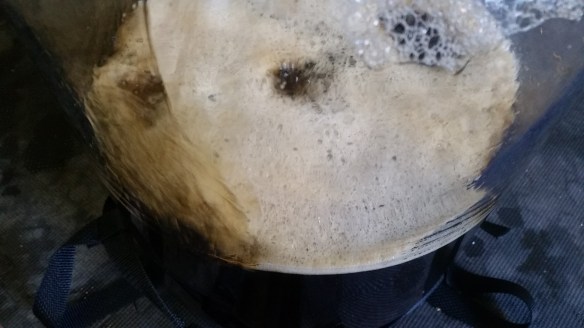
Olde Persica Porter, just into the primary fermenter

Olde Persica Porter, just into the primary fermenter

Olde Persica Porter

  • 7 lbs. Vienna malt (Weyermann)
  • 3 lbs. peach wood smoked 2-row malt (Copper Fox Distillery)
  • 1 lb. 80° crystal malt
  • 1 lb. 40° crystal malt
  • 0.5 lb. black (patent) malt
  • 0.5 lb. chocolate malt
  • 2 oz. Cascade whole hops (5.1% alpha), 60 minute boil
  • 1 oz. Willamette hop pellet (4.1% alpha), 10 minute boil
  • 1 oz. Willamette hop pellet (4.1% alpha), 1 minute boil and 5 minute steep after flame-out
  • 1 Whirlfloc tablet, 10 minute boil
  • 0.25 yeast nutrient, 10 minute boil
  • White Labs California Ale yeast (WLP001)

Target Parameters

  • 1.065 o.g., 1.017 f.g., 6.3% abv, 37 IBU, 36 SRM, 5.5 gallons into the fermenter

Procedure

  • Five days before brewing, I made a 2L starter. After two days, I split the starter (to create a yeast culture with 100 billion cells for later), and cold crashed the remainder in the flask for pitching on brew day.
  • I mashed in with 4.3 gallons of water at 166.7°, to hit a mash temperature of 154.5°. After 60 minutes, the mash was down to 151°. At this point, I added 0.75 gallons of water at 165°, to raise the mash to 152°.
  • I let the mash rest for 10 minutes, vorlaufed, and collected the first runnings. I then added 3.5 gallons of water at 175°, let everything sit for 10 minutes, and then collected the second runnings.
  • Altogether, I collected 6.75 gallons of wort with a gravity of 1.054, for a mash efficiency of 77%.
  • I brought the runnings to a boil, and added hops and other stuff per the schedule. After 60 minutes, I turned off the heat and chilled the wort to 80°. Our groundwater is still too warm to get much below that!
  • Starting gravity is 1.060. This is a bit below my target (1.065), most likely because I didn’t have the boil as vigorous as it usually is. I pitched the yeast, and will be fermenting at 68°.
  • This beer was brewed on 22 October 2016, with vigorous fermentation underway within 24 hours.