Porters are a classic homebrewing style, and they are an accessible entry point for newer brewers because their rich flavors are simultaneously enjoyable and also able to cover the results of overheated fermentations. As my brewing has progressed, and my fermentation temperature control has improved, I come back to them again and again as an enjoyable winter beer.
Last year I made a Sierra Nevada Porter clone, and this year I delved into a clone recipe for Deschute Brewing’s Black Butte Porter. The version I had was pulled from the Brew Your Own Big Book of Homebrewing (2022 updated edition), with some small modifications for hops and yeast on-hand on-hand as well as some very slight malt quantity adjustments. Instead of Galena as the bittering charge, I subbed in Chinook, which seemed like a reasonable swap, and I used Mangrove Jacki’s M36 Liberty Bell ale yeast instead of Lalbrew’s Verdant strain. Again, this seemed to be a reasonable swap that would get me into the same flavor zone. Interestingly, I learned via David Taylor’s Yeast Master List that M36 is a blend of M42 (New World/Nottingham) and M15 (Empire/Windsor); the reported fruitiness of the strain seemed like a good fit for this particular batch.
It’s interesting to note that the BYO clone recipe is very different from an AHA clone recipe. The AHA version uses chocolate wheat malt instead of chocolate malt, 80L crystal instead of 60L crystal, and a bit of dextrine malt, and it also calls for WLP002. Hops include Hallertauer instead of Tettnang. I’m not sure which version is more “authentic,” and I suppose it doesn’t really matter in the end! As another aside, I brewed a version of the AHA recipe back in 2021, as Turtle Toe Porter.
Because this is not a direct version of the clone recipe, and in honor of a landmark in my home state, I have called this batch “Bear Butte Porter.” I also used some South Dakota-grown hops from my dad, another fitting addition to the beer.
Bear Butte Porter
- 10.25 lb. 2-row brewer’s malt (Great Western)
- 0.75 lb. crystal 60L (Briess)
- 0.75 lb. chocolate malt (Simpsons)
- 0.35 oz. Chinook hop pellets (12.3% alpha), 60 minute boil
- 2 oz. Cascade whole hops (3.5% est. alpha), 20 minute boil
- 1 Whirlfloc tablet, 5 minute boil
- 2 oz. Tettnang hop pellets (2.4% alpha), 5 minute boil
- 1 pkg. Liberty Bell ale yeast (Mangrove Jack’s M36)
Target Parameters
- 1.052 s.g., 1.012 f.g., 5.4% abv, 33 IBU, 33 SRM
- Full volume infusion mash, held at 152° for 60 minutes and 168° for 10 minutes
- Claremont tap water with Campden tablet, with approximate ppm of 110 Cl, 50 SO4, 40 Ca, 156 HCO3, 12 Mg, 87 Na
Procedure
- I heated 7.5 gallons of Claremont tap water, with Campden tablet, to 158°, before adding the grains as well as 6 mL of 88% lactic acid to adjust the mash pH. I held the mash at 152° for 60 minutes, with recirculation, before raising the temperature to 168°. After 10 minutes at the mash-out temperature, I removed the grains and heated the runnings to a boil.
- In total, I collected 6.7 gallons of runnings with a gravity of 1.043, for 68% mash efficiency.
- Once the runnings were boiling, I added the hops and finings per the recipe. After 60 minutes on the boil, I turned off the heat and chilled to 78° before transferring to the fermenter and dropping to 66° in the fermentation chamber.
- Once the beer was at 66°, I pitched the yeast.
- I brewed this beer on 25 October 2024; it had a starting gravity of 1.057.
- I fermented the beer at 66° until 28 October 2024, when I pulled it to ambient (~70°). Active fermentation seemed mostly done, so I figured it wouldn’t hurt it to sit at ambient for awhile.
- I kegged the beer on 16 November 2024. Final gravity was 1.016, for 5.4% abv. This was around 71% measured attenuation. It’s on the lower end that Mangrove Jack’s reports for the strain (74% to 78%), but in my experience I’ve often had lower attenuation with the Windsor strain that comprises part of this blend.
Tasting
- Appearance
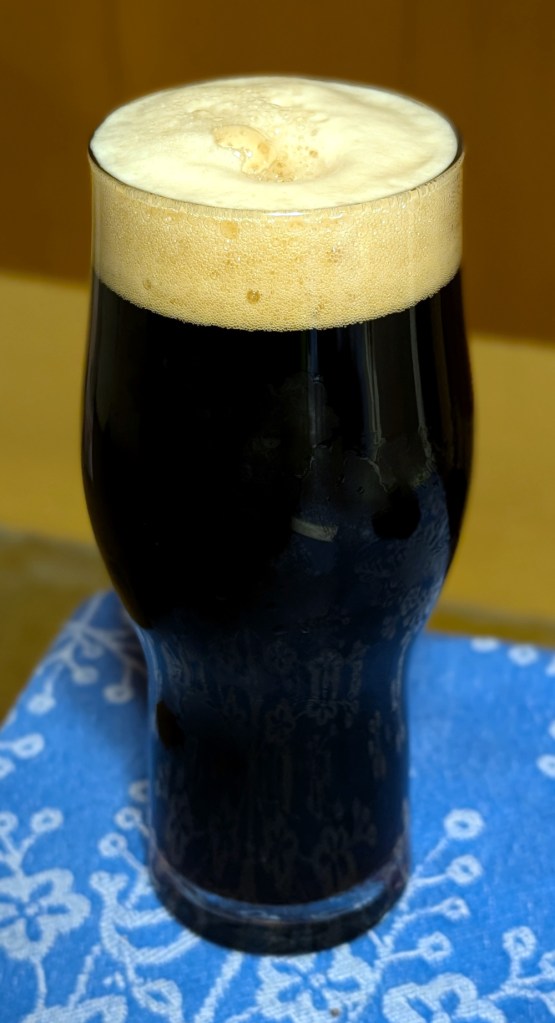
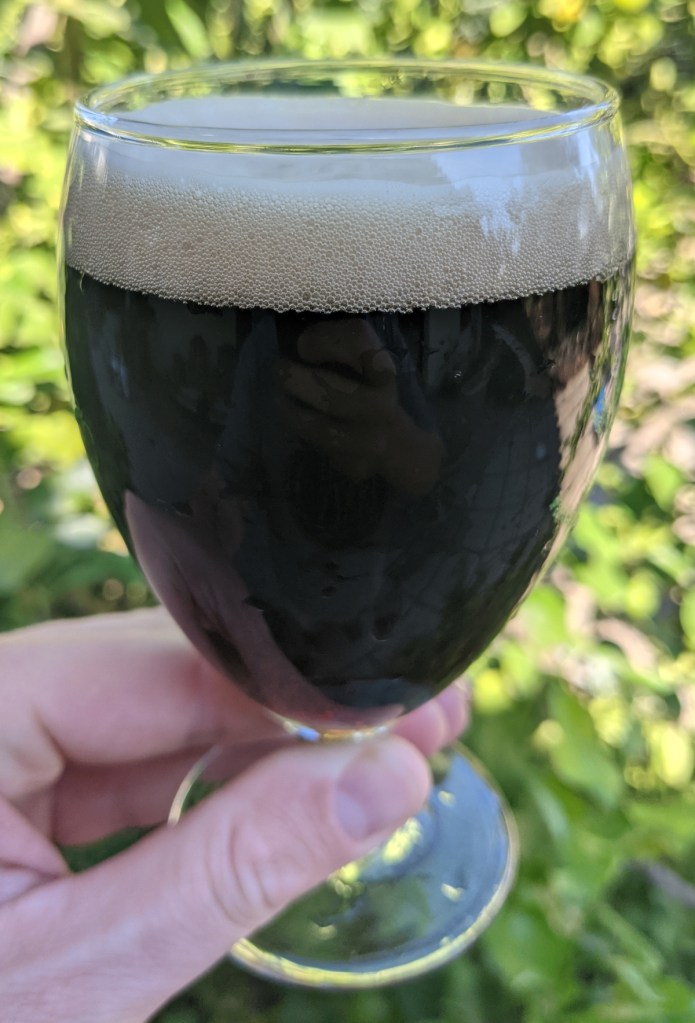
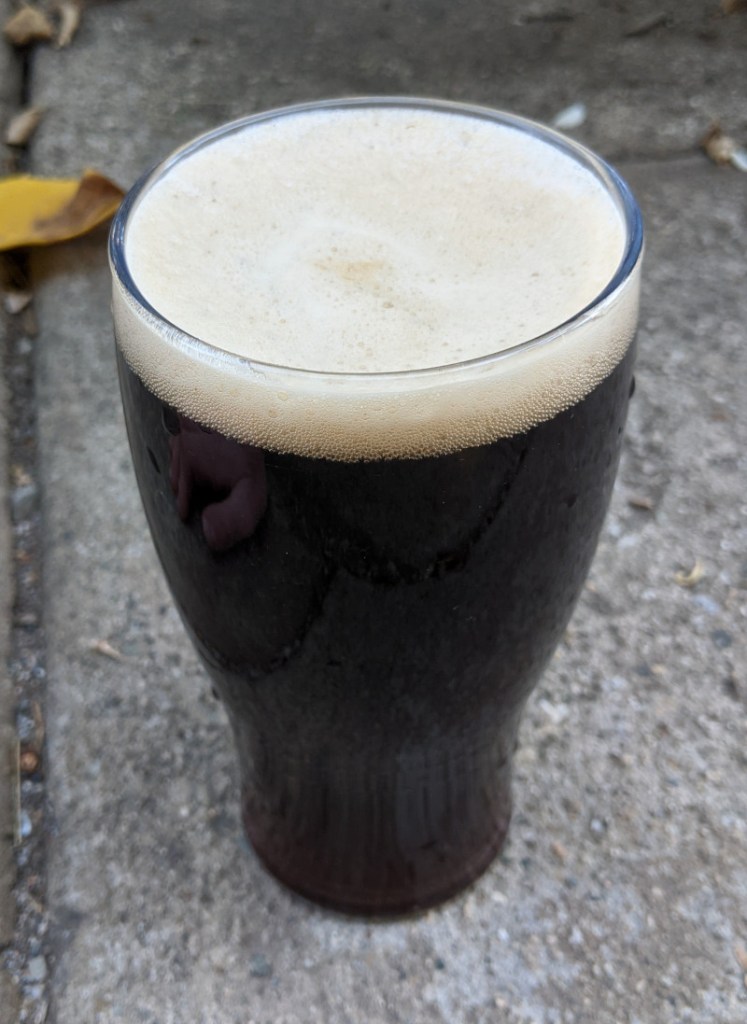
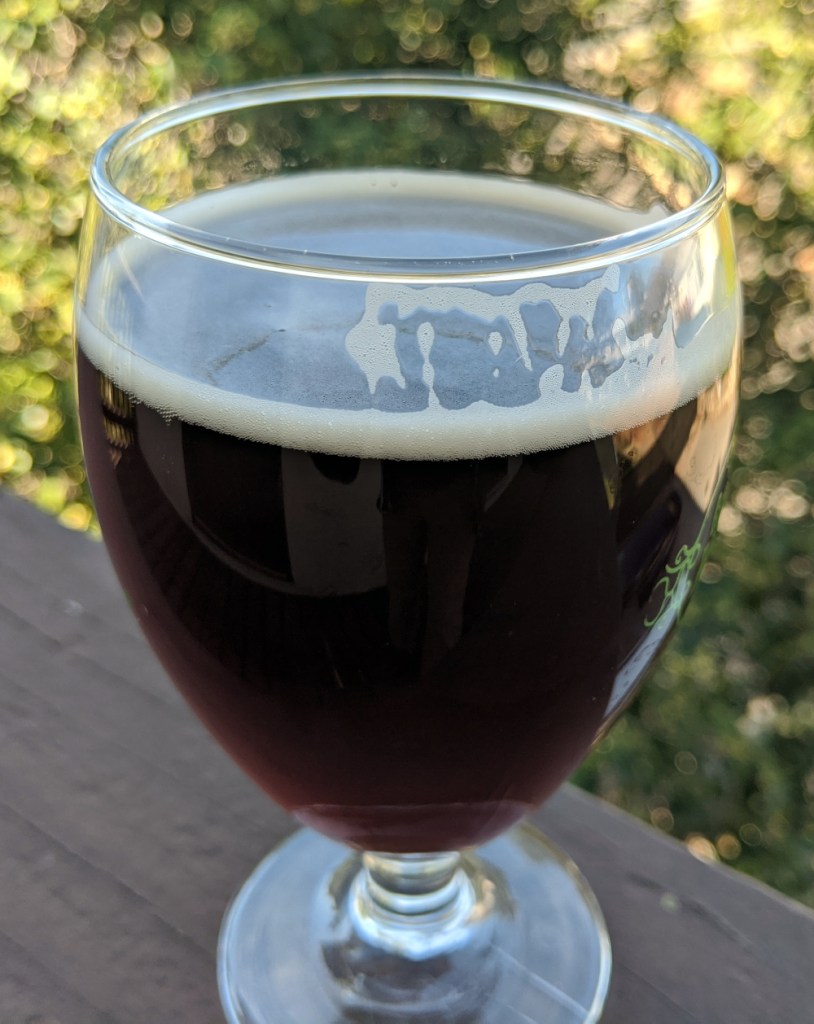
- Deep, deep brown beer with dark garnet highlights, very clear. Pours with a persistent and creamy tan head. Beautiful! Great lacing down the side of the glass.
- Aroma
- Moderate dark chocolate: coffee aroma, a touch of earthy hop character.
- Flavor
- Slightly roasty and bitter chocolate malt character, a bit of dark sugar character; medium bitterness. A medium bit of dark dried fruit yeast character, but it’s in the background.
- Mouthfeel
- Medium carbonation, medium-full body, off-dry finish.
- Would I Brew This Again?
- I love this beer! It’s a perfect American porter, and wonderfully drinkable. Porter is such an underappreciated style; this version looks great and tastes great!
- Overall
- 10/10


 Andy's Brewing Blog