I’m pretty satisfied with my brewing at the moment, which makes sense after nearly 20 years in the hobby! 2026 will be a year of small goals–but I do think it’s important to set some.
Submit something for publication about AquiloPils. It’s a cool story, there’s a cool label, and I have had intentions of writing it up, but just never made the time.
Improve my pH management. I’ve never really stepped up to serious pH measurement, mainly because good equipment is fairly expensive and finicky. In the past, I used cheap pH meters, but they’re not built to last. A few projects–such as Salty One Gose–would benefit from more precise pH data, so 2026 is the year to do this.
Rebrew Salty One Gose. Related to the goal above, this recipe ended up pretty good but I think will be stellar once I dial in the appropriate level of sour.
Embrace dry hopping for pale lagers and similar beers. I have avoided this due to concerns about haze, but I feel that I am missing an opportunity to get a subtle “pop” of hop aroma and flavor in my German pils and kölsch recipes. During the past year or two, I’ve been focusing on late kettle additions, and they have sometimes done well, but I feel like I’m often missing something. I aim to try this with a batch or two and see what happens.
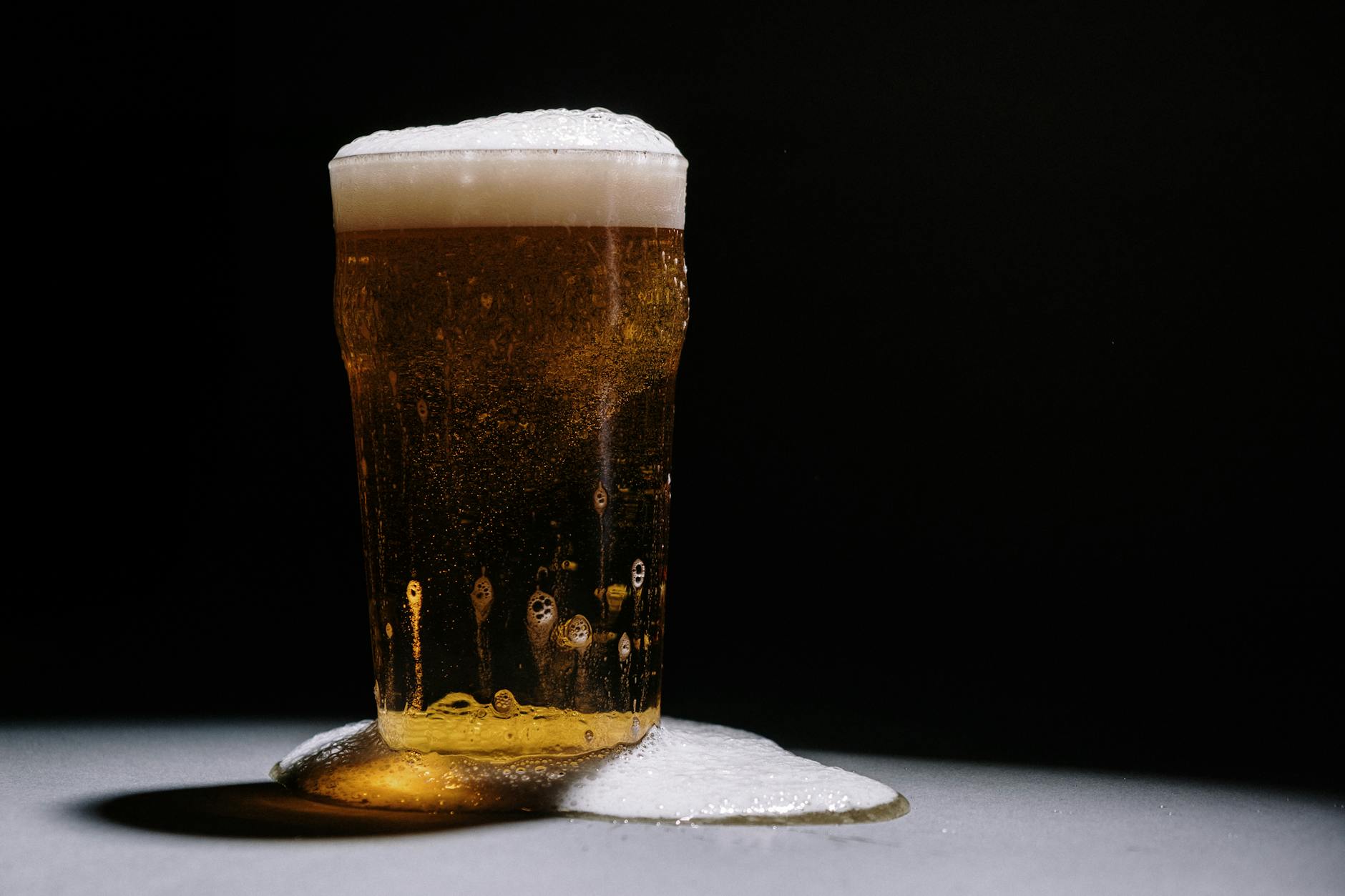
Beer in stock photos always seems to be leaving a mess on the table. Why is spilled beer a trope? Photo by cottonbro studio on Pexels.com
2025 was a decent year for brewing; I focused in part on perfecting classic styles, in addition to returning to a few standby recipes. I feel that I know my brewing system pretty well and have been learning the mash and recipe formulation techniques to get to my destination. Interestingly, I was at nearly 100 percent dry yeast during the past year–I might try one or two liquid yeast varieties for particular batches, but in the end the variety and convenience of dry yeast can’t be beat.
Favorite Batch(es)
Mountain Town Stout was phenomenal, and (surprisingly) my first American stout.
AquiloPils was supremely enjoyable, probably in large part because of the story behind it.
Least Favorite Batch
2025 didn’t have any absolute disasters, but I can say my Old Speckled Hen homage still needs some work.
Mosaic SMaSH Pale Ale wasn’t close to my best, but with some tweaking it can be a winner.
Most Fun New Style/Recipe to Try
Salty One Gose was amazing, and I think it will be even better when I dial it in more.
Upcoming Beer With Most Potential
Six-Shooter Abbey Singel is a Belgian ale clocking in around 6.7% abv; it’s still conditioning, but I’ll put it on tap soon!
Best Ingredient/Technique Added to Repertoire
This was the year of small batches, following my “Brew Year’s Resolution” of doing more small batch beers. This was greatly facilitated by adding an Anvil Foundry 6.5 to my equipment range. This smaller Foundry makes it so easy to do <5 gallon batches, which in turn has encouraged me to brew more often on this system. I’ve really enjoyed trying a bigger spectrum of styles; in many cases, 2.5 gallons is the absolutely perfect quantity.
This year I started a subscription to Craft Beer & Brewing, and it has been a fantastic addition to my homebrew reading routine. The articles tend to focus a bit more on the commercial brewing side, but there are also tons of interesting style profiles. They also highlight lots of interesting homebrew scale recipes, and I’ve enjoyed brewing several. I still love Zymurgy and BYO (now sadly only in online form), but Craft Beer & Brewing brings something different.
Overall Stats
24 batches
8 were “half batches” (between 2.5 and 3 gallons)
I feel like I did a really good job of branching out into new styles, or styles I haven’t brewed much previously; this includes gose, American brown ale, American stout, Belgian single, and others.
The AHA’s re-launch as a 501(c)(3) is apparently well underway. I think “they” (the founding board) have done an excellent job in communication and transparency so far, with a newsy update on the website, forum Q&A, and upcoming virtual town hall. In my opinion, we’ve seen more transparent communication about AHA in the past month than I’ve seen in the past decade. Serious kudos to the founding board for enabling this. At least so far, it feels like things are heading in a good direction, and that there is a genuine attempt to move along from “how we always did things,” the bane of so many organizations.
AHA has now posted and invited comment on its draft vision statement, as follows:
We celebrate, educate, and promote the art, science, and joy of fermentation, championing a united community of today and tomorrow’s homebrewers.
As I submitted to AHA, I really like this version of the vision statement. My initial (half-comprehended) take was that this was way too broad, but I think the use of “homebrewers” at the end brings the vision back to AHA’s roots while also allowing a big tent for fermentation in the future.
AHA also provided their draft strategic priorities, as follows:
My submission to AHA: I have no significant feedback on these; all are on-target and appropriate. I think my main curiosity is what they envision being encompassed within each. Organizational strength and health is a logical first priority, as AHA gets its feet under itself. I view #3 (community, collaboration, and competition) as essential for strength and health. What is AHA’s value proposition now, and how does it engage new members and retain old members? Members who are invested and feel like they have a voice will continue their membership and also be more open to philanthropic support. There will need to be some additional thought around how to shift member culture from the “old way” (minimal communication, little engagement in decision-making, one big in-person event annually, homebrewers viewed implicitly are primarily useful for marketing craft beer, philanthropy something we do for other organizations) to a new way that encourages dialogue, creates meaningful opportunities for participation in decision-making, creates a community where as many people as possible feel like they have a voice, where they have a connection, and all in a way that gets people to think about chipping in a little extra support for AHA. This is a culture shift — but one I think AHA can do! The transparent communication is a HUGE first step; keep up that great work!
The big news of late was that the American Homebrewers Association is being spun off from the Brewers Association as a stand-alone non-profit! I view this as nearly entirely a net good; the BA has increasingly treated the AHA as an unwanted guest during the past few years, and I don’t think the combination was making much sense anymore. The AHA had a reduced voice in BA governance, Homebrew Con was vastly scaled back (and cancelled for this year), AHA membership numbers were down from their peak, and there is a general sense that the hobby is ebbing versus the heady days of the early 2010’s. The vibe I got from the forums, likely at least in part from the aforementioned decisions, was that the AHA wasn’t able to provide a level of engagement or service that made it a compelling need for homebrew hobbyists.
AHA has asked for members to comment on what we’re hoping for in the newly independent organization, as well as a suggested vision statement. I have submitted my thoughts there, but in the meanwhile I also wanted to post them here in case they are useful for others.
“Please provide comments to consider on the future planning of the AHA.”
AHA will need to decide its target membership — is it just for the USA? USA+Canada+Mexico? Worldwide? AHA can’t be everything to everyone, which on the one hand will be a disappointment for some, but on the other hand is necessary for organizational focus.
On the topic of target membership, who is that? There is sometimes an implicit assumption that brewers are homeowners who work as engineers, and that’s not helpful. I really like the way that AHA has made things like 1 gallon stovetop batches more visible lately; let’s keep that energy going! (but don’t forget those making the 5 gallon batches)
Similarly, what sort of fermentations does AHA support? Beer is the obvious core. Does mead stay as a part of this? They seem to be linked at least at an organizational level. Does it make sense going forward? My gut on this is “yes,” but I think it’s a question that needs to be asked! Are the legal frameworks for mead different from those for beer? I would argue against distilling becoming a core of the organization — it’s a very different process, community, and legal framework — and wine also doesn’t make much sense.
With the disconnect between AHA and BA, I foresee a need for AHA to step up and advocate for homebrewers in brewery spaces–especially holding club meetings or organizing general events. Although laws vary from locality to locality, a “toolkit” for homebrewers or homebrewing clubs who want to meet up and share homebrew at public spaces would be very helpful. I think it could also be a potential collaboration between AHA and BA to communicate to the commercial industry about this ongoing desire from hobbyists.
What is the future of Zymurgy? Personally, I like having a physical magazine; I spend too much time with electronic devices as it is, and I enjoy sitting with a homebrew and reading it cover-to-cover. I also recognize that print media is a mixed bag at best these days, not everyone shares my love of printed publications, and even the membership may be split on this. That said, I think any decisions should include both current membership (which I expect skews conservative in wanting a printed publication) and potential membership (which may or may not share those views).
Who owns Zymurgy? That is, where does the copyright for the back issues reside? There is a ton of great content in there, and I am hoping it won’t be locked up by BA. If this hasn’t been outlined yet, it needs to be done ASAP — don’t hope for a future resolution. What other IP will matter?
Consider apps carefully. If well designed, they are useful; but do we need another app for homebrewers? They are expensive to build and maintain, so I would somewhat argue against them.
The recipe archive at the AHA website and in Zymurgy is valuable. I’ve seen a lot of people say, “But there are so many recipes online! I don’t need that archive.” So many of the recipes online are awful. I trust the recipes that the AHA produces, because they have at least minimal vetting.
How does AHA confront the currently changing relationship of society with alcohol? I think it will continue to evolve and ebb and flow, but I do think we need to meet all potential hobbyists where they are.
Community is important. I really love the AHA forum, and find it (for my needs) to be the kind of community I want overall. That said, I really would like to see the AHA help with informal meetups. Not everyone is a club member, or wants to be a club member, or can be a club member, and not everyone has capacity to attend a national conference. But, many folks (me included) would welcome a chance to meet up, swap brews, and hang out with fellow homebrewers. Years ago, AHA used to sponsor rally days. Could something like that return?
What will membership guidelines / rules be? Most member-based organizations will have some kind of code of conduct / member expectations / etc. I don’t feel great about “litmus tests” for members, but I think we’ll want a process for removing someone who is acting counter to the aims of AHA or who grossly violates the norms of a healthy organization.
Members need to feel like we have voices. This hasn’t happened with the BA in recent years. I recognize that there are many potentially competing interests, but yet another survey isn’t necessarily going to be what we need. There should, eventually, be a clear process for volunteering and participating in governance of the AHA. It can’t just be those with the cash to pay to attend HomebrewCon (or its equivalent) every year; that’s only partially representative of the membership.
Speaking of fundraising, I suspect there is going to be heavy lifting to change the philanthropic nature of our homebrewing community. We are conditioned to “doing it for charity” at brew fests and such, but haven’t yet been primed to think of the AHA as one of those charitable options. Fortunately or unfortunately, many (most?) will think that the buck stops with their annual membership dues. We’re going to have to change that thinking. AHA will need to make a compelling case for why members should donate above and beyond their annual dues. Part of that is making initiatives that all members feel they might benefit from. That does not mean there shouldn’t be more focused initiatives (I support those!), but we need to have options. Don’t forget unrestricted donations, either! It doesn’t have to be an immediate donation — estate gifts are equally important. For that matter, make estate planning an option for members!
What other hobbyist groups are important to link up with? If we have similar needs or potentially at least small overlaps in audience, that could be mutually beneficial. Can we learn something from other hobbyist organizations? Have they noted trends or opportunities that might parallel needs for the AHA?
Speaking from a position of ignorance, what is the plan for after the BA? At least initial statements have said that connections for GABF, etc., will remain. What happens when BA says “no more” on that? (perhaps they have promised otherwise, but let’s be realistic here; if it’s not in writing, it’s going away) Would that scenario have a major impact? Or minor impact? Are there members who sign up just for GABF early access, and who would disappear if that disappeared?
For those who have followed things, there is a general distrust and dissatisfaction with the BA. I suspect that is part of why AHA is going independent. BUT…we probably want to have some form of working relationship, at some level. What will that look like?
“Relax, Don’t Worry, Have a Homebrew.” (only partly kidding)
“The American Homebrewers Association will create a community of home brewers of beer and beer enthusiasts, promoting the fun of the hobby, building opportunities for sharing knowledge and camaraderie, and advocating for homebrewers of all locations, backgrounds, and brewing approaches.”
It has been three years since I last did one of these posts, but I figured I would give it a go in 2025. I usually only somewhat loosely adhere to these resolutions, but they can be fun ways to frame the year.
More Small Batches.
I enjoy brewing, and sometimes it’s more about the brew day than consuming the final product. One way to get around an occasional backlog in beer (and to have more variety) is to brew smaller batches. So, I’m going to aim to do a greater percentage of 3 gallon brews this year. Although I anticipate continuing with 5 gallon batches as the bulk of my brewing (especially for favorites like German pils), I hope to work more 3 gallon batches into the rotation, especially for new-to-me styles.
Conditioning Time.
Somewhat paradoxically relative to the item above, some of my beers would benefit from a longer conditioning or lagering time before serving. For instance, my märzen was on tap within 6 weeks after kegging, but a minimum of 8 weeks and preferably 10 would have been ideal to hit the point of brilliance for this particular recipe. A German pils (not yet posted) is at 6 weeks and is now brilliant and ready to serve; I often have these beers on around 2 weeks after kegging. Beyond simple discipline, I think the key to achieving this goal is brewing frequently enough that I can afford to let a keg sit for longer lagering.
New Styles.
I have explored a good chunk of the styles out there, but there are still more to do. In the most recent Zymurgy issue that highlights the winners of the 2024 NHC, there was a really intriguing gose recipe. Sour beers aren’t my usual favorite, quick sour methods are sometimes a bit one dimensional or not advised for many styles, and the possibility of contamination always gives me second thoughts. But, this particular “Salty One” by gold medal winner Jonathan Hernandez relies on a blending technique that avoids souring on the cold side, and allows some complexity on the hot side. Basically, you make a fraction of the batch as sauergut, and then adding this to the rest of the wort at the boil. I’m going to give it a try!

 Andy's Brewing Blog