
Summer is a great time for pale lagers! For this recipe, I riffed on the Schell’s Pils clone I’ve brewed in the past. It is intended to be a German pils, which is a style I quite enjoy. This recipe uses only 2-row malt, rather than pilsner malt, for the base, with a bit of CaraPils or similar malt.
For this iteration, I tried out Mecca Grade’s pale American malt as the primary base grain, using a bit of Rahr 2-row to finish out that supply. I also subbed in Carafoam instead of Carapils. The hops are entirely whole cones from South Dakota (thanks, Dad!). I had to guess on the alpha based on what is typical for the style, and as you’ll see in the results probably guessed high.
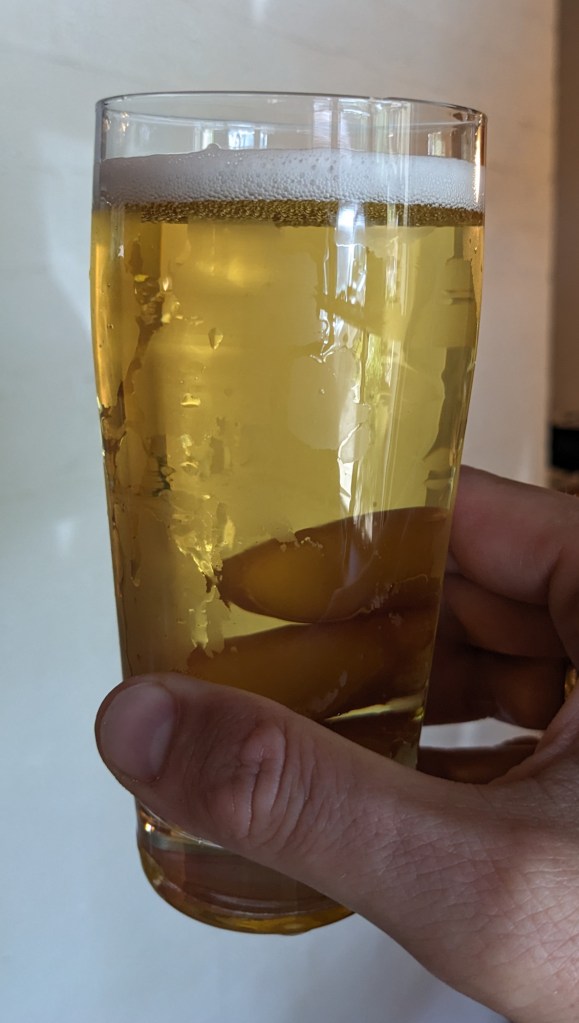
Dakota Gold Pils
- 7 lb. 9 oz. Lamonta Pale American malt (Mecca Grade)
- 2 lb. 7 oz. 2-row pale malt (Rahr)
- 0.5 lb. Carafoam malt (Weyermann)
- 1.09 oz. Hallertauer whole hops (3.0% estimated alpha), 60 minute boil
- 1 oz. Sterling whole hops (4.5% estimated alpha), 60 minute boil
- 1 oz. Saaz whole hops (3.5% estimated alpha), 15 minute boil
- 0.5 tsp. BrewTanB, 10 minute boil
- 1 Whirlfloc tablet, 5 minute boil
- 1 oz. Saaz whole hops (3.5% estimated alpha), 5 minute boil
- 1 tsp. yeast nutrient (WLN1000, White Labs), 5 minute boil
- 2 pkg. Diamond Lager dry yeast (Lallemand)
Target Parameters
- 1.047 s.g., 1.010 f.g., 4.8% abv, 35 IBU, 5 SRM
- Full volume mash, 149° for 60 minutes, 168° mash-out for 10 minutes
- RO water with minerals added to hit target of 59 ppm Ca, 8 Mg, 89 SO4, 63 Cl, RA=-47, alkalinity=0.
Procedure
- Starting with 7.6 gallons of RO water, I added 2.7 g gypsum, 2.2 g epsom salt, and 3.4 g of calcium chloride, to hit the target water profile. I also added half of a sodium metabisulfate tablet, to remove any latent oxygen in the water.
- I heated the water to 154° and added the grains to hit a target mash temperature of 149°. I did not add any lactic acid, because the pH was calculated to be approximately fine (pH of 5.4) without any additions.
- After a 60 minute mash, I heated to 168° for the mash-out, and pulled the grains after 10 minutes of this.
- In total, I collected 6.8 gallons of runnings with a gravity of 1.039, for 70% efficiency.
- I brought the runnings to a boil, adding hops and finings as indicated by the recipe. After a 60 minute boil, I turned off the heat and chilled to ~70°. I transferred the wort to the fermenter, and chilled down to 50° before pitching the yeast.
- Starting gravity was 1.047. I brewed the beer on 15 April 2023, fermenting at 52°. I held it here until 13 May 2023, when I cold crashed the beer.
- I kegged the beer with a closed transfer on 28 May 2023. Final gravity was 1.009, for 5.0% abv.
Tasting
- Appearance
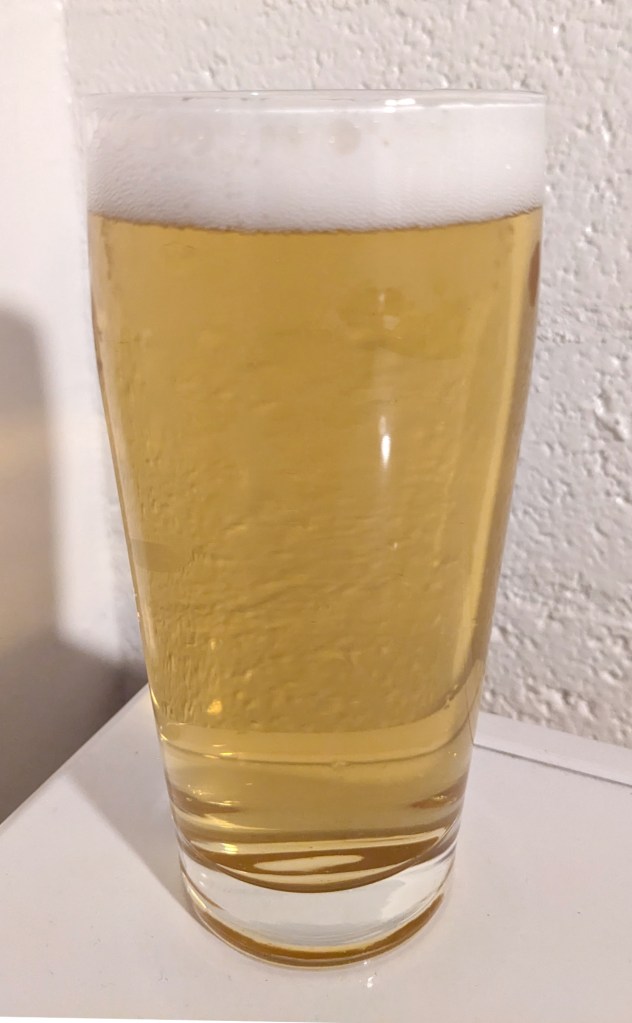
- Brilliantly clear, straw-colored beer that pours with a fine and persistent white head. Absolutely beautiful!
- Aroma
- Sweet malt aroma. Not really much for hops.
- Flavor
- Cracker and sweet malty flavor. Moderately low bitterness, with a very clean fermentation profile. There is not a ton of hop character, surprisingly.
- Mouthfeel
- Medium-light body, moderately high carbonation, and smooth finish with a slightly extended bitterness.
- Would I Brew This Again?
- This is an excellent beer! A touch more bitterness and hop flavor/aroma would be great, but it is otherwise fantastic in drinkability and appearance. It’s not really a German pils at all–it should be more bitter–but that’s OK. Were I to assign a BJCP category, I would probably put it in International Pale Lager. This is the definition of a lawnmower beer!
- Overall
- 10/10 as a beer on its own; 6/10 as a German pils.
 Andy's Brewing Blog