
German beers are certainly my favorite, although a classic German pils is probably my most frequently brewed style within that realm (19 batches since 2016). I haven’t done many märzens, and it seemed like a good seasonal style to explore again. My first version was Monks’ Fortitude Märzen, and it was an exceptional beer. Malt is at the forefront of this style, with Monks’ Fortitude hitting 1.055 with 71% Vienna, 25% Munich II, and 4% Carared malts. For my latest foray into märzens, I took a page from Brewing Classic Styles, via their Munich Madness recipe. Atlhough BCS is pushing 20 years old, it has stood the test of time as a handy reference, especially for styles that have been pretty constant.
My version of Munich Madness has been adjusted slightly from the original, primarily to lower the abv a bit. The original had a starting gravity of 1.059, so I dropped it to 1.054 to hit the lower bound of the BJCP style and also make it a bit more drinkable for my tastes. This was done by maintaining the grain proportions and dropping the amounts slightly, and drops the recipe from around 6% to the lower end of 5%.
Munich Madness II
- 4.75 lb. pilsner malt (Rahr)
- 3.5 lb. Munich I malt (Weyermann)
- 2.75 lb. Vienna malt (Weyermann)
- 0.75 lb. Caramel Munich 60L malt (Briess)
- 0.5 tsp. BrewTanB, added to mash
- 2 oz. Hallertauer Mittelfrueh hop pellets (2.7% alpha), 60 minute boil
- 0.5 tsp. BrewTanB, 10 minute boil
- 1 Whirlfloc tablet, 5 minute boil
- 3 pkg. Diamond Lager dry yeast (Lallemand)
Target Parameters
- 1.054 o.g., 1.013 f.g., 5.3% abv, 19 IBU, 10 SRM
- Full volume mash at 152° for 60 minutes, 10 minute mash-out at 168°
- Claremont tap water, with Campden tablet, adjusted to hit water profile of 56 ppm Ca, 12 ppm Mg, 87 ppm Na, 89 ppm SO4, 110 ppm Cl, and 20 ppm CO3.
Procedure
- Starting with 7.5 gallons of tap water, I added a Campden tablet and 6.25 mL of 88% lactic acid, followed by 2 g of gypsum, in order to hit my water profile.
- I heated the water to 158°, and added the grains, holding at 152° with recirculation for 60 minutes before heating to 168° and holding there for 10 minutes.
- At the end of the mash, I removed the grains. In total, I collected 6.75 gallons of runnings with a gravity of 1.045, for 70% mash efficiency.
- I brought the runnings to a boil, adding hops and finings per the recipe. After 60 minutes, I turned off the heat and chilled to 80° before transferring to the fermenter.
- I chilled the fermenter overnight down to 50°, before pitching the yeast.
- I brewed the beer on 13 September 2024 and pitched the yeast on 14 September 2024. Starting gravity was 1.053.
- I fermented at 52° until 30 September 2024, when I let the beer free rise to 60°, and then pulled to ambient (~74°) on 5 October 2024.
- I kegged the beer via closed transfer on 12 October 2024. Final gravity was 1.012, for 5.4% abv.
Tasting
- Appearance
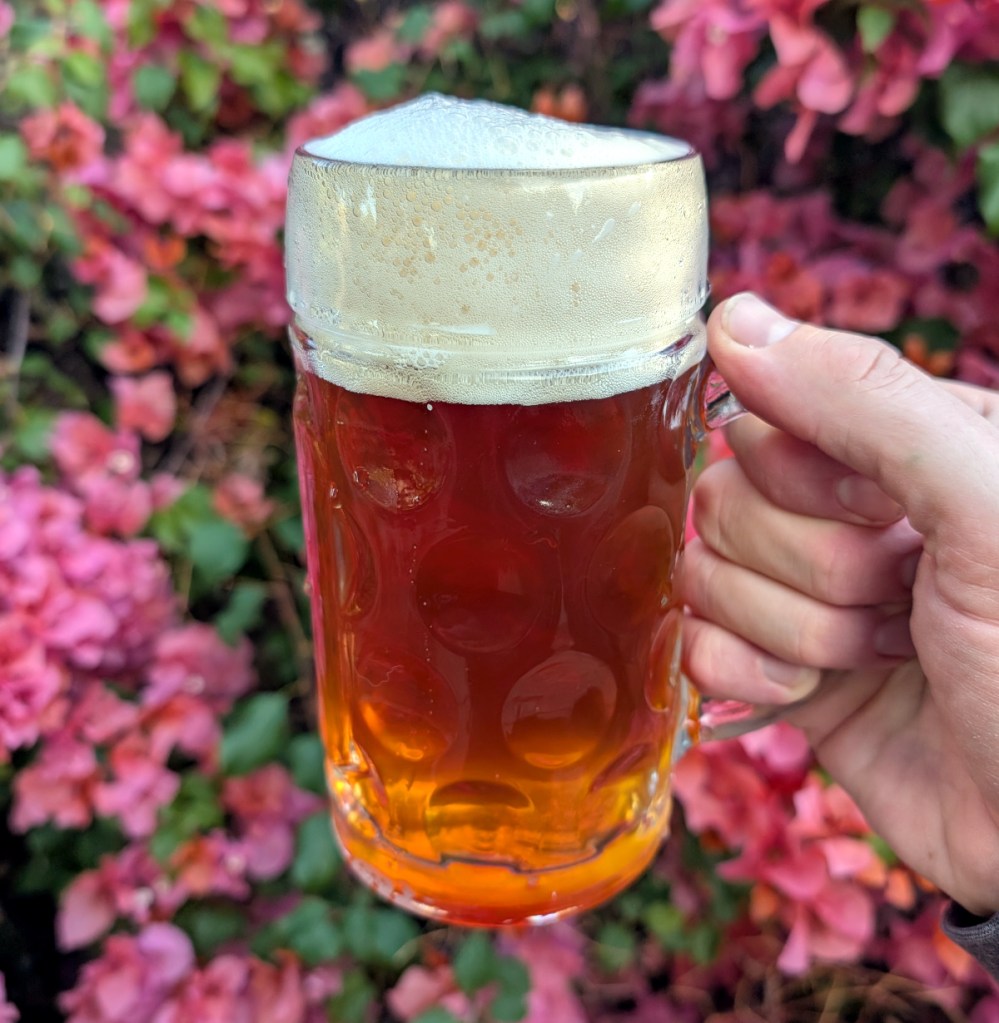
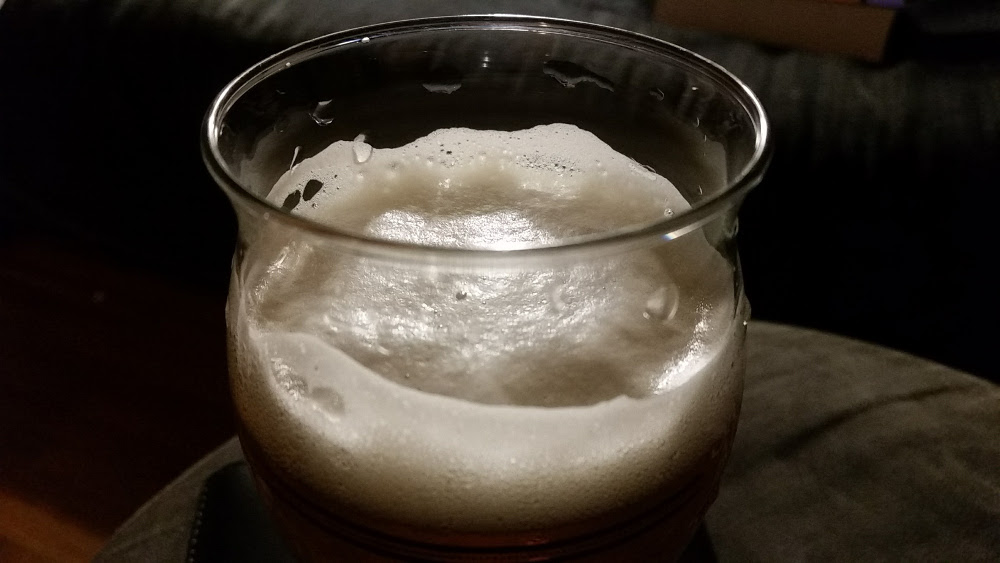
- The beer pours with a tall and persistent ivory head; it is a clear and medium amber-orange beer.
- Aroma
- A moderate bread crust malt character at the forefront; slight spicy hop aroma behind that.
- Flavor
- Very rich, malty character dominates the flavor, with some bready notes. A medium-low, clean bitterness with a hint of spice is behind that. Yeast profile is clean. It is a very easy drinking beer!
- Mouthfeel
- Medium body, moderate carbonation, smooth finish that is slightly dry.
- Would I brew this again?
- This is a fantastically drinkable fall lager, which is interesting but not so interesting that I can’t have another. The malt character is excellent. I rushed this beer just a touch (relative to a “traditional” märzen) in terms of lagering, and a little more time would help it condition and clear to brilliance. Overall, though, this is a winner! [note added after the post was published – by mid-December, the beer had cleared to brilliant; so, a minimum of two months seems to be optimal for this style, recipe, and yeast]
- Overall
- 8/10


 The Basics

 Andy's Brewing Blog