Holy Helles & First Amendment Blonde Ale Kegged

I did a whole mess of kegging tonight, to clear out fermenter space and move along some projects.

First up was my Holy Helles (a Munich Helles), which I split into two 2.5 gallon kegs. The reason behind this was that I plan to enter it in the National Homebrew Competition, and also to serve it at Easter. I didn’t want to dose the Easter beer with gelatin (in case some of our guests don’t do gelatin), but don’t much care for the NHC one.

A few notes on the helles fermentation…on 21 January 2017, the gravity was down to 1.014. At this point, I raised the temperature from 50° to 68° for a diacetyl rest. I left it at this temperature for about a week, and then dropped it down to 34° until kegging.

Final gravity was 1.012, a touch higher than predicted (1.010). With a starting gravity of 1.047, this equals 4.6% abv. That should make a nice, drinkable beer!

Next, I kegged the First Amendment Blonde Ale. Final gravity was 1.011, down from a starting gravity 1.051, for 5.2% abv. I hit my numbers perfectly on this batch–wow, what a nice treat!

I’m storing these beers at 34°, and force carbonating the blonde ale right away.

First Amendment Blonde Ale

This batch is a slight rework of my favorite blonde ale recipe. I upped the base malt a slight bit, and have switched to just Warrior as a bittering addition. I recently bought a pound of the stuff–my intention is to use it for the bulk of my bittering additions in various recipes going forward. Warrior’s bittering properties are supposed to be fairly gentle (attributed to its low cohumulone values), so I figured I would try it out as an alternative to some other hopping strategies I have used in the past.

The name honors the Women’s Marches that took place across the country on the day I brewed this (I was there with my family at the Los Angeles one)–and of course, it honors all who peacefully and proudly exert their constitutional rights, regardless of where they fall on the political spectrum.

Overall, I was quite pleased with how the brew session went. Other than a high-than-expected efficiency (which is not the worst thing on the planet), I hit my temperatures and brew numbers quite effectively.

First Amendment Blonde Ale

  • 9.5 lbs. 2-row brewer’s malt (California Select, Great Western Malting Co.)
  • 0.5 lb. 20° caramel malt (Briess)
  • 0.4 oz. Warrior hop pellets (15.8% alpha), 60 minute boil
  • 1 Whirlfloc table, 10 minute boil
  • 1 tsp. Fermax yeast nutrient, 10 minute boil
  • 1 pkg. California Ale yeast (WLP001, White Labs)

Target Parameters

  • 152° mash, 60 minutes
  • 1.051 o.g., 1.011 f.g., 5.2% abv, 24 IBU, 5 SRM, 5.5 gallons into the fermenter

Procedure

  • Three days in advance, I made a 1.5L starter. It ran on the stir plate for two days, before I split it up and cold-crashed it. I set aside 0.64L for another batch, and the remainder will be used in this batch.
  • I built up my water from RO for this batch, adding all of the minerals to the strike water (3.375 gallons). I used 4.9g gypsum, 0.9g epsom salts, and 4.6g calcium chloride. I also added 2 tsp. of phosphoric acid (10% concentration), to acidify the mash. The final target brewing water profile will be 75 ppm Ca, 100 ppm S04, and 75 ppm Cl. This profile, based on one in the Palmer and Kaminski water book, will hopefully avoid the “flabby” taste I have been getting in my blonde ales brewed with local tap water.
  • I warmed up my mash tun with 3.375 gallons of water at 170°. Once it hit 164°, I added the grains, to hit my target mash temperature of 152° on the dot.
  • I mashed for 60 minutes. I checked the pH, and it was around 5.4.
  • After 60 minutes, I added 1.3 gallons of water at 185°, let it sit for 10 minutes, vorlaufed, and collected the first runnings.
  • Next, I added 3.5 gallons of water at 185°, let it sit for 10 minutes, vorlaufed, and collected the second runnings.
  • I total, I collected 6.8 gallons of wort with a gravity of 1.044–82% efficiency! I’ll aim for a lower boil in order to ensure I don’t overshoot my target gravity.
  • Once I brought the brew to a boil, I added the hop pellets in a bag and boiled for 60 minutes, adding the Whirlfloc and Fermax with 10 minutes to go.
  • After 60 minutes of boiling, I chilled the wort to 70°, transferred to the fermenter while aerating, pitched the yeast, and sealed it up.
  • I brewed this beer on 21 January 2017. Starting gravity was 1.051, precisely on target. I plan to ferment this batch at 66°.

Beer Tasting: New World Blonde Ale

blonde_aleMy New World Blonde Ale ran out last week, but I did a tasting before the keg kicked. Results are below.

  • The Basics
    • Original gravity = 1.045; final gravity = 1.008; abv = 4.9%; estimated IBU = 24
  • Aroma
    • Initial aroma has a bit of orange with a hint of grainy maltiness behind that.
  • Appearance
    • Moderately hazy and light gold beer, with a low and fine but persistant white head.
  • Flavor
    • Light malt flavor with a slightly grainy and bready aspect. Hops are at a moderately high level for a blonde ale, with a slight orange pith aspect to it. When I first tapped this beer, the citrus was a bit overwhelming and unpleasant–almost like rotten orange. I think somewhere this flavor was euphemistically called “candy orange,” but I can’t say it is a particularly pleasant flavor. It has moderated quite a bit, but is still hanging around in the shadows.
  • Mouthfeel
    • This is a light-bodied beer with moderately high carbonation, so that it has a slightly effervescent feel on the tongue. The finish is dry, and the hop bitterness persists as the dominant character.
  • Would I brew this again?
    • This is a decent beer, but not a great beer. Or I should say that it’s not really to my tastes. I think I will lay much of the “blame” on HBC 438–the hop comes across as a bit harsher than I like. Perhaps it is good in other styles, but it just doesn’t do the trick in this particular beer. Apparently HBC 438 has been a pretty divisive hop–people either love it or hate it. I wonder if there’s not some compound in there similar to the various stuff in brussels sprouts, where folks with one taste receptor taste awesomeness and folks with another taste receptor taste awfulness.
  • Overall rating
    • 5 / 10

Honey Fuggle Ale Kegged

Today I kegged my Honey Fuggle Ale, after 11 days in the primary fermenter. This will definitely be a unique beer, in all of the best ways (I hope). The lightly fruity esters from the yeast and the sweet notes from the honey malt have melded in a way that’s not really common in an American blonde ale. I would bet it’s going to be on the edge of that style, but it’s a blonde ale in my mind still! What’s homebrewing without pushing boundaries?

Time and conditioning will tell how this shapes up. The final gravity was 1.012, down from 1.047, for 4.6% abv.

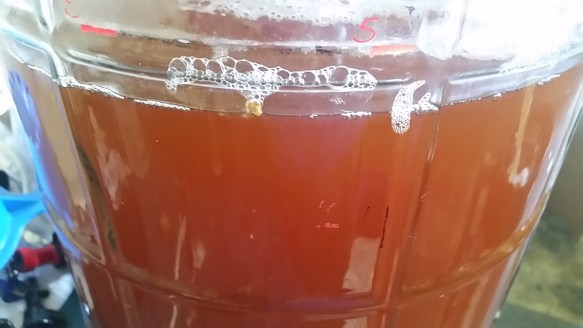
Honey fuggle ale in the primary fermenter

Honey Fuggle Ale

I recently ran across a fun-looking recipe in BYO (December 2015 issue), for a clone of Firestone Walker’s 805. I was in the mood to make a blonde ale, and particularly in the mood to make a new recipe of blonde ale. With a few minor modifications (US Fuggles instead of Willamette for the hops, and a touch less wheat malt, to use up my stash without having to buy more), I had everything in order.

The original recipe suggested building up from RO water; given the highly mineralized nature of our tap water, that seemed like a good idea. I’ve noticed that many of my lighter-flavored beers come across as a bit “flabby”, and suspect that the water is behind it. So, I bought a bunch of distilled water and some more brewing minerals. For the 3.75 gallons of mash water, I added 7 g of calcium chloride and just under 1/4 tsp. of 10% phosphoric acid. The 4.9 gallons of sparge water were treated with just 1/4 tsp. of 10% phosphoric acid.

I have to say that I really enjoy the honey malt addition in this one–it adds a deliciously sweet and distinct character to the wort. Although it certainly isn’t a malt for all occasions, it’s a nice ingredient to keep in the back of my mind for other batches. I’m intrigued to see how the honey malt plays out in a blonde ale like this one.

I had planned to use my culture of Conan (Yeast Bay’s “East Coast Ale” yeast), but when growing up the culture I noticed the aroma was a bit “off” from the first few generations. It wasn’t awful–just not quite right. So, I made a decision to toss it and go with dry yeast instead. The yeast didn’t really owe me anything–I got three good batches out of it, so that seemed to be plenty fine. I’m not sure if it was a contamination issue, or if the yeast had just drifted genetically.

20160521_072106

Grains ready for the mash tun.

Honey Fuggle Ale

  • 8.25 lbs. 2-row malt (Great Western Malting Co.)
  • 0.75 lbs. honey malt
  • 0.5 lb. white wheat malt
  • 1 oz. US Fuggle hops pellets (4.5% alpha, 3.1% beta), 60 minute boil
  • 1 oz. US Fuggle hops pellets (4.5% alpha, 3.1% beta), 5 minute steep after boil
  • 1 tsp. Irish moss (10 minute boil)
  • 1/4 tsp. yeast nutrient (10 minute boil)
  • 1 pkg. Nottingham dry yeast (Danstar)
  • Brewing water prepared as follows:
    • 3.75 gallons of mash water, with 7 g. calcium chloride and 1/4 tsp. 10% phosphoric acid
    • 4.9 gallons of sparge water, with 1/4 tsp. 10% phosphoric acid

Brewing Targets

  • Mash temperature = 156°
  • Original gravity = 1.045 (actual = 1.048)
  • Color = 5 SRM
  • IBU = 19

Procedure

  • I mashed in with 3.75 gallons of water at 167.9°, to hit a mash temperature of 157°. The mash was down to 152° after 60 minutes.
  • I collected the first runnings, and then added 4.9 gallons of water at 185°, to bring the mash bed up to right at 170°. I let it sit for 10 minutes, vorlaufed, and collected the rest of the wort.
  • I collected 7.2 gallons of wort at a gravity of 1.039, for 81% efficiency! Wow! I am not sure if this was the result of my water treatment, or something else, but it was certainly unexpectedly high.
  • I brought the wort to a boil, and added the various ingredients per the schedule in the recipe.
  • After 60 minutes, I added the final dose of hops and chilled the wort down to 80°. After transferring it into my carboy, I let it cool in the fermentation chamber for an hour or two, down to 68°, and then sprinkled the yeast on the wort.
  • The starting gravity was 1.048, and I am fermenting the beer at 68°. This beer was brewed on Saturday, 21 May 2016.