Bear Butte Porter

Porters are a classic homebrewing style, and they are an accessible entry point for newer brewers because their rich flavors are simultaneously enjoyable and also able to cover the results of overheated fermentations. As my brewing has progressed, and my fermentation temperature control has improved, I come back to them again and again as an enjoyable winter beer.
Last year I made a Sierra Nevada Porter clone, and this year I delved into a clone recipe for Deschute Brewing’s Black Butte Porter. The version I had was pulled from the Brew Your Own Big Book of Homebrewing (2022 updated edition), with some small modifications for hops and yeast on-hand on-hand as well as some very slight malt quantity adjustments. Instead of Galena as the bittering charge, I subbed in Chinook, which seemed like a reasonable swap, and I used Mangrove Jacki’s M36 Liberty Bell ale yeast instead of Lalbrew’s Verdant strain. Again, this seemed to be a reasonable swap that would get me into the same flavor zone. Interestingly, I learned via David Taylor’s Yeast Master List that M36 is a blend of M42 (New World/Nottingham) and M15 (Empire/Windsor); the reported fruitiness of the strain seemed like a good fit for this particular batch.

It’s interesting to note that the BYO clone recipe is very different from an AHA clone recipe. The AHA version uses chocolate wheat malt instead of chocolate malt, 80L crystal instead of 60L crystal, and a bit of dextrine malt, and it also calls for WLP002. Hops include Hallertauer instead of Tettnang. I’m not sure which version is more “authentic,” and I suppose it doesn’t really matter in the end! As another aside, I brewed a version of the AHA recipe back in 2021, as Turtle Toe Porter.

Because this is not a direct version of the clone recipe, and in honor of a landmark in my home state, I have called this batch “Bear Butte Porter.” I also used some South Dakota-grown hops from my dad, another fitting addition to the beer.

Bear Butte Porter

  • 10.25 lb. 2-row brewer’s malt (Great Western)
  • 0.75 lb. crystal 60L (Briess)
  • 0.75 lb. chocolate malt (Simpsons)
  • 0.35 oz. Chinook hop pellets (12.3% alpha), 60 minute boil
  • 2 oz. Cascade whole hops (3.5% est. alpha), 20 minute boil
  • 1 Whirlfloc tablet, 5 minute boil
  • 2 oz. Tettnang hop pellets (2.4% alpha), 5 minute boil
  • 1 pkg. Liberty Bell ale yeast (Mangrove Jack’s M36)

Target Parameters

  • 1.052 s.g., 1.012 f.g., 5.4% abv, 33 IBU, 33 SRM
  • Full volume infusion mash, held at 152° for 60 minutes and 168° for 10 minutes
  • Claremont tap water with Campden tablet, with approximate ppm of 110 Cl, 50 SO4, 40 Ca, 156 HCO3, 12 Mg, 87 Na

Procedure

  • I heated 7.5 gallons of Claremont tap water, with Campden tablet, to 158°, before adding the grains as well as 6 mL of 88% lactic acid to adjust the mash pH. I held the mash at 152° for 60 minutes, with recirculation, before raising the temperature to 168°. After 10 minutes at the mash-out temperature, I removed the grains and heated the runnings to a boil.
  • In total, I collected 6.7 gallons of runnings with a gravity of 1.043, for 68% mash efficiency.
  • Once the runnings were boiling, I added the hops and finings per the recipe. After 60 minutes on the boil, I turned off the heat and chilled to 78° before transferring to the fermenter and dropping to 66° in the fermentation chamber.
  • Once the beer was at 66°, I pitched the yeast.
  • I brewed this beer on 25 October 2024; it had a starting gravity of 1.057.
  • I fermented the beer at 66° until 28 October 2024, when I pulled it to ambient (~70°). Active fermentation seemed mostly done, so I figured it wouldn’t hurt it to sit at ambient for awhile.
  • I kegged the beer on 16 November 2024. Final gravity was 1.016, for 5.4% abv. This was around 71% measured attenuation. It’s on the lower end that Mangrove Jack’s reports for the strain (74% to 78%), but in my experience I’ve often had lower attenuation with the Windsor strain that comprises part of this blend.

Tasting

  • Appearance
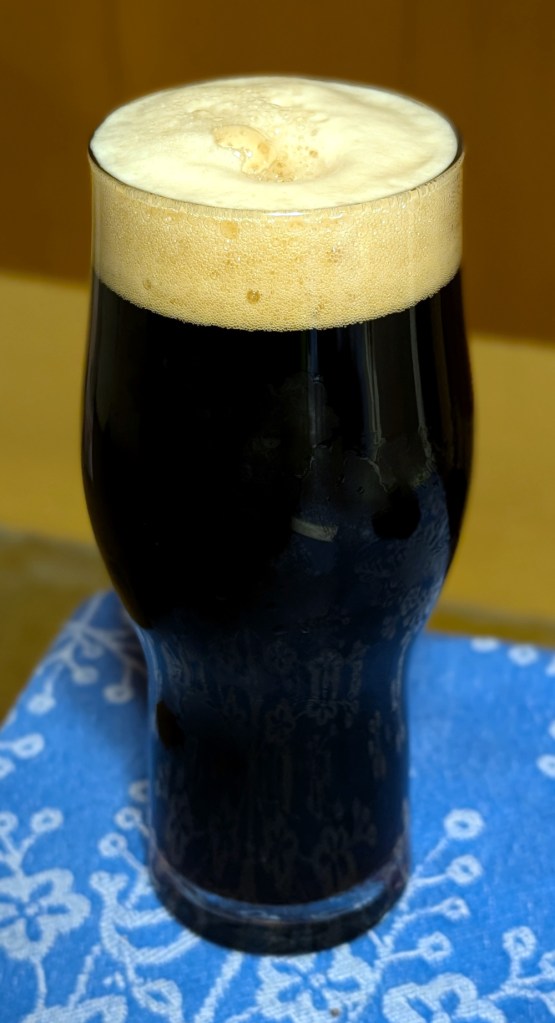
    • Deep, deep brown beer with dark garnet highlights, very clear. Pours with a persistent and creamy tan head. Beautiful! Great lacing down the side of the glass.
  • Aroma
    • Moderate dark chocolate: coffee aroma, a touch of earthy hop character.
  • Flavor
    • Slightly roasty and bitter chocolate malt character, a bit of dark sugar character; medium bitterness. A medium bit of dark dried fruit yeast character, but it’s in the background.
  • Mouthfeel
    • Medium carbonation, medium-full body, off-dry finish.
  • Would I Brew This Again?
    • I love this beer! It’s a perfect American porter, and wonderfully drinkable. Porter is such an underappreciated style; this version looks great and tastes great!
  • Overall
    • 10/10

Black Bear Pils

I really like German pils, and make it pretty frequently…with 14 brews of this style under my belt, it’s time for number 15! For this iteraton, I returned to Dave Carpenter’s Lager book for inspiration via the Pfriem Pilsner recipe. My current version is modified for hop varieties on-hand; thanks to my HOPBOX I had a few different German hops in the freezer, which were a perfect match for this style. Notably, I’ve never brewed with Saphir before, and wanted to give it a try. I also had some S-189 in my stockpile (from a freebie give-away), and figured this would be a good batch to try it in.

The batch practically named itself. I was brewing in my garage on a hot summer day, with the Foundry right at the garage door entry. I ran across the driveway (our house is horseshoe shaped, with a parking space right in the middle of the U) to grab something from my fermenting area, leaving my brew rig unattended for a minute. Looking out the window and towards the garage, I suddenly noted a black bear wander into our yard. It ambled over to the open garage door, obviously intrigued by the malty aromas of a pilsner mash. As it started to poke its nose around the Foundry, two thoughts went through my head…first, “That’s so cool! I should get a picture!” The second thought was…”My beer! The bear! I don’t want the mash tun tipped over! The bear could get burned! My beer could get wasted! Action! Quick!” In an instant, I was at the door, yelling at the unexpected visitor to get out of my garage! With what I can only assume was surprise, the bear craned its neck to look at me, and then booked it out of the yard. Disaster averted! And beer recipe named.

Black Bear Pils

  • 10.25 lb. Barke pilsner malt (Weyermann)
  • 2 oz. acidulated malt (Weyermann)
  • 1 oz. Hallertau Tradition hop pellets (6.1% alpha), 60 minute boil
  • 0.5 oz. Hallertau Tradition hop pellets (6.1% alpha), 10 minute boil
  • 0.5 oz. Saphir hop pellets (3.7% alpha), 10 minute boil
  • 0.5 oz. Spalt Spalter hop pellets (3.0% alpha), 10 minute boil
  • 1 tsp. BruTanB, 10 minute boil
  • 1 Whirlfloc tablet, 5 minute boil
  • 1.5 oz. Saphir hop pellets (3.7% alpha), 10 minute whirlpool
  • 2 pkg. SafLager German lager yeast (Fermentis S-189)

Target Parameters

  • 1.047 s.g., 1.007 f.g., 35 IBU, 4 SRM, 5.2% abv
  • Full-volume mash, no sparge, at 142° for 40 minutes and 156° for 40 minutes, with 10 minute mash-out at 168°
  • Claremont tap water adjusted with RO and minerals to hit 47 ppm Ca, 2.5 ppm Mg, 33 ppm Na, 92 ppm SO4, 39 ppm Cl, and 11 ppm HCO3, with 9 ppm alkalinity and RA=-26 ppm

Procedure

  • To produce the water, I added 2 mL of 88% lactic acid to to 2.5 gallons of tap water to remove the bicarbonate, and then 1/4 of a Campden tablet to remove the chloramines. Then, I added 4.5 gallons of RO water and 3.5 g gypsum to achieve a final water with 47 ppm Ca, 2.5 ppm Mg, 33 ppm Na, 92 ppm SO4, 39 ppm Cl, and 11 ppm HCO3, with 9 ppm alkalinity and RA=-26 ppm.
  • I heated the mash water to 146°, and added the grains to hit a target mash temperature of 142°. I held it at this temperature for 40 minutes, chasing away bears when necessary. It wasn’t necessary to add lactic acid for this batch, because I already had acidulated malt. After the initial rest, I raised the mash temperature to 156°, and held it here for another 40 minutes. Finally, I heated to 168° and held it there for 10 minutes before removing the grains.
  • In total, I collected 6.5 gallons of runnings with a gravity of 1.041, for 70% mash efficiency.
  • I brought the runnings to a boil, adding hops, BrewTanB, and Whirlfloc as indicated in the recipe. In total, I had a 70 minute boil.
  • I brewed this beer on 20 August 2022. After chilling to ~75°, I transferred the beer to my fermenter and continued to chill overnight down to 48°.
  • Starting gravity was 1.047, right on target. I pitched the yeast on 21 August 2022, and started the fermentation at 48°.
  • I raised the fermentation temperature to 55° on 28 August, and then to 60° on 1 September 2022. I crashed the fermenter to 36° on 3 September 2022, and lagered at this temperature until kegging on 28 October 2022.
  • Final gravity was 1.010, for 4.9% abv. Although there was some yeast disturbance upon kegging and initial serving, I was pulling remarkably clear drafts within about 10 days. I’m quite pleased with that!

Tasting

  • Appearance
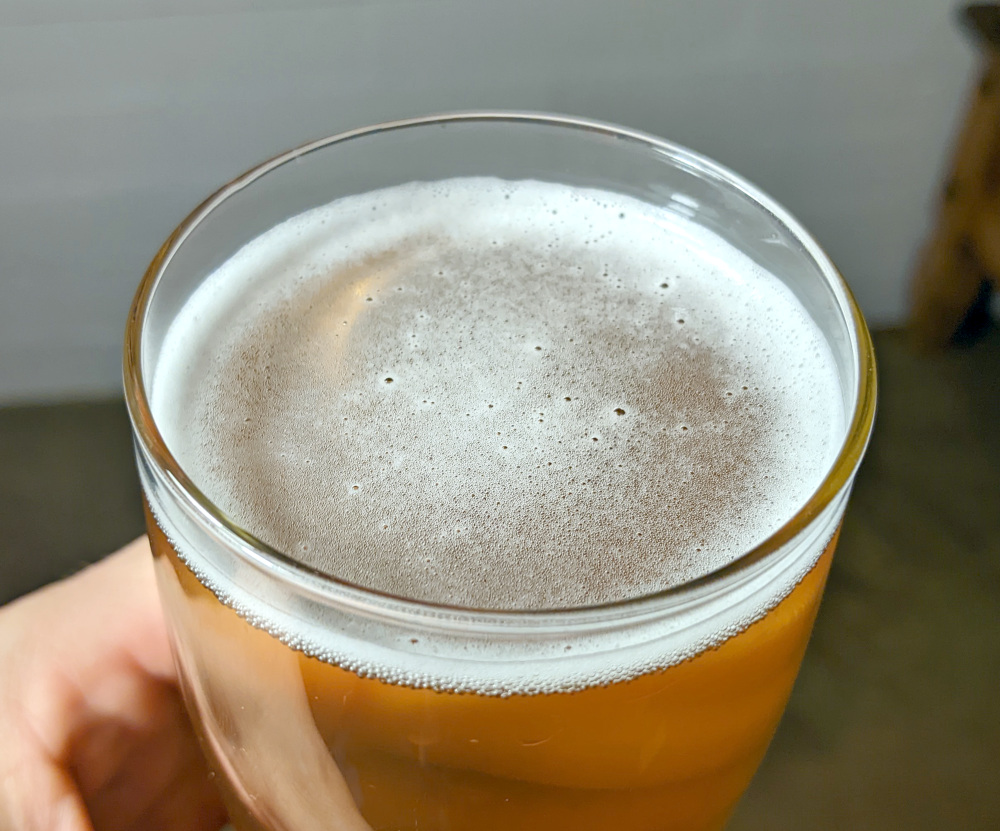
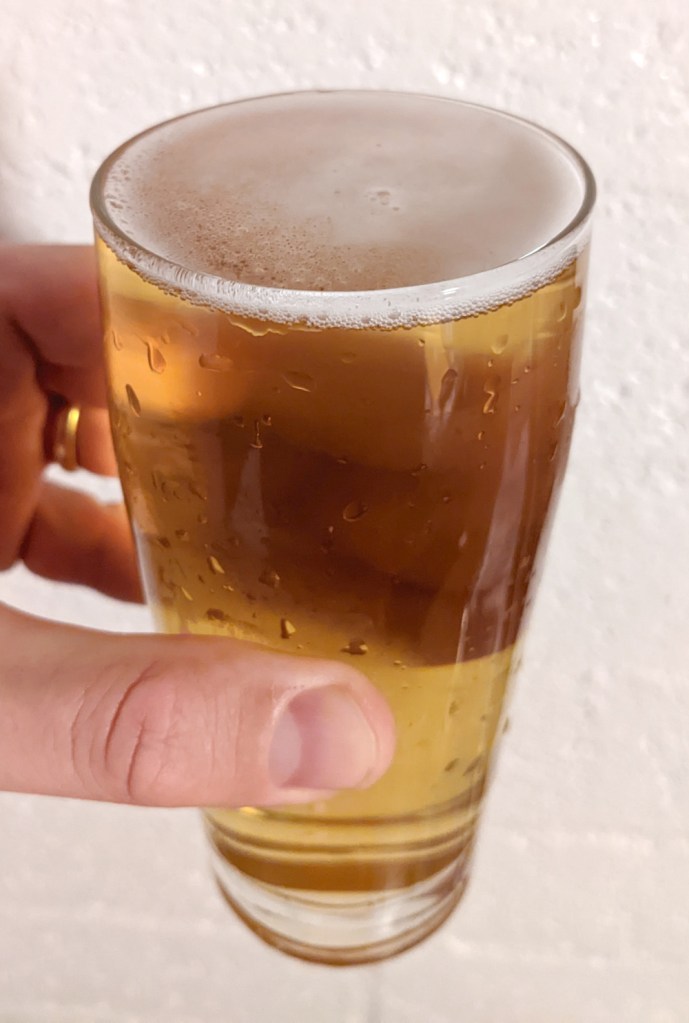
    • Near brilliantly clear, straw-colored beer, which pours with a medium white head of modest persistence.
  • Aroma
    • Spicy hop aroma with a doughy and very slight honey quality to the malt. Clean fermentation profile in the aroma. Wonderful!
  • Flavor
    • Cracker-like malt profile, with a slight bit of malty sweetness. Moderately high and clean bitterness, with a modest spicy quality. Clean yeast character. The malt is at the front of the taste, and the bitterness sneaks in and then pops for an extended and prominent bitter finish. The mineral character of the water also comes through, against the hops.
  • Mouthfeel
    • Medium-light body, moderate carbonation, off-dry finish.
  • Would I Brew This Again?
    • This is a super solid German pils! I wish the head retention was better, but everything else works super well. I’m also pleased with the yeast–it emphasizes the malt well, and also dropped clear pretty quickly.
  • Overall
    • 9/10