Levitation Ale Homage

I like my session beers, and I’m always looking for something creative and interesting. This is the core philosophy of Stone Brewing, so I was excited to see a recipe for their Levitation Ale. I’m not sure I’ve ever sampled it “in the wild,” but a session amber ale sounded pretty neat.

A few versions of Levitation Ale are floating around, and I used a version from Jennifer Talley’s Brewing Session Beers book. My version is a parallel rather than a clone, with some different hops and malts. The original recipe called for crystal 75, so I mixed crystal 60 and crystal 80, tilting towards the former because I was running low on the latter. I also adjusted the hops, so that I had Mt. Hood and Mandarina Bavaria, rather than Simcoe and Crystal. I also dropped the black malt, because it made the beer too dark. Finally, I used WLP001 versus an English ale yeast. With all of those changes, I should definitely deem this an homage (a la Denny Conn) rather than a clone. Either way, it was an interesting beer.

Levitation Ale Homage

  • 8.5 lb. 2-row malt (Briess)
  • 12.5 oz. caramel malt 60L (Briess)
  • 12 oz. caramel malt 120L (Briess)
  • 1.4 oz. caramel malt 80L (Briess)
  • 0.5 tsp. BrewTanB (mash)
  • 0.7 oz. Magnum hop pellets (12.6% alpha), 60 minute boil
  • 0.5 oz. Amarillo hop pelletrs (10.4% alpha), 10 minute boil
  • 0.5 tsp. BrewTanB, 10 minute boil
  • 1 Whirlfloc tablet, 5 minute boil
  • 1 oz. Mandarina Bavaria hop pellets (6.7% alpha), 10 minute whirlpool
  • 1 oz. Mt Hood hop pellets (4.0% alpha), 10 minute whirlpool
  • 1 pkg. American West Coast Ale Yeast (Lallemand BRY-97)
  • 1.5 oz. Amarillo hop pellets (10.4% alpha), dry hop in keg

Target Parameters

  • 1.046 s.g., 1.011 f.g., 4.5% abv, 48 IBU, 15 SRM
  • Full volume infusion mash, held at 154° for 60 minutes and 165° for 10 minutes
  • Claremont tap water adjusted to hit 72 ppm Ca, 12 ppm Mg, 87 ppm Na, 127 ppm SO4, 110 ppm Cl, 156 ppm bicarbonate, RA=69

Procedure

  • I started with 7.75 gallons of water, treated with a Campden tablet and 4 g gypsum, heated to 159° before mash-in. I added the BrewTanB just before adding the grains, and then added 6 mL of 88% lactic acid to adjust the mash pH.
  • I held the mash at 154° for 60 minutes, with recirculation, before raising to 165° for a 10 minute mash-out. Then, I pulled the grains and brought the runnings to a boil.
  • I collected 6.9 gallons of runnings with a gravity of 1.039, for 72% mash efficiency.
  • I brought the runnings to a boil, adding hops and other finings per the schedule. The boil was 90 minutes long total, so the first hop addition wasn’t until 30 minutes in.
  • After the full 90 minute boil, I turned off the heat and added the whirlpool hops, whirlpooling for 10 minutes at just below boiling. Of course, it chilled down into the 180s relatively quickly.
  • After the whirlpool finished, I removed the hops and continued chilling.
  • I transferred the wort to the fermenter, chilled down to 68°, and pitched the yeast.
  • Starting gravity was 1.050. I brewed the beer on 24 August 2024.
  • I kegged the beer on 4 September 2024, with a final gravity of 1.014 for 4.8% abv. I added the dry hops in a bag, intending to remove them after a few days and add gelatin. Unfortunately, I forgot that they would sink, and so I couldn’t recover them. Ah well.

Tasting

  • Appearance
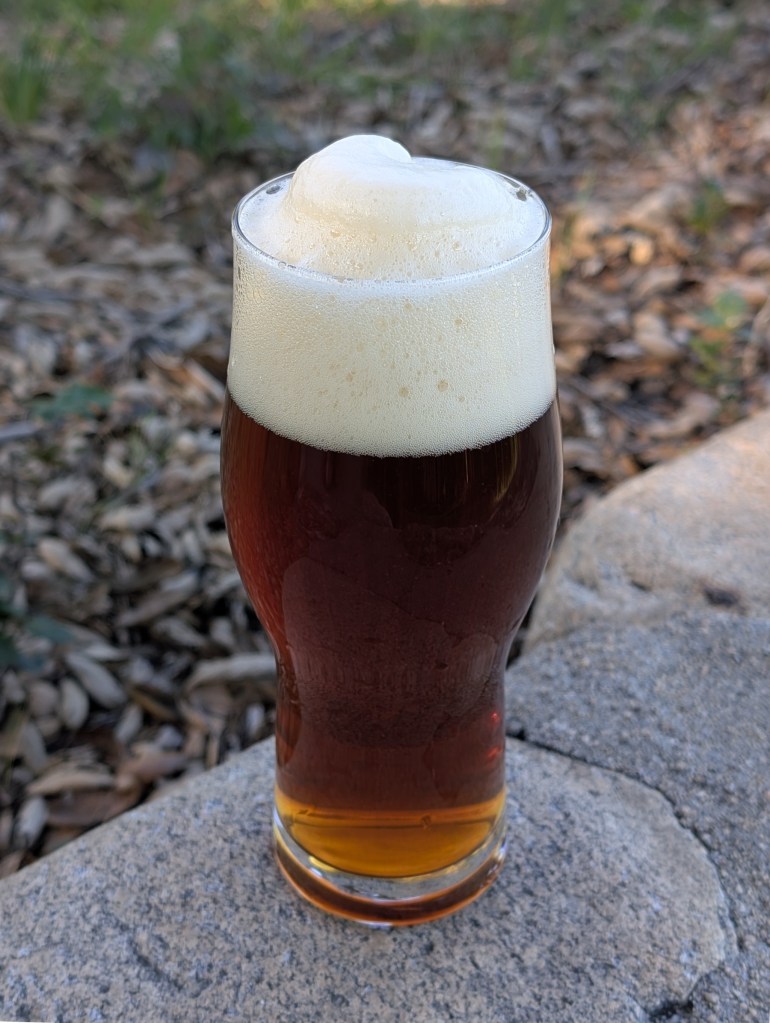
    • Deep amber beer with moderate haze; persistent but thin ivory head
  • Aroma
    • Light caramel malt notes with a good dose of citrus. a touch of pine
  • Flavor
    • Medium caramel malt flavor, against a strong orange/citrus and moderate pin character from the hops. Delicious! Medium-high bitterness.
  • Mouthfeel
    • Medium-light body, moderate carbonation, slightly dry, somewhat thin finish.
  • Would I Brew This Again?
    • This is a wonderful session amber ale, bursting with hop flavor and aroma. The haze is a minor flaw, but the flavor and aroma totally make up for it. I would love to try this with the original malt and hop combos, to see how it is. I might also add the black patent back in, to darken the beer. The malt body comes across as a little thin, so for a future version I might try Vienna or Maris Otter instead of plain 2-row, and/or mash at a higher temperature. Overall, this is a very drinkable beer!
  • Overall
    • 8/10

Amber Rye Ale

I firmly believe that amber ales deserve more love than they get nowadays. A well crafted amber ale is one of my favorite beers, but ambers are often hard to find relative to their zenith around 20 years ago. I make them semi-regularly, but wanted to take things in a slightly different direction this time around. So…why not add some rye?

With this particular batch, I wanted a beer that had the caramel quality and dry hop character of my favorite ambers, while adding a bit of rye spice to help it stand out. The recipe was loosely based on one by Charlie Papazian, “Choco Red Rye Wedding Ale.” I got a bit of feedback via the AHA forum, which was helpful in further refining my plans. For something a little different, I used Lutra kveik — it is supposed to ferment fairly clean at lower temperatures, so I thought it would be an interesting experiment.

I served the beer at the Lake Arrowhead Brewfest this past weekend, and it was pretty well received. I maybe have a gallon left, and will be savoring that.

Amber Rye Ale

  • 8 lb. 2-row malt (Rahr)
  • 2 lb. rye malt (Weyermann)
  • 10 oz. crystal 60 (Great Western)
  • 8 oz. caramel/crystal malt 135/165L (Bairds)
  • 2 oz. chocolate wheat malt (Weyermann)
  • 6 oz. rice hulls
  • 1 oz. Cascade whole hops (5.5% alpha), 60 minute boil
  • 1 oz. Cascade whole hops (5.5% alpha), 15 minute boil
  • 1 Whirlfloc tablet, 5 minute boil
  • 1 oz. Cascade whole hops (5.5% alpha), 5 minute boil
  • 1 pkg. Lutra kveik (Omega OYL-071) dry yeast
  • 1 oz. Cascade whole hops (5.5% alpha), dry hop in keg

Target Parameters

  • 1.048 s.g., 1.012 f.g., 4.8% abv, 31 IBU, 17 SRM
  • Full-volume mash, no sparge, at 156°
  • Claremont tap water, treated with Campden tablet

Procedure

  • I heated the strike water to 162° (with Campden tablet), and mashed in to hit a mash temperature of 156. I added 5.6 mL of 88% lactic acid to adjust the pH.
  • After 60 minutes of mash with recirculation, I raised the temperature to 168° for a 10 minute mash out. Then, I pulled the grains. In total, I collected 5.9 gallons of runnings with a gravity of 1.045, for 67% mash efficiency.
  • I brought the kettle to a boil, adding hops and finings per the recipe.
  • After a 60 minute boil, I chilled the wort to 85°, transferred to the fermenter, and pitched the yeast. I let it ferment at ambient in the garage, which was around 66° for most of the time. Vigorous fermentation took off in under 12 hours.
  • I brewed this beer on 25 May 2022, and kegged it on 9 June 2022. I added the dry hops to the keg in a bag.
  • Starting gravity was 1.052. Final gravity was 1.017, for 4.6% abv.

Tasting

  • Appearance
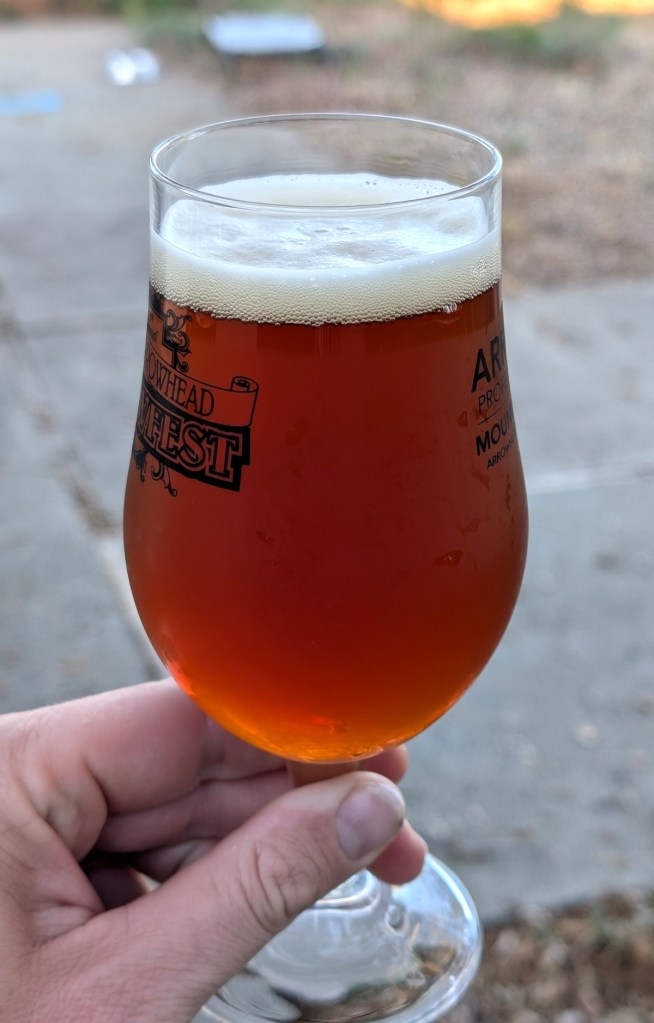
    • This beer pours with a creamy, tall, and persistent ivory head. The beer itself is deep amber and brilliantly clear. It is beautiful in the glass!
  • Aroma
    • There is plenty of rye “zing.” I pick up a little dried stonefruit, and some fresh hay from the hops. The fermentation profile is surprisingly clean.
  • Flavor
    • Rye and rich malt, with a touch of dark caramel behind that. The bitterness is moderate and clean. Just like with the aroma, I don’t get anything really for yeast.
  • Mouthfeel
    • Medium body, moderate carbonation. Smooth finish.
  • Would I brew this again?
    • YES! This is a fantastic and interesting beer from start to finish. The end product was exactly what I envisioned. Fermentation profile is wonderfully clean (or at least playing well with the malts and hops). I can’t think of anything to change.
  • Overall
    • 10/10

Melange Amber Ale

This was another quick kitchen-sink recipe to finish up some stray ingredients, with the side benefit of putting a tasty brew on tap. It’s interesting how amber ales really aren’t that common anymore in craft beer, given how prevalent they were 20 years ago. In a quick search of local breweries, I didn’t find a single example in their offerings! That’s part of why I homebrew, I suppose.

(As a historical note, the very first amber ale I did as a solo homebrewer was in December 2009. On average, I have brewed roughly one batch a year since.)

Melange Amber Ale

  • 8.25 lb. 2-row malt (Great Western)
  • 1.75 lb. Munich I malt (Weyermann)
  • 1 lb 2.4 oz. Crystal 75 malt (Great Western)
  • 0.5 lb. Crystal 60 malt (Great Western)
  • 1 oz. Carafa Special III malt (Weyermann)
  • 1 oz. Cascade whole hops (5.5% alpha), 60 minute boil
  • 1 oz. Cascade whole hops (5.5% alpha), 15 minute boil
  • 2 oz. Cascade whole hops (5.5% alpha), 5 minute boil
  • 1 Whirlfloc tablet, 5 minute boil
  • 1 pkg. Safale American Ale yeast (US-05)

Target Parameters

  • 60 minute infusion mash, 152°, batch sparge
  • 1.052 o.g., 1.011 f.g., 31 IBU, 15 SRM, 5.4% abv
  • Claremont tap water

Procedure

  • I mashed in with 4 gallons of water at 162°, to hit a mash temperature of 152°. I added 2.5 mL of 88% lactic acid, to adjust the pH.
  • After 45 minutes of mashing, I added 1.25 gallons of water at 190°, to raise the mash temperature to 158°. I let it rest for another 15 minutes, before collecting first runnings.
  • Next, I added 3.75 gallons at ~185°, let rest for 10 minutes, and collected the second runnings.
  • In total, I collected 7.2 gallons with a gravity of 1.045, for 76% mash efficiency. This was exactly where I wanted to be!
  • I boiled for 60 minutes, adding hops and finings per the recipe. After 60 minute, I chilled down to 78 °, and chilled another 10° in my fermentation chamber, pitching the yeast ~8 hours later.
  • Starting gravity was 1.051, with 5.75 gallons into the fermenter. I brewed the beer on 13 June 2020, and fermented it at 66°.
  • After about a week, I pulled the beer out to finish at ambient (~75°), in order to free up room in the fermentation chamber.
  • I kegged the beer on 23 June 2020; it had a final gravity of 1.013, for 5.0% abv. I added 2.5 oz. corn sugar in 1 cup of water for priming and sealed it up to carbonate.
  • When I tried the beer after ~2 weeks, carbonation seemed a bit low, so I finished carbonation using my CO2 tank. I am beginning to wonder how reliable the BeerSmith carbonation calculator is for kegged batches, because I’ve had this as a perpetual problem.

Tasting

  • Appearance
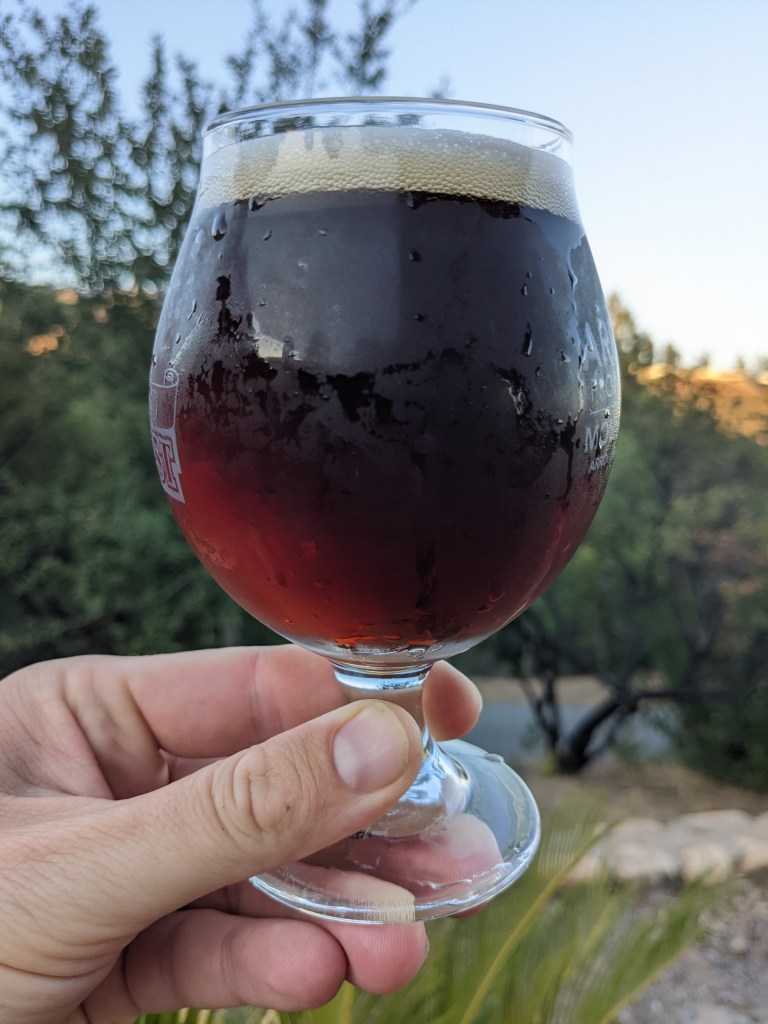
    • The beer is a gorgeous deep amber color, and fairly clear, with only a touch of haze at this point (~2 weeks at serving temperature of below). It pours with a thick ivory head, that thins to a persistent rim around the glass.
  • Aroma
    • Crisp, caramel aroma that’s really pleasant and distinctive, with a background of woody hop aroma. Very, very nice!
  • Flavor
    • Malt forward, with a bready richness backed up by a touch of caramel. Bitterness is moderate, but not quite enough to keep the malt from becoming too cloying. I think it has just a touch too much caramel malt, and so it’s on that edge of too sweet. After a sip, though, the hops and malt really nicely balance each other out as it lingers on the palate.
  • Mouthfeel
    • Medium-full body, medium carbonation. Smooth finish, that’s not too dry.
  • Would I brew this again?
    • This is a good enough beer, but as mentioned above it has a bit too much caramel on the flavor. Crystal malt makes up 15% of the malt bill, and I would probably ratchet it back a touch (probably on the crystal 75) to bring it a little more into a balance I like. I think this would drink a little better in the late fall / winter, when a fuller, maltier beer is more welcome than during a warm summer afternoon! So, it’s not an awful beer, but not the best amber ale I’ve done.
  • Overall
    • 6/10

Beer Tasting: Hell Creek Amber Ale 1.1

20170611_212509

Hell Creek Amber Ale, appropriately served in a fossil-themed glass

The keg is gone barely a week for my wild hop amber ale, so it’s better late than never in posting this review. Also, I bottled up a few of these and enjoyed sharing them with some folks at Homebrew Con (including a paleontologist or two)!

  • Aroma
    • Malt dominates the aroma, with malty-sweet toffee and light caramel character. No appreciable yeast or hop character.
  • Appearance
    • Very clear beer with a deep amber color. The head is ivory in color, and settles down to a low but persistent quality.
  • Flavor
    • Hoppiness dominates on the front end of the flavor, and persists throughout the tasting and into the finish. The hop character is fairly herbal, and the bitterness has a slight rough edge to it. The malts come across moderately, with a caramel and bready quality. There is a minerally character to this, and next time I’ll probably adjust the water a bit to lower that. 100 percent Claremont tap water apparently doesn’t work with this recipe!
  • Mouthfeel
    • Moderate body and moderate carbonation. The finish tends toward the dry and bitter side.
  • Would I brew this again?
    • This is an improvement, certainly, on the last version of this beer. I think it was a good move to ditch the special B. This is an interesting beer, because I “have” to brew it within some self-imposed constraints (only Montana/South Dakota ingredients). I would say that the beer doesn’t age entirely well, probably due to the high percentage of caramel malts, and had a bit of an oxidized note towards the end of the keg. For the next iteration of this recipe (assuming there is a next, of course!), I’ll probably switch up the grain bill and see what other amber ale recipes are out there. The caramel is just a touch heavy in this for my tastes. As noted above, I’ll also play with the water a bit.
  • Overall
    • 6.5/10

Big Batch Update: Saison, Amber Ale, Pilsner

There’s lots to report with kegging and fermentation for a few recent batches. So, here’s what’s new:

  • Thumbspike Saison 2.0
    20170528_144954

    • This might have had the quickest turn-around on any kegged beer I’ve ever done! I brewed the beer on 12 May 2017, starting with an 80° fermentation temperature. On 16 May, I raised the temperature to 85°. Everything really churned along, from start to finish (as you might expect with fermentation at those temperatures)! I kegged the beer on 20 May 2017, with a final gravity of 1.004. That works out to 6.7% abv. I’ve had it on tap for about a week, and it’s a pretty interesting and enjoyable beer. All of the ingredients melded together quite nicely, and I am pleased with the results. It’s a very refreshing brew for a warm afternoon on the patio.
    • My first impressions are that it has a very lightly fruity aroma, with a slight tartness on the flavor. Head retention seems pretty miserable at this point, but I don’t know if that’s a real feature of the beer or because I didn’t wash my glass from a previous beer before pouring this one.
  • Hell Creek Amber Ale 1.1
    • I brewed this beer on 14 April 2017, with a starting gravity of 1.060. I kegged the beer on 7 May 2017. Final gravity was 1.016, which equates to 5.8% abv.
  • Czech-ed Out Pilsner
    • This batch has the honor of being my first dumper, ever. I’ve weathered warm fermentations, low gravities, and incomplete fermentations, and have always soldiered through in the end. Alas, this particular batch just wasn’t any good. The culprit wasn’t infection, bad fermentation, or anything like that. It was bad hops! As noted in my original post, the late hop addition smelled really grassy. I should have known better than to add them to the kettle, but wasn’t quite that smart. So, I kegged the beer, carbonated it, and pulled my first sample…to a whiff of pilsner that smelled pretty much like freshly mown lawn, and not in a good way. It was almost reminiscent of jalapenos, but in any case was not reminiscent of what a good European pilsner should taste or smell like. Lesson learned!
    • In terms of fermentation history, I started fermentation at 50° on 9 April. I raised the beer to 65° on 21 April, and then dropped it to 33° on 30 April 2017. I kegged the beer on 14 May, at which point it had a final gravity of 1.011. This equates to 5.6% abv.