Alstadt Altbier 2.2

I love it when I have honed a house recipe, and altbier is one of my annual favorites. This is largely similar to what I made previously; the 2024 version is my fifth brew of the recipe! Compared to last year, I altered the CaraMunich addition to include a blend of Caramel Munich 60L (Briess) and Caramunich II, versus just Caramunich I as I did last year. Because the 2023 version was a bit harsh on bitterness, I swapped out the Magnum hops and went with Spalt alone for the hop additions. Finally, I used a blend of K-97 and Köln dry yeasts; sadly, Köln’s days are numbered in my brewery, because it has been discontinued by Lallemand.

Alstadt Alt 2.2

  • 6.5 lb. pilsner malt (Rahr)
  • 1.5 lb. Munich I malt (Weyermann)
  • 1.5 lb. Vienna malt (Weyermann)
  • 0.5 lb. Caramel Munich 60L (Briess)
  • 0.5 lb. Caramunich II malt (Weyermann)
  • 2 oz. Carafa Special I malt (Weyermann)
  • 0.5 tsp. BrewTanB, added to mash
  • 2.0 oz. Spalt Spalter hop pellets (4.3% alpha), 60 minute boil
  • 0.5 tsp. BrewTanB, 10 minute boil
  • 1.0 oz. Spalt Spalter hop pellets (4.3% alpha), 5 minute boil
  • 1 Whirlfloc tablet, 5 minute boil
  • 1 pkg. Köln Kölsch Style Ale Yeast (Lallemand)
  • 1 pkg. SafAle German Ale yeast K-97 (Fermentis)

Target Parameters

  • 1.048 s.g., 1.011 f.g., 4.9% abv, 35 IBU, 14 SRM
  • 60 minute infusion mash, full volume, 152°
  • Claremont tap water treated with Campden tablet

Procedure

  • I mashed in with 7.5 gallons of water at 157°, to hit a mash temperature of 152°. I added 4 mL of 88% lactic acid and held the mash here (with recirculation) for 60 minutes, before raising to 168° for the 10 minute mash-out.
  • After removing the grain basket, I had 6.5 gallons of wort with a gravity of 1.043, for an efficiency of 71%.
  • I brought the runnings to a boil, adding malt and finings per the recipe. After the 60 minute boil, I chilled to 80° and transferred to the fermenter. I let it chill a bit down to 60° in the fermentation chamber, before pitching the yeast and setting the fermentation temperature to 64°. I ended up using a mix of yeast, because the K-97 was a year past expiration.
  • I brewed the beer on 11 August 2024, and it had a starting gravity of 1.051.
  • I let the beer free-rise to 66° on 22 August 2024, when I started fermenting a pale ale. Finally, I let the beer finish at ambient on 22 August, around 75° to 80°.
  • I kegged the beer on 23 August 2024, and it had a final gravity of 1.011. This works out to 5.3% abv.

Tasting

  • Appearance
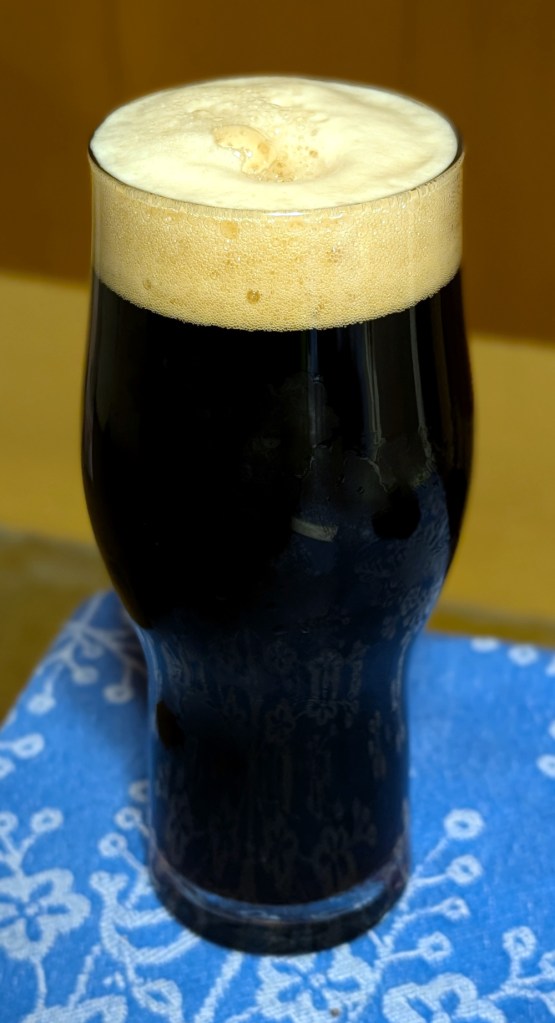
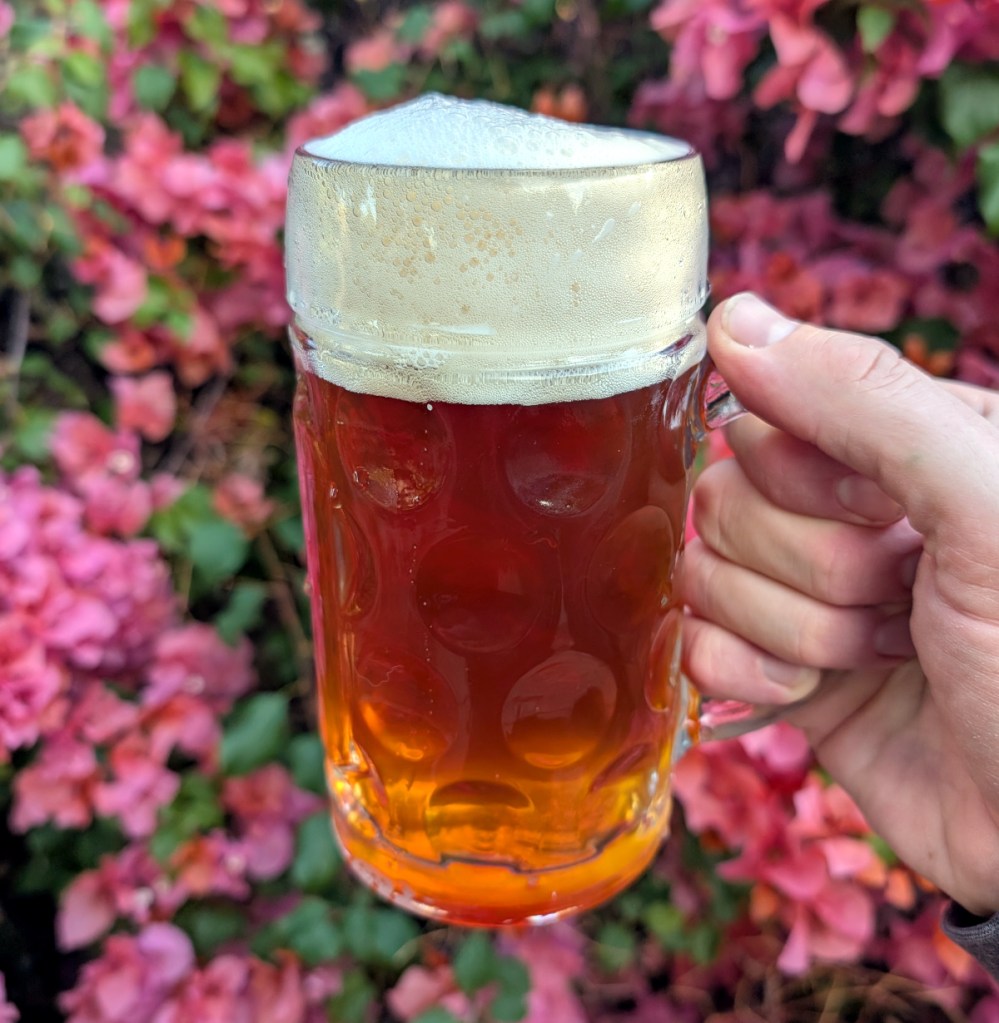
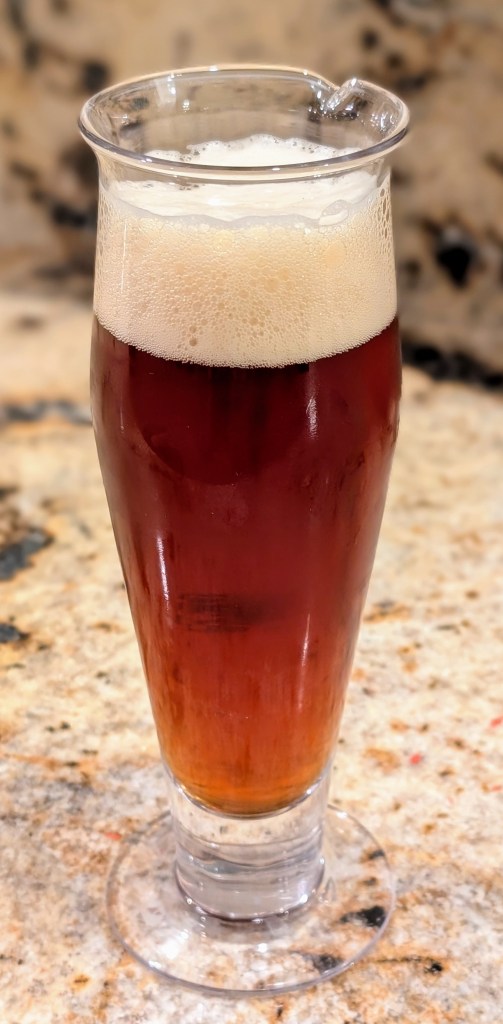
    • Deep copper color, very clear, with a fine and reasonably persistent ivory colored head.
  • Aroma
    • Bread crust malt aroma at the front, along with dark caramel. A slight touch of spicy hop aroma.
  • Flavor
    • Relatively bitter beer; malt flavor is of dark breadcrest and rich mattiness. I pick up some dried fruit character, from the malt/yeast interplay.
  • Mouthfeel
    • Medium body, medium carbonation, slightly dry finish.
  • Would I brew this again?
    • This remains a wonderful althier recipe, despite slight tweaks over the years. It took a bit of time to clear, but is now fantastic! I love this beer!
  • Overall
    • 10/10

Dad’s 3P 2024

pale yellow beer with white head in conical pilsner glass

I’ve made two previous versions of Pre-Prohibition Pilsners, distinguished as such by having a bit more body and malt character than a typical American macro lager, and distinguished from European pilsners by adjuncts and the frequent use of American hops. My dad’s version originally comes from the April 1999 issue of BYO; it stands out in having a bit of flaked rye in it. Additionally, 6-row malt is nowhere to be seen in my version of this recipe.

This year’s edition is broadly inspired by the 2016 version, but you can check out the last version for differences. I used all American hops (Mt. Hood) instead of German ones, and brought Novalager into the mix, too. The main goal is to have something drinkable for the dog days of summer, but not so inoffensive as to be boring.

Dad’s 3P 2024

  • 6.75 lb. 2-row malt (Briess)
  • 2.25 lb. pilsner malt (Rahr)
  • 1 lb. yellow corn, flaked (Briess)
  • 0.5 lb. rye, flaked (Briess)
  • 0.5 lb. Carafoam (Weyermann)
  • 0.25 lb. rice hulls
  • 0.5 tsp. BrewTanB, in mash
  • 1 oz. Mt. Hood hop pellets (6.0% alpha), 60 minute boil
  • 1 oz. Mt. Hood hop pellets (6.0% alpha), 10 minute boil
  • 0.5 tsp. BrewTanB, 10 minute boil
  • 1 Whirlfloc tablet, 5 minute boil
  • 2 pkg. Novalager yeast (Lallemand)

Target Parameters

  • 1.050 s.g., 1.009 f.g., 30 IBU, 5.5% abv, 4 SRM
  • Full volume mash with recirculation for 60 minutes at 152°, 10 minute mash-out at 168°
  • Water blended from RO and Claremont tap water to hit target of 52 ppm Ca, 10 ppm Mg, 64 ppm Na, 82 ppm SO4, 113 ppm Cl, 5 ppm bicarbonate, alkalinity=4 ppm, RA=-39.

Procedure

  • I built my water the night before with 4 gallons of distilled water and 3.5 gallons of Claremont tap water, adding a Campden tablet and 3.2 mL of 88% lactic acid to drop out the carbonates.
  • I mashed in by heating the strike water to 158°, and then adding the grains and 2.4 mL of 88% lactic acid for pH adjustment.
  • I held the mash, with recirculation, at 152° for 60 minutes, before raising the temperature to 168° for a 10 minute mash-out.
  • At the conclusion of the mash, I removed the grains and let them drain. In total, I collected 6.6 gallons of runnings with a gravity of 1.043, for 69% mash efficiency.
  • As the runnings came to a boil, I added 2.5 g of calcium chloride. Once the runnings boiled, I added the hops and finings per the recipe.
  • After the full 60 minute boil, I chilled the wort to 78° before transferring to the fermenter and letting it chill to 46° in the fermentation chamber.
  • I pitched the yeast at 46°, and then let the fermenter free rise to 52° for fermentation.
  • I brewed the beer on 19 May 2024. Starting gravity was 1.049.
  • I let the beer free rise to 60° on 25 May 2024, and then to 65° on 29 May 2024.
  • The beer was kegged using a closed transfer on 3 June 2024. Final gravity was 1.009, for 5.2% abv.

Tasting

  • Appearance
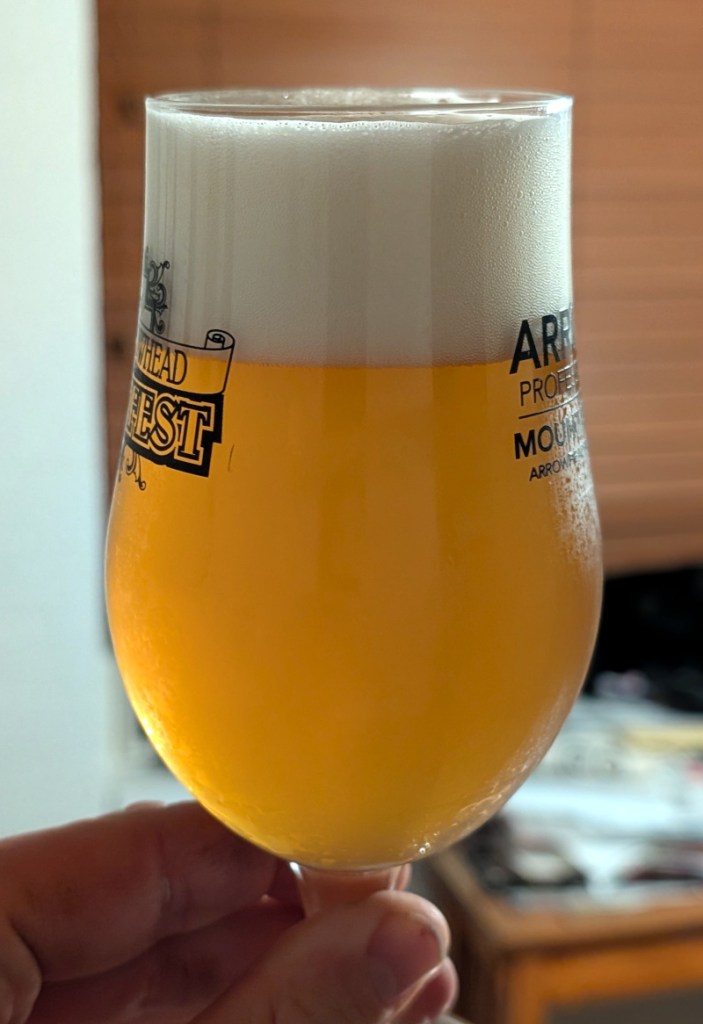
    • Brightly clear, straw yellow beer, which pours with a fine and persistent white head. It just looks nice!
  • Aroma
    • Grainy sweet malt aroma; no appreciable yeast character or hop character apparent.
  • Flavor
    • Medium-high bitterness at the forefront, with a slightly herbal quality. Malty notes and a light hint of corn sweetness are behind that, but the beer definitely tilts toward bitter. Clean fermentation character, Crisp finish.
  • Mouthfeel
    • Medium body with a rounded feel. Dry finish. Medium carbonation.
  • Would I Brew This Again?
    • This is an interesting American lager, and highly drinkable. It’s a great summer beer! I’ve never done a six-row version of this, and might have to try it sometime in the pursuit of historical accuracy. Relative to the BJCP guidelines for Pre-Prohibition Lager (Category 27, Historical Beer), it hits most of the notes but should have perhaps a bit more hop aroma and a slightly taller head. Overall, though, this is a solid beer and recipe! It’s really enjoyable to drink on a hot afternoon, which is really all I demand from such a beer.
  • Overall
    • 9/10

Snowdrop Kölsch 2024

Kölsch is a simple style in so many ways, but a hard one to do well. After a few iterations, I perfected a recipe that works well for me. I first brewed Snowdrop Kölsch in 2023, and it’s a definite winner. I made a batch earlier this year, but it unfortunately (and frustratingly!) got infected, so I did a deep cleaning in the fermenters for my second attempt. This one succeeded!

Other than slight changes in malt brand (Rahr pilsner instead of Viking) and building up my water from scratch, this is identical to the 2023 edition of the recipe. There is no sense in messing with perfection! Sadly, Lallemand has discontinued their German ale yeast, so I will have to search for a different strain in future years. This is a shame, because I quite like it! I suppose it’s back to liquid yeast whenever my dry yeast supply runs out.

Snowdrop Kölsch

  • 9.5 lb. pilsner malt (Rahr)
  • 0.5 lb. Munich I malt (Weyermann)
  • 0.5 tsp. BrewTanB (mash)
  • 1 oz. Edelweiss hop pellets (5.8% alpha), 45 minute boil
  • 0.5 tsp. BrewTanB, 10 minute boil
  • 1 Whirlfloc tablet, 5 minute boil
  • 1 oz. Edelweiss hop pellets (5.8% alpha), 5 minute boil
  • 1 pkg. Köln Kölsch-style yeast (Lallemand)

Target Parameters

  • 1.046 s.g., 1.010 f.g., 24 IBU, 4 SRM, 4.6% abv
  • Full volume mash, 60 minute mash at 152°, 10 minute mash-out at 168°
  • RO water with added minerals to hit target of 50 ppm Ca, 6 ppm Mg, 6 ppm Na, 54 ppm SO4, 72 ppm Cl, 0 ppm HCO3, -39 ppm RA

Procedure

  • Starting with 7.25 gallons of RO water, I added 0.4 g of sea salt, 1.4 g of epsom salt, 1.7 g of gypsum, and 3.6 g of calcium chloride, in order to reach my target water parameters. I heated the water to 157° before adding the grains and holding the mash at 152° (with recirculation) for 60 minutes. Next, I heated the mash to 168° for a 10 minute mash-out, before pulling the grains.
  • In total, I collected 6.6 gallons of runnings with a gravity of 1.041, for 73% mash efficiency.
  • I brought the runnings to a boil, adding hops and finings per the recipe. After 60 minutes, I chilled the wort to 78°, let it settle for a bit, and transferred to the fermenter. I chilled the wort to 60° in the fermentation chamber before pitching the yeast, and fermented at 64°.
  • I brewed this beer on 23 June 2024. Starting gravity was 1.048.
  • I kegged the beer on 12 July 2024, using a closed transfer.
  • Final gravity was 1.009, for 5.2% abv.

Tasting

  • Appearance
    • Exceptionally clear, light yellow beer with somewhat persistent white head. It is pretty in the glass!
  • Aroma
    • Grainy sweet aroma, light fruity character. Very subtle floral hop note.
  • Flavor
    • Light malty character, medium-low bitterness. Slight fruitness, of the pear/apple variety (but not strictly apple; it has more depth than that!). Slight floral hop quality.
  • Mouthfeel
    • Medium-light body, moderate carbonation, smooth and pleasant finish.
  • Would I Brew This Again?
    • This is a very good kölsch! I don’t know that it’s my best–the hop aroma is a little more subdued than last year’s version–but this one still hits the notes!
  • Overall
    • 9/10

Session Saison

I’ve been spending lots of time in LagerTown (a few miles over from Flavertown) and overall feel like I have a good handle on many of these styles, especially pale lagers. So, I’m looking for some new challenges. The saison style has been of variable success for me, with the last saison session producing a good beer despite a ton of mishaps in the process. I’ve only made six batches of this style previously, most centered around the “Thumbspike Saison” incarnation.

For 2024, I decided to try a saison yet again, to have a drinkable and interesting brew on tap. I generally prefer lower alcohol beers, so used the Session Saison recipe at Great Fermentations as a starting point. It was a chance to use up some grains I had sitting around, while also experimenting with yeasts and techniques. Previously, I’ve never really been able to hit the attenuation I want in a saison consistently, so I focused on the areas of mash technique, ingredients, and yeast choice to move a few levers towards a drier beer.

The grain bill is pretty close to the original recipe, although I swapped in flaked oats instead of flaked barley based on what was accessible at home. I used honey instead of corn sugar, because I had a container of Costco honey and figured it would create the same result. This element of the recipe is important for getting towards a dry beer. Finally, I used up some of my hop stash–Ariana, a newer and high alpha German variety seemed like a good fit.

I haven’t used Lallemand’s Belle Saison strain before and wanted to give that a try here. It’s a diastaticus yeast, so I needed to keep this in mind in terms of separating out equipment later on, but I also hoped it would give me a better result than the diastaticus-negative yeasts I’ve used in most previous batches. I coupled this with creating a highly attenuative wort–I elected for a long mash of 120 minutes at only 149 degrees, in addition to the honey mentioned above.

Oddly enough, despite the low starting gravity (1.046 or so), the high attenuation takes it out of session territory — 5.3% calculated, and 5.9% actual when all was said and done! It’s not the monster 9.5% abv upper bound for the BJCP style, but it’s also not one anyone should chug by the pint.

I had an interesting experience on consumption of this one — the temperature probe on my keezer got knocked to the bottom of the chamber by accident, with a net result of the overall keezer temperature being around 50° instead of 40°. I was fairly disappointed in the carbonation and flavor of the saison–it wasn’t anywhere near highly carbonated, and the beer was a bit flabby. Once I figured out the temperature issue, things fell right into place with a more proper level of carbonation and a crisper beer. Beer held at 40° and 23 PSI will hit 3.5 volumes of CO2–but the the same PSI at 50° will be only 3 volumes. It was an amazing example of how critical temperature and carbonation are for beer enjoyment!

Session Saison

  • 3 lb. 9 oz. pilsner malt (Rahr)
  • 2 lb. 2-row malt (Briess)
  • 2 lb. Munich I malt (Weyermann)
  • 8 oz. Aromatic Munich malt 20L (Briess)
  • 8 oz. flaked oats
  • 0.5 tsp. BrewTanB, in mash
  • 1.25 oz. Ariana hop pellets (8.9% alpha), 15 minute boil
  • 0.5 tsp. BrewTanB, 10 minute boil
  • 1 lb. wildflower honey, 10 minute boil
  • 0.75 oz. Ariana hop pellets (8.9% alpha), 5 minute boil
  • 1 tsp. yeast nutrient (WLN1000, White Labs), 5 minute boil
  • 1 pkg. Belle Saison dry yeast (Lallemand)

Target Parameters

  • 1.046 s.g., 1.005 f.g., 5.3% abv, 26 IBU, 6 SRM
  • Full volume infusion mash to hit target of 149°, 120 minutes, no sparge
  • Claremont tap water, neutralized with lactic acid to reduce carbonates, target parameter of 60 ppm CA, 22 ppm Mg, 136 ppm Na, 175 ppm SO4, 150 ppm Cl, 10 ppm HCO3, RA=-48 ppm

Procedure

  • I added 6.5 mL of 88% lactic acid to 7.25 gallons of tap water, to remove the carbonates. As a result, no pH adjustment was needed (per calculations) for the mash.
  • I heated the water to 153°, added the grains, and held at 149° with recirculation for 120 minutes.
  • At the end of the mash, I raised the temperature to 168° for a 10 minute mash-out, before removing the grains.
  • In total, I collected 6.75 gallons of runnings with a gravity of 1.035, for 74% mash efficiency.
  • I brought the runnings to a boil and added hops and finings per the recipe. After 60 minutes, I turned off the heat and chilled to 75° before transferring the wort to the fermenter and chilling to 65° in the fermentation chamber before pitching the yeast.
  • I brewed this beer on 9 May 2024; it had a starting gravity of 1.048.
  • I held the fermentation at 68° until 14 May 2024, when I pulled the probe from the side of the fermenter and let the chamber free-rise to 85°.
  • I removed the beer to ambient temperature on 19 May 2024. At this point, final gravity was 1.003, presumably terminal.
  • I kegged the beer on 26 May 2024, adding 4 oz. of corn sugar to do some natural carbonation.
  • The abv on the final product was 5.9 percent — the combination of mash and yeast strain seemed to really do the trick for a dry beer!

Tasting

  • Appearance
    • Golden beer, slightly hazy, pours with a creamy white head that settles to a persistent blanket.
  • Aroma
    • Pear aroma, with a bit of spice/pepper alongside that, somewhat reminiscent of a pear cobbler. A light bit of maltiness as the beer warms.
  • Flavor
    • A fairly bitter beer with a spicy, peppery flavor from the yeast. Low level of grainy flavor from the malt. The fruitiness doesn’t come through as intensely as in the aroma, until the beer warms up a bit.
  • Mouthfeel
    • Very dry, highly carbonated, light body.
  • Would I Brew This Again?
    • Once I got temperature and carbonation dialed in, this was a fairly excellent saison. It could use a touch more malt character; perhaps a bit of Vienna in for some of the 2-row or pilsner malt? The aroma and mouthfeel are about perfect! I’m very pleased that I finally achieved “dry beer” status.
  • Overall
    • 7/10

Summer Session IPA 2024

I’ve been making a session IPA at least annually for awhile now, because it’s a good way to balance the needs of my palate with the needs of my liver. These recipes usually go with a lighter grain bill that leans on flavorful base malts, alongside a high mash temperature to boost body and reduce attenuation. Kveik strains are part of my usual recipe in these, also, because I am often brewing these last-minute and so want a quick fermenting, temperature tolerant variety of yeast.

The 2024 iteration of my session IPA is in the same mold as previous years–I used a 2-row base malt, but beefed things up with a generous helping of Vienna and some Crystal 40. The hops aren’t too dramatic, but are old favorites for this style of beer.

Summer Session IPA 2024

  • 8 lb. 2-row malt (Briess)
  • 1.25 lb. Vienna malt (Weyermann)
  • 0.5 lb. Crystal 40 malt (Great Western)
  • 0.5 tsp. BrewTanB, in mash
  • 2 oz. Citra hop pellets (12.8% alpha), 15 minute boil
  • 1 tsp. BrewTanB, 10 minute boil
  • 1 Whirlfloc tablet, 5 minute boil
  • 1 pkg. Lutra kveik (Omega #OYL-071, dry)
  • 2 oz. Ella hop pellets (17.6% alpha), dry hop in keg
  • 2 oz. Galaxy hop pellets (15.3% alpha), dry hop in keg

Target Parameters

  • 1.044 s.g., 1.011 f.g., 4.4% abv, 48 IBU, 6 SRM
  • Full volume infusion mash to hit target of 156°, 60 minutes, no sparge
  • Claremont tap water, neutralized with lactic acid to reduce carbonates, target parameter of 60 ppm CA, 22 ppm Mg, 136 ppm Na, 175 ppm SO4, 150 ppm Cl, 10 ppm HCO3, RA=-48 ppm

Procedure

  • Prior to the mash, I added 6.5 mL of 88% lactic acid to the 7.25 gallons of tap water (along with a Campden tablet), to drop out the carbonates. Then, I heated the water to 161°, before adding the grains and 1 mL of 88% lactic acid to adjust the mash pH. I held the mash at 156° for 60 minutes, with recirculation, before raising to 168° for 10 minutes.
  • After the mash was done, I pulled the grains and brought the runnings to a boil. In total, I collected 6.5 gallons of runnings with a gravity of 1.039, for 70% mash efficiency.
  • Once the runnings were at a boil, I added hops and finings per the recipe. Following the 60 minute boil, I turned off the heat and chilled to 78° before transferring to the fermenter and pitching the yeast.
  • Starting gravity was 1.045. I brewed this beer on 28 April 2024 and fermented it at ambient.
  • I kegged the beer on 20 May 2024, adding the dry hops in a baggie at this time. FInal gravity was 1.012, for 4.3% abv.

Tasting

  • Appearance
    • Clear, light gold beer, pouring with a persistent white head. Very pretty!
  • Aroma
    • Mandarin orange aroma, with a hint of tropical fruit. Hop aroma moderately high. The malt is in the background, and I don’t get much for yeast.
  • Flavor
    • Hop-forward, with a strong bitterness against a fairly light malt backbone. Very quaffable! Hop flavor has elements of orange and citrus pith. There might be a little peach, but that is more by suggestion (due to the characters of the variety) than something that is easily perceived.
  • Mouthfeel
    • Medium-light body, moderate level of carbonation, crisp and dry finish.
  • Would I brew this again?
    • This is a delightful session IPA, which has matured nicely. It doesn’t taste watery at all, and the hop elements are just what I would want in a modern West Coast IPA, I am quite happy with this one! I might go for a little more hop complexity – but it’s an easy fix with different varieties of hops.
  • Overall
    • 9/10