
Amber ales have gotten a bit of short shrift in my homebrewing world lately. They’re fairly easy to craft well, and rank among the classic (and stereotypical) “brewpub” styles. I brewed them relatively frequently when I started out in homebrewing, and as a result got a little bored with them. It has been nearly a year and a half since my last amber ale, though, and lately I have been kinda missing having one on tap.
One good thing about amber ales is that for me they have a fairly broad spectrum of possible flavors, which makes them convenient for using up ingredients. The flip side of this is that they can become a muddy mess of too many competing flavors. I think I have struck a reasonable balance in the recipe below, although the proof will be in the tasting a few weeks down the line. My first task was to use up a few lingering pounds of Maris Otter for the base malt, with the remainder made up with the ol’ standard American two-row. A touch of Victory malt will add some biscuit notes, and honey malt should bring in a bit of caramel sweetness (instead of using the more traditional crystal malt). To aim for deeper red hues, I’ve added in just the tiniest bit of black malt.

Hop spider in action for Spring Cleaning Amber Ale
Spring Cleaning Amber Ale
- 5.34 lbs. Maris Otter malt (Thomas Fawcett)
- 3.5 lbs. 2-row malt (Great Western Brewing Co.)
- 0.75 lbs. Victory malt
- 0.5 lbs. honey malt
- 2 oz. de-bittered black malt
- 1 oz. Cluster hops pellets (6.8% alpha), 60 minute boil
- 1 oz. American Fuggle hops pellets (4.5% alpha, 3.1% beta), 5 minute boil
- 1 tsp. Irish moss, 10 minute boil
- 0.5 tsp. yeast nutrient, 10 minute boil
- Vermont Ale yeast (The Yeast Bay), prepared in starter
Brewing Targets
- Mash temperature = 152°
- Original gravity = 1.049
- IBU = 29
Procedure
- I made a yeast starter three days in advance, using a jar of yeast that I had set aside three months ago. The 1.75L starter took right off. After two days, I saved 0.6L for another batch and cold-crashed the rest for this batch.
- On brew day, I mashed in with 4 gallons of water at 163.8°, to hit my target mash temperature of 152° exactly. The mash went down to 149° after 60 minutes. At this point, I vorlaufed and drained the first runnings. I added 4.75 gallons of water at 190°, to hit 169°. I let this sit for 10 minutes, vorlaufed and collected the rest of the wort.
- All together, I collected 7 gallons of wort at a gravity of 1.041, for 76% efficiency.
- I brought the wort to a boil, and added the hops and other ingredients per the schedule for the recipe.
- After 60 minutes, I chilled the wort and transferred it into the fermenter. The wort was exceptionally clear–quite a change after all of the hazy wheat-based recipes of late! The temperature was only down to 80°, so I let it sit in the fermentation chamber for three hours until the temperature hit 68°, and pitched the yeast at this point.
- Starting gravity was 1.050, nearly exactly at my brewing target. I’ll be fermenting at 68°.
- I brewed this on May 14, 2016.
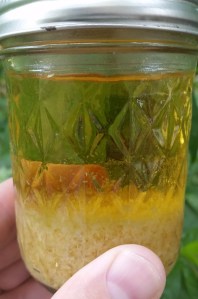
 The diverse Belgian styles don’t always appeal to me, but I think that’s because they’re often either done badly or overdone in the latest souring craze. I’m actually quite fond of the various witbiers and their cousins (including my white IPA). But, because I have another iteration of my white IPA planned, saison had a bit more appeal for the moment. I’ve had a number of good ones over the years, and they aren’t afflicted by the funky bacteria that seem to dominate so many US-brewed salutes to Belgian beers these days. Why not, then?
 Time to make a classic summer beer! For this batch, I wanted to try something different, by mixing techniques used on two previous blonde ales that have turned out well. Firstly, following my Summer Blonde Ale, I elected to keep a simple grain bill. This meant mostly 2-row malt, with a touch of dark Munich malt (somewhere in the 10 to 20 lovibond range). However, I wanted a slightly more complex hops character, so I followed a version of the hopping schedule from my
  Andy's Brewing Blog