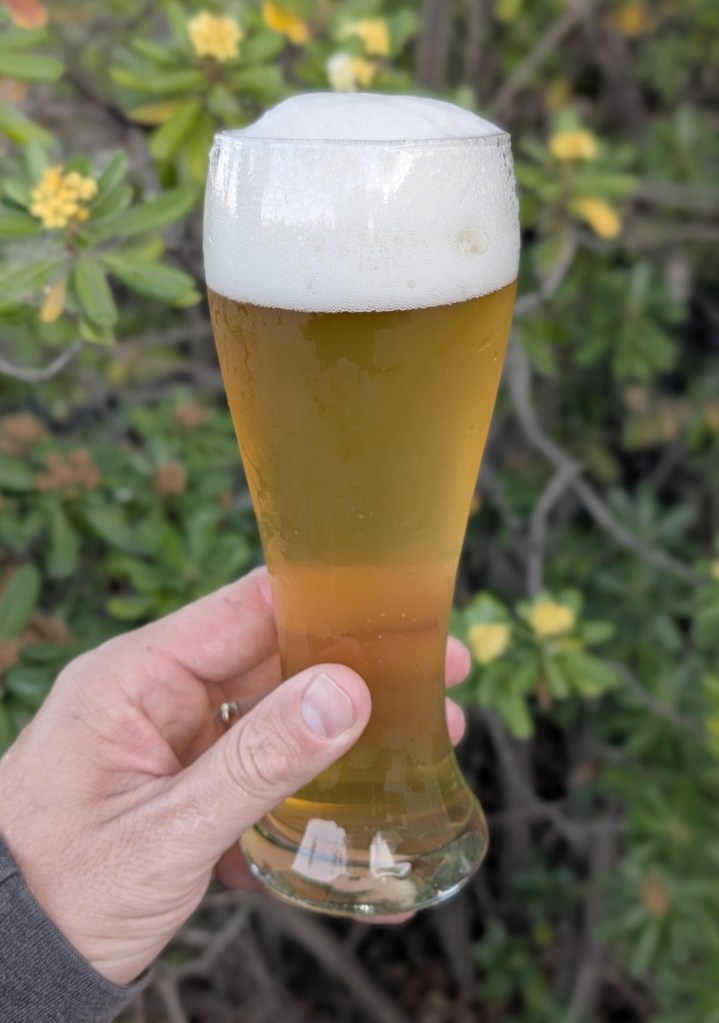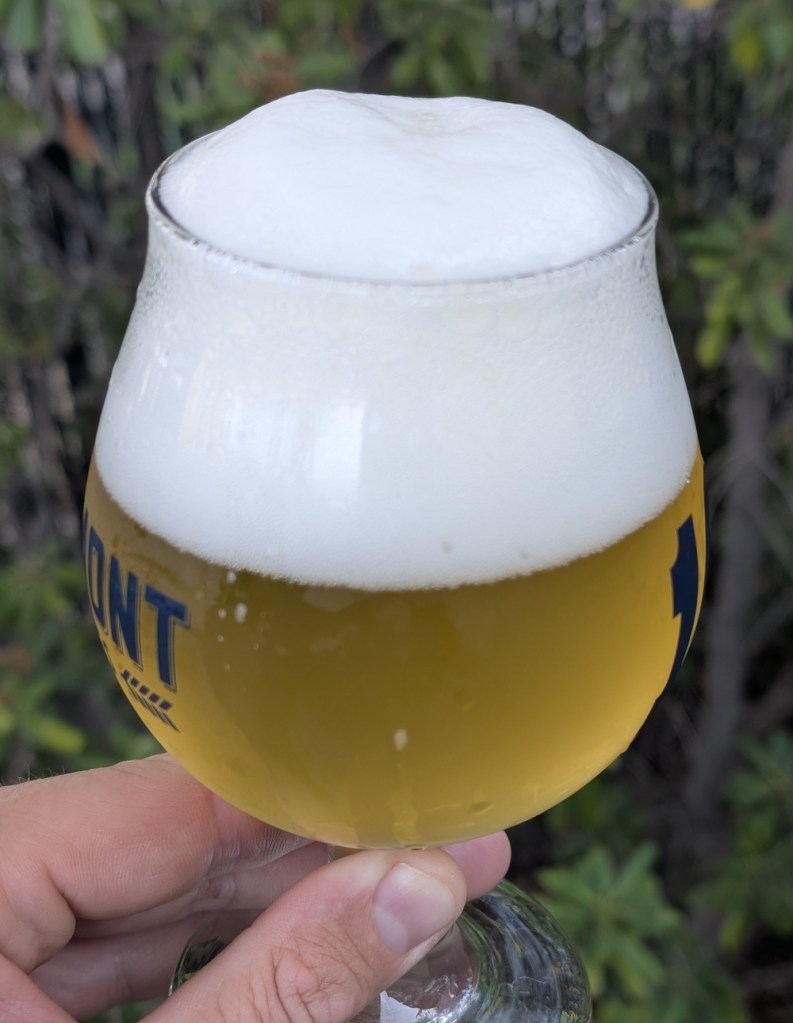
Old Speckled Hen Homage

As a semi-mass-market English ale, Old Speckled Hen is one of my favorites. I think it’s mainly due to the name and associated nostalgia of my early days of better beer exploration, but in any case it’s something I come back to from time to time. A decade ago, I attempted a clone, which turned out okay but not great. This beer has been kicking around in my head ever since, and I even buy a bottle (or can) from time to time. It’s a legitimately enjoyable beer! Given that continued fascination, it was time for another attempt.

My new version is based on two recipes posted online, somewhat different from the previous template I used. The current edition leans into a more complex malt bill, reducing the previous substantial addition of crystal 120 and adding a major addition of crystal 40. I also used this as a chance to try out a dry version of WLP066 (London Fog Ale Yeast), which seemed to target much of what I was looking for in yeast character. A constant is the use of Maris Otter as the base malt, along with Lyle’s Golden Syrup to provide another flavorful fermentable.

Old Speckled Hen Homage

  • 9.5 lb. Maris Otter pale ale malt (Thomas Fawcett)
  • 1 lb. crystal 40 malt (Great Western)
  • 3 oz. caramel 120 malt (Briess)
  • 11.4 oz. Lyle’s Golden Syrup (added to boil)
  • 1 oz. Challenger hop pellets (5.6% alpha), 60 minute boil
  • 1 oz. East Kent Goldings hop pellets (5.4% alpha), 20 minute boil
  • 1 Whirlfloc tablet, 5 minute boil
  • 1 oz. East Kent Goldings hop pellets (5.4% alpha), 5 minute boil
  • 1 pkg. London Fog ale dry yeast (WLP066)

Target Parameters

  • 1.054 s.g., 1.013 f.g., 35 IBU, 10 SRM, 5.3% abv
  • Full volume mash with 60 minutes at 156° and 10 minutes at 168°; 60 minute boil
  • Claremont tap water, with Campden tablet added

Procedure

  • I heated 7.35 gallons of water to 162°, adding a Campden tablet to remove chloramines. I added the grains with 5.5 mL of 88% lactic acid, and let them mash at 156° for 60 minutes. Next, I raised the mash temperature to 168° for 10 minutes and then pulled the grains.
  • In total, I collected 6.25 gallons of runnings with a gravity of 1.046, for 73% mash efficiency.
  • I brought the mash to a boil, adding hops and finings per the recipe. After a 60 minute boil, I turned off the heat and chilled to 70° before transferring to the fermenter.
  • I brewed this beer on 24 December 2025. Starting gravity was 1.052; I am fermenting at ambient, around 65°.
  • I kegged the beer on 7 February 2025, adding 2.5 oz. of corn sugar to the keg dissolved in 0.5 cup of boiling water.
  • I let the keg sit for around 2 weeks before chilling down to ~35° until a free space opened up on my keezer.
  • Final gravity was fairly high, at 1.019, for 4.4% abv.

Tasting

  • Appearance
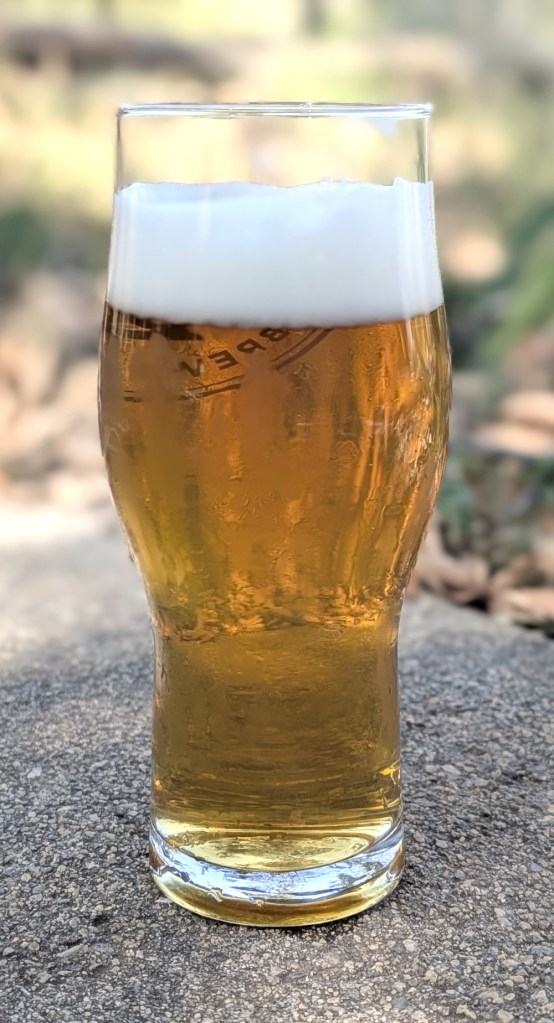
    • A very clear, light amber beer, which pours with a thin ivory head that quickly subsides. It’s a bit lighter in color than the original inspiration.
  • Aroma
    • Caramel notes are most prominent, with a little bit of candy, and a touch of light fruitiness behind that.
  • Flavor
    • Caramel and malty notes are at a moderate level. Medium-high bitterness. The hops, especially in initial tastes, have a woody and moderately herbal quality, in addition to a touch of earthiness. I don’t particularly care for the herbal notes here. I’m guessing they are coming from the hops; it doesn’t match EKG, so perhaps the Challenger is the culprit?
  • Mouthfeel
    • Moderate carbonation, medium body, smooth and slightly dry finish.
  • Would I Brew This Again?
    • This is definitely closer to what I want for an Old Speckled Hen clone, but the hops need a rework. I would probably ditch the Challenger and lean in on EKG entirely, or find another hop to sub in. The herbal notes I get here are more than I care for, but not something that totally wrecks the beer; it’s just not to my personal taste. It might be something with this lot of EKG (if that’s the true culprit), because I didn’t have that concern previously. The malt and yeast all do well, although I might go 50/50 on the crystal 40 and crystal 120 in order to round out the malt profile and deepen the color. I love the gentle fruitiness on the yeast and also how it dropped so clear. This is a very pretty beer!
  • Overall
    • 6/10

Hop Water v1.0

I enjoy hop water as a non-alcoholic option, but it can be pricey and sometimes even hard to find at my usual grocery store. With my hop stash, it should be easy to make at home, right? There are plenty of recipes for hop water out there (e.g., in the March/April 2024 Zymurgy), but most of them require you to make a keg’s worth and carbonate in the keg. I don’t really have the space for that (beers are the primary thing in my keezer!), and I don’t really want 2, 3, or 5 gallons of hop water that may or may not taste good. For carbonated non-alcoholic beverages, I’m a huge fan of making concentrates that can then be purpose-mixed by the glass (see my tonic syrup and soda syrup recipes).

Photo by Donovan Kelly on Pexels.com

I’ve been keeping an eye out for just this kind of recipe, and recently saw one on the NABeer reddit forum. It fit my most important criterion–a recipe that could be made as a concentrate and mixed with sparkling water–and also gave very specific directions. So, I made some slight adjustments and crafted a batch! The recipe is below.

Hop Water v1.0

  • 500 mL of tap water, heated to 170°
  • 5 g of Centennial hop pellets
  • 1 tsp. of white sugar
  • 1 tbs. of freshly squeezed lime (or lemon) juice
  • carbonated water (12 oz. per serving, approximately)

Procedure

  • I put the white sugar into my Pyrex, and then set my pour-over coffee setup (carefully washed to reduce coffee aroma) on top of the Pyrex.
  • I put the hop pellets inside a tea bag, set inside the pour-over coffee setup. Then, I slowly poured the water over the hop pellets, stopping once I had collected around 500 mL of hop water concentrate.
  • Next, I poured the hoppy goodness into a mason jar, closed it up, and set it in an ice bath to chill. This ice bath isn’t required, but I was impatient and wanted to sample my hop water quickly!
  • Once the concentrate was chilled, I added the lime juice, shook it all up well, and then got ready to serve.
  • To prepare a serving, I mixed 1 shot (~30 mL) of the concentrate with 12 oz. of carbonated water.

Initial Impressions

This is pretty respectable hop water! It’s not overly sweet, and the hoppy bitterness and aroma come through prominently. A recipe on Zymurgy called for 2 oz. of hops cold (1 oz. each of a hop like Citra and Centennial) steeped overnight for a 1 gallon batch, so I might try that to see how it compares.

I’m going to use this as a jumping-off point for some variants — I would like to try a “dip-hopped” version, and I’ll definitely attempt a version with a greater amount of hops. It will be fun to explore this new world, and I’m so glad I have found a hop water I can mix as I need it, without having to tie up a keg.

AHA Next Steps…Vision and Priorities

The AHA’s re-launch as a 501(c)(3) is apparently well underway. I think “they” (the founding board) have done an excellent job in communication and transparency so far, with a newsy update on the website, forum Q&A, and upcoming virtual town hall. In my opinion, we’ve seen more transparent communication about AHA in the past month than I’ve seen in the past decade. Serious kudos to the founding board for enabling this. At least so far, it feels like things are heading in a good direction, and that there is a genuine attempt to move along from “how we always did things,” the bane of so many organizations.

Photo by vedanti on Pexels.com

AHA has now posted and invited comment on its draft vision statement, as follows:

We celebrate, educate, and promote the art, science, and joy of fermentation, championing a united community of today and tomorrow’s homebrewers.

As I submitted to AHA, I really like this version of the vision statement. My initial (half-comprehended) take was that this was way too broad, but I think the use of “homebrewers” at the end brings the vision back to AHA’s roots while also allowing a big tent for fermentation in the future.

AHA also provided their draft strategic priorities, as follows:

1) Organizational Strength & Health
2) Knowledge & Learning
3) Community, Collaboration & Competition

My submission to AHA: I have no significant feedback on these; all are on-target and appropriate. I think my main curiosity is what they envision being encompassed within each. Organizational strength and health is a logical first priority, as AHA gets its feet under itself. I view #3 (community, collaboration, and competition) as essential for strength and health. What is AHA’s value proposition now, and how does it engage new members and retain old members? Members who are invested and feel like they have a voice will continue their membership and also be more open to philanthropic support. There will need to be some additional thought around how to shift member culture from the “old way” (minimal communication, little engagement in decision-making, one big in-person event annually, homebrewers viewed implicitly are primarily useful for marketing craft beer, philanthropy something we do for other organizations) to a new way that encourages dialogue, creates meaningful opportunities for participation in decision-making, creates a community where as many people as possible feel like they have a voice, where they have a connection, and all in a way that gets people to think about chipping in a little extra support for AHA. This is a culture shift — but one I think AHA can do! The transparent communication is a HUGE first step; keep up that great work!

Let There Be Rauch!

Smoked beers can be nice as an occasional treat (especially in the winter), and I have made a few over the years. One classic style that has escaped my brew log to date, however, is rauchbier. I remember trying one years ago, from a fellow homebrewing paleontologist, and it is still one of the most memorable beers I have ever sampled! The combination of smoke and maltiness was unlike anything I had tried previously, and the beer lives on in my memory, well over a decade later (and probably closer to 15 or 20 years now).

After years of thinking about rauchbier but never making one, I was spurred into action by Dan Jablow’s article (“Making Friends With Smoked Beer”) in the November/December 2024 issue of Zymurgy. He included a 1 gallon recipe called “Let There Be Rauch!”, and the approach seemed simple enough. So, I scaled it up to 5.5 gallons and adjusted the hops slightly to move the bitterness level into the higher end of the style’s range in the BJCP guidelines.

Let There Be Rauch!

  • 5 lb. beechwood smoked malt (Weyermann)
  • 3 lb. Munich light malt (BESTMALZ)
  • 3 lb. pilsner malt (Rahr)
  • 1 lb. Caramunich II malt (Weyermann)
  • 0.5 tsp. BrewTanB, added to mash
  • 1 oz. Hallertauer Mittelfrueh (5.5% alpha), 60 minute boil
  • 1 oz. Hallertauer Mittelfrueh (5.5% alpha), 15 minute boil
  • 0.5 tsp. BrewTanB, 10 minute boil
  • 1 WhirlFloc tablet, 5 minute boil
  • 3 pkg. SafLager West European Lager dry yeast (Fermentis S-23)

Target Parameters

  • 1.054 s.g., 1.015 f.g., 29 IBU, 11 SRM, 5.2% abv
  • Full volume mash with 60 minutes at 154° and 10 minutes at 168°; 60 minute boil
  • Water built from RO and tap water to hit target water parameters of 59 ppm Ca, 4 ppm Mg, 29 ppm Na, 56 ppm SO4, 88 ppm Cl, 52 ppm CaCO3, RA=-2

Procedure

  • I collected 2.5 gallons of tap water (with Campden tablet) and 5 gallons of RO water, with 3 g CaCl and 2 g gypsum, to hit the target water parameters.
  • I heated the strike water to 161° and added the grains to hit a mash temperature of 154°. I added 2 mL of 88% lactic acid, to adjust the pH. I held the mash at 154° for 60 minutes, with recirculation, before I raised the temperature to 168° for 10 minutes.
  • Upon removing the grains, I had a total of 6.6 gallons at a gravity of 1.045, for 68% mash efficiency.
  • I brought the runnings to a boil and added finings and hops per the schedule.
  • After 60 minute boil, I turned off the heat, did an initial chill to ~70°, and then transferred the beer to the fermenter. I chilled it further to 52° before pitching the yeast.
  • I brewed the beer on 24 November 2024, with a starting gravity of 1.055. I fermented the beer at 54°, and let it free rise to 60° on 3 December 2024.
  • I cold crashed to 35° on 5 December 2024, and kegged the beer with a closed transfer on 8 December 2024. The beer had a very nice and subtle smoke flavor/aroma.
  • Final gravity was 1.018; this works out to 4.9% abv.

Tasting

  • Appearance
    • Beautiful! It is a brilliantly clear light amber beer, with a creamy and persistent off-white head
  • Aroma
    • Bready malt with a touch of toastiness at a moderate level, a medium level of smoke–almost lightly bacony, Very pleasant balance.
  • Flavor
    • Bread crust and malty flavor at a moderate level; smoky flavor, somewhat bacon-like, at a medium level. Moderate hop bitterness with a slightly spicy quality. The smoke balance is perfect against the malt; not overwhelming at all, but pleasantly alongside each other!
  • Mouthfeel
    • Medium carbonation, medium body, only slightly dry finish.
  • Would I Brew This Again?
    • It’s not often I nail something on the first batch, but this is just a great recipe! It dodges the peaty phenolics of some versions, and is both interesting and drinkable. I am pleased!
  • Overall
    • 10/10

Denny Kong-ish West Coast IPA

I made my first version of this new-style West Coast IPA last year, and learned some lessons about hopping techniques in the process. During that previous batch, I used a hop bag that was too small for the dry hopping addition, and as a result the hop flavor/aroma were pretty underwhelming. This time around, I opted to let the hops float free in the fermenter. I use a BrewBucket 7.5, which has a rotating pickup arm, so I could do a closed transfer into the keg without excessive hop particles clogging things. The hop choices on this version used up some of my hop stash–three-quarters of a pound of hops went into the final recipe!

Denny Kongish West Coast IPA

  • 12 lb. 5 oz. pilsner malt (Rahr)
  • 1 lb. Vienna malt (Weyermann)
  • 0.5 tsp. BrewTanB, added to mash
  • 4 oz. dextrose, added to boil
  • 0.85 oz. Enigma hop pellets (17.9% alpha), 60 minute boil
  • 0.5 tsp. BrewTanB, 10 minute boil
  • 1 Whirlfloc tablet, 5 minute boil
  • 2 oz. LUPMOMAX Cashmere hop pellets (13.5% alpha), 30 minute whirlpool
  • 1 pkg. California ale dry yeast (WLP001, White Labs)
  • 4 oz. Idaho #7 hop hash (31.4% alpha), dry hop in primary fermenter
  • 2 oz. Azacca hop pellets (12.2% alpha), dry hop in primary fermenter
  • 2 oz. LUPOMAX Sabro HBC 438 hop pellets (19.0% alpha), dry hop in primary fermenter
  • 1.15 oz. Enigma hop pellets (17.9% alpha), dry hop in primary fermenter

Target Parameters

  • 1.063 s.g., 1.010 f.g., 7.0% abv, 64 IBU, 5 SRM
  • Full volume infusion mash, held at 149° for 120 minutes and 168° for 10 minutes
  • Neutralized Claremont tap water with Campden tablet, RO water, and mineral salts added to mash to achieve 51 ppm Ca, 8 ppm Mg, 33 ppm Na, 104 ppm SO4, 53 ppm Cl, 8 ppm CO3.

Procedure

  • Starting with 3 gallons of tap water, I added 2.5 mL of 88% lactic acid as well as a Campden tablet, along with 5 gallons of RO water, 0.75 CaCl, 1.5 g epsom salt, and 3.5 g gypsum to hit the target water parameters.
  • I heated the water to 155° and added the grains, along with 17.2 mL of 10% phosphoric acid for pH adjustment, to hit an estimated pH of 5.35.
  • I held the mash at 149° for 120 minutes, with recirculation, and then raised the mash to 168° for 10 minutes before pulling the grains.
  • In total, I collected 6.9 gallons of runnings with a gravity of 1.050, for 69% mash efficiency.
  • I brought the runnings to a boil, with a 90 minute total boil. After 30 minutes, I added the first round of hops, and then proceeded following the recipe.
  • After the 90 minute boil, I chilled to 170° before adding the whirlpool hops and letting them sit for 30 minutes while whirlpooling.
  • Next, I chilled to 68°, transferred to the fermenter, and chilled down to 64° before pitching the yeast.
  • I brewed the beer on 1 January 2025, and it had a starting gravity of 1.066.
  • I added the dry hops on 11 January 2025, loose into the fermenter.
  • I cold crashed the beer on 15 January 2025.
  • I kegged the beer on 18 January 2025, into a CO2 purged keg. Final gravity was 1.007–that’s wonderfully dry and works out to 7.8% abv. I had a similar experience last batch, so this mash regime works wonders!

Tasting

  • Appearance
    • Light gold beer, slight haze, which pours with an exceptionally persistent and creamy white head–it’s like a meringue! This head leaves beautiful lacing down the side of the glass. The beer is surprisingly clear. As a result, I am feeling good about my decision not to use post-fermentation finings; this likely helped with oxidation reduction.
  • Aroma
    • Citrus and dank hop aroma at a high level, neutral yeast profile, and no malt character to speak of in the aroma.
  • Flavor
    • Very bitter, citrus pith and dank hop character, with a bit of grapefruit along the way, and a long-lingering hop aftertaste. The hop flavor is a bit one-note; it has the usual issue with Azacca to my tastebuds, which is an orange pith quality on the edge of rotten orange. I’ve never understood the appeal of that hop! Low level of maltiness, but it is there. Clean fermentation character.
  • Mouthfeel
    • Medium-high carbonation, medium-light body, very dry finish.
  • Overall
    • 7.5/10
  • Would I Brew This Again?
    • I really like this recipe as a template for a double IPA; it is a clean background to let the hops shine. This is the first time in awhile that I have let the hops float free for dry hopping, and with the Brew Bucket’s rotating pickup arm, things worked well. Thanks to the closed transfer (and perhaps the BrewTanB?), the hop character has held up well. The beer is clear enough without finings, so I think there is no need to use Biofine Clear as the original recipe stipulates. Azacca, as usual for my experience, gives a harshness in the citrus note that I don’t care for. This formulation is a bit one-note on the hops. But, it’s okay overall! In a beer like this, a different hop combo would be the ticket to hoppiness.
      • Interesting note: when I tasted this again last night, after a rauchbier, I got more tropical notes, and the unpleasant orange wasn’t as apparent. I would rate the beer higher in that case – perhaps a 8.5/10.